
Sooner Magic Took Over Omaha Oklahoma Baseball Is National Champion Again
One night after the College World Series championship was pushed to its final possible game, Oklahoma answered with a 13–2 statement against North Carolina—closing an improbable postseason run, claiming the program’s third national title and giving a new generation of Sooners its own Omaha memory.
The final out arrived shortly after Oklahoma had removed nearly all suspense from the night. Jackson Cleveland struck out the side in the ninth inning at Charles Schwab Field, the Sooners poured out of the dugout, and a season that had repeatedly lived on the edge ended beneath a championship dogpile in Omaha.
Oklahoma defeated North Carolina 13–2 on Monday, June 22, in the winner-take-all third game of the Men’s College World Series championship. The margin was emphatic, but the emotion behind it came from everything that preceded it: an at-large tournament bid, a difficult path through nationally seeded opponents, a Game 2 loss that extended the Finals and one final night when the Sooners played as though pressure had become fuel.
By Tuesday morning, the scoreboard had already become shorthand for something larger. “13–2” was not simply the score of the deciding game. It was the clean numerical ending to a postseason that had transformed Oklahoma from a dangerous regional team into the last team standing in college baseball.
Oklahoma did not ease into its third national championship. It turned the final game of the season into nine innings of proof.
A Championship Series That Required the Full Distance
The Finals did not move in a straight line. Oklahoma opened the series with a 9–3 victory, using another wave of power and sustained pressure to move within one win of the championship. North Carolina responded the following night, winning 6–2 and making Monday’s game an absolute final: no series advantage left, no tomorrow available.
That sequence matters because it gave the championship game a different emotional temperature. Oklahoma had already seen what its offense could do to North Carolina, but it had also been reminded that momentum in Omaha is temporary. The Sooners had to reset after the loss rather than treat Game 3 as a continuation of Game 1.
Monday’s answer was immediate. Oklahoma scored twice in the second inning, added another run in the third and widened the gap with three in the fourth. By the time Kyle Branch launched a three-run home run during a four-run eighth, the final had become a coronation.
It was a fitting conclusion for a team whose postseason identity had been built around accumulation. Oklahoma did not depend on one swing, one starter or one narrow formula. The Sooners drew walks, forced defensive decisions, found hits throughout the order and repeatedly created innings that felt heavier than the individual plays inside them.
The Ball Graphic as an Instant Championship Archive
Championship culture moves quickly. Within minutes of the final out, fans begin looking for the image that can hold the night still: a final score, a trophy, a dogpile, a year or a phrase that makes the emotion legible after the noise has faded.
The Baseball National Champions Shirt uses the most elemental object in the sport—the baseball itself—as the frame for Oklahoma’s achievement. Rather than trying to recreate every inning of the postseason, the graphic compresses the title into a single visual emblem: championship language wrapped around the object that moved through every decisive pitch.
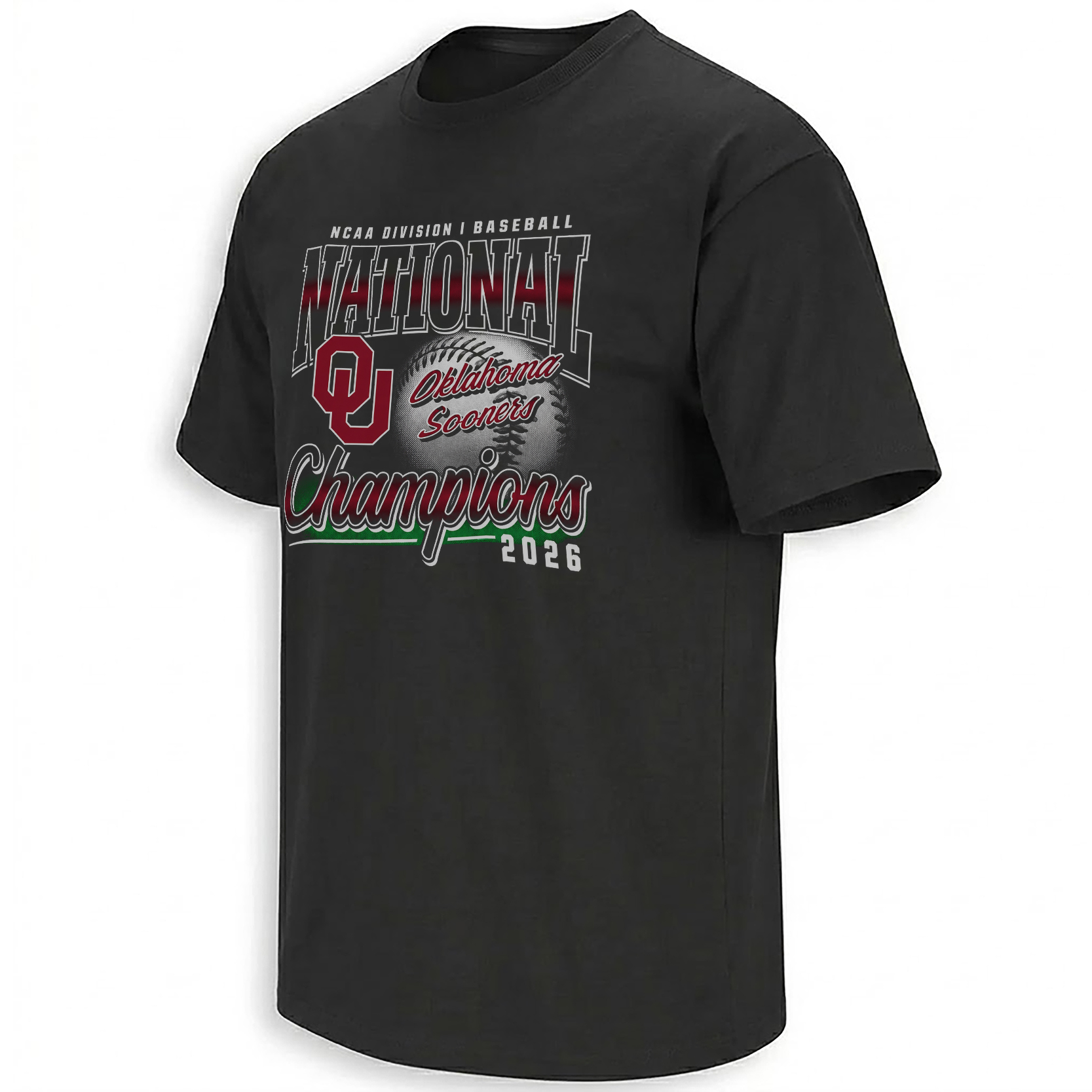
The circular structure is important. A baseball graphic naturally resembles a seal, patch or stamped championship mark. It gives the artwork the authority of something commemorative without requiring an elaborate scene. The eye moves around the ball, catches the title language and arrives at the year that now separates this Oklahoma team from every season that came before it.
Crimson carries the institutional memory. Against the pale surface of the baseball, it functions like both team identity and handwritten scorebook ink. The contrast makes the design readable from a distance, while the curved lettering follows the geometry of the ball rather than sitting on top of it like an ordinary headline.
The artwork combines the shape of a game-used baseball, the authority of a championship seal and Oklahoma’s crimson identity. Its simplicity is what gives it longevity: the design records who won, what they won and when it happened without competing with the memory itself.
Kyle Branch Turned the Deciding Game Into His Night
Championship games often produce unlikely statistical signatures. For Oklahoma, the defining offensive line belonged to Kyle Branch, who entered the final evening without the tournament profile of the names that had driven most of the Sooners’ Omaha conversation.
Branch went 3-for-4 and drove in six runs, a career high. His RBI single opened the scoring in the second inning. His two-run single extended the advantage in the sixth. Then, with Oklahoma already closing in on the title, he drove a 3–2 pitch over the left-field wall for a three-run homer in the eighth.
That final swing gave the championship broadcast the kind of image that becomes permanently attached to a player. The score was already comfortable, but Branch’s home run made the inevitability visual. Oklahoma was no longer protecting a lead. It was placing its name on the trophy in capital letters.
Jaxon Willits Built an Omaha Record, Not Just a Hot Week
If Branch owned the deciding game, Jaxon Willits owned the wider tournament. The Oklahoma shortstop was named the Most Outstanding Player of the 2026 Men’s College World Series after batting .500 across six games.
Willits finished with 13 hits in Omaha, the highest College World Series total by an Oklahoma player. He recorded multiple hits in five of the Sooners’ six games and reached base five times in the championship clincher, where he went 3-for-4 with a double, two walks and two RBIs.
His tournament did not feel like a brief burst of luck. It felt structural. Each time Oklahoma needed another inning to stay alive, create separation or answer an opponent, Willits seemed to be connected to it. The Most Outstanding Player award therefore read less like an individual flourish and more like the statistical summary of Oklahoma’s entire Omaha rhythm.
Three hits, six RBIs and the three-run homer that turned the eighth inning into a championship countdown.
A .500 average, 13 hits and repeated multi-hit performances across Oklahoma’s six games in Omaha.
Five and two-thirds innings, one run allowed and five strikeouts after entering during the third inning.
LJ Mercurius Made the Lead Feel Safe
The final score suggests an uncomplicated night, but the championship game still required a stabilizing pitching decision. Freshman starter Nick Wesloski worked into the third inning before Skip Johnson turned to LJ Mercurius with Oklahoma leading 3–1.
Mercurius gave the Sooners exactly what a championship bullpen appearance demands: length, calm and an absence of free damage. He covered 5.2 innings, allowed one run and struck out five without issuing a walk.
His outing kept North Carolina from turning a manageable deficit into a volatile game. Each scoreless inning made Oklahoma’s offensive pressure feel heavier. By the time Jackson Cleveland entered for the ninth and struck out three consecutive hitters after a leadoff single, the pitching staff had converted the Sooners’ early advantage into the cleanest possible ending.
Why This Run Felt Like Sooner Magic
“Sooner Magic” is often used when Oklahoma turns improbability into a recognizable program habit. It describes more than a comeback. It describes the feeling that a team remains dangerous after the normal logic of a season says its opportunity should be narrowing.
The 2026 baseball team fit that language. Oklahoma entered the NCAA Tournament as an at-large selection and the No. 2 seed in the Atlanta Regional. The Sooners then moved through a route filled with nationally seeded opponents, defeating Georgia Tech, Kansas, Alabama, Georgia and North Carolina on the way to the title.
The path was not protected by an easy bracket. Oklahoma beat the No. 2, No. 3, No. 5, No. 7 and No. 15 national seeds during the tournament. That sequence made the championship feel earned through repeated confrontation rather than one favorable weekend.
The offensive transformation deepened the story. Oklahoma finished the season with 95 home runs, but nearly half of them arrived during the final 19 games. The Sooners hit 47 homers in that stretch after producing 48 across their first 46 games. What had been a capable offense became an Omaha-level force precisely when the season offered no room for hesitation.
Sooner Magic was not one miracle swing. It was the repeated refusal to let the next seeded opponent become the end of the story.
1951, 1994 and 2026 Now Belong on the Same Line
Oklahoma’s baseball history had two national championship anchors before Monday night. The Sooners won in 1951 and again in 1994. Those years lived far enough apart that each title belonged to a distinct version of college baseball and a different generation of Oklahoma supporters.
The third title does not simply increase the count. It reactivates the older years. Photographs from 1994 return to social timelines. Fans compare uniforms, stadiums and dogpile images. Families identify which championship belongs to their childhood and which one they watched with their own children.
That is the cultural function of a new title. It makes the archive feel present again. The 1951 and 1994 teams are no longer isolated historical entries; they become the first two points in a three-title line that now reaches into 2026.
Omaha Became a New Kind of Oklahoma Football Alternative
Oklahoma’s athletic identity is so closely associated with football that other championship moments can initially appear to live in its shadow. A College World Series title changes that balance, at least for one summer.
Baseball creates a different emotional calendar. Its championship is played through long afternoons, bullpen decisions, dirt-stained uniforms and a June destination that college fans refer to with one word: Omaha. Reaching the city is an achievement. Winning the final game there changes the meaning of every previous round.
Across Oklahoma fan spaces, the reaction quickly moved between the final score, the championship dogpile, Branch’s six-RBI performance, Willits’ tournament record and the larger realization that the baseball program had ended a 32-year title wait. The dominant mood was not surprise alone. It was recognition that this team had created a chapter strong enough to stand beside the university’s most familiar sports memories.
From One Ball Graphic to a Wider College Baseball Archive
The strongest championship designs do not attempt to replace game footage or official photographs. They perform a smaller and more personal function. They preserve the symbols fans use after the broadcast ends.
Here, those symbols are a baseball, Oklahoma crimson, the national champions language and the year 2026. Together they form an emblem that can be understood immediately without recreating the entire bracket.
The design also belongs within the wider College Baseball Shirts collection , where Omaha slogans, team-specific graphics and tournament memories create a visual record of how the postseason was experienced beyond the box scores.
The broader NCAA Shirts collection places Oklahoma’s title alongside the traditions, rivalries and championship language that make college sports feel regional, generational and intensely personal.
Frequently Asked Questions
When did Oklahoma win the 2026 college baseball national championship?
Oklahoma won the title on June 22, 2026, defeating North Carolina 13–2 in the deciding third game of the Men’s College World Series championship at Charles Schwab Field in Omaha.
How many baseball national championships has Oklahoma won?
The 2026 championship was Oklahoma baseball’s third national title. The Sooners also won the College World Series in 1951 and 1994.
Who was named Most Outstanding Player of the 2026 College World Series?
Oklahoma shortstop Jaxon Willits received the honor after batting .500 with 13 hits, seven RBIs, five doubles and six runs across six games in Omaha.
Why was Kyle Branch important in the championship game?
Branch went 3-for-4 with a career-high six RBIs. His performance included the opening RBI, a two-run single and a three-run eighth-inning home run.
Why is the baseball-shaped design meaningful?
The circular baseball composition turns Oklahoma’s team colors, championship status and 2026 title year into a compact commemorative emblem tied directly to the sport and the Omaha victory.
What does “Sooner Magic” mean in the context of the 2026 title?
In this postseason, the phrase describes Oklahoma’s ability to grow stronger through an unlikely tournament path, defeat a series of nationally seeded opponents and finish the run with a dominant winner-take-all performance.
The Oklahoma Sooners 2026 ball graphic holds the title inside baseball’s most familiar shape, while the broader college baseball archive follows the Omaha language, championship symbols and fan memories created throughout the tournament.
Baseball National Champions Shirt preserves the Oklahoma Sooners’ 2026 College World Series title through a crimson ball graphic inspired by the 13–2 championship victory, the Omaha dogpile and the program’s third national crown.