Beneath the Omaha Lights: Oklahoma Built a Championship Stadium Memory
The Sooners’ third baseball national championship will always belong to a score, a dogpile and a date. Yet the deeper memory is architectural: the field beneath them, the lights above them and the stadium that gave Oklahoma’s 13–2 final victory a permanent setting.
Oklahoma’s final game of the 2026 season ended with almost no ambiguity left on the scoreboard. The Sooners defeated North Carolina 13–2 on June 22 at Charles Schwab Field, finished the year 43–23 and claimed the program’s third national championship.
The result joined 2026 with the title seasons of 1951 and 1994, ending a thirty-two-year gap between Oklahoma baseball championships. Inside the stadium, however, history did not arrive as a date on a list. It arrived through movement: players leaving the dugout, crimson uniforms racing toward the mound and a field suddenly occupied by everyone who had carried the season to its final out.
The first wave of fan reaction naturally centered on the score and celebration. Yet as photographs and clips circulated, the physical setting became part of the memory. The light towers, seating bowl, infield dirt and broad Omaha night gave the title a recognizable home. Oklahoma had not merely won a championship. It had created a new stadium image for Sooner baseball.
The scoreboard identified Oklahoma as champion. The stadium gave the championship a place fans could return to in memory.
Charles Schwab Field • Omaha • June 22, 2026A Winner-Take-All Game That Became a Coronation
Deciding championship games usually tighten as they move toward the final innings. Each pitch becomes heavier because there is no later game to repair the outcome. Oklahoma reversed that pattern.
The Sooners scored twice in the second inning, added another run in the third and continued widening the margin. North Carolina briefly pulled within two, but Oklahoma’s offense kept changing the scale of the night. The lead grew to five runs, then seven, then eleven.
By the time the eighth inning ended, the stadium had entered the strange emotional state created by a decisive championship margin. The game was technically still active, but anticipation had replaced uncertainty. Oklahoma supporters were no longer asking whether the Sooners could finish. They were waiting to see the exact shape of the celebration.
That wait is part of what makes stadium memories so strong. Thousands of people understand the same approaching outcome at slightly different moments. One fan begins recording. Another calls a family member. Players inside the dugout try to remain composed while watching the final outs move closer.
For eight and two-thirds innings, the diamond remained the site of competition. After the last strike, the same dirt and grass became the stage for Oklahoma’s dogpile, trophy celebration and newest national-championship photograph.
Crossed Bats Turn the Championship Into a Baseball Crest
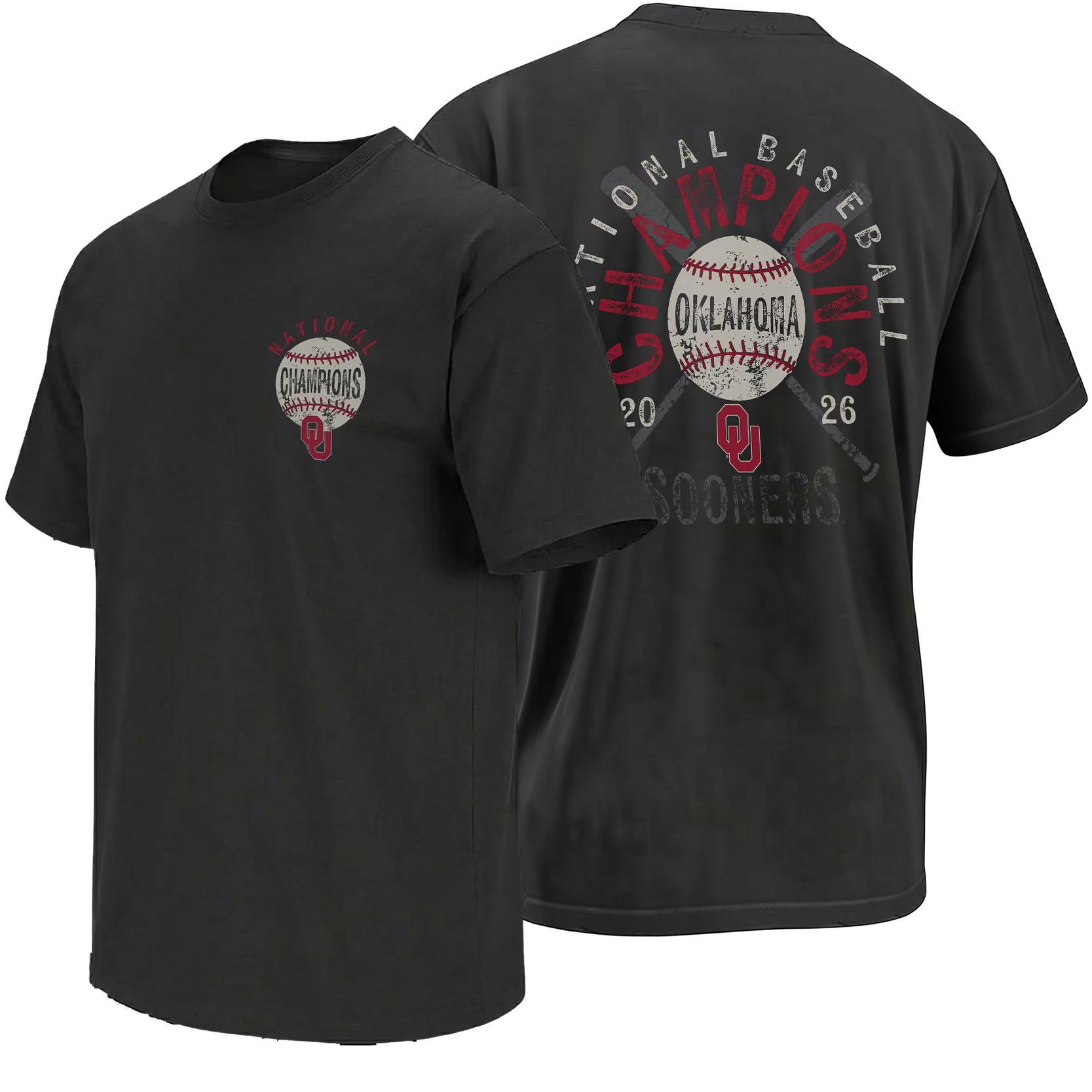
The National Baseball Champions Oklahoma Sooners Stadium design begins with one of the most durable visual arrangements in baseball culture: two bats crossed behind the central team mark.
Crossed bats work like heraldic symbols. Their symmetry creates the feeling of a crest, while the familiar wooden silhouettes identify the sport before every word is read. They also frame the Oklahoma mark without competing with it, turning the front into a compact emblem of program, sport and championship year.
The format carries an older athletic-club quality. Crossed equipment has appeared on uniforms, scorecards, patches and souvenir graphics for generations because it can condense an entire sport into a small, balanced image.
The crossed-bat composition reads like an Oklahoma baseball seal. It carries enough information to identify the title while remaining compact enough to feel like a clubhouse patch rather than a full poster reduced onto the front.
The Front Works Like a Badge; the Back Works Like a Ballpark
The two-sided composition separates identity from atmosphere. The front is controlled and emblematic. The back is expansive and cinematic.
On the front, crossed bats sit behind the Oklahoma mark and championship language. The arrangement resembles a tournament badge or team-issued insignia, with the year anchoring the achievement to one exact season.
The back moves outward. Large “National Baseball Champions” lettering rises above a stadium scene, while the architecture beneath the words creates depth and location. The result is closer to a commemorative sports poster than a repeated logo.
That contrast is important. Repeating the same title graphic on both sides would document the championship only once. Here, the front answers who won. The back answers where the victory became emotionally permanent.
Why Stadiums Become Part of Championship Identity
Sports history is often told through people and numbers, but place controls how those memories appear. A championship photograph is shaped by the distance from the dugout, the height of the stands, the direction of the lights and the colors surrounding the team.
Charles Schwab Field has become one of the defining visual settings in college baseball. The structure is familiar to anyone who follows the College World Series, even when different teams occupy the field. Its identity comes from repetition: eight programs arrive, the bracket narrows and one group remains when the trophy enters the frame.
For Oklahoma, the stadium now holds a specific meaning. It is the place where the Sooners finished a 5–1 Omaha run, answered their only College World Series loss and raised a trophy that had not returned to the program since 1994.
Championship nights do not occur against an empty background. Light towers, upper decks and the dark sky frame the players, turning the stadium into a silent participant in the image fans will revisit for decades.
Three Visual Layers Tell the Full Championship Story
Oklahoma’s interlocking mark places the title inside a larger university identity, connecting baseball with the traditions carried across every Sooners sport.
Crossed bats identify the specific language of baseball: repetition, craft, pressure and the offensive force that produced thirteen runs in the deciding game.
The stadium and 2026 date transform the design from a general Oklahoma emblem into a timestamp tied directly to one Omaha championship night.
Those three layers make the design readable at different distances. From far away, the crimson-and-white composition communicates Oklahoma. Closer inspection reveals the bats, title language and stadium structure. The details reward the viewer without making the central message difficult to understand.
The Stadium Back Feels Like a Vintage Sports-Page Illustration
The back graphic borrows from the tradition of illustrated stadium posters, old game programs and newspaper championship pages. The architecture is not rendered as a neutral photograph. It becomes part of a composed scene beneath oversized title lettering.
That treatment allows the stadium to function symbolically. The stands represent the crowd that witnessed the final. The lights represent the night when the result became permanent. The field represents the physical work behind the title.
The slightly distressed texture also matters. Oklahoma’s championship was only hours old when celebratory graphics began appearing, but supporters were already viewing the moment through the lens of future memory. The aged finish anticipates the way the image may feel years later.
The artwork combines a compact collegiate crest with an expansive stadium illustration. Crossed bats provide traditional baseball symbolism, while the back transforms Oklahoma’s championship from a result into a remembered place beneath the Omaha lights.
The Route to the Stadium Was Harder Than the Final Margin Suggests
A 13–2 championship score can make an entire postseason appear inevitable. Oklahoma’s route was not.
The Sooners entered the NCAA Tournament as a regional No. 2 and lost to Georgia Tech in Atlanta. That defeat pushed them into elimination games before the national conversation had seriously positioned Oklahoma as the likely champion.
They responded by winning three consecutive elimination games, including two victories over the national No. 2 seed. The last required ten innings. Oklahoma then traveled to Lawrence and swept No. 15 Kansas, winning the second Super Regional game by the same 13–2 score that would later define the national final.
In Omaha, Oklahoma shut out No. 7 Alabama, defeated No. 3 Georgia twice and won two of three against No. 5 North Carolina. The Sooners’ only College World Series loss ended a nine-game winning streak and forced the championship into a decisive third game.
That context changes the way the stadium scene reads. It was not merely the location of one dominant performance. It was the final destination of a team that repeatedly had to regain control of its postseason.
Why the Game 2 Loss Made the Stadium Louder on Monday
Oklahoma entered the championship series with momentum and won Game 1 by a 9–3 score. North Carolina answered 6–2 in Game 2, ending the Sooners’ winning streak and transforming the final into a genuine winner-take-all event.
That interruption created a different atmosphere for June 22. Every supporter understood that one dugout would leave with the trophy and the other would leave carrying the memory of how close it had come.
Oklahoma’s early scoring prevented the pressure from remaining evenly distributed. Each added run shifted more of the stadium toward anticipation. By the late innings, the physical space itself seemed to change. The North Carolina side faced an almost impossible margin, while Oklahoma’s side prepared for release.
This is why the back design’s stadium scale feels appropriate. The championship was not experienced privately. It unfolded in a packed public space, where thousands of reactions accumulated into the sound surrounding the final out.
1951, 1994 and 2026 Now Share the Same Oklahoma Skyline
Every championship generation remembers its title through the dominant media of its era. Oklahoma’s 1951 championship survived through archival photographs, university records and stories carried across decades.
The 1994 team became the modern historical reference for Sooners supporters. During the 2026 run, that year appeared repeatedly because it measured the duration of the wait. Thirty-two seasons separated the two trophies.
The newest championship entered the archive instantly. Video of the final out, photographs of the dogpile and images from the trophy presentation circulated before the stadium had emptied.
The crossed-bats-and-stadium design connects those eras without pretending they were visually identical. The crest belongs to an older baseball tradition. The large back composition belongs to the poster and streetwear language through which contemporary fans preserve major moments.
How Fans Turn a Stadium Into Personal Memory
Not every Oklahoma supporter was physically present in Omaha, yet the stadium still became part of the shared experience. Broadcast angles, crowd shots and celebration clips allowed viewers elsewhere to construct a mental map of the night.
A supporter watching from Norman may remember the camera cutting toward the dugout. An alumnus in another state may remember the scoreboard occupying one corner of a television. A family watching together may associate the field with the exact moment everyone stood up before the final strike.
Stadium imagery allows those different experiences to gather around one recognizable setting. It creates a common background for memories that occurred in living rooms, restaurants, watch parties and group chats far beyond Nebraska.
Across fan spaces, the emotional conversation moved quickly between pride in the postseason route, relief after the Game 2 setback, amazement at the deciding margin and the realization that a new generation could finally claim its own Oklahoma baseball title.
Why Crossed Bats Still Work in Modern Fan Culture
Sports graphics continually change, but some symbols survive because they communicate efficiently. Crossed bats require no explanation. They imply baseball, balance and competition within a shape that remains clear on a small chest graphic or enlarged sign.
Their symmetry also gives the Oklahoma mark stability. The bats extend outward while the program logo remains centered, creating the impression that the championship has been formally sealed.
In contemporary streetwear language, that restraint is valuable. The front can remain compact while the back carries the narrative scale. The wearer encounters the design differently depending on direction: badge first, stadium story second.
A Championship Artifact Inside the College Baseball Archive
Oklahoma’s 2026 title produced several distinct forms of visual memory. Schedule graphics preserve the sequence of games. Bracket designs preserve the structure of elimination. Pennants connect the title with baseball memorabilia. Stadium artwork preserves atmosphere and place.
Together, those approaches create a broader record of the same postseason. The College Baseball Shirts archive follows how different programs and fan bases translate Omaha through destination language, regional identity, scores, brackets and championship scenes.
Within the wider NCAA Shirts collection, the Oklahoma stadium piece also reflects a central feature of college sports culture: the relationship between a team, a university community and the physical venues where shared history becomes visible.
The design therefore functions less like a generic championship declaration and more like a location marker. It returns the title to the lights, field and stands that surrounded the Sooners when the wait finally ended.
Frequently Asked Questions
Who won the 2026 Men’s College World Series?
The Oklahoma Sooners won the 2026 Men’s College World Series by defeating North Carolina 13–2 in the deciding third game of the championship series.
Where did Oklahoma win the 2026 baseball national championship?
Oklahoma clinched the title at Charles Schwab Field in Omaha, Nebraska, the home of the Men’s College World Series.
How many baseball national championships has Oklahoma won?
Oklahoma has won three NCAA Division I baseball national championships, with title seasons in 1951, 1994 and 2026.
What do the crossed bats represent in the Oklahoma design?
The crossed bats create a traditional baseball crest around the Oklahoma mark, connecting the championship with vintage team patches, athletic seals and classic ballpark souvenir graphics.
Why is the stadium important to the meaning of the artwork?
The stadium gives the championship a physical setting, preserving the field, lights and public atmosphere surrounding Oklahoma’s final victory in Omaha.
What does the front-and-back composition communicate?
The front presents Oklahoma’s championship as a compact crossed-bat baseball crest, while the back expands the story into a large stadium scene tied to the 2026 national title.
The National Baseball Champions Stadium design pairs a crossed-bat Oklahoma crest with the architectural scale of championship night, while the wider college baseball archive preserves the brackets, scores and Omaha visuals surrounding the Sooners’ historic run.
National Baseball Champions Shirt captures Oklahoma’s 2026 College World Series title through a compact crossed-bat front crest and an expansive stadium back graphic inspired by the lights, field and atmosphere surrounding the Sooners’ 13–2 championship victory in Omaha.