The Tools That Built a Title: Oklahoma’s 2026 Championship in Glove, Ball, Cap and Bat
Oklahoma’s third baseball national championship can be told through a final score and a trophy. This graphic tells it through the familiar objects that made the run possible: a worn glove, a baseball, an OU cap, a tied cloth and an Oklahoma bat arranged like pieces saved from a championship locker.
Oklahoma completed the 2026 season with a 13–2 victory over North Carolina in the deciding game of the Men’s College World Series championship series. The Sooners finished 43–23 and added a third national title to the program’s earlier championships in 1951 and 1994.
The first celebration images centered on the mound, the dogpile and the trophy. Yet every championship is also built from quieter objects that remain visible throughout the season: gloves broken in across hundreds of innings, bats lined against dugout walls, caps darkened by heat and baseballs repeatedly placed into new hands.
That is the language of this design. It does not reconstruct the final game as a literal scene. Instead, it gathers the physical vocabulary of baseball into a vintage equipment collage and turns ordinary tools into evidence of Oklahoma’s championship year.
The trophy shows what Oklahoma won. The glove, ball, cap and bat recall the work that had to happen before anyone could lift it.
Sooner baseball • Omaha • Championship equipment cultureThe Front Begins With the Most Intimate Object in Baseball
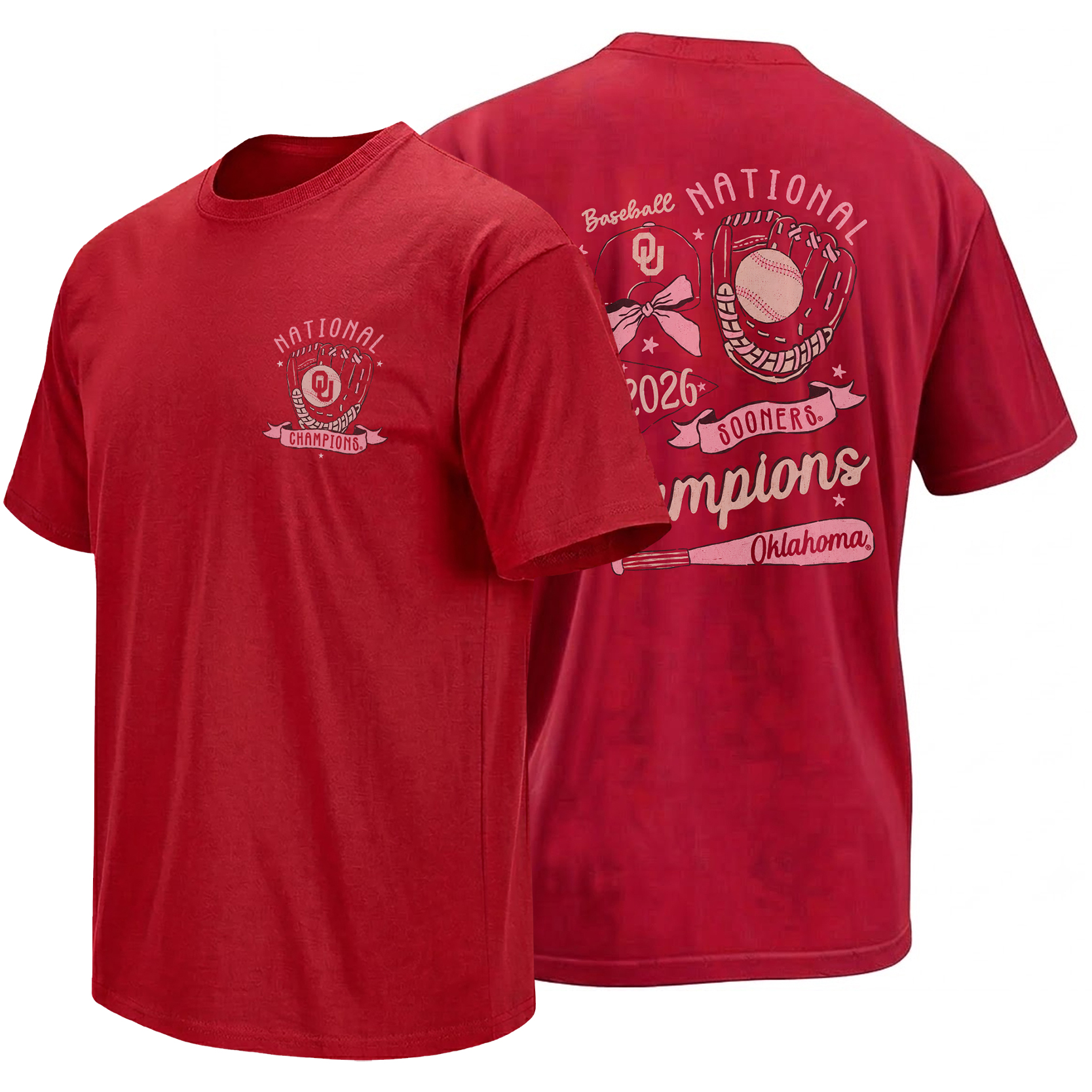
The front graphic centers a baseball inside a large glove, with the Oklahoma mark positioned directly on the ball. “National” arcs above the pocket, while a “Champions” ribbon anchors the composition below.
The glove is an effective championship symbol because it is both protective and personal. Players shape gloves over time. Leather softens, pockets deepen and every crease becomes connected with repetition. Unlike a scoreboard or trophy, a glove belongs to one hand.
By placing Oklahoma inside the glove, the design makes the championship feel secured rather than simply announced. The ball has been caught. The final result has been held. The compact scale gives the front the feeling of a stitched clubhouse patch or a small commemorative crest.
The Back Opens the Locker and Displays the Entire Baseball Vocabulary
The Oklahoma National Baseball Champions design expands dramatically across the back.
At the top, “Baseball National” establishes the sport and achievement. An OU cap with a tied cloth sits opposite a large glove holding the ball. The year 2026 appears across a banner, followed by a separate Sooners ribbon and oversized script lettering that completes the word “Champions.”
At the bottom, a horizontal baseball bat carries the Oklahoma name. The bat does not cross another piece of equipment; it acts as a visual underline, stabilizing the larger collage above it and closing the composition like the footer of a vintage sports poster.
Why Baseball Equipment Carries Memory Differently
Baseball is unusually dependent on objects that acquire character through use. A new glove can feel stiff and impersonal. A used glove carries fingerprints, dirt and the shape created by thousands of catches. A bat shows marks from contact. A cap changes color across a long summer.
Those changes matter because they make equipment feel like a witness. The objects do not merely identify the sport. They seem to absorb the season.
The design treats the glove, cap, baseball and bat as objects collected after the final out. Arranged together, they feel less like separate illustrations and more like pieces pulled from the locker of a season that ended with Oklahoma on top.
The largest visual symbol represents control, repetition and the defensive act that ends every completed play.
The OU mark turns a familiar baseball object into an unmistakable piece of Oklahoma program identity.
Positioned inside the glove, the ball becomes the center of the crest and the object through which the championship was physically decided.
The Oklahoma bat beneath the collage acts as both equipment and underline, giving the back artwork balance and offensive energy.
The Tied Cloth Adds Locker-Room Personality
One of the most distinctive details is the cloth tied around the OU cap. It prevents the composition from feeling like a formal catalog of baseball equipment.
The knot introduces individuality, movement and a slightly homemade quality. It suggests a piece of gear customized inside the clubhouse rather than arranged by an athletic department for a clean promotional photograph.
That detail also helps the artwork sit comfortably within vintage streetwear language. The design feels collected, layered and personal—closer to an old illustrated sporting-goods advertisement or a hand-built team poster than a modern geometric championship logo.
Why the Distressed Illustration Fits a New Championship
Oklahoma’s 2026 title was new when the design appeared, but the artwork already carries signs of age. Lines are imperfect, colors are softened and the large script does not have the polished finish of a digital scoreboard.
That tension is deliberate. Fans experience championship nights in the present while simultaneously understanding that the images are becoming future nostalgia.
The aged illustration style allows the 2026 title to enter the same visual world as old baseball cards, felt pennants, scorebooks, equipment catalogs and family photographs from earlier championship generations.
The graphic does not rely on a literal stadium or player portrait. It builds Oklahoma’s title from baseball objects, hand-drawn banners and softened colors, allowing the equipment itself to become the storyteller.
From 1951 and 1994 to the Equipment of a New Generation
Oklahoma’s three championship seasons belong to very different versions of college baseball media. The 1951 title survives through historical archives. The 1994 championship became the program’s long-standing modern reference. The 2026 victory circulated immediately through live video, social feeds and postgame graphics.
Equipment provides continuity between those eras. Gloves changed in construction, bats changed in technology and uniforms evolved, but the basic visual vocabulary remained recognizable.
That continuity gives the artwork its emotional strength. A supporter who remembers 1994 and a younger fan watching Oklahoma win in 2026 can both read the same glove, ball, cap and bat without explanation.
A Different Kind of Championship Artifact
Other Oklahoma championship graphics preserve the final score, tournament bracket, Omaha schedule or stadium setting. This design focuses on material culture—the physical objects most closely associated with playing the sport.
Inside the wider College Baseball Shirts archive, that gives the piece a distinct role. It represents the title through equipment rather than through tournament structure.
The broader NCAA Shirts collection places it within the larger tradition of college programs turning school identity, athletic rituals and championship moments into visual objects shared across generations.
Frequently Asked Questions
Who won the 2026 Men’s College World Series?
Oklahoma won the 2026 Men’s College World Series by defeating North Carolina 13–2 in the deciding third game of the championship series.
How many baseball national championships has Oklahoma won?
Oklahoma has won three NCAA Division I baseball national championships, with titles in 1951, 1994 and 2026.
What objects appear in the Oklahoma championship artwork?
The design includes a baseball glove, baseball, OU cap, tied cloth, championship banners, Sooners lettering and a horizontal Oklahoma baseball bat.
What appears on the front of the design?
The front features a compact championship crest built around a glove holding a baseball with the Oklahoma mark, National lettering and a Champions ribbon.
Why does the design use baseball equipment instead of a stadium?
The equipment approach connects the championship with the physical tools used throughout the season, allowing the glove, ball, cap and bat to function as objects of memory.
Why does the artwork have a vintage appearance?
The hand-drawn lines, softened colors, script lettering and equipment collage reference old sporting-goods advertisements, baseball cards and clubhouse memorabilia.
The 2026 National Baseball Champions gear design gathers the glove, ball, OU cap and Oklahoma bat into one championship archive, while the wider college baseball collection follows the brackets, schedules, slogans and Omaha imagery surrounding the Sooners’ run.
National Baseball Champions Shirt captures Oklahoma’s 2026 title through a glove-and-ball front crest and a vintage back collage featuring an OU cap, tied cloth, baseball glove, 2026 banners, Sooners lettering and an Oklahoma bat.