Philly Goggles: How Kyle Schwarber Turned a Triple Celebration Into Clubhouse Language
Kyle Schwarber is built into Philadelphia baseball culture through towering home runs, June power surges and postseason noise. That is exactly why the sight of him forming goggles around his eyes after a triple feels so perfectly Phillies: the rare event becomes a joke, the joke becomes a gesture and the gesture becomes part of the clubhouse.
By June 20, Kyle Schwarber had already hit 25 home runs in the 2026 season and again sat at the front of Major League Baseball’s power conversation. His left-handed swing remained one of Philadelphia’s most reliable sources of immediate offense, capable of changing a scoreboard before the crowd had settled into its seats.
Yet the image that spread through Phillies social channels was not another bat flip or upper-deck home run. It was Schwarber in the dugout, hands raised around his eyes, performing the team’s triple-goggles celebration.
The contrast made the moment work. Schwarber is one of the sport’s most recognizable home-run hitters. A triple asks him to occupy an entirely different kind of baseball image: running through second, arriving at third and celebrating a hit defined by movement rather than pure distance.
A Schwarber home run feels inevitable. A Schwarber triple feels rare enough to deserve its own pair of imaginary binoculars.
The Gesture Makes a Triple Visible Before the Replay Begins
Baseball celebrations work best when they explain the event quickly. A viewer arriving late should be able to understand what happened from one gesture in the dugout.
The triple goggles accomplish that through visual shorthand. Hands circle the eyes like binoculars, creating a playful signal associated with seeing a runner reach third.
The movement is readable from across a dugout and from inside a short social-media clip. It requires no prop, no costume and no rehearsed choreography beyond teammates recognizing the same cue.
That simplicity allows the celebration to travel. A player can perform it after hitting a triple, teammates can repeat it from the bench and fans can copy it in the stands without needing official instructions.
A triple moves the batter through three bases in one live-ball play, making speed, placement and aggressive baserunning part of the result.
The hand goggles turn the result into an immediately recognizable dugout gesture that teammates can repeat together.
When a famous power hitter performs it, the celebration gains another layer because triples are not the outcome most fans associate with him.
The Artwork Turns a Dugout Gesture Into a Philly Character Portrait
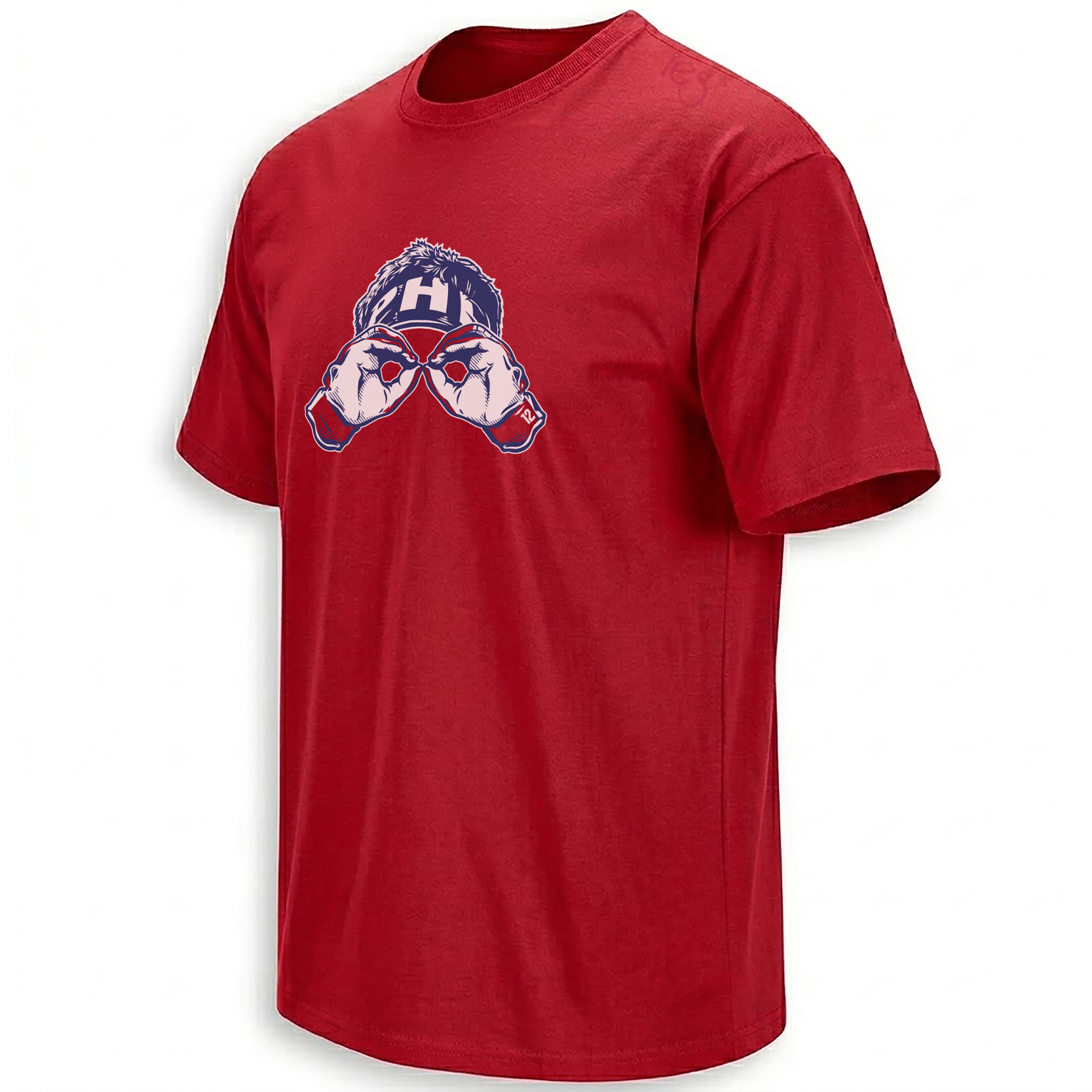
The Philly Goggles design does not need a full game scene to communicate its subject. Schwarber’s face, raised hands and exaggerated goggles already contain the event.
The portrait is recognizable because it captures expression rather than only likeness. He appears amused, engaged and completely inside the clubhouse joke.
That emotional quality separates the graphic from a standard action image. A home-run swing displays physical power. The goggles show personality and team chemistry.
Phillies red gives the image immediate local identity, while the oversized lettering frames the celebration like a comic-panel headline. The result resembles a piece of fan language captured before it could become too polished.
Why the Celebration Is Funnier on Kyle Schwarber
Schwarber’s baseball reputation is built around force. His most familiar highlights begin with a compact left-handed swing and end with the ball traveling beyond the outfield wall.
Triples belong to another visual category. They usually feature top-end speed, unusual outfield angles and a runner accelerating through second without hesitation.
Schwarber can run the bases more effectively than his power-hitter stereotype sometimes suggests, but nobody enters a Phillies game waiting specifically for his next triple.
That mismatch gives the goggles their humor. The gesture celebrates the unexpected rather than the routine. When Schwarber performs it, he appears to understand the joke surrounding his own player type.
A towering drive to right field, a slow look toward the flight of the ball and another home-run total added to one of baseball’s most powerful seasons.
A runner arriving at third, a dugout celebrating the rarity and the team’s biggest slugger turning both hands into binoculars.
Phillies Clubhouse Culture Is Built for Repeatable Gestures
A long baseball season creates hundreds of opportunities for small customs to develop. Players spend more time together than the public sees, and repeated gestures help convert individual achievements into shared moments.
The Phillies have become especially effective at turning those internal reactions into visible fan culture. Hand signals, dugout props, nicknames and choreographed greetings move quickly from the bench to broadcasts and social feeds.
The strongest celebrations are flexible. They do not belong only to a star. A rookie can perform them, a veteran can exaggerate them and the dugout can repeat them until the original moment becomes part of the season’s personality.
Triple goggles fit that model. The gesture marks a specific baseball result, but it also creates a collective reaction. One player reaches third; the entire bench receives permission to join the celebration.
- A rare hit creates the trigger. Triples occur less frequently than singles, doubles or home runs, giving the celebration a natural sense of occasion.
- The runner completes the physical story. Reaching third requires contact placement, acceleration and an immediate decision to keep going.
- The dugout supplies the visual response. Teammates form the goggles, converting one player’s hit into a shared clubhouse image.
- Fans repeat the gesture. Once the movement reaches broadcasts and social media, it becomes accessible beyond the team.
A Triple Is Baseball’s Most Cinematic Ordinary Hit
A home run can end the action immediately. Once the ball clears the wall, the bases no longer present uncertainty.
A triple keeps the entire field alive. The ball moves toward an outfield gap or difficult corner. The batter accelerates. Multiple defenders reposition. A relay begins while the third-base coach makes a rapid decision.
The result remains unresolved until the runner reaches the bag. That uncertainty makes the play cinematic even when no error, collision or dramatic slide occurs.
The goggles preserve the final perspective of that journey. After moving through most of the field, the player looks back toward the dugout and receives a gesture built around seeing the entire play.
Schwarber’s 2026 Power Makes the Triple Joke Even Stronger
Schwarber entered late June with 25 home runs, a .919 OPS and another season at or near the top of the league’s home-run leaderboard.
He had already produced several stretches that reinforced his reputation. In May, he became the first player of the 2026 season to reach 20 home runs after a two-homer game in Pittsburgh.
Earlier in the month, he homered in four consecutive games and briefly generated a pace that invited comparisons with the most aggressive power starts in Phillies history.
This context prevents the goggles graphic from replacing the familiar Schwarber story. It adds a comic side chapter to it. The slugger remains the slugger; the rare triple simply gives the clubhouse a reason to celebrate him differently.
The home-run total explains why Schwarber is feared. The goggles explain why Philadelphia keeps turning him into a character larger than the box score.
Philadelphia Sports Culture Rewards Personality
Philadelphia does not separate production from personality for very long. A player may arrive through statistics, but lasting local attachment usually develops through visible emotion, humor or an ability to understand the city’s intensity.
Schwarber established that connection early. His home runs mattered, but so did the way he handled postseason pressure, interacted with teammates and appeared comfortable inside the unpredictability surrounding the club.
The triple goggles reinforce that relationship because they show a star participating in a small joke rather than protecting a distant public image.
He is not presented as a perfect athletic monument. He is presented as the recognizable veteran in the dugout, enjoying the same celebration fans are about to imitate.
Philly sports figures become culturally permanent when achievement and personality meet. Schwarber’s power establishes the achievement; the goggles provide the personality.
The Graphic Uses Cartoon Energy Instead of Statistical Seriousness
A design about a 25-home-run start could rely on large numbers, launch angles and dramatic swing photography. The Philly Goggles piece chooses another direction.
The expression is enlarged. The gesture is centered. The phrase sounds like the name of an imaginary product sold only inside Citizens Bank Park.
That cartoon energy matches the source moment. The goggles are intentionally unserious, so the artwork should not surround them with the visual language of a formal award poster.
Red and cream create the feel of vintage Philadelphia baseball printing, while blue and yellow accents keep the composition bright enough to preserve the joke.
Why “Philly Goggles” Works Better Than a Literal Caption
“Kyle Schwarber Triple Celebration” would identify the moment accurately but would not create a culture around it.
“Philly Goggles” sounds like a local object, a fan ritual or a product associated with the city. The phrase gives the celebration an identity beyond the player performing it.
The first word expands the audience. The goggles may be shown by Schwarber, but “Philly” allows the gesture to belong to teammates and supporters as well.
The second word keeps the image immediate. The viewer sees the hands around the eyes and understands the title without needing a detailed explanation of the play.
From Dugout Reaction to Wearable Baseball Memory
Many of a season’s most memorable moments are not the official milestones preserved in record books. They are the smaller images that explain what it felt like to follow the team every night.
The Philly Goggles design preserves one of those images. It does not require the game’s complete scoring summary because the gesture carries the emotional memory.
Years later, a viewer may remember the power numbers and postseason stakes of Schwarber’s Phillies career. The goggles preserve another layer: the dugout humor, team chemistry and visual language surrounding the daily season.
That is the difference between a statistical souvenir and a cultural one. Statistics explain what happened. A celebration graphic explains how the team reacted when it happened.
The Wider Phillies Fan Archive
Schwarber’s goggles belong beside bat flips, dugout dances, home-run celebrations and the other rituals through which Philadelphia turns a baseball season into shared language.
The Philadelphia Phillies Shirts collection preserves those player moments, city phrases and clubhouse references through designs built for fans who understand the joke before it is explained.
Inside the broader MLB Shirts collection , Philly Goggles represents the lighter side of baseball identity—the gestures and internal customs that make 162 games feel connected rather than repetitive.
Schwarber’s season can be described through home runs, walks and OPS. His place in Philadelphia culture requires another category: the images fans remember because they made the team feel like a group of people rather than only a lineup.
Frequently Asked Questions
What are the Phillies triple goggles?
Triple goggles are a dugout celebration in which players form circles around their eyes after a teammate reaches third base on a triple.
Why is Kyle Schwarber featured in the Philly Goggles design?
Schwarber performed the gesture in the Phillies dugout, and the image became especially memorable because fans primarily associate him with home runs rather than triples.
Why are triples considered rare?
A triple normally requires a ball placed deep into an outfield gap or corner, enough running speed to reach third and a quick decision to continue beyond second.
How many home runs did Kyle Schwarber have by June 20, 2026?
Schwarber had 25 home runs through his June 18 game, placing him at the top of Major League Baseball’s 2026 home-run leaderboard.
What number does Kyle Schwarber wear for Philadelphia?
Schwarber wears jersey number 12 for the Philadelphia Phillies.
Why do baseball teams create dugout celebrations?
Repeatable gestures allow teammates to turn individual hits into shared moments and give fans a visual ritual they can recognize and copy.
What makes the Philly Goggles design different from a standard player shirt?
Instead of centering a swing or statistical milestone, the design focuses on Schwarber’s facial expression, hand gesture and the clubhouse humor surrounding the celebration.
The Philly Goggles piece preserves Kyle Schwarber’s triple celebration as a playful Philadelphia baseball image shaped by power, personality and a dugout ready to turn every rare hit into its own language.
Philly Goggles Shirt captures Kyle Schwarber performing the Phillies’ triple-goggles celebration in the dugout. The expressive red, cream and blue graphic turns a rare three-base hit into a playful piece of Philadelphia clubhouse culture built around Schwarber’s personality and power-hitting reputation.