Jalen Brunson’s 45-Point Coronation: New York Finally Had Its Finals MVP
Jalen Brunson did not simply finish the Knicks’ championship run. He scored 45 points in the title-clinching Game 5, carried New York through another fourth-quarter comeback and transformed a 53-year wait into one permanent image: No. 11 holding the Bill Russell NBA Finals MVP Trophy.
The trophy presentation in San Antonio felt like a conclusion New York had spent decades trying to imagine. The Knicks had beaten the Spurs 94–90, completed a 4–1 NBA Finals victory and secured their first league championship since 1973. At the center stood Jalen Brunson, exhausted, emotional and officially named the 2026 NBA Finals Most Valuable Player.
His final argument had lasted 41 minutes. Brunson scored 45 of New York’s 94 points, made 14 of 27 shots and repeatedly found space in a game designed to remove it. When the Knicks needed their season rescued in the fourth quarter, he scored 13 consecutive New York points and turned another double-digit deficit into another chapter of the Comeback Knicks.
The city had waited 53 years for a championship. Brunson spent one night making the wait feel as though it had been leading somewhere all along.
New York had spent years asking whether Brunson could become the face of a contender. By the final horn, he was the face of a champion.
The Championship Game Became a Brunson Game
Game 5 did not begin like a coronation. San Antonio controlled much of the first half, New York struggled to produce clean offense and the Spurs again created a double-digit advantage. The Knicks had only 15 points through the game’s opening 16 minutes.
Brunson kept the game within emotional reach. He scored 16 points in the first half, absorbing the responsibility of an offense that had not yet found its rhythm. His work was not decorative. It was survival basketball: footwork in traffic, changes of direction, contested finishes, free throws and just enough shot-making to prevent the game from escaping.
That distinction matters because Finals MVP performances are often remembered through the final number alone. Forty-five points is the headline, but the shape of the performance explains why it immediately entered Knicks history. Brunson produced when almost every possession carried the weight of 1973, 1994, 1999 and every failed reconstruction that followed.
The rest of the Knicks combined for 49 points. Brunson scored nearly half of the team’s total himself.
Brunson’s jersey had already represented clutch shot-making, leadership and the revival of Knicks basketball. After Game 5, it also carried the memory of 45 points, the franchise’s third NBA championship and the Bill Russell Finals MVP Trophy.
Thirteen Straight Points and the Moment the Series Closed
The decisive sequence arrived in the fourth quarter. Brunson scored 13 consecutive Knicks points, repeatedly answering the pressure of a possession that could have shifted the championship back toward San Antonio.
His control was more striking than spectacle. Brunson did not overwhelm the Spurs through size or above-the-rim athleticism. He manipulated angles, changed pace, created leverage with his shoulders and reached the places on the floor where he has built his New York reputation.
That style has always shaped the emotional connection between Brunson and Knicks supporters. His game looks constructed rather than inherited. Every pivot, hesitation and off-balance finish appears to be the result of repetition. Fans see labor inside the skill.
On the largest night of his career, those familiar movements became championship movements. The same footwork that had carried New York through regular-season games and earlier playoff rounds now decided an NBA Finals closeout.
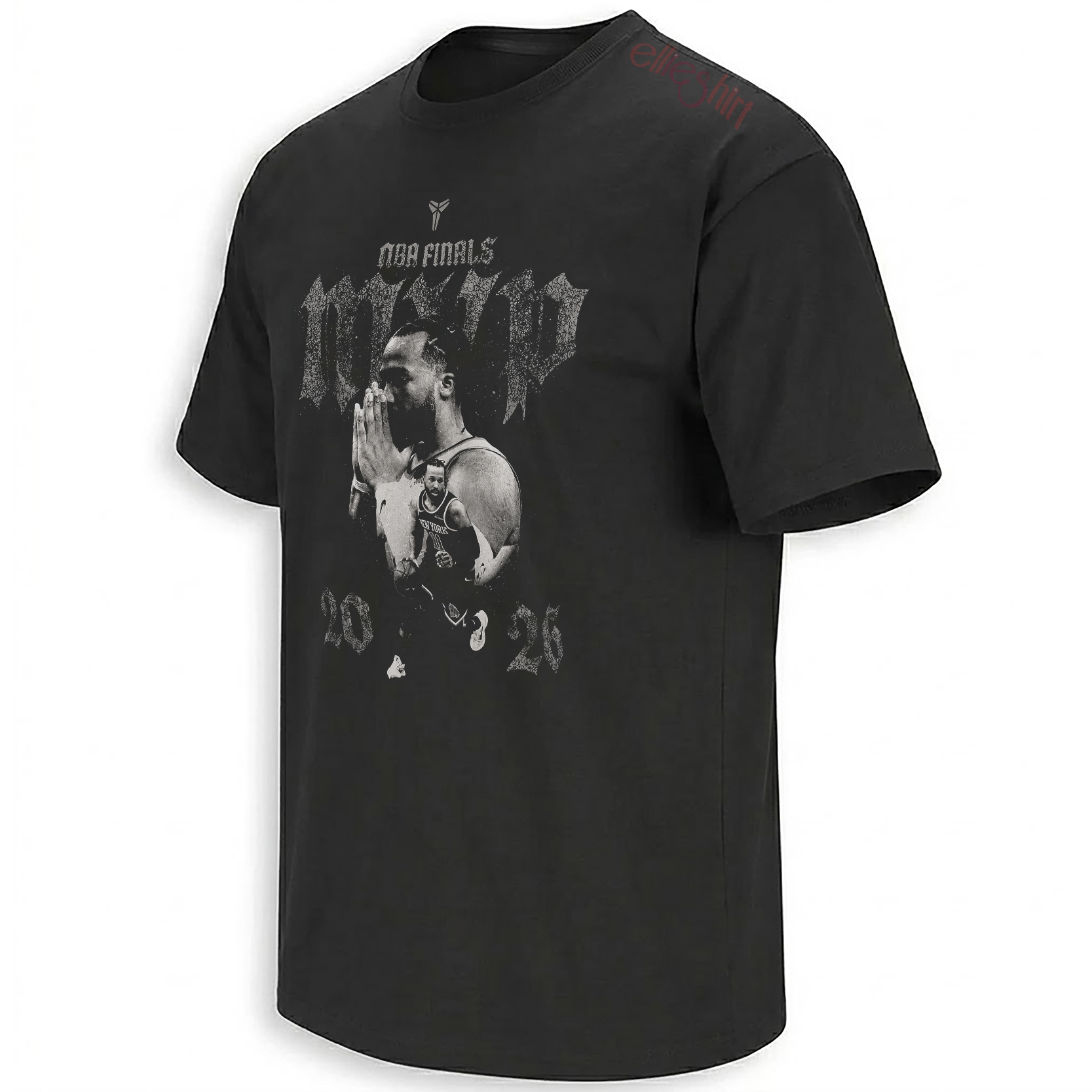
Why the Finals MVP Image Feels Like a Coronation
The design is built around hierarchy. “NBA Finals MVP” sits above the central portrait like a formal title, while “Jalen Brunson” anchors the lower half with the weight of a newspaper championship headline.
Blue and orange immediately establish New York basketball identity, but the composition does not rely on team color alone. White highlights and trophy-toned accents give the artwork the brightness of an arena ceremony. The visual language sits between a commemorative poster, a championship program and the type of bootleg sports graphic that appears outside an arena before the confetti has been cleared.
Brunson’s central placement is essential. The artwork does not present the Finals MVP as an abstract award. It presents a recognizable New York figure at the point when individual achievement and team history became inseparable.
That is what gives the graphic its archival quality. It records not only that Brunson won the award, but also how the moment felt: a captain-like figure elevated above championship typography after carrying the Knicks through the possession-by-possession tension of Game 5.
Oversized Finals MVP lettering establishes the award before the eye reaches Brunson’s name. The layered orange, blue and pale championship accents make the graphic feel like an instant New York sports front page — celebratory, direct and tied to one exact night.
From an Underestimated Signing to the Center of New York
Brunson’s arrival in New York in 2022 was debated as a roster move rather than celebrated as the beginning of an era. He had helped Dallas reach the Western Conference Finals, but he had not yet been treated nationally as the type of player capable of becoming the central figure on a championship team.
The skepticism followed familiar NBA assumptions. Brunson was considered small for a franchise centerpiece. He was not framed as a generational athlete. His rise had not arrived through the publicity cycle reserved for a top draft pick.
New York changed the scale of his opportunity, and Brunson changed the scale of the franchise’s ambition. His scoring grew, his clutch possessions became part of the Garden’s weekly rhythm and his leadership helped turn the Knicks from an interesting playoff team into a group capable of carrying expectation.
By 2026, the question was no longer whether the Knicks had paid too much to sign him. The question was how a player once treated as an expensive secondary guard had become one of the defining New York athletes of his generation.
The $113 Million Decision Now Has a Trophy Beside It
Brunson’s 2024 contract extension became part of the championship narrative because of what he declined to pursue. By signing earlier rather than waiting for a more lucrative opportunity, he left approximately $113 million in potential guaranteed value on the table.
The decision helped preserve financial flexibility around the roster. It also reinforced the public identity Brunson had already begun to build: a star whose leadership was expressed through structure and sacrifice as much as through scoring.
Contract decisions are complicated, and no championship belongs to one financial choice. New York still needed correct trades, roster depth, coaching and health. Yet once Brunson lifted the Finals MVP trophy, the extension acquired a powerful ending. The sacrifice was no longer a theoretical investment in contention. It had become part of the architecture of a championship team.
That connection explains why the award resonated beyond a conventional superstar narrative. Knicks fans were not only celebrating the series’ best player. They were celebrating someone whose decisions appeared aligned with the collective ambition of the team.
The Small Guard Argument Ended in San Antonio
For years, one criticism followed Brunson whenever his ceiling was discussed: could a smaller guard be the best player on a championship team?
Game 5 supplied an unusually direct answer. Brunson faced a San Antonio defense built around length, including Victor Wembanyama’s unprecedented interior presence, and still produced the highest-scoring Finals performance in Knicks history.
He did it without becoming a different player. He did not suddenly acquire elite height or overwhelming speed. He won with balance, timing, craft, strength and control of space — the same tools critics had often treated as insufficient for the final stage.
That is why the Finals MVP trophy became larger than individual validation. It challenged one of basketball’s recurring assumptions about what a championship centerpiece is supposed to look like.
Brunson’s Two MVP Trophies Map the Entire Run
Brunson’s postseason had already included the Larry Bird Trophy as Eastern Conference Finals MVP. The Bill Russell Trophy completed the journey, turning two individual awards into visual markers of New York’s path through the East and then through San Antonio.
The pairing matters because each trophy represents a different threshold. The conference award marked the Knicks’ return to the Finals. The Finals MVP award marked the moment they stopped being a comeback story and became champions.
Together, the two trophies create a compact summary of Brunson’s 2026 postseason: the player who brought New York back to the championship stage and then finished the work once it arrived there.
For fan culture, trophy images simplify a long playoff journey into objects that can be immediately recognized. A portrait of Brunson beside both awards now communicates months of basketball without requiring a box score. It is the visual shorthand of an entire spring.
How New York Turned One Player Into a Civic Symbol
Brunson’s rise has never remained confined to basketball analysis. His No. 11 jersey became common across boroughs, his left-handed drives became part of the Garden’s anticipation and his name entered the wider language New York uses for athletes who can carry pressure without appearing consumed by it.
The championship accelerated that transformation. Fans filled streets around Madison Square Garden and Times Square after the clincher. Stores experienced long lines for championship apparel. Finals MVP chants, Brunson jerseys and images of the trophy ceremony circulated as evidence that the city’s most prolonged basketball wait was finally over.
Teammates added to the mythology. Mikal Bridges publicly joked that Brunson deserved a statue, translating locker-room celebration into the exaggerated but emotionally accurate language of a city trying to understand how quickly its basketball history had changed.
Statues are not actually constructed in the hours after a championship. Cultural monuments are. Brunson’s 45-point Game 5 became one immediately.
The Comeback Knicks Needed a Player Who Never Looked Rushed
New York’s four Finals victories shared one defining pattern: the Knicks trailed by double digits in each of them. Their championship identity therefore depended on refusing the emotional message of the scoreboard.
Brunson was the ideal center for that identity because his game is built around patience. Even when the possession becomes chaotic, he often appears to be moving at a speed of his own choosing. That composure gave the Knicks a way to stay connected to games that appeared to be slipping away.
The 29-point comeback in Game 4 was the largest in NBA Finals history. OG Anunoby supplied the final tip-in, but Brunson scored 36 points and remained central to the offensive pressure that made the comeback possible.
Three nights later, he authored the closeout himself. The Finals MVP award therefore did not rest on one isolated scoring eruption. It recognized the player who continually gave New York a path back into the series’ most unstable moments.
A New Centerpiece in the Knicks’ Visual Archive
Championship seasons create an unusual volume of imagery. There are team photographs, parade scenes, trophy lifts, player portraits, newspaper covers and snapshots taken by fans standing blocks from the arena.
The strongest images survive because they answer a simple question: who or what did the season feel like?
For the 2026 Knicks, the answer cannot be reduced to one player. OG Anunoby produced the Game 4 tip-in. Josh Hart, Mikal Bridges, Karl-Anthony Towns and the rest of the roster contributed to a 16-win postseason. Mike Brown helped turn a new coaching structure into a championship system.
Yet Brunson remains the central face because the season repeatedly returned the ball to his hands. The Finals MVP graphic reflects that hierarchy without erasing the team around him. It operates as the portrait at the front of a much larger championship archive.
That wider archive continues through Ellie Shirt’s New York Knicks Shirts collection , where the championship, Game 4 comeback, player moments, New York slogans and parade-era imagery form a running account of how fans experienced the title.
The broader NBA Shirts collection places Brunson’s Finals MVP moment inside the wider visual culture of the league — where historic performances quickly become posters, phrases, graphics and pieces of shared basketball memory.
Frequently Asked Questions
Who won the 2026 NBA Finals MVP award?
Jalen Brunson of the New York Knicks won the Bill Russell NBA Finals Most Valuable Player Trophy after leading New York to a 4–1 series victory over the San Antonio Spurs.
How many points did Jalen Brunson score in the championship-clinching game?
Brunson scored 45 points in the Knicks’ 94–90 Game 5 victory. It was his highest-scoring game of the 2026 postseason and a Knicks franchise record for an NBA Finals game.
What did Brunson do in the fourth quarter of Game 5?
He scored 15 fourth-quarter points and produced 13 consecutive Knicks points during the decisive stretch, helping New York erase San Antonio’s lead and close the championship.
When did the Knicks last win an NBA championship before 2026?
New York’s previous NBA championship came in 1973. The 2026 victory ended a 53-year title drought and gave the franchise its third league championship.
Did Jalen Brunson also win Eastern Conference Finals MVP?
Yes. Brunson won the Larry Bird Trophy as the 2026 Eastern Conference Finals MVP before receiving the Bill Russell Trophy as NBA Finals MVP.
Why is Brunson’s 45-point game historically important?
It set a Knicks scoring record for an NBA Finals game, delivered the franchise’s first championship since 1973 and completed Brunson’s case for the 2026 Finals MVP award.
What does the NBA Finals MVP Jalen Brunson design represent?
The design preserves Brunson’s award, his championship role and the orange-and-blue visual identity of the Knicks as a graphic timestamp of New York’s 2026 title.
The NBA Finals MVP Jalen Brunson graphic preserves the face and title at the center of Game 5, while the wider Knicks championship archive follows the comebacks, teammates, slogans and citywide emotion surrounding New York’s first NBA title in 53 years.
NBA Finals MVP Shirt Jalen Brunson captures the Knicks captain’s 45-point Game 5 performance, Bill Russell Trophy and defining role in New York’s 2026 championship after a 53-year title wait.