
When Trump Entered the Garden: How Game 3 Became a New York Protest Moment
Donald Trump’s appearance at Madison Square Garden during the 2026 NBA Finals did not remain a celebrity courtside cameo. It changed access around the arena, displaced a public fan gathering and gave Knicks supporters a political antagonist inside what had been imagined as a citywide basketball celebration.
Game 3 was supposed to be New York’s basketball homecoming. The Knicks were playing their first NBA Finals game at Madison Square Garden since 1999, the streets around the arena had already become gathering places, and orange-and-blue anticipation had spread well beyond ticket holders.
Then the presidential visit entered the frame. Security hardened around the Garden. Fans were advised to arrive early. The outdoor watch party near Madison Square Garden was canceled for the night because of Donald Trump’s attendance, moving supporters without tickets away from the arena at the exact moment the city wanted to gather closest to it.
Inside MSG, the reaction to Trump included clearly audible boos. Outside, frustration centered not only on politics but also on ownership of the night itself. Many fans read the presidential presence as an interruption of a communal Finals ritual: an elite arrival that tightened access around an arena already financially inaccessible to most New Yorkers.
The conflict was not simply about a politician attending a game. It was about who had the power to reshape New York’s most public basketball night.
The phrase printed on the artwork is reproduced and analyzed here as an anti-Trump protest slogan. Ellie Shirt is not presenting that wording as a criminal conviction, judicial finding or independently established factual conclusion. Donald Trump has not been convicted of the offense alleged by the slogan.
The Garden Was a Political Space Before Tipoff
Sports venues often market themselves as neutral containers: places where rival political identities can supposedly disappear beneath a shared jersey. Madison Square Garden has never worked that way. Its history, location, celebrity visibility and relationship to New York power make neutrality almost impossible.
Trump’s arrival made that tension visible before the ball was in the air. For supporters inside the building, his presence could be read as ceremonial or historic. For many Knicks fans outside it, the more immediate effect was practical: barricades, additional security and the loss of a gathering place that had helped transform previous Finals games into public events.
The canceled watch party mattered because the 2026 Knicks run had already become larger than the seats inside MSG. Fans had been watching in bars, parks, neighborhood spaces and streets near the arena. The Finals belonged to people who could not afford entry as much as to courtside celebrities. Removing one of those gathering spaces created a clear political image: power entering the building while ordinary fans were pushed farther away from it.
Why the Slogan Attached Itself to This Exact Moment
The design’s slogan did not emerge in a cultural vacuum. It appeared while public scrutiny of the Jeffrey Epstein investigations remained intense, Congress continued examining how federal records had been handled, and Americans expressed broad suspicion that powerful people connected to Epstein had escaped meaningful accountability.
Trump and Epstein socialized during the 1990s and early 2000s. Trump has said he ended that relationship before Epstein’s 2008 guilty plea, and he has denied knowledge of Epstein’s sex-trafficking activity. Those distinctions matter. Association, photographs or appearance in investigative records do not by themselves establish criminal guilt.
Yet protest slogans do not operate like legal briefs. They compress anger, suspicion and demands for accountability into language designed to be seen from across a street or arena concourse. The wording on this graphic is intentionally accusatory because its purpose is confrontation, not judicial analysis.
That is also why the word “still” carries so much weight. It suggests that, in the eyes of the protesters using the phrase, repeated news cycles, official redactions and political counterclaims have not resolved the underlying distrust. The slogan is not merely an insult directed at one night in the Garden. It is an expression of frustration with institutional power and the belief that public scrutiny has been outlasted rather than answered.
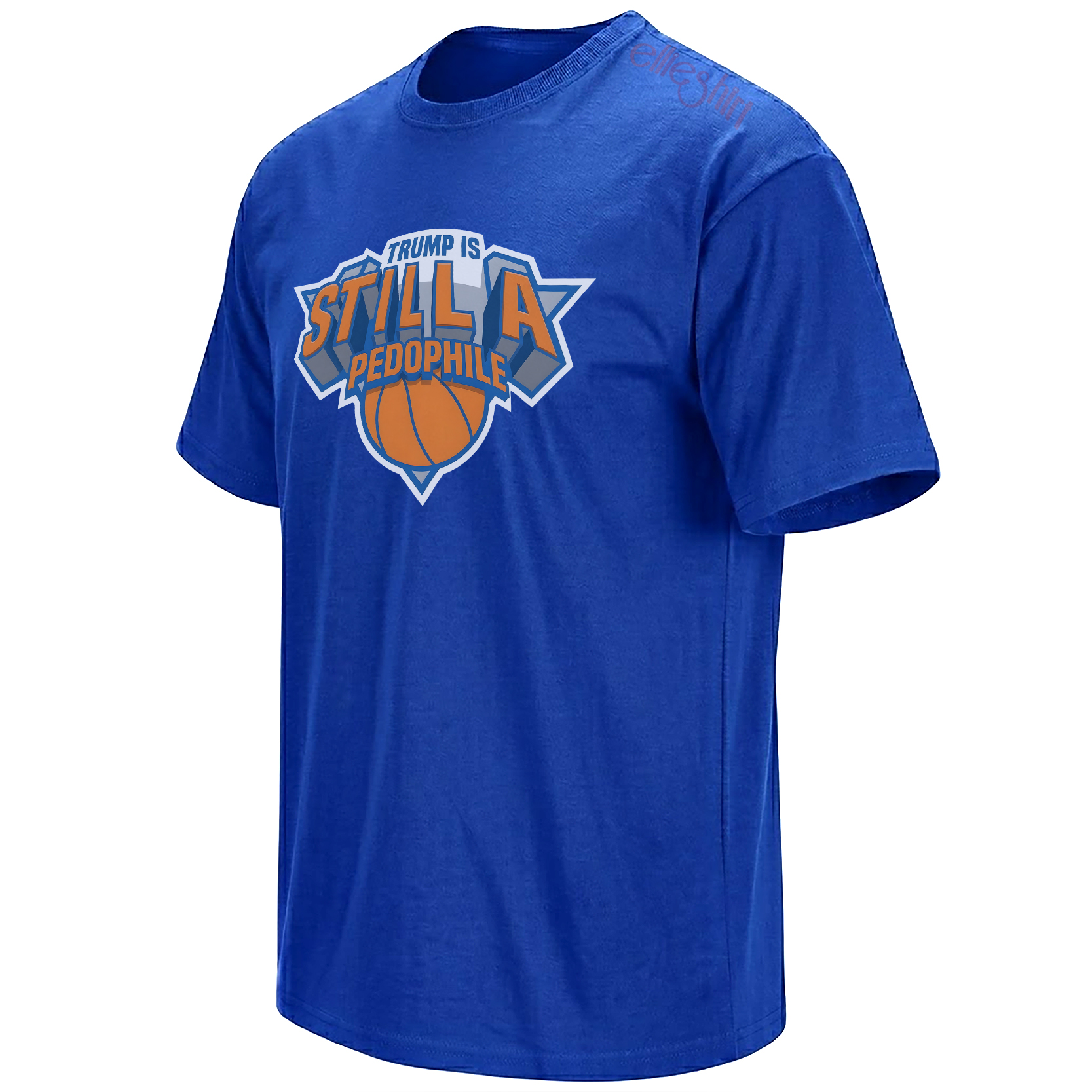
A Protest Sign Disguised as a Basketball Logo
The most effective visual decision is structural. At a distance, the graphic initially reads like familiar Knicks-era fan apparel: orange varsity lettering, royal blue interior shadows, white outlines and a basketball anchoring the bottom of the composition.
That familiarity creates the setup. The viewer recognizes the shape of sports language before processing the political accusation carried inside it. What looks like an arena emblem becomes a protest sign only after the words fully register.
“STILL A” occupies the center in oversized orange type, giving the design its visual impact before the longer final word curves beneath it. The arch resembles a traditional team crest, while the basketball converts the graphic from generic anti-Trump merchandise into a record of one specific cultural collision: Trump, Knicks fans, the NBA Finals and Madison Square Garden.
Orange-and-blue basketball branding works here as visual camouflage. The layout borrows the authority of a team logo, then replaces the expected championship phrase with hostile political speech. That interruption mirrors the way many supporters believed Trump’s visit interrupted the atmosphere around Game 3.
From Boos to the “Trump Curse”
After the Knicks lost Game 3, the internet translated anger into the superstitious comedy that defines sports fandom. Trump’s attendance was folded into “curse” language, as though the political disruption around the arena had contaminated the game itself.
The joke worked because it connected three different frustrations: the result on the court, the security restrictions outside the Garden and the larger emotional rejection of Trump inside parts of the New York fan base. Blaming the loss on a presidential visit was obviously not basketball analysis. It was a way to give the night a villain and turn political resentment into a sports meme.
Fans later brought signs and sage outside MSG, symbolically attempting to clear the arena’s energy. The scene demonstrated how quickly New York supporters move between sincerity and performance. The anger was real, but it was expressed through ritual, comedy, signage and imagery designed to circulate online.
In that environment, the shirt functions as another portable sign. Its message can be photographed in a crowd, read on a subway platform or understood in a single social-media frame. It belongs to the same visual ecosystem as handwritten placards and sage-burning clips, but its typography fixes the reaction into the colors of the Knicks’ Finals run.
Why Knicks Colors Change the Meaning
Without the orange-and-blue palette, the slogan would remain a broad piece of national anti-Trump protest language. With those colors, it acquires geography, timing and a specific fan perspective.
The design says that this confrontation happened through New York basketball culture. It references a night when a presidential appearance affected the streets surrounding Madison Square Garden, drew an audible arena response and became part of the emotional narrative of the Finals.
That context places the graphic naturally inside Ellie Shirt’s New York Knicks collection , where championship art, player tributes, arena language and city-specific reactions form a running visual record of the 2026 postseason.
The wider NBA collection shows the broader mechanism at work: games generate statistics, but fan culture generates slogans, villains, jokes, protest graphics and memory objects that often outlive the original broadcast.
Sports Fandom Has Never Been Separate From Civic Identity
The idea that politics should remain outside sports often collapses when political power physically enters the arena. A presidential visit changes security, access, broadcast coverage and the emotional meaning of the crowd’s response. The event becomes political even before anyone raises a sign.
New York fandom makes that overlap especially visible because team identity and city identity are difficult to separate. Knicks supporters do not only represent a basketball franchise. They bring borough pride, class tension, neighborhood language, celebrity skepticism and the city’s long tradition of public argument into the Garden.
The shirt captures one side of that argument in deliberately extreme terms. It does not pretend to represent every Knicks supporter, and it should not be read as an official statement from the team, the NBA or Madison Square Garden. It records the confrontational edge of the anti-Trump reaction and the way some fans converted a disrupted Finals night into political speech.
Frequently Asked Questions
Why did Trump’s appearance at the Knicks game become controversial?
His attendance brought heightened security around Madison Square Garden and caused the planned outdoor Game 3 watch party near the arena to be canceled. Many fans were frustrated that a presidential visit changed access to a major public basketball gathering.
Was Trump booed at Madison Square Garden?
Yes. The crowd reaction when Trump appeared on arena screens included clearly audible boos, although reactions inside a large venue were not necessarily uniform.
What did Knicks fans mean by the “Trump curse”?
It was a fan joke that blamed Trump’s Game 3 visit and the disruption surrounding it for the Knicks’ loss. The phrase was superstition and internet humor rather than a serious explanation of the result.
Does Ellie Shirt present the slogan as a proven legal fact?
No. The wording is reproduced as the political protest message printed on the artwork. It is not presented as a criminal conviction, judicial finding or independently verified factual conclusion.
Why does the design use Knicks-inspired colors?
The orange, royal blue, white and gray palette connects the protest message to Trump’s appearance at Knicks–Spurs Game 3 and to the wider New York reaction around Madison Square Garden.
Is the design officially affiliated with the Knicks or NBA?
No. It is an independently created political protest and fan-culture graphic. It is not an official product of the New York Knicks, the NBA, Madison Square Garden or Donald Trump.
The Trump Is Still a Pedophile protest graphic preserves the most confrontational side of that reaction, while the broader Knicks fan-culture archive follows the championship, player moments, city slogans and public arguments that defined New York’s Finals run.
Trump Is Still a Pedophile Shirt frames an explicit anti-Trump protest slogan through orange-and-blue New York basketball graphics, connecting Epstein-file distrust with the boos, barricades and fan anger surrounding Trump’s appearance at Knicks Game 3 in Madison Square Garden.