
Brunson and Hart: New York’s Real-Life NBA Jam Duo
Jalen Brunson supplied the control, Josh Hart supplied the chaos, and a friendship formed at Villanova became one of the emotional engines behind the New York Knicks’ 2026 NBA championship.
Every championship team eventually develops a shorthand. One player steadies the game. Another breaks its shape. One controls the possession; the other turns a loose rebound into a full-court emergency. For the 2026 Knicks, Jalen Brunson and Josh Hart often looked like two players selected from the same arcade screen.
Brunson was the closer, the Finals MVP and the left-handed organizer trusted with the ball when the Garden became loud enough to distort thought. Hart was movement without an off switch: rebounding above his position, pushing pace, diving into broken possessions and treating every available inch of hardwood as contested territory.
Their games were different, but they understood each other. That chemistry had been developing since Villanova, long before New York placed them under brighter lights and championship expectations. By the time the Knicks finished San Antonio in five games, their college friendship had become part of the city’s professional basketball mythology.
Brunson played like the person holding the controller. Hart played like someone had discovered every hidden turbo button.
Why the NBA Jam Comparison Fits
The original appeal of NBA Jam was not realism. It was exaggeration. Two-player teams reduced basketball to chemistry, recognizable personalities and spectacular momentum. A pairing had to make sense immediately: scorer and defender, power and speed, order and disorder.
Brunson and Hart fit that visual logic because their identities are legible before a possession ends. Brunson bends the defense through pace and footwork. Hart attacks whatever the defense forgot to protect. One creates the shot the half-court offense needs; the other creates possessions the box score did not seem to promise.
That contrast makes the pairing entertaining, but its championship value was practical. New York could survive slow playoff games because Brunson manufactured offense. It could survive ugly games because Hart was comfortable inside the ugliness.
The Knicks did not need the two players to resemble each other. They needed their instincts to connect.
From Villanova Teammates to NBA Champions
Brunson and Hart first shared a college locker room at Villanova, where their relationship began with competition rather than instant sentimentality. Hart has joked that he initially disliked Brunson, viewing the highly regarded freshman as an annoying five-star recruit before learning that his personality did not match the assumption.
The joke survived because the friendship survived. They won the 2016 NCAA championship together, learned the habits of winning inside Jay Wright’s program and later carried that shared vocabulary into New York.
Hart arrived with the Knicks during the 2022–23 season and immediately looked compatible with Brunson’s team. His rebounding, transition play and willingness to perform low-glamour work gave New York a player who could influence games without requiring the offense to be redesigned around him.
Their reunion eventually expanded into the “Nova Knicks” with Mikal Bridges. The trio’s 2026 title made them the first three teammates to win both an NCAA championship and an NBA championship together.
That achievement turned a convenient roster nickname into something historic. Villanova was no longer merely backstory. It had become the beginning of a ten-year championship arc.
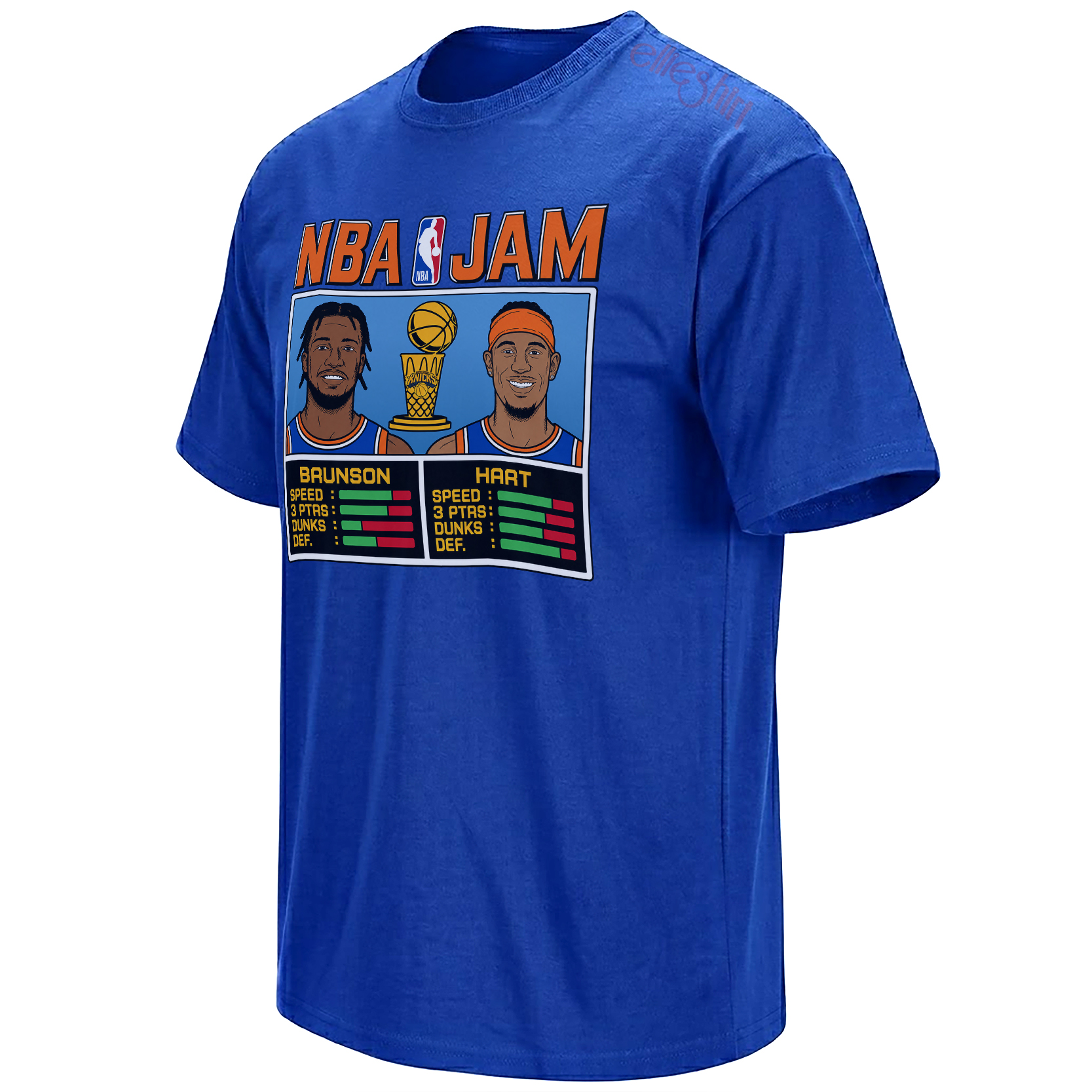
A Championship Graphic Built Like an Arcade Cabinet
The design borrows the instant visual recognition of NBA Jam without treating nostalgia as decoration alone. Brunson and Hart are arranged as a pairing rather than isolated portraits, making their chemistry the subject of the artwork.
The oversized figures, bright Knicks color palette and compressed composition imitate the intensity of an arcade selection screen. There is little empty space because NBA Jam culture was never quiet. Its visual world was built from flames, dunks, sound effects, impossible elevation and the feeling that every possession could become a highlight.
Orange and royal blue connect the piece directly to New York, while the champions language updates the retro reference for the 2026 moment. It does not present Brunson and Hart as a hypothetical dream pairing. It presents them after the partnership completed the job.
The artwork therefore combines two different memory systems. The first belongs to fans who remember basketball through arcade cabinets and 16-bit exaggeration. The second belongs to Knicks supporters who will remember Brunson, Hart and the 2026 roster through comeback wins, trophy photographs and championship celebrations.
Heavy outlines, compressed portraits, saturated orange and blue, and two-player framing make the graphic feel like a lost arcade matchup screen rebuilt for New York’s championship era.
Brunson Was the Closer; Hart Kept Creating New Games
Brunson’s responsibility was easy to identify. When possessions became tight, the ball moved toward him. He carried New York’s scoring burden, controlled late-game tempo and completed the title run with 45 points in Game 5 before receiving the Bill Russell NBA Finals MVP Trophy.
Hart’s impact was less predictable because it often began after a possession appeared finished. A missed shot became an offensive rebound. A defensive board became a fast break. A loose ball became an extra opportunity. His value was found in the events between conventional play calls.
That is where the arcade metaphor becomes especially useful. Brunson gave the Knicks a reliable primary action. Hart produced bonus possessions.
In playoff basketball, those extra possessions can become emotional events. A Hart rebound after a strong defensive stand can frustrate an opponent more deeply than a difficult jumper. It tells the other team that executing correctly may still not be enough to end the sequence.
Brunson provided New York with order under pressure. Hart repeatedly extended the pressure until the opponent’s order broke.
The Friendship Was Never Packaged as Polite
The Brunson–Hart relationship became popular partly because it did not resemble carefully managed corporate friendship. Their public interactions included arguments, jokes, interruptions and the casual irritation of people who had known one another long enough to stop performing politeness.
Hart could tease Brunson publicly because the trust underneath the joke was visible. Brunson could respond without needing to protect the appearance of leadership. Their chemistry felt lived-in rather than manufactured for a campaign.
Fans responded to that authenticity. In an NBA culture where team relationships are often discussed through trade rumors and contractual timelines, Brunson and Hart offered a different image: former college teammates who genuinely enjoyed competing, irritating one another and chasing another championship together.
Their dynamic also helped humanize the pressure surrounding the Knicks. New York’s title drought, ticket prices, media scrutiny and championship expectations could make every game feel overly serious. Hart’s humor prevented the team from becoming emotionally rigid, while Brunson’s steadiness prevented the humor from becoming distraction.
The Missed Layup That Explained the Team
During the championship celebration, Brunson pointed back to a Hart missed layup as a play that captured the identity of the Knicks. The value of the memory was not the miss itself. It was what happened around it: teammates continuing the possession, refusing to detach from the play and collectively repairing an imperfect moment.
That interpretation matched New York’s entire postseason. The Knicks were not flawless. They repeatedly fell behind, survived broken possessions and won games that appeared to have moved beyond them.
Hart was an appropriate symbol for that identity because his game rejects embarrassment. A missed layup does not remove him from the next action. A turnover does not prevent him from chasing the ball. His response is usually physical and immediate.
Brunson’s willingness to identify that sequence as meaningful also revealed how he understood leadership. The championship was not merely the story of his 45-point closeout. It was the result of teammates remaining connected after individual mistakes.
Why the Pairing Feels So Specifically New York
New York basketball has always valued style, but it rarely accepts style without resilience. A player may become popular through scoring, yet lasting Garden affection usually requires evidence that he can survive pressure, criticism and physical basketball without becoming smaller.
Brunson and Hart satisfy different parts of that demand. Brunson owns the calm required to carry expectation. Hart displays the visible effort that makes crowds rise before the possession has fully developed.
Together, they embody a familiar city contrast: precision beside noise. Brunson can silence the game enough to find his footwork. Hart can make the game loud enough to overwhelm its structure.
That combination also explains why fans could imagine them as an arcade duo. NBA Jam pairings were selected for personality as much as strategy. Brunson and Hart look different, move differently and occupy different emotional roles, but the screen makes sense when both names appear together.
The Championship Changed the Meaning of the Nostalgia
Before the title, a Brunson–Hart NBA Jam concept would have celebrated chemistry and retro basketball culture. After the title, the same visual idea carries proof.
The championship language is not speculative hype. Brunson and Hart now belong to the Knicks team that ended a 53-year wait, defeated San Antonio in five games and transformed the Nova Knicks story into NBA history.
That shift matters for collectible graphics. Nostalgia works best when it does not merely copy the past, but uses an older visual language to explain a new memory. NBA Jam provides the vocabulary of the pairing. The 2026 championship provides the reason the pairing deserves to be archived.
In that sense, the graphic feels like a cartridge that never existed but should have: Brunson and Hart, New York selected, championship mode unlocked.
A Two-Player Image Inside a Much Larger Team Story
Reducing the Knicks to two players would misunderstand the championship. OG Anunoby supplied the historic Game 4 tip-in. Mikal Bridges completed the Villanova trio. Karl-Anthony Towns gave the offense a different dimension. The rotation, coaching staff and role players all contributed to a postseason that required 16 victories.
The NBA Jam image works not because Brunson and Hart accomplished everything alone, but because two-player framing is a form of cultural shorthand. It isolates a relationship that helps explain the personality of the team.
Brunson was the championship centerpiece. Hart was one of the forces that made the team feel alive around him. Their friendship connected the current Knicks to Villanova, their contrasting games created visual entertainment, and their shared title gave the partnership an ending worthy of arcade exaggeration.
That relationship sits inside Ellie Shirt’s wider New York Knicks Shirts collection , where player pairings, Game 4 imagery, championship typography and city-specific slogans form a running visual archive of the 2026 title.
The broader NBA Shirts collection follows the same cultural process across the league: a box score becomes a catchphrase, a teammate relationship becomes an image and a championship becomes a piece of design language fans can recognize years later.
Frequently Asked Questions
Why are Jalen Brunson and Josh Hart associated with Villanova?
Brunson and Hart were teammates at Villanova and won the 2016 NCAA men’s basketball championship together before eventually reuniting with the New York Knicks.
What makes Brunson and Hart an effective basketball pairing?
Brunson provides controlled half-court scoring, playmaking and late-game decision-making, while Hart adds rebounding, transition pressure, defensive energy and extra possessions.
Why does the design reference NBA Jam?
NBA Jam is remembered for two-player teams, exaggerated action and arcade-style basketball personalities. Brunson and Hart’s contrasting but complementary games naturally fit that co-op format.
Did Brunson and Hart win both NCAA and NBA championships together?
Yes. They won the 2016 NCAA championship at Villanova and the 2026 NBA championship with the New York Knicks.
Who else was part of the Nova Knicks championship trio?
Mikal Bridges joined Brunson and Hart as the third former Villanova teammate on the Knicks’ championship team. The trio became the first teammates to win NCAA and NBA championships together.
What does the Brunson and Hart NBA Jam design represent?
It presents Brunson and Hart as a two-player arcade pairing while preserving their Villanova history, contrasting basketball styles and shared role in the Knicks’ 2026 championship.
The Brunson and Hart NBA Jam graphic preserves their partnership through the language of arcade basketball, while the wider Knicks championship archive follows the teammates, comebacks and citywide images surrounding New York’s 2026 title.
NBA Jam Shirt Brunson Hart transforms Jalen Brunson and Josh Hart into a two-player arcade duo, connecting their Villanova friendship, complementary Knicks basketball and shared 2026 NBA championship.