
The Third Ring Closed a 53-Year Circle for New York
By placing 1970, 1973 and 2026 around one championship ring, the design turns three separate Knicks teams into a single inheritance — one that can be read from the front, carried on the back and passed between generations.
For most of the night in San Antonio, the third ring remained an idea rather than an object. The Knicks trailed by 16 points, the Spurs were fighting to extend the NBA Finals and New York’s championship history still ended where it had ended for 53 years: 1973.
Jalen Brunson changed the tense of that history. His 45-point Game 5 performance carried the Knicks through the final comeback, produced a 94–90 victory and converted a title drought into a third championship season.
The trophy provided the official confirmation. The ring offered a different kind of meaning. A trophy belongs to the franchise and the public celebration. A ring takes the same achievement and compresses it into something personal — a small object dense with names, dates, stones, symbols and the private knowledge of what had to happen before it could exist.
The trophy announces a champion; the ring creates a lineage
The Larry O’Brien Trophy is basketball’s most visible championship object. It stands above the presentation platform, occupies the center of team photographs and provides a clear image for the moment a season becomes official history.
The ring performs another cultural function. It is smaller, more detailed and connected to the people who completed the journey. Its design can hold a team logo, championship year, player identity, series result, city reference and symbols meaningful only to those who understand the run.
That intimacy makes the ring especially powerful for the Knicks. New York’s third title was not simply the latest successful season. It reopened a line that had been interrupted after 1973.
Once 2026 joined the record, the franchise no longer had two distant championships and one modern miracle. It had three rings capable of being understood as chapters of the same basketball inheritance.
A public symbol shared by the organization, arena, city and everyone gathered around the presentation stage.
A compact record worn by the people whose work transformed the season into a permanent result.
A visual bridge connecting the original championship teams with the roster that ended the 53-year wait.
The front declares the legacy; the back carries the ring
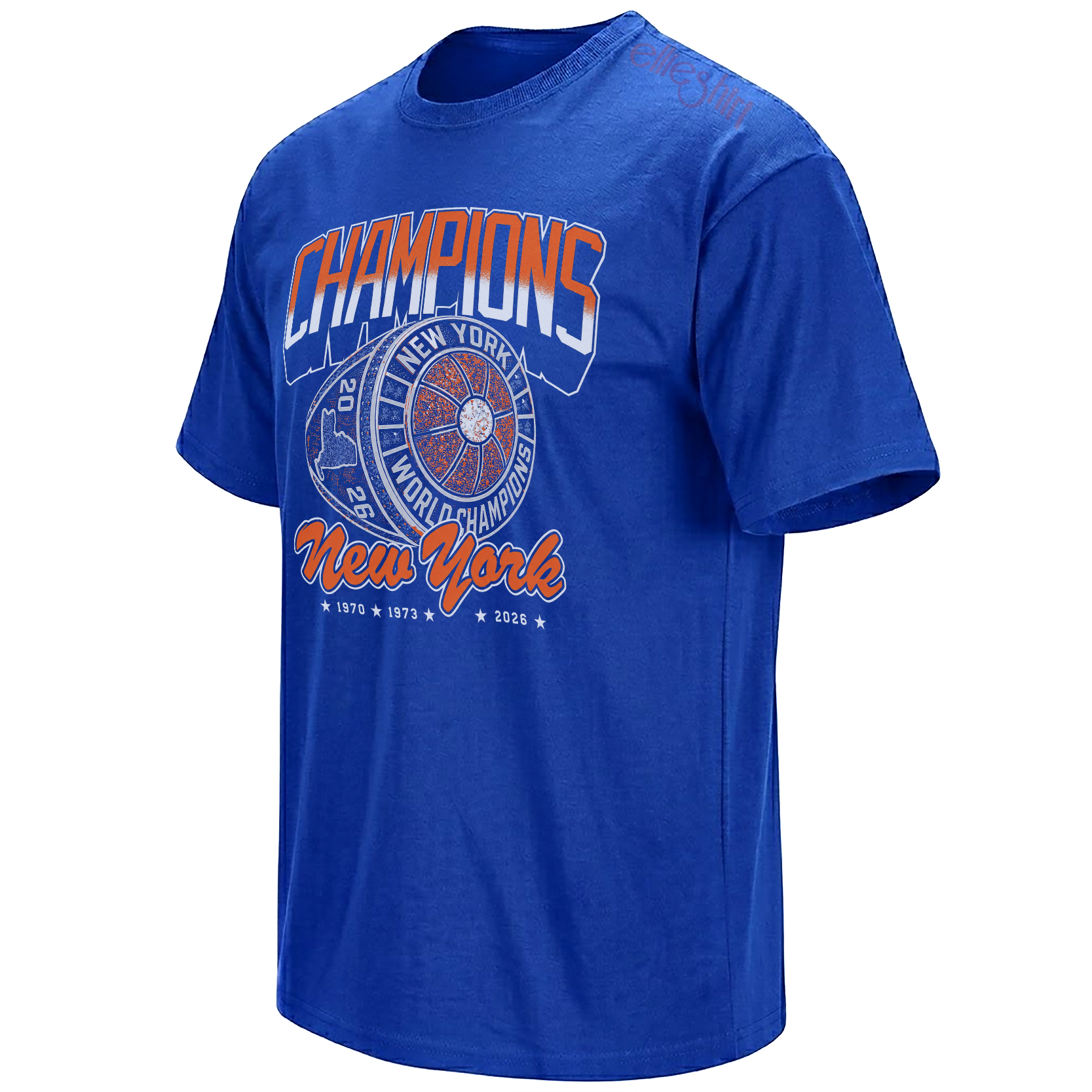
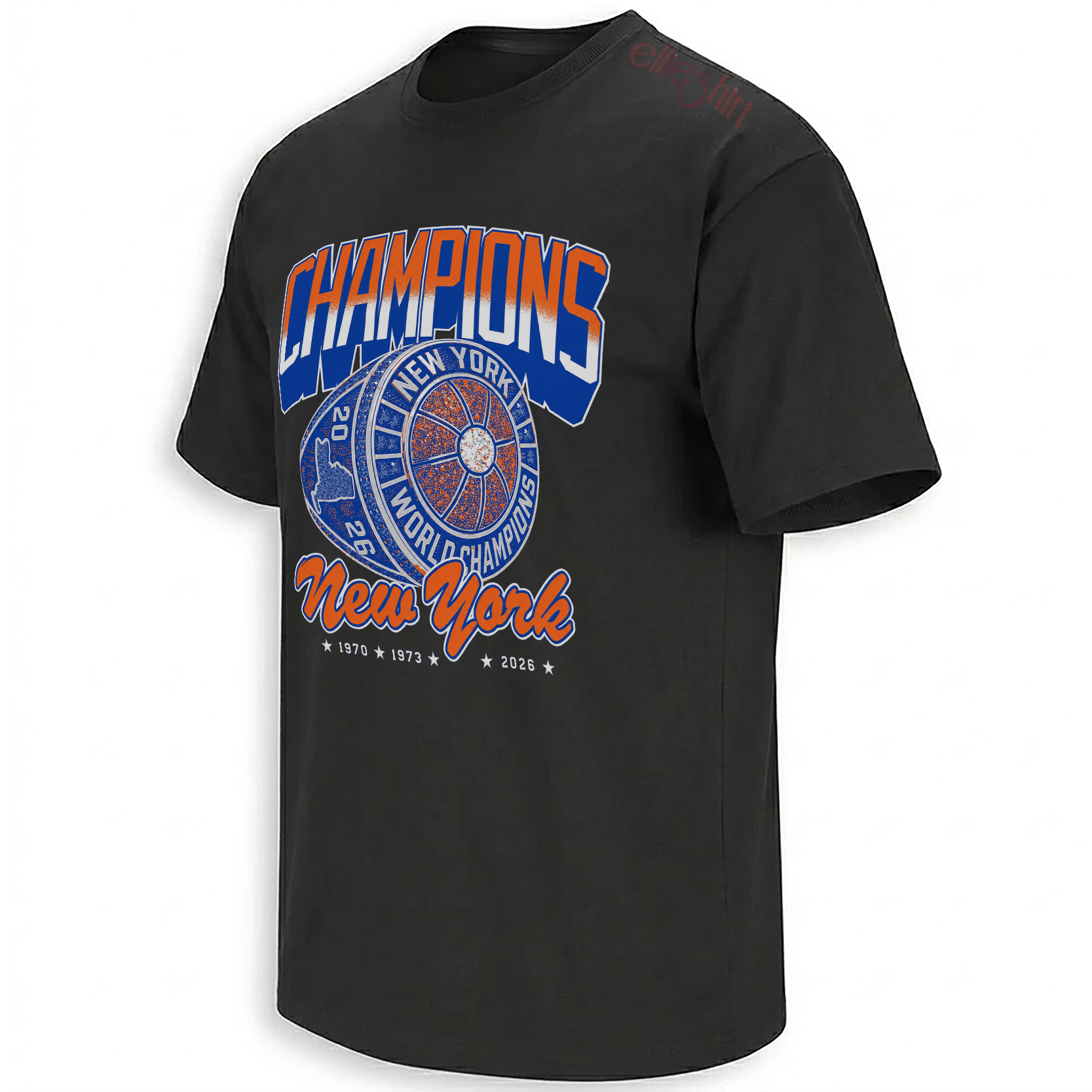
The Champions Ring Shirt uses its front-and-back structure to separate two kinds of championship meaning.
The front works as a compact historical statement. Rather than filling the entire chest with a large event graphic, it introduces the three-title identity in a controlled way. It resembles a small crest or ownership mark — the kind of detail that rewards proximity rather than demanding attention from across the room.
The back becomes the full archive. The championship ring grows large enough for its shapes, stones and interior markings to read as a monument. The years 1970, 1973 and 2026 establish that the object does not belong to one isolated roster. It represents the complete Knicks championship line.
1970 created the championship image New York kept returning to
The first Knicks championship remains one of the league’s most recognizable stories because it joined team basketball with a single theatrical image: Willis Reed emerging from the Madison Square Garden tunnel before Game 7.
Reed’s return mattered before he scored. His appearance changed the emotional temperature of the building and gave his teammates visible evidence that the captain intended to stand with them even while injured.
Walt Frazier then delivered one of the great Finals performances, and New York claimed its first NBA championship. The 1970 ring therefore carries several meanings at once: the beginning of the franchise’s title identity, the mythology of the captain and a version of the Knicks built around collective intelligence rather than isolated star power.
Inside the three-ring design, 1970 is not simply the earliest date. It is the foundation stone — the year that established what championship basketball was supposed to look and feel like in New York.
1973 proved the first championship was an era, not an accident
Three years later, the Knicks won again. The second title changed the historical meaning of the first.
A single championship can become a glorious exception. A second establishes continuity. The 1973 team confirmed that Red Holzman’s Knicks represented a sustained basketball culture built around passing, defense, veteran intelligence and several personalities willing to exist inside a collective structure.
The second ring also expanded the franchise’s visual mythology. Reed, Frazier, Dave DeBusschere, Bill Bradley, Earl Monroe and the larger championship group became more than remembered players. They became reference points against which later Knicks teams would be measured.
For the next 53 years, 1973 remained the final date on every championship timeline. Its importance grew not only because of what happened that season, but because no later team had managed to place another year beside it.
2026 transformed inherited history into lived experience
The 2026 Knicks did not reproduce the exact identity of the early championship teams. They played in another era, under different rules and inside a media environment where every possession could become a clip, meme or argument within seconds.
Yet supporters repeatedly found familiar ideas inside the run. Brunson gave the team a steady organizing center. The roster relied on complementary roles. Defense, rebounding and late-game execution mattered as much as individual scoring bursts.
The Finals also forced New York to win through recovery. The Knicks came back from double-digit deficits in all four victories, including the 16-point hole in Game 5. The third ring therefore does not read like the reward for an easy march. Its visual weight comes from resistance.
For supporters who witnessed 1970 or 1973, the new ring reconnects the present with memories that had become increasingly distant from modern basketball.
For the generation formed by the 1994 and 1999 Finals runs, it resolves decades of emotional proximity without completion.
For younger fans, 2026 is the first Knicks championship that belongs to lived memory rather than family storytelling, archived footage or photographs of rings worn by players from another century.
A championship ring is designed to be read slowly
Sports graphics usually communicate from a distance. Large typography, team colors and trophies allow the result to be understood immediately.
Championship jewelry invites closer attention. The surface is divided into small fields: the face, shoulders, interior band and individual stones. Each area can contain a different part of the story.
That density makes ring imagery ideal for a title with several historical layers. The object can hold the modern team identity while also acknowledging the two earlier banners. It can appear celebratory from far away and archival when examined more closely.
Enlarging the ring on the back of the shirt reverses the normal relationship between jewelry and viewer. An object usually seen in a player’s hand becomes large enough to function like architecture. The ring is no longer merely worn; it becomes a stage on which the entire championship history is displayed.
How the ring design allows separate generations to share the same object
The first championship created the foundational Knicks mythology: Reed’s tunnel, Frazier’s command and the arrival of a team identity New York would spend decades trying to recover.
The second ring established a championship era and became the last date on the franchise timeline for more than half a century.
Brunson and the modern roster transformed the old rings from distant history into the opening chapters of a three-title legacy.
The visual power of placing all three years together comes from compression. Fifty-six years separate the first championship from the third, yet the dates can occupy a few inches around the same ring.
That compression does not make the gap feel smaller. It makes the present feel connected. The design treats history not as a straight line disappearing behind the team, but as a circle returning to New York in a new form.
Why the design works better as two connected views
A single large front graphic would communicate the ring immediately, but it would remove the sense of discovery built into the current layout.
The smaller front mark establishes belonging. It tells the viewer that the wearer is carrying the three-title identity without revealing the entire visual story at once.
The back provides the reveal. The scale changes, the jewelry takes over and the dates become part of a larger monument. That contrast gives the design movement even while the wearer is standing still.
Culturally, the structure also mirrors the championship itself. The front resembles the controlled public statement: New York is champion again. The back contains the accumulated detail — all the history, waiting and generational meaning required for the statement to exist.
From individual plays to the permanent symbol of the ring
The 2026 title can be remembered through Brunson’s Game 5 scoring, OG Anunoby’s Game 4 tip-in, the locker-room champagne, the trophy presentation and the city’s reaction once the result became final.
Ring imagery arrives after those events and gathers them into one permanent symbol. It does not preserve every possession individually. It represents the fact that all of them contributed to an achievement that can no longer be reversed.
The wider New York Knicks Shirts collection follows the title through those different emotional stages, from player moments and comeback language to historical championship designs.
The 2026 NBA Finals Champions collection brings together the completed-title imagery, while the broader NBA Shirts archive places the third Knicks ring inside the larger visual culture of trophies, banners, jewelry and basketball memory.
Frequently asked questions
Why are 1970, 1973 and 2026 shown on the Knicks championship-ring design?
The three years represent every NBA championship in Knicks history. Placing them around one ring connects the franchise’s original championship era with the team that ended the 53-year title wait.
What does a championship ring symbolize that the trophy does not?
The trophy represents the franchise’s public achievement, while the ring makes that achievement personal. It is worn by members of the championship group and can hold detailed references to the team, season, city and playoff journey.
Why is the ring graphic larger on the back of the shirt?
The larger back placement allows the ring to function like a monument, making its stones, years and championship symbolism easier to read while the smaller front graphic acts as a restrained identity mark.
Why was the Knicks’ 1970 championship historically important?
It was the franchise’s first NBA title and included Willis Reed’s famous return before Game 7, followed by a championship-clinching performance that became central to Knicks and NBA Finals mythology.
Why does the third Knicks championship carry such strong generational meaning?
The 2026 title was New York’s first since 1973. It connected fans who remembered the original championship teams with younger supporters experiencing a Knicks championship for the first time.
The Champions Ring Shirt turns 1970, 1973 and 2026 into a connected front-and-back visual archive — a restrained championship mark on the front and a full ring monument carrying the franchise’s three-title history across the back.
Champions Ring Shirt connects the New York Knicks’ title years of 1970, 1973 and 2026 through a two-sided championship design, pairing a restrained front identity with a large ring graphic that closes the franchise’s 53-year historical circle.