The Knicks Championship Was a Team Photograph Before It Became History
New York’s 2025–26 title will always include Jalen Brunson’s 45-point closeout, but the lasting image is a crowded one — stars, defenders, rebounders, creators and role players arranged around the trophy they built together.
The championship-clinching box score points immediately toward Jalen Brunson. He scored 45 points in Game 5, controlled the fourth quarter and left San Antonio holding the Finals MVP trophy after New York defeated the Spurs 94–90.
The celebration images tell a wider story. Brunson appears inside a crowd rather than alone. Karl-Anthony Towns, OG Anunoby, Josh Hart, Mikal Bridges and the wider rotation occupy the same frames, leaning toward the Larry O’Brien Trophy as though the object has created its own gravity.
That crowded visual is the emotional truth of the 2025–26 Knicks. The title had a clear leader, but it did not have only one face. It was built from overlapping responsibilities, contrasting personalities and players whose value often appeared in completely different areas of the game.
A 45-point closeout can define the night without explaining the entire season
Finals history naturally concentrates around singular performances. One player receives the final interview, the most prominent headline and the award designed to identify the series’ defining figure.
Brunson earned that centrality. His scoring gave New York control when Game 5 threatened to extend the series, while his leadership had already shaped the team’s emotional discipline throughout the postseason.
Yet the championship would be incomplete as a one-man narrative. Towns gave the lineup size, shooting and a second high-level scoring pressure point. Anunoby carried the defensive assignments and produced the Game 4 tip-in that pushed New York within one victory of the title. Hart turned rebounds and loose possessions into momentum. Bridges connected the lineup through length, movement and two-way adaptability.
Around them, the supporting cast supplied the minutes, defensive resistance, pace changes and emotional energy that rarely dominate championship photographs but remain inside every result.
Brunson gave the team somewhere stable to stand when the score and emotional temperature became uncertain.
Towns changed spacing, rebounding and the physical balance of matchups throughout the run.
Anunoby’s assignments and off-ball work created the conditions for several of New York’s loudest moments.
Hart made the game feel faster and less predictable through rebounds, movement and second efforts.
Bridges helped connect scoring, defense and lineup flexibility while extending the group’s shared history.
A championship poster built like a team class photo
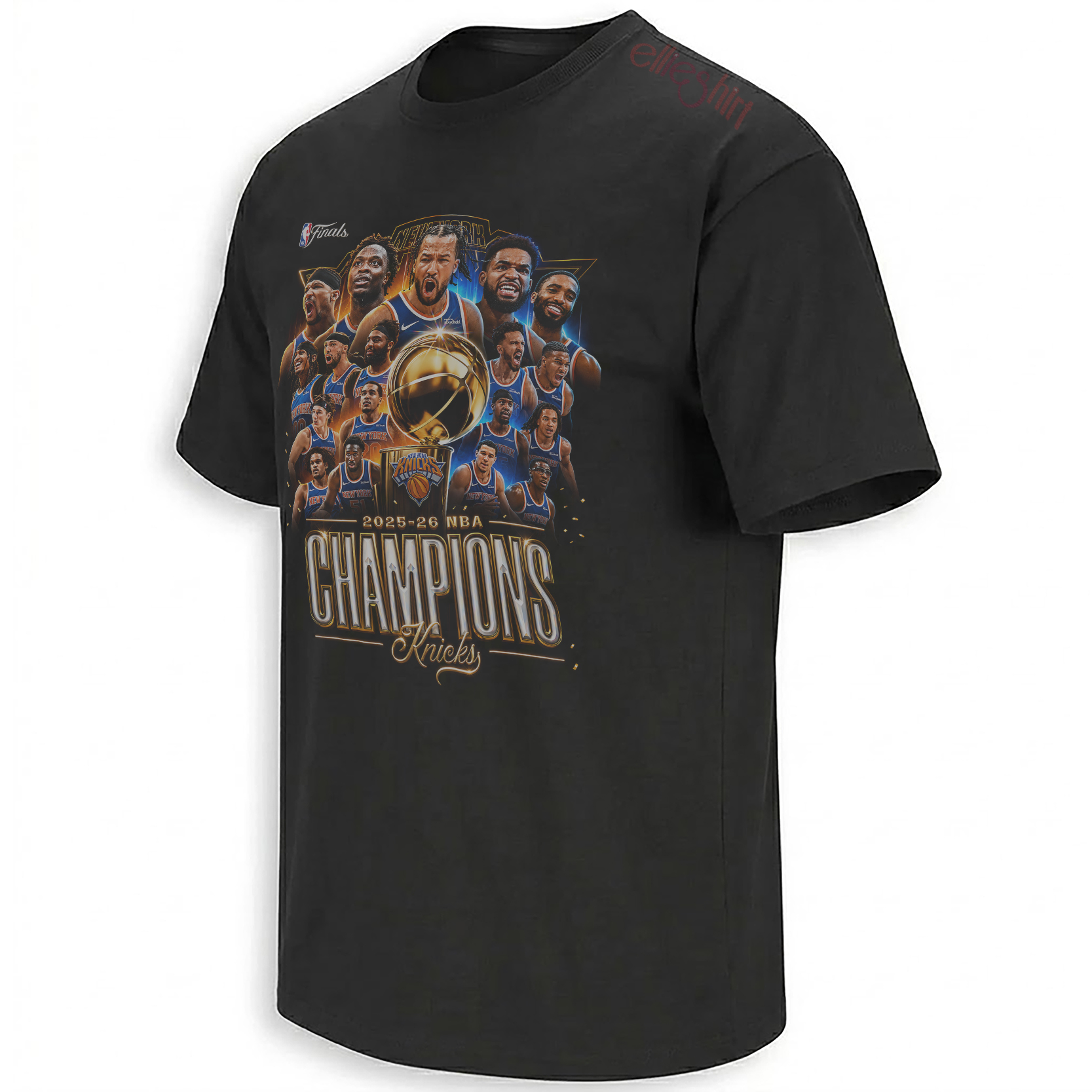
The 2025–26 NBA Champions Shirt does not organize the title around one isolated portrait. It layers the roster into a vertical collage, placing several players above, beside and behind the trophy.
The structure resembles a championship class photograph filtered through concert-poster and sports-card culture. Larger faces occupy the upper tier, smaller figures fill the lower edges and the trophy sits in the middle as the object linking every individual image.
This hierarchy acknowledges star power without allowing the stars to erase the team. Brunson and the leading figures command immediate attention, but the eye continues moving through the composition until the roster itself becomes the subject.
Why the trophy sits at the center while the players create the movement
The Larry O’Brien Trophy is the most stable shape in the design. Its reflective gold surface creates the center of gravity, while the portraits around it appear to move, shout, lean and compete for visual space.
That relationship captures the basic logic of a championship team. The trophy is singular, but the paths toward it are multiple. Every face reaches the same object through a different role.
The upper portraits are larger and more emotionally expressive, establishing immediate intensity. The middle tier compresses several players around the trophy, creating the feeling of a locker-room group closing around the prize. The lower tier expands the roster downward until the composition meets the championship wordmark.
The trophy gives every portrait a common destination and prevents the collage from reading as a collection of disconnected stars.
Crowded portraits create the intensity of a locker room, poster wall or championship photograph filled beyond its natural frame.
Tall gold lettering beneath the roster converts the emotional collage into a clear record of the 2025–26 result.
Black fabric turns blue, orange and gold into a night-of-the-title palette
The black garment creates the emotional environment of the design. It recalls late-night celebration, arena tunnels, locker-room photography and the hours after a championship when bright graphics appear against dark streets and television screens.
Knicks blue and orange remain present in jerseys, outlines and secondary details, but gold carries the championship hierarchy. The trophy, glow effects and large “Champions” lettering use metallic tones to separate victory from ordinary team branding.
This balance prevents the graphic from becoming a standard blue-and-orange team poster. The Knicks colors identify the people and city; gold identifies what the group achieved.
The warm edge lighting around several portraits also creates the impression of players emerging from one shared glow. Visually, the title is not attached to only the trophy. It reflects onto every face in the frame.
Why fans remember rosters as collections of personalities
A championship roster eventually becomes a list of names and statistics, but that is rarely how supporters remember it in real time.
They remember Brunson’s composure, Towns’ emotional release, Anunoby’s quiet expression, Hart’s restless energy and the familiar connection between former Villanova teammates. They remember bench reactions, postgame interviews and the way certain players entered the frame whenever the game changed.
A collage is effective because it preserves those differences without demanding that every player occupy the same scale or pose. One face can communicate control, another aggression, another joy and another disbelief.
The result resembles a yearbook page for a season rather than a formal portrait of one night. Each figure represents a separate memory, but the trophy and championship text force those memories to remain connected.
Years later, supporters may not remember every statistical detail of every playoff game. They are more likely to recognize the faces and immediately recover the emotional role each one played.
A championship collage can acknowledge the work official highlights compress
Broadcast packages naturally repeat the decisive moments: the final shot, the trophy lift, the Finals MVP presentation and the most dramatic replay.
Team success contains far more activity than those clips can preserve. It includes film sessions, defensive coverages, substitutions, practice repetitions and bench minutes that may never become viral images.
The collage format visually resists that compression. By filling the composition with additional bodies, it suggests that the visible stars stand inside a larger structure.
This does not make every contribution identical. It makes every contribution part of the same frame. That distinction is central to team memory: championship value can vary in scale without becoming disconnected from the result.
Fans searched for the full room, not only the trophy presentation
After Game 5, the official celebration was followed by a search for less controlled images: players inside the locker room, champagne moving through the air, Towns holding the trophy and Anunoby accidentally broadcasting a few seconds of the scene.
That appetite explains the cultural power of a team collage. Supporters wanted evidence of how every personality reacted once the pressure disappeared.
The championship was emotionally satisfying because the roster had become familiar as a group. Seeing only the trophy would confirm the result. Seeing the faces confirmed who had lived through it.
Across fan spaces, the conversation quickly expanded from Brunson’s 45 points to the shared journeys inside the roster — Towns’ vindication, the Villanova relationships, Anunoby’s Game 4 heroics and the role players who helped keep the postseason run stable.
Where the team collage sits inside the Knicks championship story
Different graphics preserve different layers of the title. A ring design connects 2026 to 1970 and 1973. A champagne piece preserves the locker-room release. A Brunson graphic remembers the closeout performance. An Anunoby design keeps the Game 4 tip-in alive.
The team collage performs the broadest task. It gathers the roster into one visual record and presents the championship as a collective achievement rather than a single isolated event.
The wider New York Knicks Shirts collection follows those different emotional stages through player moments, city references, Finals drama and title imagery.
The 2026 NBA Finals Champions collection brings the completed championship archive together, while the broader NBA Shirts collection places New York’s team portrait inside the larger visual culture of playoff rosters, championship posters and basketball memory.
Frequently asked questions
Why does the Knicks team collage include so many player portraits?
The collage presents the 2025–26 championship as a roster achievement. Larger portraits establish the leading figures, while the surrounding players show that the title depended on a wider system of scoring, defense, rebounding and supporting roles.
Why is the championship trophy placed in the center of the design?
The trophy gives every portrait a shared focal point. It visually connects different players and roles to the same completed achievement rather than allowing the collage to read as unrelated individual images.
What makes a team collage different from a single-player championship design?
A single-player design emphasizes individual greatness. A team collage preserves the relationships, personalities and complementary roles that allowed one player’s defining performance to become a championship result.
Why does the black background work well with this Knicks design?
Black creates a late-night championship atmosphere and allows the Knicks’ blue and orange uniforms, gold trophy and metallic typography to stand out with stronger contrast.
Why is Jalen Brunson still visually important in a team-focused design?
Brunson was the Finals MVP and scored 45 points in the title-clinching game, so the collage gives him clear visual prominence while keeping him inside the larger roster structure that supported the championship run.
The 2025–26 NBA Champions Knicks Team Collage Shirt gathers the roster around the Larry O’Brien Trophy, preserving New York’s title as a crowded championship portrait built from stars, role players, contrasting personalities and one shared destination.
2025–26 NBA Champions Shirt turns the New York Knicks title roster into a layered team collage, placing Brunson, Towns, Anunoby, Hart, Bridges and the wider championship squad around the gold trophy at the center of the season.