You Can’t Scare Me. I Have a Crazy Bestie.
The phrase turns friendship into an exaggerated security system: one person stays calm because somewhere nearby is a best friend with anger issues, zero patience for “stupid people” and apparently no requirement to hear both sides of the story.
Every close friendship eventually develops job descriptions nobody formally assigned. One person remembers the reservation. One sends the “text me when you get home” message. One attempts diplomacy. And somewhere in the group chat is the person everyone hopes will not become personally invested in the conflict.
“You can’t scare me, I have a crazy bestie” takes that familiar friendship structure and turns it into mock-threat language. The extended version removes any remaining subtlety: “She has anger issues and a serious dislike for stupid people, and I’m not afraid to use her.”
The joke is not really about fear. It is about backup. Instead of writing the sentimental version — “my best friend always has my back” — the meme imagines loyalty as an emergency response system with questionable escalation procedures.
The emotional meaning is “my best friend has my back.” Internet humor simply replaces “has my back” with “may need to be contained.”
This Is a Friendship Joke With a Long Search Life
There is no clear evidence that the extended phrase belongs to one original viral tweet, TikTok or creator. Instead, searching the wording reveals years of circulation across shirts, SVG files, Pinterest pins, marketplace listings and social posts.
Amazon listings use “You Can’t Scare Me I Have A Crazy Bestie.” Walmart and SHEIN index closely related versions. TikTok Shop carries the phrase as friendship apparel, while Pinterest has circulated the longer “anger issues” wording.
That pattern tells us something important about the meme. This is not an event-based joke that depends on remembering one viral clip. It has become a reusable template — a piece of best-friend language people recognize even when the typography, color palette or illustration changes.
The stable element is not the exact artwork. It is the role assignment: the wearer is supposedly difficult to intimidate because the bestie is the unpredictable member of the partnership.
External Versions Show How Stable the Punchline Has Become
An independently indexed version uses almost the complete wording: “You can’t scare me, I have a crazy bestie. She has anger issues and a serious dislike for stupid people, and I’m not afraid to use her.” The visual treatment is completely different, but the verbal structure is nearly unchanged.

Another common version adds skeletons, messy buns or flowers. Others use nothing except typography. That flexibility is usually a sign that the words themselves have become the meme unit.
The Ellie Shirt Version Looks Like a Warning Poster
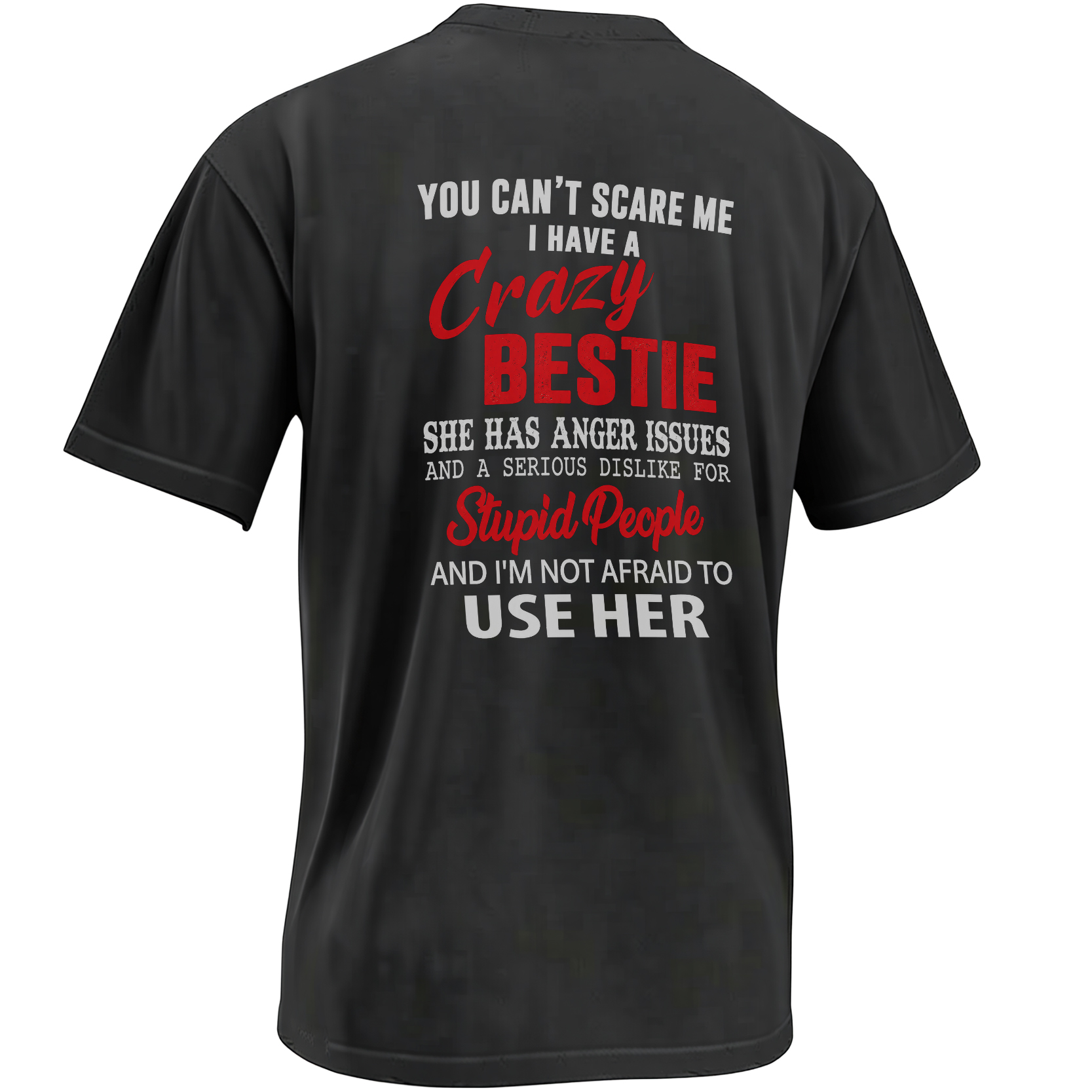
The Ellie Shirt design removes cute friendship symbolism almost completely. There are no interlocking hearts, smiling cartoon friends or sentimental BFF icons. Instead, the composition behaves like a vertically stacked warning notice.
White text establishes the sentence, while red typography selectively increases the perceived danger. “CRAZY BESTIE” becomes the central block. “ANGER ISSUES” receives another visual hit. “STUPID PEOPLE” becomes a separate punchline. The final “USE HER” lands at the bottom like the conclusion of a very unofficial emergency procedure.
Social Media Keeps Reusing the Exact Same Friendship Role
The wording is still appearing in contemporary bestie posts rather than surviving only on old novelty-shirt pages. Instagram search results in 2026 contain the extended anger-issues version embedded in friendship posts and reels, showing that the phrase remains understandable inside current social language.
That durability makes sense because the underlying friendship archetype is not tied to one platform. Long before “bestie” became a caption staple, friend groups were already joking about the responsible one, the chaotic one, the dramatic one and the one who should probably not be told about the argument until everyone has calmed down.
Why “Anger Issues” Is Funny Here — and Where the Joke Stops
The wording uses “anger issues” as exaggerated personality shorthand. It does not establish that the imaginary best friend has a diagnosed condition, nor does the joke need actual aggression to work.
The comedy depends on theatrical escalation. The wearer claims to possess a frightening backup plan; the audience understands that this is a humorous way of describing fierce loyalty and a friend who is quicker to confront nonsense.
“I’m not afraid to use her” functions as mock-threatening friendship language. The cultural reading is exaggerated loyalty and sarcasm, not an instruction to threaten or harm anybody.
Why Bestie Memes Often Sound More Aggressive Than Romantic Memes
Internet friendship language frequently celebrates closeness by insulting the friendship itself. Best friends call each other chaotic, annoying, unstable or impossible precisely because intimacy removes the need for polished sentimentality.
A romantic graphic may say “you are my everything.” A bestie graphic is much more likely to say “thanks for being the person I can send evidence to at 2 a.m.” Both communicate trust; only one sounds suitable for a police report.
The “Crazy Bestie” phrase belongs completely to that second tradition. The friendship is affectionate because the wording assumes total loyalty. The absurdity comes from describing that loyalty as if the best friend were a deployable resource.
The Back Print Makes the Long Joke Work
The artwork also benefits from being treated as a back graphic. The sentence is simply too long to behave like a small chest logo. Giving it vertical space allows each key phrase to function almost as its own beat.
From a distance, viewers first recognize the large words: CRAZY BESTIE, ANGER ISSUES, STUPID PEOPLE, USE HER. Only when they move closer does the complete sentence become readable. That creates two levels of humor — the visual warning first, the full joke second.
Ellie Shirt currently places the design in its verified Newest collection. That is the most accurate collection to use here rather than inventing a Best Friend, BFF or Friendship category that the current site structure does not confirm.
Frequently Asked Questions
What does “You Can’t Scare Me, I Have a Crazy Bestie” mean?
It is an exaggerated friendship joke saying the wearer feels fearless because a fiercely loyal and supposedly unpredictable best friend is always available as backup.
What is the full Crazy Bestie saying?
A common extended version reads: “You can’t scare me, I have a crazy bestie. She has anger issues and a serious dislike for stupid people, and I’m not afraid to use her.”
Did the Crazy Bestie phrase come from one viral meme?
No single authoritative origin is clearly documented. The wording has circulated broadly across social posts, graphics, SVG designs and apparel listings.
Why does the design emphasize “Crazy Bestie” and “Anger Issues”?
Those larger red-and-white phrases let viewers understand the joke from a distance before reading the complete sentence.
Is the phrase meant as a real threat?
No. Its normal meme reading is sarcastic friendship exaggeration — a deliberately overdramatic way to say that your best friend is intensely loyal and always has your back.
The You Can’t Scare Me I Have A Crazy Bestie Shirt turns that BFF archetype into a red-and-white warning poster, while Ellie Shirt’s Newest archive follows the wider stream of current jokes, personality graphics and internet-language designs.
You Can’t Scare Me I Have A Crazy Bestie Shirt turns protective friendship humor into a bold red-and-white warning graphic built around the familiar anger-issues, stupid-people and fiercely loyal bestie joke.