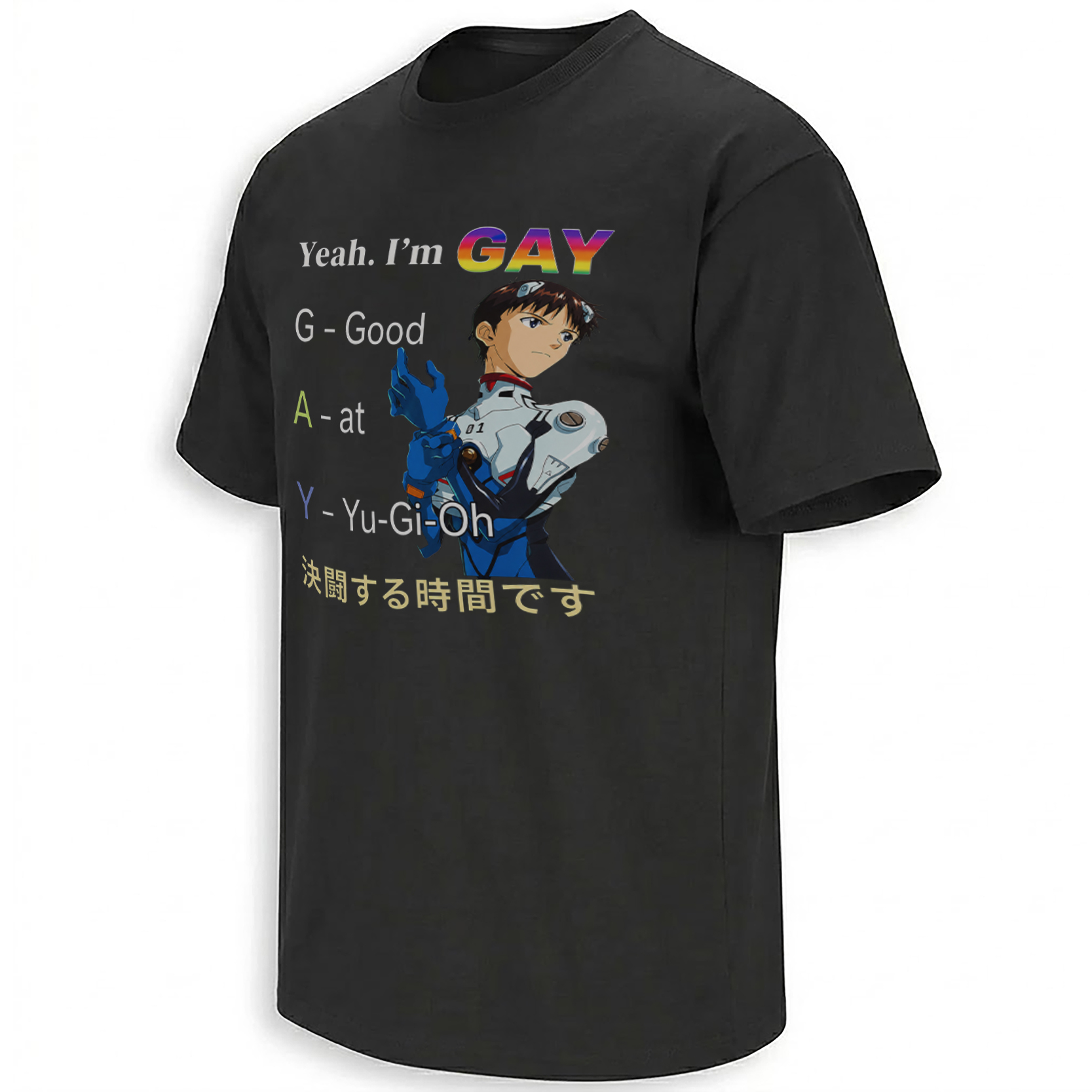
“Yeah I’m Gay.” Good at Yu-Gi-Oh.
A deliberately misleading acronym, Yu-Gi-Oh fandom language and one of anime meme culture’s favorite awkward protagonists collide in a joke whose entire purpose is making the audience re-read the first line.
The joke lands in two stages. First comes the declaration: “Yeah, I’m gay.” Then the visual delays the explanation just long enough for the reader to commit to one interpretation before revealing the acronym: Good At Yu-Gi-Oh.
This is classic internet shirt logic. It is not trying to build an elaborate setup. It uses a familiar word, creates a moment of social expectation and then reroutes the meaning toward something aggressively nerdy.
The addition of a Shinji-like anime figure makes the punchline feel even more online. Shinji Ikari has spent years as one of anime fandom’s most reusable meme characters: anxious, uncomfortable, emotionally overwhelmed and endlessly recaptioned. Pairing that visual energy with a boast about being unusually good at a trading-card game produces exactly the sort of tonal mismatch meme culture likes.
The punchline is not “gay.” The punchline is that someone apparently needed a dramatic confession just to announce they are good at Yu-Gi-Oh.
Why Yu-Gi-Oh Already Fits This Kind of Meme
Yu-Gi-Oh has always been unusually compatible with exaggerated internet humor. The original anime turns card games into world-ending drama, complete with monologues, impossible tactical reversals and characters treating a draw phase like a military decision.
Online fandom pushed that seriousness further into parody. “Pot of Greed” became a long-running copypasta because characters repeatedly explained the card’s famously simple effect. Manga panels became reaction images. Dialogue was edited into increasingly absurd exchanges.
The Yeah I’m Gay Shirt fits directly into that tradition. The acronym only works because “Yu-Gi-Oh” is recognizable enough to carry the final letter by itself.
There Is a Real Yu-Gi-Oh “Gay Meme” History — But Not This Exact Origin
It is important not to invent a false lineage for the design. Research does not establish that this exact “Good At Yu-Gi-Oh” acronym originated from one famous historic post.
What can be verified is that Yu-Gi-Oh fandom has been producing related “gay” meme language for years. Know Your Meme traces the confirmed “Gay Gay Homosexual Gay / I Can Still Hear His Voice” format to a 2018 Tumblr edit of a Yu-Gi-Oh manga panel featuring Yugi remembering Atem.
That edit spread through Yu-Gi-Oh communities and later into broader fandom spaces, where people redrew the format with characters from completely different franchises. It is a useful cultural ancestor because it demonstrates that Yu-Gi-Oh imagery, queer-language jokes and fandom recaptioning have overlapped online for years.
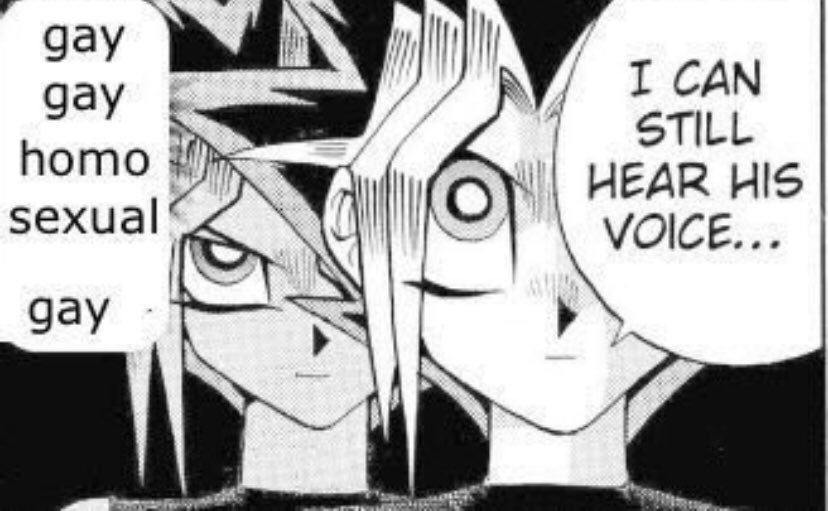
This 2018 Yu-Gi-Oh edit is a documented example of the franchise’s long-running overlap with queer-language fandom memes — related cultural context rather than the verified origin of the “Good At Yu-Gi-Oh” acronym. Explore the documented meme history →
Why Shinji Is Such an Effective Meme Character
Shinji’s internet afterlife works because his emotional posture is almost the opposite of a conventional hero meme. He is frequently anxious, defeated, uncomfortable or visibly unsure what to do.
The famous “Shinji in a Chair” image became a widespread redraw and exploitable template during the 2010s. Other Evangelion scenes have been detached from their original context and reused to describe procrastination, social discomfort and absurd everyday problems.
That makes a Shinji-inspired figure perfect for a fake-confidence joke. “Yeah, I’m gay” arrives with apparent certainty, but the visual character underneath it looks like someone who might be struggling to announce even the least consequential piece of personal information.
The design should be read as a crossover of meme languages rather than a literal Evangelion × Yu-Gi-Oh canonical reference. The humor comes from placing an Evangelion-coded anxious character inside a Yu-Gi-Oh acronym joke.
The Acronym Is Doing Nearly All the Work
Acronym shirts succeed when the viewer initially reads the large letters as one familiar meaning and only later discovers the alternate expansion. “GAY” is especially effective because it is already a complete word rather than a random sequence of initials.
“Good At Yu-Gi-Oh” is deliberately clumsy English, which actually makes the meme stronger. A polished phrase would feel engineered. The awkwardness makes it sound like someone reverse-engineered an acronym solely to justify the joke.
Yu-Gi-Oh itself adds another comic layer because being skilled at a famously complicated trading-card game is exactly the sort of niche achievement internet fandom can treat with absurd seriousness.
Why Anime Meme Culture Keeps Recycling Itself
The strongest anime memes rarely remain attached to only one series. A Yu-Gi-Oh panel gets redrawn with Danganronpa characters. Evangelion screenshots become universal reaction images. Characters from unrelated franchises are inserted into formats whose original context no longer matters.
That recycling is not a flaw. It is the mechanism that lets old anime imagery remain alive years after broadcast. Fans recognize the emotional pose first and the original episode second.
The “Good At Yu-Gi-Oh” design belongs to that remix culture. It is funny because the references do not belong together neatly — and the internet has spent decades proving that neatness is unnecessary.
Where the Design Fits Inside Ellie Shirt
A verified dedicated Yu-Gi-Oh or Evangelion Ellie Shirt collection URL was not available in current research, so no character-specific collection URL is being invented. The safer broader path is the Newest collection , where current meme, internet-culture and crossover designs appear together.
The specific artwork remains directly accessible through the Yeah I’m Gay — Good At Yu-Gi-Oh design page .
Frequently Asked Questions
What does “GAY” mean on the Good At Yu-Gi-Oh shirt?
The design turns GAY into the intentionally humorous acronym “Good At Yu-Gi-Oh.”
Is “Good At Yu-Gi-Oh” an official Yu-Gi-Oh phrase?
No. It is internet acronym humor built around the recognizable Yu-Gi-Oh name.
Did this exact meme originate from Neon Genesis Evangelion?
No verified source establishes that. The design uses Shinji-style anime meme imagery, while the wordplay itself belongs to broader internet and Yu-Gi-Oh fandom humor.
Why is Shinji commonly used in memes?
Shinji’s anxious expressions, awkward situations and emotionally overwhelmed poses make Evangelion screenshots unusually flexible as reaction images and redraw templates.
Does Yu-Gi-Oh have a history of gay-themed fandom memes?
Yes. One documented example is the 2018 “Gay Gay Homosexual Gay / I Can Still Hear His Voice” Yu-Gi-Oh edit, which later spread into wider online fandoms.
The Yeah I’m Gay — Good At Yu-Gi-Oh graphic works because it combines acronym humor, anime discomfort and trading-card fandom into one deliberately ridiculous confession, while the Newest archive follows the wider stream of current internet-culture designs.
Yeah I’m Gay Shirt turns GAY into “Good At Yu-Gi-Oh,” combining anime meme awkwardness, Shinji-style imagery and trading-card fandom humor in a deliberately misleading internet joke.