When the NY Mark Became a Map: Los Yankees and Hispanic Heritage 2026
The Yankees entered Hispanic Heritage Month with October already waiting for them. One day after New York secured another postseason berth, the familiar navy identity of Bronx baseball opened outward toward the flags, languages and communities that have long made “Los Yankees” mean something beyond one borough.
September 15 arrived at an unusually charged moment for New York baseball. The Yankees had clinched a place in the 2026 postseason the night before, their third consecutive October appearance, while Major League Baseball was opening Hispanic Heritage Month across the sport.
For the Yankees, those two stories do not really sit in separate lanes. Spanish-language baseball has been part of the organization’s everyday communication for decades, and the club entered this year’s celebration only days removed from its fourth annual Hispanic Heritage Media Day at Yankee Stadium.
That September 9 gathering brought together Spanish-language journalists and Yankees figures including radio voice Rickie Ricardo, Mariano Rivera, Fernando Cruz, Carlos Rodón and manager Aaron Boone. The organization described the event as the culmination of monthly Spanish-language press conferences it has maintained for more than two decades.
“Los Yankees” does not translate New York baseball into another culture. It reminds us that another culture has been inside New York baseball all along.
Spanish-Language Yankees Culture Is Bigger Than One Heritage Month
The most useful way to understand the design is to begin with language rather than flags. “Los Yankees” is not a marketing invention that suddenly appears each September. It is the ordinary Spanish-language name used by generations of fans, broadcasters and journalists following the club in New York, Puerto Rico, the Dominican Republic, Panama, Venezuela, Mexico and far beyond.
The Yankees have built an institutional version of that connection through their Spanish-language media operation. This year’s Hispanic Heritage Media Day brought together journalists representing countries throughout Latin America and the Caribbean, while Rivera and Cruz sat with Ricardo to discuss baseball from two very different generational perspectives.
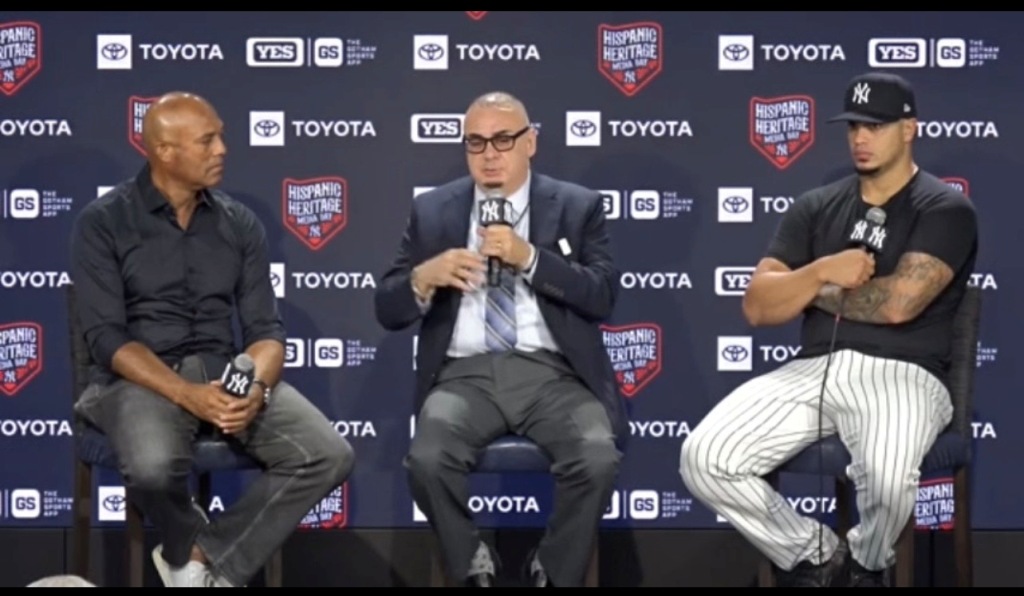
That photograph gives the heritage conversation a human scale. Rivera connects Panama to one of the most iconic careers in Yankees history. Cruz represents Puerto Rican baseball in the current clubhouse. Ricardo has spent years carrying the sound of Yankees games into Spanish-speaking homes.
The common thread is not simply nationality. It is transmission: who tells the baseball story, what language they tell it in and which communities hear themselves inside the franchise.
The Front Turns One Famous Mark Into Many Flags
The Hispanic Heritage Los Yankees 26 design takes that idea and compresses it into the most recognizable piece of New York baseball geometry.
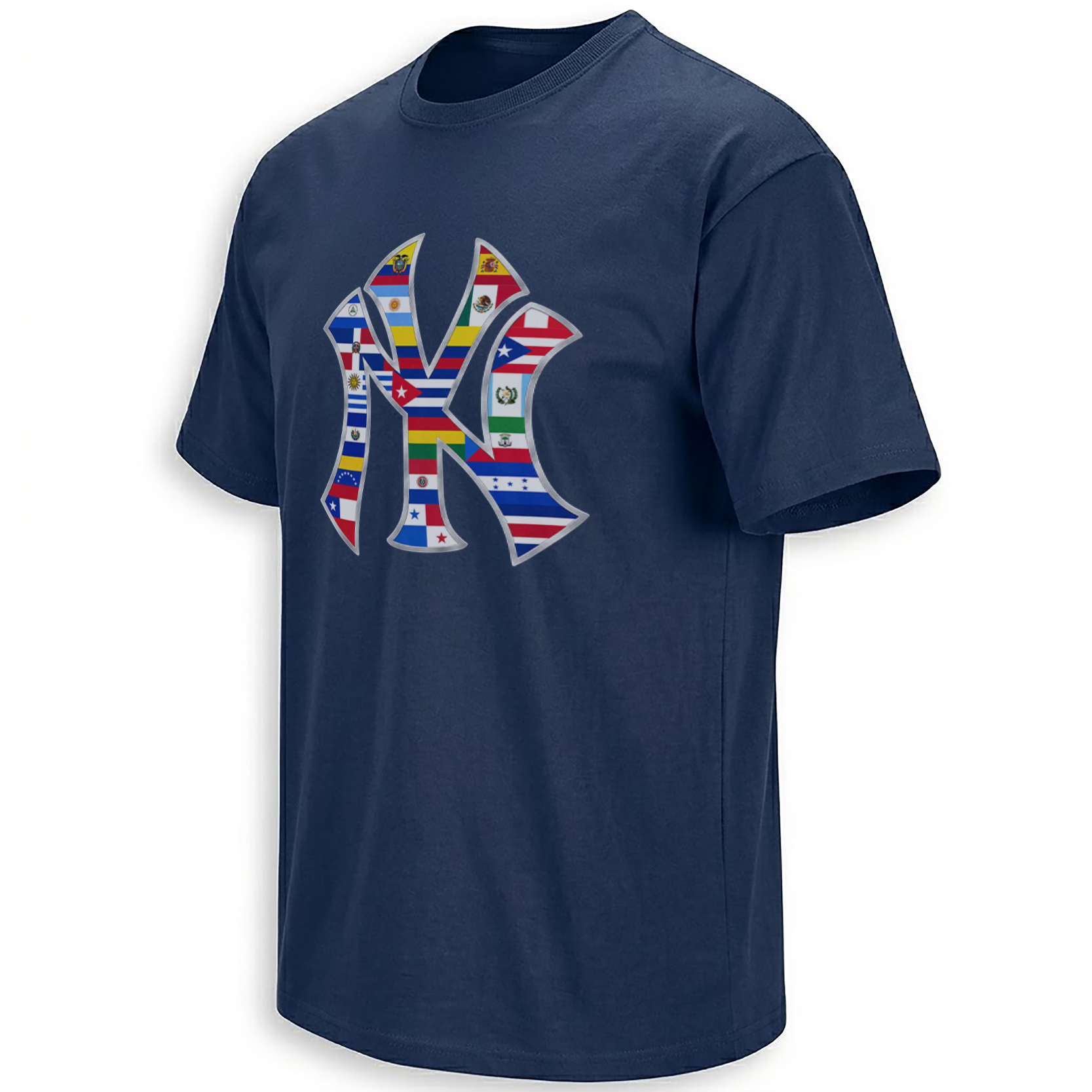
From across the room, the composition still reads immediately as New York baseball. Up close, the identity fragments into red, yellow, blue, green and white sections. That shift in viewing distance is the strongest part of the graphic.
The familiar outline is not erased. It becomes a container large enough to hold several national stories at once. That visual logic mirrors how diaspora fandom works in a city like New York: a fan does not have to choose between Bronx baseball and a family connection to Puerto Rico, the Dominican Republic, Mexico, Cuba, Venezuela, Colombia, Panama or elsewhere.
The Yankees have historically used similar country-specific thinking in their “Rep Your Flag” programs, pairing club identity with flags chosen by Latino and Hispanic fans. The shirt expands that logic from one flag at a time into a single multi-country visual field.
The Back Changes the Voice From New York to Los Yankees
If the front is culturally dense, the back is almost deliberately traditional. Oversized silver-gray varsity lettering curves across the shoulders, and a large block “26” occupies the space where a baseball jersey number would normally sit.
The logo becomes a visual meeting point for multiple national backgrounds while preserving its unmistakable New York silhouette.
See the front graphic →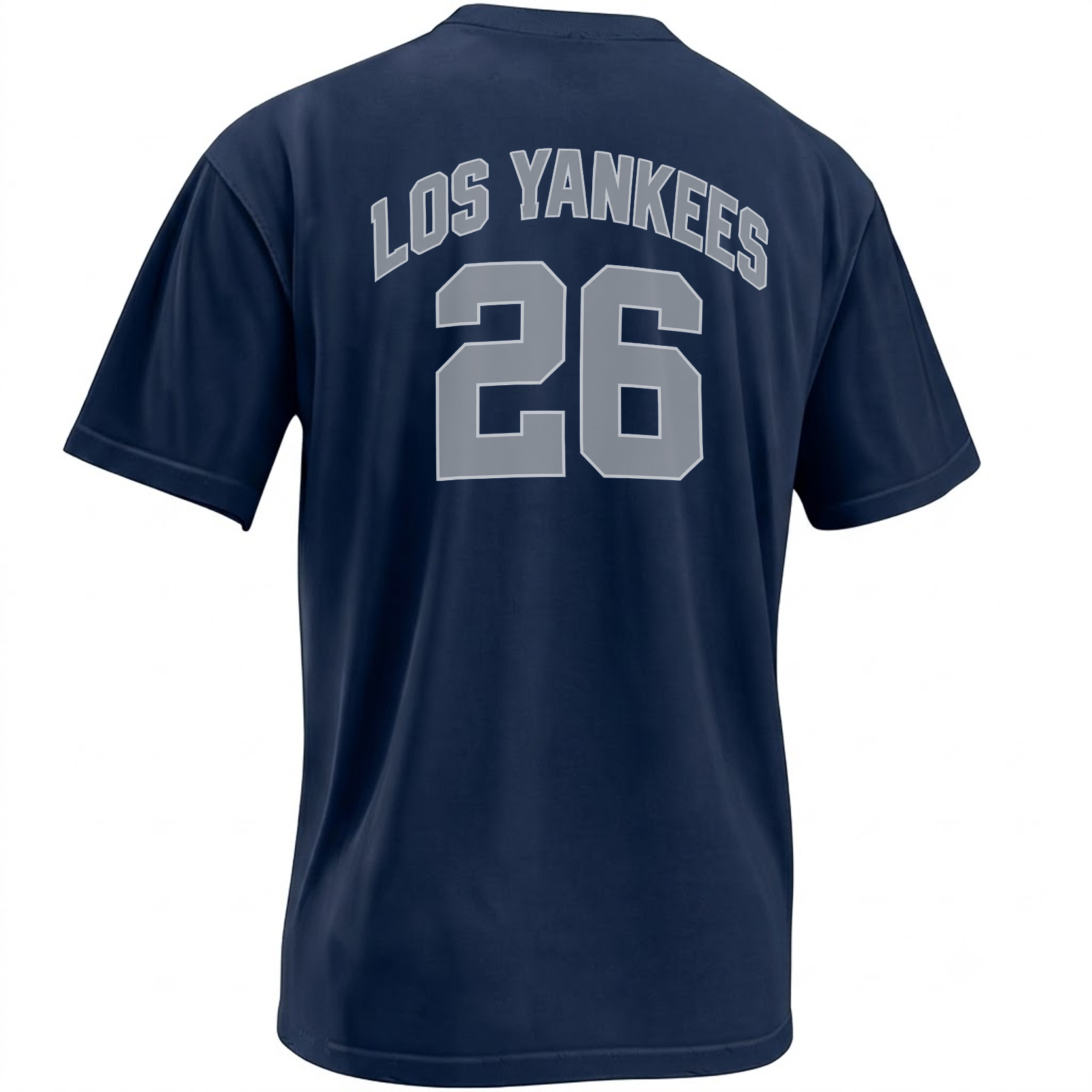
Spanish-language team identity takes over the jersey-style back, while “26” timestamps the graphic to the 2026 heritage moment.
See the back graphic →That front-to-back contrast is what keeps the piece from feeling like a heritage-month poster placed on a shirt. The front operates like a cultural emblem. The back operates like baseball uniform language.
“LOS YANKEES” across the shoulders immediately changes the voice without changing the team. Then “26” makes the concept specific to this season. In this artwork, the number functions as a 2026 marker rather than an attempt to reference a current player.
A translation can sometimes feel secondary to the original. “Los Yankees” does not. It has its own broadcasting history, fan language and cultural rhythm. Putting those words where a player name would normally sit makes Spanish-language fandom the subject rather than a decorative detail.
The Yankees’ 2026 Heritage Story Was Already Happening Before September 15
The organization’s fourth annual Hispanic Heritage Media Day took place nearly a week before the official start of the month, reinforcing the idea that the relationship is larger than a calendar campaign.
Local Hispanic media coverage of the event described journalists from the Dominican Republic, Puerto Rico, Venezuela, Mexico, Panama, Cuba, Nicaragua and Colombia gathering at Yankee Stadium. Sessions extended from press conferences to the field and finished with a Latin-inspired dinner led by Dominican chef Carlos Monegro.
The Yankees’ own social post emphasized that the annual event concludes monthly Spanish-language press conferences the organization has conducted for more than two decades. That continuity gives the current visual moment a useful distinction: heritage is being celebrated publicly, but the infrastructure connecting the team to Spanish-speaking fans exists throughout the season.
Hispanic Heritage Arrived as October Baseball Became Official
There is another reason the timing matters. The Yankees secured a postseason berth on September 14, then followed it with an 8–1 win in Minnesota on September 15. This is therefore a heritage graphic appearing while the club is actively shifting from regular-season survival toward another October run.
That overlap gives “Los Yankees 26” an unusually specific timestamp. It belongs to Hispanic Heritage Month, but also to the late-season version of the 2026 Yankees — a club that survived major injuries, got Aaron Judge back in September and punched its postseason ticket for a third straight year.
Years later, that is likely to be the real value of the “26” on the back. It does not simply date the artwork. It ties the heritage language to one particular season, one particular September and one particular stage of Yankees history.
The Flag Mosaic Fits a Much Older Baseball Relationship
Latino influence on Yankees history cannot be compressed into one list of famous players. It reaches through generations, nationalities and roles: players on the field, families in the Bronx, broadcasters in Spanish, reporters covering the clubhouse and fans following games across borders.
That is why the artwork works best as a collective symbol rather than a player piece. There is no portrait at the center because no single player could logically carry the whole subject.
Inside Ellie Shirt, the verified New York Yankees collection creates the team-specific archive for current Bronx baseball moments, while the broader MLB collection connects the design to the wider culture of Hispanic Heritage Month across baseball.
Readers looking specifically for this cultural theme can also use the Hispanic Heritage product search or browse Los Yankees designs without relying on an unverified heritage collection URL.
Frequently Asked Questions
What does “Los Yankees” mean?
“Los Yankees” is the natural Spanish-language way of referring to the New York Yankees and has long been part of Spanish-language baseball broadcasting and fan conversation.
What do the flags inside the front graphic represent?
The front uses a mosaic of Hispanic and Latin American national imagery to represent the many cultural backgrounds found throughout Yankees fandom.
What does the number 26 mean on the back?
Within this design, “26” serves as a visual marker for the 2026 edition of the Los Yankees Hispanic Heritage concept rather than a reference to a specific current player.
What did the Yankees do for Hispanic Heritage in 2026?
The organization held its fourth annual Hispanic Heritage Media Day on September 9, continuing more than two decades of monthly Spanish-language press conferences and bringing together figures including Rickie Ricardo, Mariano Rivera and Fernando Cruz.
Why is the 2026 timing important?
Hispanic Heritage Month began immediately after the Yankees clinched a 2026 postseason berth, linking this heritage moment with another active October run for New York.
Why does the design use different approaches on the front and back?
The front uses detailed multicultural imagery inside the New York mark, while the back switches to traditional varsity-style baseball typography with “Los Yankees 26,” creating a contrast between heritage symbolism and classic uniform language.
The Los Yankees 26 Hispanic Heritage design preserves the 2026 moment through a flag-filled front and Spanish-language jersey back, while the New York Yankees archive follows the other player, postseason and Bronx-culture images defining this season.
Hispanic Heritage Shirt — Los Yankees 26 captures Yankees culture through a flag-filled New York front mark and silver “LOS YANKEES 26” jersey-style back, connecting Hispanic heritage, Spanish-language fandom and the club’s 2026 Bronx baseball identity.