XX Equals Woman: Why the Biology Statement Became a Women’s Sports Fairness Symbol
“XX = Woman” compresses a complicated argument into one direct formula. For supporters, it expresses the belief that women’s athletic categories should remain organized around biological sex so female competitors retain fair and meaningful opportunities.
Women’s sports exist because male and female bodies develop differently on average, particularly after puberty. Separate categories allow female athletes to compete for scholarships, roster positions, records, medals and professional opportunities without those average physical differences determining every result.
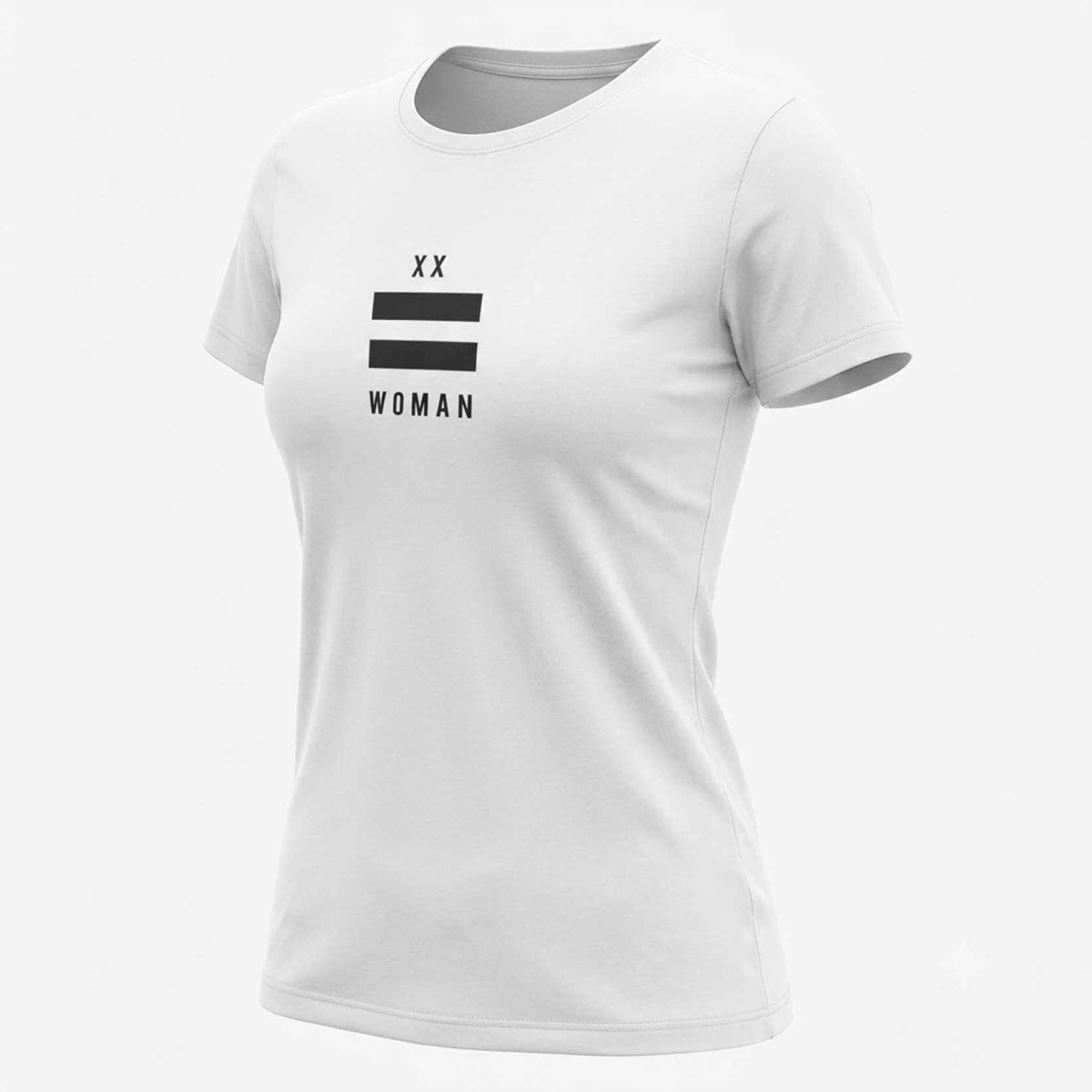
The XX Equals Woman design places that principle inside the visual language of a simple equation. Two chromosomes appear on one side, the word “Woman” on the other, and the equal sign turns the message into a statement intended to look settled rather than negotiable.
That simplicity is also where careful context becomes important. Most women have XX chromosomes, and most men have XY chromosomes, but human development includes rare chromosomal and physiological variations. International sports organizations therefore write detailed eligibility regulations rather than relying on a shirt slogan as a complete medical definition.
The strongest argument for women’s sports does not require contempt for anyone. It requires a clear category, fair rules and respect for every athlete affected by them.
What the XX Statement Is Trying to Communicate
In ordinary biological development, an XX chromosomal pattern is associated with female development, while an XY pattern is associated with male development. The slogan uses that familiar distinction as shorthand for sex-based athletic categories.
Supporters argue that women’s competition was created to account for physical differences including average height, muscle mass, skeletal structure, oxygen-carrying capacity and power developed through male puberty.
Their concern is not merely who receives a trophy. Eligibility rules can affect playing time, team selection, scholarships, qualification standards and the preservation of female records.
The design therefore works as an advocacy statement. It tells the viewer that “woman” should continue to have a biological meaning when used as an athletic classification, even when gender identity is treated differently in other parts of social life.
Why Sports Categories Need More Precision Than Slogans
“XX = Woman” is effective graphic language, but biology is not perfectly summarized by two letters. Some women have differences in sex development or chromosomal variations that do not fit the most common XX pattern.
That does not make biological sex meaningless. It means governing bodies must distinguish between a general biological pattern and the precise criteria used in elite competition.
Modern policies may consider chromosomes, the SRY gene, gonadal development, androgen sensitivity, testosterone exposure or whether an athlete experienced male puberty. Different sports also involve different questions of safety, strength and performance advantage.
A careful defense of female competition should therefore avoid claiming that every individual can be completely diagnosed through visual appearance or a single internet argument.
This design expresses a sex-based position on women’s sports. It should not be read as permission to harass transgender people, speculate publicly about athletes’ bodies or dismiss women with rare differences in sex development.
The 2026 Olympic Policy Shift
In March 2026, the International Olympic Committee announced a new policy intended to protect the female category in Olympic sport. The policy limits women’s Olympic events to athletes who meet its female eligibility criteria and introduces a one-time test for the SRY gene.
The IOC described the change as a way to preserve fairness, safety and the integrity of female competition. The policy is scheduled to apply at the 2028 Los Angeles Olympics rather than retroactively changing previous results.
Supporters welcomed the move as a clearer international standard. Critics raised concerns about privacy, compulsory genetic screening and the treatment of athletes with differences in sex development.
The IOC’s March 2026 announcement presents the new female-category policy as an eligibility framework for Olympic competition. It distinguishes competitive classification from broader judgments about a person’s dignity or identity.
Read the official IOC policy announcement →Why Supporters Focus on Puberty and Performance
The debate often returns to male puberty because it produces average changes in height, bone dimensions, muscle development, strength and cardiovascular capacity.
International federations including World Athletics have argued that those advantages can affect fair competition in the female category. Their regulations have changed over time as new evidence, legal challenges and athlete cases have emerged.
Opponents of restrictive policies argue that available research does not answer every sport-specific question and that broad rules may unfairly exclude a small number of athletes.
These competing concerns explain why the issue remains difficult. Sport must create enforceable categories while also protecting privacy and avoiding unnecessary humiliation.
Women’s Sports Are About More Than Elite Medals
The fairness debate extends below the Olympic level. School teams, college scholarships, amateur records and developmental opportunities can determine whether girls remain involved in sport.
Supporters of sex-based categories argue that female athletes should not have to reach an international final before their competitive interests are treated as important.
Critics respond that grassroots sport also has social, educational and inclusion goals that may require more flexible approaches than elite competition.
A responsible policy can recognize that different levels of sport may need different solutions. An Olympic qualifying standard is not automatically the same question as participation in a local recreational league.
Why the Design Uses an Equation
Equations visually imply clarity. There is no long paragraph, qualification or institutional language—only two elements connected by an equal sign.
That format makes the graphic suitable for rallies, public debate and social media, where messages compete for attention and must be understood quickly.
Red supplies urgency, while the clean lettering suggests that the wearer considers the underlying principle straightforward: female sport should remain a category for female athletes.
The newest Ellie Shirt collection places the design among current cultural and political statements. No additional collection has been inserted because a confirmed women’s-sports collection path was not supplied.
Frequently Asked Questions
What does “XX = Woman” mean?
It is a concise statement supporting a biological-sex definition of the women’s category, especially within competitive sport.
Do all women have XX chromosomes?
Most women have an XX chromosomal pattern, but rare chromosomal and developmental variations exist, which is why formal sports rules use more detailed eligibility criteria.
Why are male and female sports usually separated?
Separate categories account for average physiological differences that develop through puberty and help preserve meaningful competitive opportunities for female athletes.
Does supporting female categories require disrespecting transgender people?
No. A person can support sex-based sporting categories while also opposing harassment and respecting every individual’s dignity.
The XX Equals Woman design presents a direct sex-based women’s-sports statement. Explore the newest Ellie Shirt releases for additional cultural and public-debate graphics.
XX Equals Woman Shirt presents a direct biology-based statement supporting clear, fair and protected female categories in women’s competitive sports.