
Woo’s Your Daddy: How Bryan Woo’s Command Became Seattle’s Retro Ace Identity
Bryan Woo does not dominate through chaos. His best starts feel controlled from the first strike, built on elevated fastballs, aggressive counts and the growing certainty that Seattle’s No. 22 intends to own the plate before the hitter can settle in.
Bryan Woo returned to T-Mobile Park on June 18 with something to correct. Baltimore had scored seven runs against him one week earlier, turning one of his most difficult 2026 starts into a direct challenge for the rematch.
Woo answered with seven scoreless innings, three hits allowed and nine strikeouts as Seattle defeated the Orioles 3–0. He worked through seven frames on only 80 pitches, repeatedly began plate appearances with strikes and helped hand Baltimore its first shutout of the season.
That immediate response explains why “Woo’s Your Daddy” works as more than an easy surname pun. The phrase carries playful retro bravado, but the baseball beneath it is precise: a starter attacking the zone, controlling tempo and forcing a lineup that had recently beaten him to experience an entirely different afternoon.
The pun sounds like swagger. Woo’s pitching gives it credibility: get ahead, control the plate and make the hitter operate inside his game.
The Phrase Turns a Surname Into Ballpark Authority
“Who’s your daddy?” has circulated through sports culture for decades as a boast directed toward an opponent who appears unable to solve the same matchup.
Replacing “Who’s” with “Woo’s” makes the line instantly player-specific. It preserves the sound of the original phrase while transforming Bryan Woo’s surname into the source of the joke.
The result fits a starting pitcher particularly well. Every start is a sequence of repeated confrontations. Hitters receive several opportunities to adjust, and the pitcher must continue controlling them after the initial surprise disappears.
When Woo is commanding his fastball, those repeated at-bats can feel increasingly restricted. The hitter knows the pitch is coming, understands the general area and still struggles to create clean contact.
One small spelling change turns a familiar sports taunt into a phrase that belongs specifically to Seattle’s right-handed starter.
No. 22 anchors the joke to the current Mariners rotation and gives the retro phrase a modern player identity.
The wording becomes stronger when attached to a pitcher capable of responding to a difficult outing with seven scoreless innings.
The Retro Artwork Matches an Old-School Pitching Taunt
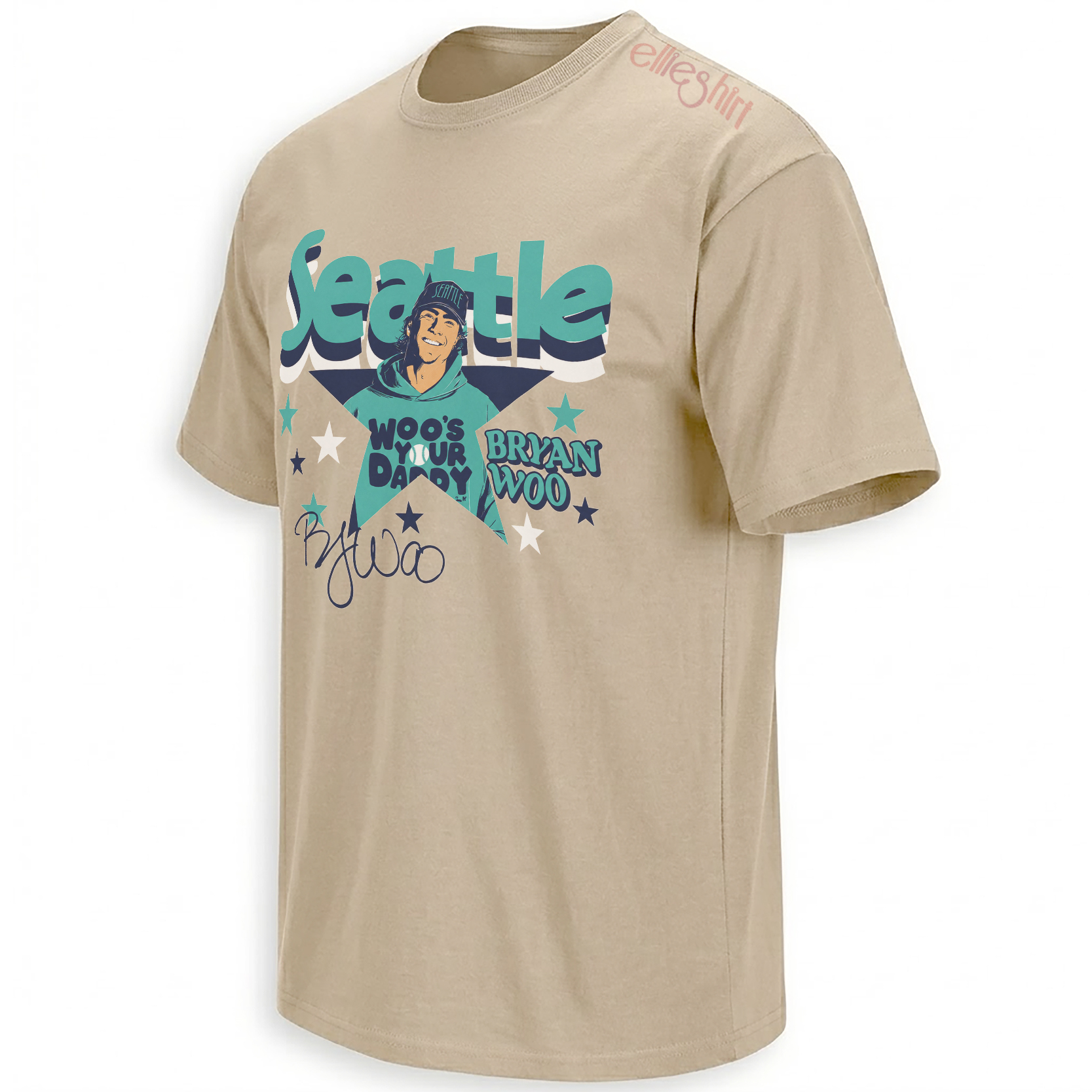
The Woo’s Your Daddy design treats the phrase like a piece of vintage ballpark advertising rather than a polished modern statistic card.
Distressed lettering gives the slogan the appearance of something passed between generations of fans. The retro portrait places Woo inside that older visual language even though his pitching approach is shaped by contemporary velocity data and advanced pitch design.
Seattle navy, teal and silver establish the Mariners identity, while cream and warm accent colors create the aged print quality of a classic pitcher poster.
The composition works because the joke is already bold. The artwork does not need excessive effects. Woo’s portrait, the slogan and the team palette carry the story.
The Baltimore Rematch Showed the Mental Shape of an Ace
Dominant seasons are not built only from the starts in which every pitch works immediately. They are also built from the response after an opponent exposes a weakness.
Baltimore had seen Woo recently enough to carry a fresh scouting plan into Seattle. The Orioles had scored seven earned runs against him on June 11, one of the rare nights when his usual control did not protect him from damage.
Seven days later, Woo changed the terms of the matchup. He allowed only three hits, issued one walk and struck out nine.
His efficiency was as important as the strikeout total. Sixteen of the 25 hitters he faced received a first-pitch strike, and he completed seven innings without requiring a heavy workload.
That is how a starter prevents the previous game from becoming a pattern. He does not merely throw harder. He restores the count advantage and makes the lineup react to him again.
- Baltimore won the first meeting. Woo allowed seven runs in a road start that gave the Orioles recent evidence against his approach.
- The rematch moved to T-Mobile Park. Seattle’s home environment gave Woo another opportunity against nearly the same lineup.
- He restored first-pitch control. Early strikes kept hitters from waiting comfortably for one preferred location.
- Seven scoreless innings reversed the story. The same opponent that had damaged him one week earlier became the latest lineup contained by Seattle’s No. 22.
His Fastball Is Effective Because Hitters See More Than Velocity
Woo’s fastball power is obvious, but velocity alone does not explain why hitters frequently swing beneath it or produce incomplete contact.
His lower release point changes the visual path of the pitch. The ball can remain above the barrel longer than the hitter expects, creating the impression that it is carrying through the upper portion of the strike zone.
Woo also uses both a four-seam fastball and sinker. The pitches arrive at similar speeds but create different movement decisions, forcing hitters to account for more than one fastball shape.
That combination allows him to remain aggressive. He does not need to avoid the zone to create uncertainty. The movement profile creates uncertainty inside the zone.
This is one reason his control matters so much. When Woo places the fastball where he intends, the hitter must defeat both the speed and the unusual angle.
The 2025 Breakout Changed His Place in Seattle’s Rotation
Seattle entered 2025 with one of baseball’s deepest collections of starting pitchers. Logan Gilbert, George Kirby, Luis Castillo and Bryce Miller already gave the rotation established names and different forms of dominance.
Woo emerged from that group as the staff’s most consistent starter.
He finished the season 15–7 with a 2.94 ERA, 198 strikeouts and a 0.93 WHIP over 186⅔ innings. The performance earned his first All-Star selection, recognition on the All-MLB Second Team and the Mariners’ team MVP honor.
More important than any one award was the volume. Woo provided six or more innings in each of his first 25 starts while issuing no more than two walks in those games.
That run gave Seattle something every contender needs: predictable length without predictable pitches.
Premium fastballs, a difficult release angle and improving secondary pitches gave Woo the raw weapons of a frontline starter.
Repeatedly working through six frames changed him from a talented arm into the rotation’s dependable weekly anchor.
Why Six Innings Became Part of His Brand
Modern starting pitchers are often removed before facing a lineup for the third time. Bullpens are designed to absorb more innings, and even strong outings can end after five frames.
Woo’s 2025 streak pushed against that pattern. Twenty-five consecutive starts of at least six innings established the longest such run to begin a season in Mariners history.
The value extended beyond his personal statistics. Every additional inning protected Seattle’s relief staff and allowed the manager to reserve high-leverage arms for closer games later in the series.
Length also strengthened the “Woo’s Your Daddy” idea. The phrase implies continuing control, not a brief encounter. Woo repeatedly remained on the mound long enough to face the same hitters again and keep the matchup in his favor.
A dominant inning creates a highlight. Twenty-five straight six-inning starts create the feeling that the entire game belongs to the pitcher.
T-Mobile Park Amplifies His Best Qualities
Woo’s June 18 response continued a broader pattern of strong pitching in Seattle. T-Mobile Park supports pitchers, but his home success cannot be reduced to dimensions alone.
The familiar mound, defensive positioning and crowd rhythm allow him to work quickly without sacrificing control. When he gets ahead, the ballpark can begin to feel increasingly restrictive for opposing hitters.
Seattle fans also respond to efficient pitching differently than they respond to constant escape acts. A fast inning keeps the crowd focused, preserves momentum and returns the offense to the field before the opposing lineup can create emotional pressure.
Woo’s home starts often carry that pace. The pitcher receives the ball, attacks and leaves the opponent with very little time to reshape the inning.
Woo’s combination of first-pitch strikes, quick innings and premium fastballs makes T-Mobile Park feel less like a neutral setting and more like an environment built around his preferred tempo.
The Design Uses Confidence Without Making Woo Look Chaotic
Many pitcher graphics rely on visible strain: an open mouth, a twisting delivery and the moment of maximum effort just before release.
The retro Woo design uses a calmer form of authority. His portrait is composed, allowing the phrase to provide the loudest emotional element.
That balance matches his pitching identity. Woo can reach premium velocity, but his best starts do not appear uncontrolled. The mechanics remain smooth, the walk totals stay low and the pace rarely suggests panic.
The artwork therefore separates performance from effort. Fans see the result—an assured Seattle starter—rather than only the physical force required to produce the pitch.
From Sixth-Round Pick to All-Star Starter
Seattle selected Woo in the sixth round of the 2021 MLB Draft while he was recovering from Tommy John surgery.
The selection required projection. Woo did not arrive as a fully formed, high-volume college ace. His professional development depended on rehabilitation, added strength and the organization’s belief that his fastball traits could translate into a starting role.
He returned to the mound in 2022 and reached the majors in June 2023, a rapid climb for a pitcher whose draft year had been interrupted by surgery.
By 2025, he had moved beyond the language of potential. An All-Star selection, Cy Young votes and All-MLB recognition placed him among the league’s established starting pitchers.
That development gives the retro design another layer. It presents Woo as though he has always belonged inside Seattle’s pitching tradition, even though his path from injured sixth-round pick to staff ace occurred remarkably quickly.
Why the Phrase Feels Like Classic Baseball Trash Talk
Baseball trash talk works best when it remains simple enough to survive repetition. A long explanation cannot become a chant.
“Woo’s Your Daddy” is immediately readable, easy to say and directly connected to the player’s name. It feels like something printed on a homemade sign behind the dugout or shouted after a strikeout ends an inning.
The phrase also avoids depending on one opponent. Any lineup struggling against Woo can enter the joke.
That flexibility gives the Woo’s Your Daddy piece life beyond one start. The Baltimore rematch provides a timely example, but the design represents the larger experience of watching No. 22 control a game.
Seattle’s Rotation Makes Individual Identity More Important
The Mariners possess enough starting depth that each pitcher needs a recognizable identity within the larger group.
Gilbert brings extension and power. Kirby is associated with extraordinary strike throwing. Castillo carries veteran movement and changeup command. Miller attacks with rising fastball characteristics.
Woo’s identity sits at the intersection of several strengths: premium fastball shape, low walk totals, smooth delivery and the ability to provide length.
“Woo’s Your Daddy” gives those technical qualities a fan-facing translation. Supporters do not need to explain induced vertical break or release height every time he dominates. The phrase supplies a simpler emotional summary.
The Wider Seattle Baseball Archive
Bryan Woo’s emergence belongs beside the personalities shaping the current Mariners era: Cal Raleigh’s power, Julio Rodríguez’s athleticism, Andrés Muñoz’s late-inning intensity and the deeper pitching staff supporting Seattle’s postseason ambitions.
The wider Seattle Mariners Shirts collection preserves those player stories through local phrases, retro baseball graphics and designs centered on the club’s most recognizable figures.
Inside the broader MLB Shirts collection , Woo’s retro piece represents the sport’s enduring ability to turn a surname, one strong matchup and a piece of old-school trash talk into a complete fan identity.
The numbers describe why Bryan Woo has become one of Seattle’s most important pitchers. “Woo’s Your Daddy” describes what it feels like when the opposing lineup has already seen the fastball and still cannot take control of the at-bat.
Frequently Asked Questions
What does “Woo’s Your Daddy” mean?
It is a baseball pun combining Bryan Woo’s surname with the familiar sports-taunt phrase “Who’s your daddy?” to represent his control over opposing hitters.
What number does Bryan Woo wear for the Seattle Mariners?
Bryan Woo wears jersey number 22 for Seattle, apart from the league-wide Jackie Robinson Day use of number 42.
How did Woo perform against Baltimore on June 18, 2026?
He pitched seven scoreless innings, allowed three hits and one walk, and struck out nine as Seattle defeated Baltimore 3–0.
Was Bryan Woo an MLB All-Star?
Yes. Woo earned his first American League All-Star selection during his breakout 2025 season.
What made Woo’s 2025 season significant?
He went 15–7 with a 2.94 ERA, 198 strikeouts and a 0.93 WHIP while earning All-MLB Second Team and Mariners MVP recognition.
Why is Bryan Woo’s fastball difficult to hit?
His velocity, lower release point and ability to use multiple fastball shapes make the pitch arrive on a different visual path than many hitters expect.
Why does the artwork use a retro style?
The weathered typography and vintage pitcher portrait match the phrase’s old-school ballpark-trash-talk energy while preserving Seattle’s navy, teal and silver identity.
The Woo’s Your Daddy retro pitcher piece celebrates Bryan Woo’s rise from sixth-round pick to All-Star ace through vintage Seattle colors, confident fan language and the strike-throwing identity behind No. 22.
Woo’s Your Daddy Shirt celebrates Bryan Woo with a playful Seattle baseball pun and a weathered retro pitcher portrait. The design combines Mariners navy and teal, No. 22 identity and old-school ballpark swagger inspired by Woo’s elite command, All-Star breakthrough and dominant scoreless starts.