
Willson Contreras Turned No. 40 Into Boston’s Brightest New Bat
Traded from St. Louis in December, repositioned at first base and dropped into a difficult Red Sox season, Willson Contreras has answered the transition with the same ingredients that have always defined him: bat speed, edge and visible emotion.
By late June 2026, Boston’s season had already become a conversation about disappointment, possible deadline selling and what the organization should preserve for the future. Willson Contreras stood apart from much of that frustration. Through 73 games, the veteran had produced 16 home runs, 45 RBIs and a .901 OPS, making his first season in Boston one of the clearest individual successes on the roster.
The production mattered because the transition had required more than a new uniform. Contreras waived his no-trade rights to leave St. Louis, joined a Red Sox team still searching for reliable right-handed power and carried the expectations of a hitter whose intensity has never remained hidden.
His No. 40 now appears inside an unusual Boston story. The club around him has struggled, yet his swing has looked naturally suited to Fenway Park, where pulled power, hard contact and the geometry of the Green Monster can turn one aggressive at-bat into the defining image of a night.
Contreras did not arrive in Boston to become quiet background depth. His swing, body language and urgency made that impossible from the beginning.
A Trade That Changed the Shape of Two Lineups
Boston acquired Contreras from the Cardinals in December 2025 in a deal built around pitching and organizational direction. St. Louis was entering a larger reset, while the Red Sox wanted an established right-handed hitter capable of giving the lineup more force.
Contreras had already undergone one major positional evolution. Once known primarily as a high-energy catcher, he moved increasingly toward first base in St. Louis, preserving his bat while reducing the physical demands associated with catching every day.
Boston did not need him to reproduce every stage of his career. It needed the version whose bat speed could still punish mistakes, whose pulled contact could interact with Fenway’s dimensions and whose presence could prevent the middle of the lineup from becoming passive.
Why Fenway Always Looked Like a Natural Fit
Before Contreras played his first home game for Boston, his spray chart already suggested the appeal. Much of his home-run power had historically travelled toward left field, the direction where Fenway Park offers one of baseball’s most famous architectural invitations.
The Green Monster does not guarantee success, but it changes the value of certain types of contact. A hard line drive that might become a routine out elsewhere can turn into a double. A pulled fly ball does not always need perfect elevation to create damage.
Contreras’ first Red Sox home run at Fenway arrived during the home opener and gave Boston a go-ahead run. The moment worked like a visual confirmation of the winter logic: a right-handed hitter, a pulled swing and a ballpark capable of rewarding precisely that movement.
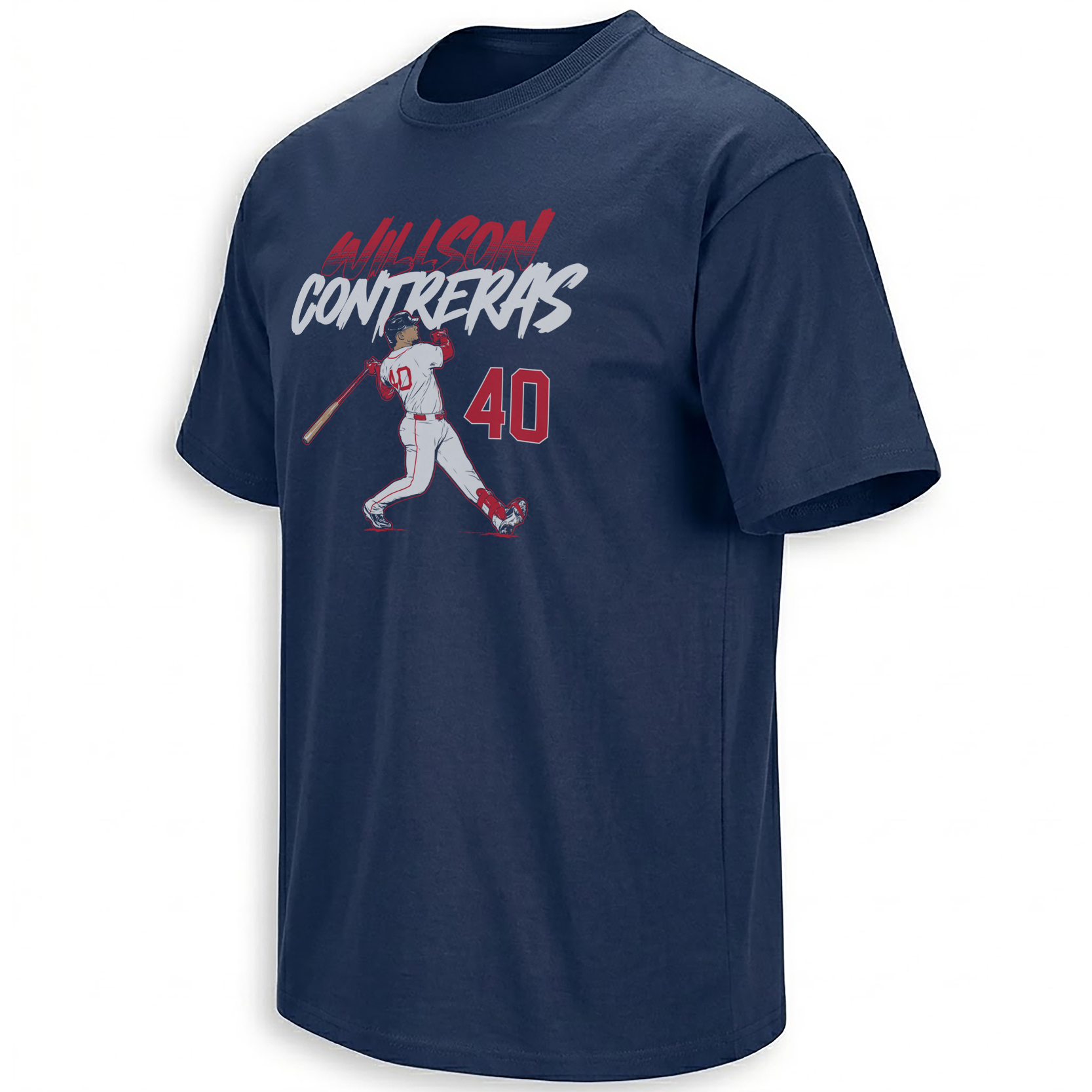
The strong red-and-navy contrast gives the graphic Boston immediacy, while the batting pose provides forward movement. No. 40 operates like a fixed scoreboard element behind the swing, turning the image into a snapshot of Contreras entering Fenway’s visual culture.
The Swing Carries the Same Emotion as the Player
Contreras has never played with neutral body language. His best moments are accompanied by visible intensity: a hard turn out of the box, a reaction toward the dugout or the sense that each plate appearance has become a personal confrontation.
That emotional openness has occasionally created controversy, but it is also central to his appeal. Fans rarely need to guess whether he considers a moment important. His posture provides the answer.
The slugger-swing design captures that identity more effectively than a static portrait would. Contreras is not presented as a calm roster addition. He is shown in the act of producing force, with his front side committed and the bat moving through the part of the zone where his Boston value becomes visible.
From Cardinals Red to Red Sox Red
The color transition appears simpler than it really is. Contreras moved from one historic red baseball identity to another, yet the emotional meaning of the uniform changed completely.
St. Louis had become tied to the complicated middle chapter of his career: the attempt to replace a legendary catcher, the move away from the position and the franchise’s eventual decision to reset. Boston offered a new context without asking him to become a different personality.
Red Sox red is sharper when paired with navy, while Fenway adds green, brick and old-scoreboard texture to the visual field. The No. 40 artwork belongs to this transition period, when a familiar player is being reinterpreted through a different historic baseball language.
A three-time All-Star with years of catching experience and a reputation built on emotional intensity.
A move to first base and a December trade created a new path for preserving his offense.
A powerful right-handed bat whose pulled contact naturally interacts with Fenway Park.
A Bright Spot Inside an Uncomfortable Season
Individual success feels different when the team around it is struggling. Every productive player becomes part of two conversations at once: what he means to the present roster and what his value might become in a possible trade.
By late June, Contreras had entered deadline speculation precisely because he was performing well. His contract, remaining control and offensive production made him attractive, even as Boston appeared unlikely to move a player who had only recently arrived.
That tension gave his season an unusual edge. Contreras was not merely helping the Red Sox. He was proving that the central logic of the trade had worked, even when the broader team plan had not produced the expected standings.
No. 40 Became a Marker of Reinvention
Uniform numbers often appear stable from the outside, but they can become timestamps for particular stages of a career. No. 40 now identifies Contreras specifically as a Boston player rather than simply following the history of his previous stops.
The number connects the first-base transition, the Fenway home run and the difficult 2026 season into one visual chapter. It separates this version of Contreras from the catcher who emerged in Chicago and the veteran who attempted to carry a different role in St. Louis.
In that sense, the graphic is not a complete career summary. It is a record of reinvention: one player, one new ballpark and a number beginning to acquire its own Boston memories.
Why Bat Speed Still Defines His Value
Contreras ranked near the top of the league in bat speed during his strong first half, an important detail for a veteran hitter. Bat speed provides both power and time. A faster barrel allows a hitter to wait longer before committing and still reach pitches with authority.
The result is visible in the kind of contact Boston expected when it acquired him. Contreras can still turn a mistake on the inner half into damage before the pitcher has time to reconsider the location.
That ability gives the swing graphic real specificity. It is not merely a generic batting pose. The movement points toward the exact skill that made his 2026 production credible: the barrel still arrives with enough speed to change an at-bat immediately.
The Wider MLB Context
Contreras’ season belongs to a larger baseball story about veteran hitters changing positions and extending their careers. Catching can consume offense over time, making the move toward first base or designated hitter a way to preserve the part of a player’s game that still creates the most value.
Boston’s gamble was that the bat remained important enough to justify the transition. Through the first half, that judgment looked sound.
The Willson Contreras No. 40 design preserves that Boston reinvention, while the broader MLB Shirts collection follows the trades, breakout seasons and visual identities shaping baseball in 2026.
Frequently Asked Questions
When did the Red Sox acquire Willson Contreras?
Boston acquired Contreras from the St. Louis Cardinals in December 2025 as part of a multi-player trade.
What number does Willson Contreras wear for Boston?
Contreras wears No. 40 for the Red Sox during the 2026 season.
How productive was Contreras during the first half of 2026?
Through 73 games, he had 16 home runs, 45 RBIs and a .901 OPS, making him one of Boston’s strongest hitters.
Why does Fenway Park suit Contreras’ swing?
His tendency to pull hard contact toward left field creates a natural interaction with Fenway Park’s Green Monster and short left-field dimensions.
What does the Willson Contreras 40 design represent?
The design captures his first Boston chapter through a powerful batting pose, Red Sox colors and the new number attached to his Fenway reinvention.
The Willson Contreras 40 piece records the veteran slugger’s first Fenway chapter, while the broader MLB visual archive follows the trades and player transformations reshaping the league.
Willson Contreras 40 Shirt captures the veteran slugger’s Boston reinvention through a powerful right-handed swing, Red Sox colors and the number defining his productive first season at Fenway.