What “We Are All Immigrants” Means — and Why the Literal Version Is Incomplete
The phrase has appeared on protest signs, speeches and solidarity graphics for decades. Its emotional meaning is easy to understand. Its historical meaning deserves more care.
“We are all immigrants” is one of those American slogans whose meaning is larger than its literal wording. For supporters, it compresses generations of migration into a simple argument: newcomers are not outside the American story. Newcomers have repeatedly helped write it.
That idea is supported by an enormous historical record. The Census Bureau has tracked foreign-born residents nationally since 1850. In that first count, 2.2 million foreign-born people represented 9.7% of the population. Immigration rose, fell and changed geographic character repeatedly over the next 175 years.
By 2024, the foreign-born population had reached roughly 50.2 million — 14.8% of the U.S. population — the largest number recorded in Census history.
The slogan has been used as solidarity language for years
“We Are All Immigrants” did not emerge from the 2026 political cycle. Versions have appeared in immigration demonstrations, civic campaigns and public writing for years.
At a February 2017 immigration rally, photographer Paul Sableman captured a protester holding a handmade sign spelling out “WE ARE ALL IMMIGRANTS” vertically. Other signs around it emphasized kindness, suffering and solidarity.
The photograph is useful because it shows how the phrase usually operates in public life: not as a Census definition, but as a response to arguments about who belongs.
.jpg)
The strongest version of the slogan is not “everyone has the same history.” It is “immigration belongs inside the American story.”
The important caveat: not everyone is an immigrant
Taken literally, “we are all immigrants” is historically incomplete.
Indigenous peoples are Indigenous to the Americas. They should not be folded into an immigration narrative built around later national borders.
The phrase can also flatten another crucial distinction: not everyone whose ancestors crossed borders did so voluntarily. Millions of Africans were forcibly transported through the Atlantic slave trade. Forced removal, displacement and internal migration are different historical experiences from voluntary immigration.
Public historians have increasingly made this point when discussing the related idea that the United States is simply “a nation of immigrants.” The phrase can express welcome, but it becomes misleading when stretched to cover Indigenous history, enslavement and every form of population movement as though they were the same thing.
“We Are All Immigrants” works best as cultural shorthand for immigrant ancestry, solidarity with newcomers and the enormous role immigration has played in shaping the United States — not as a literal statement that every American person or community arrived through immigration.
That nuance does not erase the scale of immigration in modern America
The current numbers remain historically significant.
Census definitions count as foreign-born people who were not U.S. citizens at birth, including naturalized citizens, lawful permanent residents, refugees, asylees, temporary migrants and others. In the 2024 American Community Survey, that population exceeded 50 million.
Their origins are globally diverse. Asia, Latin America, Europe, Africa, Oceania and Canada all contribute to a population that has changed dramatically since earlier European-dominated migration waves.
Immigration therefore remains both a demographic fact and one of the country’s most contested political subjects.
Why the message feels especially charged in 2026
Immigration enforcement has intensified during President Donald Trump’s second term. Reuters reported that ICE arrests climbed to nearly 51,000 in August 2026, the third consecutive monthly record, even as deportations remained around 1,200 per day.
Supporters of tougher enforcement emphasize immigration law, border control and the government’s authority to remove people without lawful status or final legal claims. Critics have focused on due process, detention practices, family disruption and the increasing number of arrests involving people without criminal records.
Those disagreements are real, and a T-shirt cannot resolve them.
What “We Are All Immigrants” does instead is enter the debate from a different direction. It asks the viewer to think about ancestry, belonging and the long history of newcomers becoming neighbors, workers, citizens and future ancestors.
This article treats the design as an immigration-solidarity and human-unity message. It does not tell readers which immigration policy, party or candidate they should support. The slogan expresses a viewpoint about belonging while the underlying policy debate remains broader and contested.
Immigrant families and descendants are deeply woven into American culture, labor, neighborhoods and civic identity.
American history cannot be reduced to immigration alone; Indigenous history and forced migration require their own accurate categories.
The design shifts from “immigrant” to the simpler word “human”
The We Are All Immigrants Shirt makes its hierarchy very clear.
“A GENTLE REMINDER” appears first in small script. The phrase then expands dramatically into distressed block letters: “WE ARE ALL IMMIGRANTS.”
Underneath, the American flag becomes a second message panel. Instead of a political party or candidate name, the word “HUMAN” sits over the flag next to a peace-sign hand.
That lower section reveals the real intent of the graphic. Immigration is the subject, but humanity is the conclusion.
Red, white and blue allow the shirt to use patriotic language without treating patriotism and immigrant solidarity as opposites. The vintage distress gives it the visual character of a civic poster rather than a polished campaign advertisement.
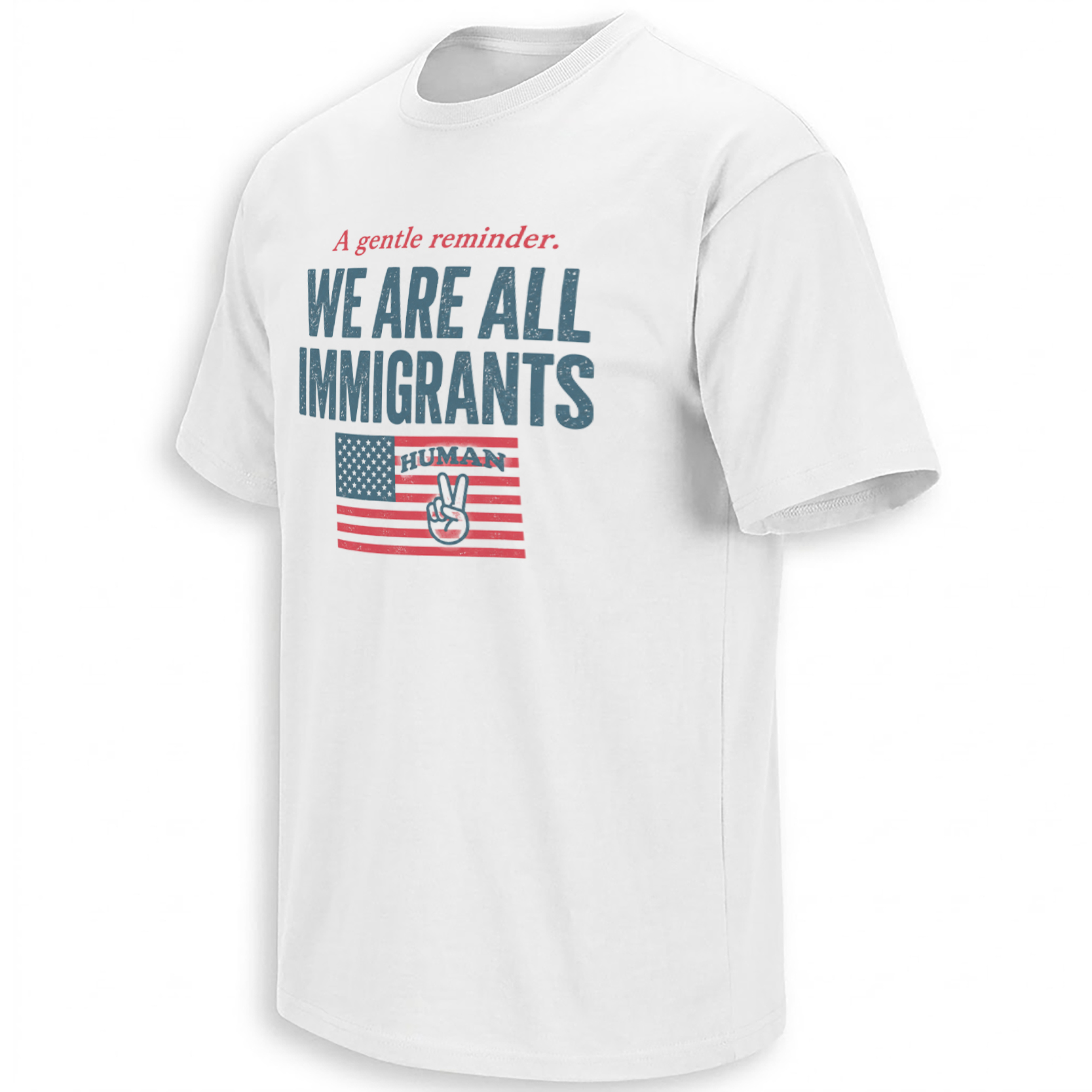
Distressed civic typography, an American flag, HUMAN lettering and a peace-sign hand frame immigration solidarity as a message about empathy and belonging rather than party branding.
View the design →Why solidarity slogans survive policy cycles
Immigration policy changes quickly. Visa rules change. Court cases alter enforcement. Administrations redefine priorities. Election campaigns reshape the language again.
Solidarity slogans tend to move more slowly because they address identity rather than statute numbers.
“We Are All Immigrants” has survived because many Americans understand themselves through a parent, grandparent or more distant ancestor who arrived from somewhere else. For them, the phrase converts genealogy into empathy.
The more historically careful version simply leaves room for Americans whose stories begin differently.
Where the design sits inside Ellie Shirt
The current product page confirms the design inside Ellie Shirt’s Newest collection. Because there is no confirmed immigration or human-rights collection on the product page, the article deliberately avoids inventing one.
We Are All Immigrants FAQ
Is “We Are All Immigrants” literally true?
No. It is best understood as a solidarity slogan. Indigenous peoples are not immigrants to the Americas, and other American histories include forced migration rather than voluntary immigration.
How many foreign-born people live in the United States?
The 2024 American Community Survey counted about 50.2 million foreign-born residents, approximately 14.8% of the U.S. population.
What does foreign-born mean in Census data?
It generally refers to people who were not U.S. citizens at birth, including naturalized citizens, lawful permanent residents, refugees, asylees, temporary migrants and others.
What is the intended meaning of the shirt?
The design uses the phrase as immigrant-solidarity shorthand and pairs it with HUMAN, the American flag and a peace sign to emphasize empathy and belonging.
Is the design tied to one political party?
The graphic itself does not name a party or candidate. It communicates a pro-immigrant and human-unity viewpoint within a broader immigration debate that includes sharply different policy positions.
America’s immigration story is enormous, but it is not the only American story. Reading “We Are All Immigrants” as solidarity rather than literal history preserves what the slogan is trying to say without erasing the histories it cannot accurately describe. Explore more newly released cultural graphics through Ellie Shirt’s Newest collection.
We Are All Immigrants Shirt uses distressed patriotic typography, an American flag, HUMAN lettering and a peace sign to express immigrant solidarity and shared humanity while recognizing the phrase as cultural shorthand rather than literal history.