
Warriors History Is Bigger Than One Dynasty — It Is Written Across the Bay
Stephen Curry now sits alone atop Golden State’s scoring history, but the names beneath him stretch through Philadelphia, San Francisco, Oakland, Run TMC, We Believe and four modern championships. The All-Time Legends skyline turns that entire lineage into architecture.
Ask Warriors fans when the franchise became theirs and the answers rarely start in the same decade. For one generation, the story begins with Rick Barry and the 1975 championship. Another remembers Chris Mullin, Tim Hardaway and Mitch Richmond running into the 1990s. Others found the team through Baron Davis and the “We Believe” upset. Millions more arrived when Stephen Curry changed the geometry of basketball.
That generational split is still alive in September 2026. In a recent Warriors fan discussion asking which team or moment first created the connection, the replies moved almost immediately between Run TMC, the 2007 We Believe run and later eras. It was a small internet conversation, but it captured something essential about Golden State: this fan base does not share one origin story.
That is why an “all-time legends” graphic has more cultural weight than a simple list of famous names. Golden State’s history has physically moved across America and across the Bay, and every relocation created another layer of memory.
Warriors history does not fit inside one arena. Philadelphia, San Francisco and Oakland all left fingerprints on the same franchise.
Curry Is No Longer Chasing Warriors History — He Sits on Top of It
NBA.com’s updated 2026 franchise scoring list now places Stephen Curry first with 26,528 Warriors points. Wilt Chamberlain remains second at 17,783, followed by Rick Barry, Paul Arizin and Chris Mullin.
Those names matter because they reveal how unusually long the Warriors’ basketball memory is. Chamberlain belongs to an era when the organization was transitioning from Philadelphia to San Francisco. Barry carries the 1975 championship generation. Mullin connects the franchise to Run TMC and the late-1980s and early-1990s Bay Area. Curry eventually became the player who pushed past all of them statistically while transforming the organization’s global identity.

The Skyline Turns Player Names Into Architecture
The All-Time Legends artwork takes that history literally. Instead of arranging players in rows like an anniversary poster, it makes their names form the structure of San Francisco itself.
Stephen Curry receives the largest treatment in the middle. Around him are Wilt Chamberlain, Rick Barry, Chris Mullin, Klay Thompson, Draymond Green and Kevin Durant. Look higher into the smaller “buildings” and the timeline expands further: Nate Thurmond, Al Attles, Tim Hardaway, Mitch Richmond, Baron Davis, Jason Richardson, Andre Iguodala, Jamaal Wilkes and other figures from different generations appear inside the cityscape.
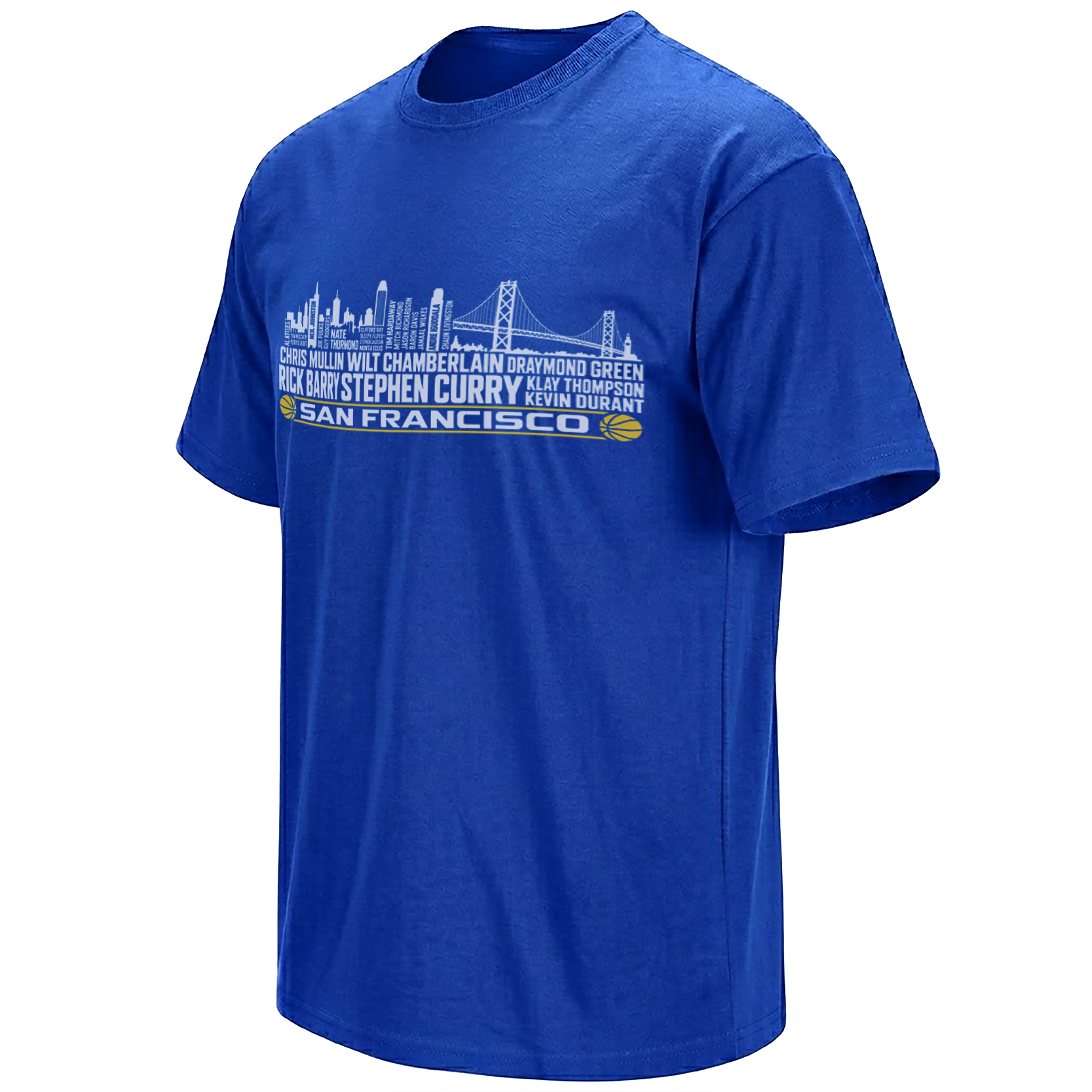
Royal blue creates the base, white typography constructs the skyline, yellow lines establish the San Francisco label, and the bridge carries the composition across the right side. The result feels less like a roster and more like an architectural blueprint for franchise memory.
Why the Bay Bridge Is More Than Decoration
The bridge is one of the most important details in the entire graphic because it connects the geography that shaped Golden State basketball.
Warriors history officially describes the Bay Bridge as a link between the franchise’s original Bay Area home in San Francisco and its long Oakland chapter. The club spent decades across the Bay before returning to San Francisco with Chase Center in 2019. That is why bridge imagery has repeatedly appeared in Warriors logos, uniforms and visual identity.
In this artwork, the bridge performs the same job symbolically. San Francisco may be printed in large letters underneath the skyline, but Oakland is impossible to separate from the memories attached to names like Mullin, Hardaway, Davis, Curry, Thompson and Green.
The NBA itself has described Bay Area basketball as a culture whose history stretches beyond one city. That regional identity is what keeps “The City,” “The Town,” Oracle Arena, Chase Center and the Bay Bridge from feeling like competing stories. They are different coordinates on the same map.
Every Warriors Generation Has Its Own Entry Point
Chamberlain connects the Philadelphia beginning to the franchise’s first San Francisco years and remains second on Golden State’s all-time scoring list.
Barry led the Warriors to the franchise’s first championship after the move west, winning Finals MVP during the four-game sweep of Washington.
Mullin, Hardaway and Richmond created one of the most enduring pre-dynasty identities in Warriors culture and remain a major nostalgia point for longtime fans.
The modern core turned Golden State into a championship dynasty and made Warriors blue and gold globally recognizable again.
Warriors Fans Are Already Treating the Curry Era Like Living History
The modern dynasty is unusual because it is already nostalgic while its central figure is still playing. Curry enters his 18th professional season as the franchise leader in points, assists and steals, and fans are increasingly discussing his career beside earlier Warriors icons rather than only against current NBA stars.
That shift is visible in fan spaces. A September discussion asking Warriors supporters which era made them fans produced answers ranging from Run TMC to We Believe to the championship years. The important part was not which era “won.” It was how naturally several generations occupied the same conversation.
A design containing Chamberlain, Barry, Mullin, Hardaway, Davis, Curry, Thompson and Green therefore does not ask fans to choose one “correct” Warriors era. It allows several versions of Dub Nation to exist in the same visual space.
A Franchise Archive Hidden Inside a City Graphic
From a distance, the shirt reads as San Francisco. From closer range, it becomes a list of names. That delayed recognition is what separates the design from a standard anniversary graphic.
The larger Golden State Warriors collection follows the same idea across individual players, championship memories and Bay Area references, while the broader NBA collection places those Warriors moments inside the wider visual history of basketball culture.
Because Curry dominates the center of this particular timeline, readers looking specifically for his era can also move through the Stephen Curry product archive, where current and historical No. 30 graphics continue to document the closing chapters of an extraordinary one-franchise career.
Frequently Asked Questions
Who are the main Warriors legends featured in the All-Time Legends design?
The largest names include Stephen Curry, Wilt Chamberlain, Rick Barry, Chris Mullin, Klay Thompson, Draymond Green and Kevin Durant, with additional historical Warriors figures integrated into the skyline.
Who is the Warriors’ all-time leading scorer in 2026?
Stephen Curry leads the franchise with 26,528 points according to NBA.com’s updated 2026 Warriors scoring leaderboard, ahead of Wilt Chamberlain and Rick Barry.
Why is the Bay Bridge important to Warriors identity?
The bridge has long symbolized the connection between San Francisco and Oakland, the two Bay Area cities most closely tied to the franchise’s history.
Does the design include the Run TMC era?
Yes. Chris Mullin, Tim Hardaway and Mitch Richmond are incorporated into the historical skyline, connecting the artwork to one of the most remembered pre-dynasty Warriors eras.
Why is Stephen Curry’s name larger than the other players?
Curry functions as the visual center because his career has become the defining modern chapter of Warriors history, and he now holds multiple major franchise records.
The All-Time Legends graphic turns decades of Warriors basketball into one Bay Area cityscape, while the Golden State Warriors archive follows the separate players, moments and eras hidden inside that larger story.
All-Time Legends Shirt turns Golden State Warriors history into a San Francisco skyline, connecting Stephen Curry, Wilt Chamberlain, Rick Barry, Chris Mullin, Klay Thompson, Draymond Green and generations of Bay Area basketball through the Bay Bridge.