Vampire Weekend Meets Jalen Brunson in A New York After-Dark Logo Parody
A familiar orange basketball crest has been rebuilt around two unexpected words. The result connects Knicks iconography, Vampire Weekend’s New York history and the late-night possessions that made Jalen Brunson the defining closer of the 2026 championship run.
By July 2026, Jalen Brunson’s championship summer had already developed several lives at once. He was the Finals MVP who scored 45 points in the deciding game, the Knicks captain whose face filled parade signs and the injured star recovering from wrist surgery after carrying New York through a 16–3 postseason.
Around him, Knicks culture kept expanding beyond ordinary basketball merchandise. The championship produced trophy graphics, roster archives, parade posters, player collages and increasingly specific pieces of fan wordplay. “Vampire Weekend” belongs to that last category.
The phrase arrives from indie music, but inside a blue-and-orange basketball crest it acquires a second meaning. It begins to sound like a nickname for the kind of playoff night Brunson repeatedly controlled: late tip, close score, final possession and a city still awake when the weekend had already moved past midnight.
The joke works because “Vampire Weekend” sounds like a band name, a New York reference and a description of playoff basketball that refuses to end early.
A Championship Summer Turned Brunson Into New York Shorthand
Before the title, Brunson was already associated with late-game decision-making. His footwork slowed defenders without slowing the possession. He could reject a screen, enter the paint, retreat into the midrange and wait until the final second for a defense to reveal its weakest answer.
The 2026 Finals expanded that identity into city mythology. New York won four games after trailing by double digits, including the record 29-point comeback in Game 4. Brunson then scored 45 points in the 94–90 closeout, the highest-scoring Finals performance in Knicks history.
Those games made “Captain Clutch” feel less like promotional language and more like an explanation for how the season ended. Brunson did not simply produce points. He became the person Knicks supporters expected to control the final minutes when the rest of the game had become unstable.
A portrait would communicate the player directly. The Vampire Weekend parody chooses a subtler route. It builds the surrounding atmosphere first and allows Brunson’s cultural association to emerge through New York colors, basketball language and the idea of the night belonging to one patient closer.
Why Vampire Weekend Carries Its Own New York Meaning
Vampire Weekend is not a random band name placed into a sports crest. The group formed among students at Columbia University and became closely associated with the specific visual and social mythology of New York collegiate indie culture.
Early discussion of the band repeatedly returned to campus references, Northeastern imagery, preppy styling and the contrast between polished presentation and restless musical ideas. Even listeners who never attended Columbia learned to recognize the band through a particular New York-coded world.
That background creates a geographic bridge to the Knicks. Madison Square Garden and Columbia belong to different versions of the city, but both feed into a larger New York cultural vocabulary: basketball, music, campuses, borough identities, nightlife and visual marks that can be recognized before every word has been read.
Vampire Weekend carries associations with Columbia, college-era New York music culture and the blog-driven indie explosion of the late 2000s.
Orange, royal blue, an arched wordmark and a basketball immediately place the graphic inside Knicks visual culture.
The combined phrase evokes weekend games, late finishes, arena lights and the hours when Brunson’s closing possessions became citywide events.
The Artwork Is Designed to Be Misread for One Second
The strongest logo parodies depend on delayed recognition. From a distance, the viewer should classify the shape before reading the altered words.
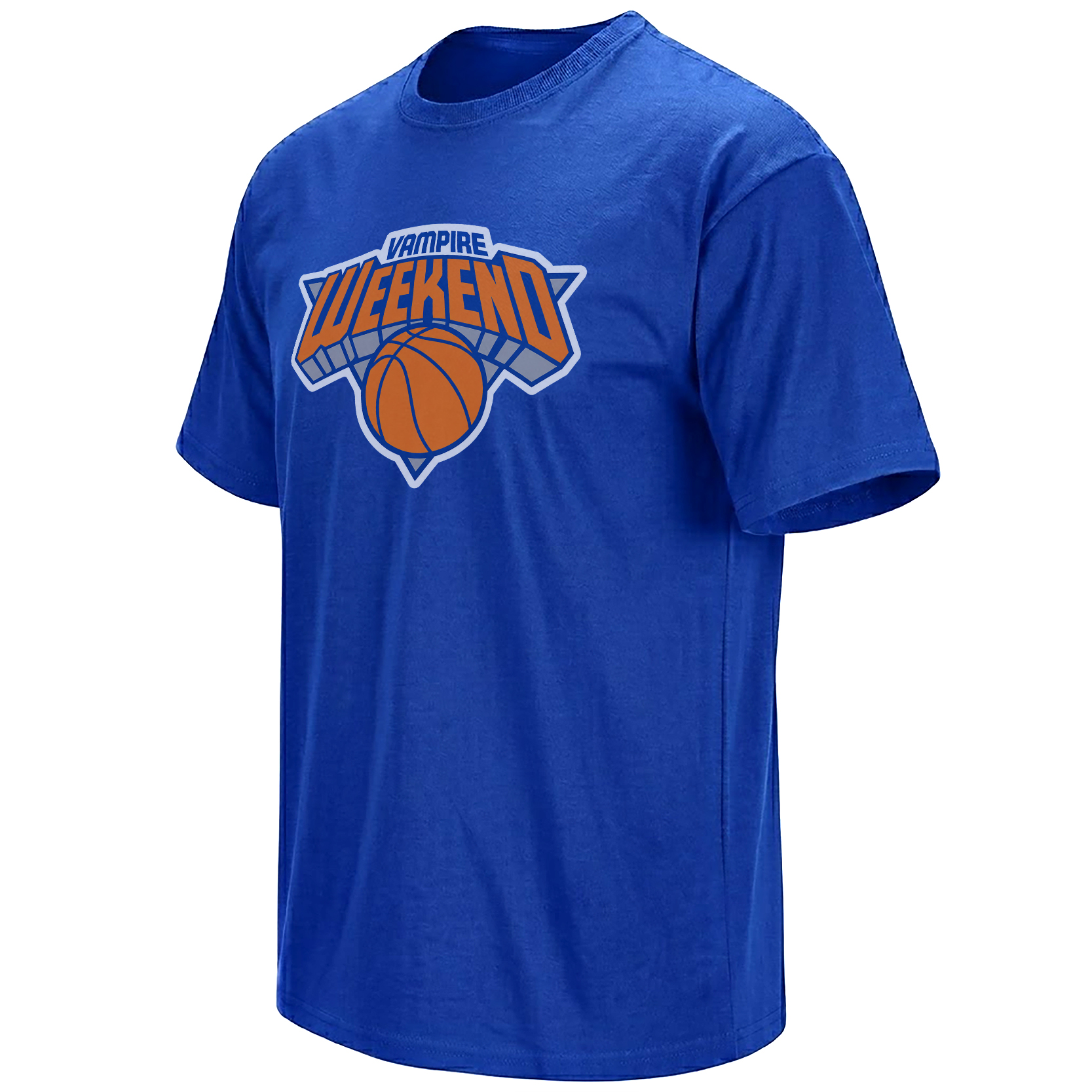
The Vampire Weekend Shirt follows that rule closely. Its angular side panels, orange basketball and wide arched lettering create the first impression of a conventional New York basketball emblem.
Only after the eye reaches the text does the substitution become visible. “Vampire” occupies the compact upper banner, while “Weekend” takes the large central position normally reserved for the primary team identity.
That delayed reveal is the cultural payoff. The design first says Knicks. Then it says Vampire Weekend. Finally, the viewer has to decide what relationship those two readings have to Brunson, late-night basketball or New York music history.
“Vampire” Sits Above the Basketball Like a Secondary Identity
The word “Vampire” is deliberately smaller. It sits inside a narrow white-and-blue banner at the top of the crest, acting almost like a qualifier for the larger word below.
In visual terms, that hierarchy makes “Weekend” the primary identity. The logo is not simply typesetting a two-word band name. It is reconstructing the phrase so it behaves like an athletic organization.
“Vampire” becomes the condition. “Weekend” becomes the team. The basketball underneath completes the transformation from music reference into fictional sports emblem.
That arrangement also supports the after-dark reading. A vampire belongs to the night. A weekend belongs to the period when prime-time games, watch parties and late city movement can stretch beyond normal schedules.
The Basketball Prevents the Design From Becoming Only a Band Reference
Remove the ball and the crest could be understood as general music merchandise. The large orange basketball fixes the graphic inside basketball culture before the viewer has time to interpret the wording.
Its curved blue seams provide one of the few rounded elements inside a design dominated by angular banners and hard geometric edges. That contrast gives the lower half a clear visual center.
The ball also extends into a pointed white-and-blue shield, creating the impression of an alternate franchise mark rather than a concert logo. It suggests a team that does not exist officially but feels familiar enough to have been discovered in an old New York sports archive.
The design’s central trick is structural rather than illustrative. No portrait, jersey number or trophy is needed. The recognizable crest shape supplies basketball identity, while the altered wording creates the cultural crossover.
Royal Blue Turns the Entire Shirt Into the Logo Background
The royal-blue garment is not a neutral canvas. It completes the emblem by extending the internal blue outward across the entire shirt.
Orange lettering gains maximum contrast against that field, while white outlines protect the shape from becoming visually heavy. Pale blue shadow layers give “Weekend” enough depth to resemble a dimensional athletic wordmark.
This color system allows the graphic to achieve immediate Knicks recognition without printing the team name. Orange and blue carry enough accumulated basketball meaning that viewers can classify the design through palette alone.
The simplicity is also what separates it from the championship collages surrounding the same cultural moment. Where roster and Finals graphics accumulate faces, statistics and trophies, this piece reduces the Brunson era to one clean alternate logo.
The Brunson Connection Is Atmospheric Rather Than Literal
The artwork contains no photograph of Jalen Brunson, no No. 11 and no printed “Captain Clutch” line. That makes the player reference less direct than a conventional tribute graphic.
Its Brunson meaning comes from the context surrounding the release: New York’s championship summer, the after-dark metaphor, his role as the team’s late-game controller and the way fans increasingly turned him into a flexible pop-culture character.
This kind of indirect player art is common when an athlete moves beyond box scores. Supporters begin attaching him to movie posters, cereal boxes, music references, civic symbols and invented logos because the player’s identity has become legible through association alone.
Brunson’s 2026 postseason created that level of recognition. A compact New York emblem can evoke him without showing him because the captain had become the default protagonist of the Knicks’ championship period.
Two Readings Can Exist Without One Canceling the Other
The words reference Vampire Weekend, a band formed at Columbia whose name carries an established association with New York indie culture.
Inside a Knicks-style crest, “Vampire Weekend” sounds like a description of fans staying awake through late playoff games and Brunson-owned fourth quarters.
The design does not require viewers to choose only one. Its value comes from holding both interpretations inside the same compact object.
Someone familiar with the band recognizes the phrase first and then discovers the basketball treatment. A Knicks supporter may recognize the team geometry first and only afterward process the indie reference.
That reversal of entry points makes the piece more culturally flexible than a simple joke printed as text. The image can circulate between music and sports audiences without explaining every layer in advance.
Why the Word “Weekend” Fits Playoff Basketball
Playoff series reorganize time. Supporters plan around tipoffs, travel days and potential closeout games. A Friday night can extend into early Saturday discussion; a Sunday game can occupy the emotional space of the entire weekend.
In New York, late games also belong to the larger rhythm of the city. Arena exits flow into Penn Station, subway platforms, bars and phone screens replaying the final possession before people have even reached home.
Brunson’s style intensified that relationship with the clock. He often appeared most comfortable when possessions slowed, the score narrowed and every decision became visible.
“Weekend” therefore describes more than scheduling. It describes a temporary world in which the Knicks game becomes the organizing event and the rest of the city arranges itself around the fourth quarter.
Vampires and Closers Share the Same Hours
The vampire metaphor is playful, but it carries a useful sports logic. Vampires are associated with darkness, patience and an advantage that increases after sunset.
Brunson’s game is not supernatural, but his public identity as a closer developed through similar timing. He often waited for the defense to become tired, conservative or predictable before attacking its final options.
His footwork could make defenders feel as though the possession had been extended beyond its natural life. A pivot created one more angle. A retreat dribble restored space. A shoulder fake reopened a lane everyone believed had already closed.
The logo never states this metaphor explicitly. That restraint keeps the wordplay from becoming a costume joke. It allows “Vampire Weekend” to remain an atmospheric description rather than a literal Brunson nickname.
The Design Belongs to the Era of Athlete Pop-Culture Crossovers
Modern sports fandom no longer separates athletes cleanly from entertainment culture. A successful player can become a reaction image, fictional character, album-cover subject or logo parody within hours of a major performance.
These crossovers are not always official collaborations. They often emerge from fans testing how far an athlete’s identity can travel before recognition breaks.
Brunson’s championship run created an unusually broad field for that experimentation. He could be presented as captain, king, closer, cereal mascot, city monument or indie-culture reference because each version pointed back to the same central fact: New York’s most important basketball moments kept passing through him.
The Vampire Weekend crest represents the minimalist end of that spectrum. It does not explain the entire joke. It assumes enough cultural recognition for the audience to complete the connection.
The Columbia Connection Gives the Parody a Local Root
Vampire Weekend’s formation at Columbia matters because it prevents the music reference from feeling imported into New York basketball culture from somewhere else.
The band and the Knicks occupy different institutions and audiences, but both belong to New York’s ability to produce identities that become recognizable far beyond the city.
Columbia supplied Vampire Weekend with part of its early mythology. Madison Square Garden supplied Brunson with the arena in which his New York mythology became public.
The logo parody connects those environments through design rather than biography. It does not claim Brunson is connected personally to the band. It simply places two New York cultural signals inside one orange-and-blue crest.
The Parody Is Independent, Not an Official Collaboration
The design should be understood as independent fan parody. It is not presented as official merchandise from Vampire Weekend, the New York Knicks, the NBA or Jalen Brunson.
That distinction is important because the cultural interest lies in transformation. A familiar sports-logo structure is rebuilt around unexpected wording, creating a new joke from recognition and contrast.
The artwork does not reproduce a band photograph, album cover or official collaboration mark. It uses the phrase “Vampire Weekend” as the altered identity inside a New York basketball crest.
In editorial terms, the design is best read as a crossover artifact: music language translated through basketball geometry during the period when Brunson’s championship identity dominated New York sports culture.
Why the Graphic Can Outlive One Finals Score
Many championship designs depend on a specific final score, opponent or title year. Their relevance is tied directly to the event they document.
The Vampire Weekend crest has a longer possible life because its central idea is atmospheric. New York basketball will continue to produce weekend games, late finishes and after-dark arena energy even after the 2026 championship becomes part of history.
Brunson’s role may continue evolving, but the period that established him as the city’s closer will remain the origin point for how the design is understood.
That gives the piece two timelines. It belongs to the championship summer that made the reference especially powerful, while its logo structure remains readable beyond the exact season.
A Cleaner Counterpoint to Championship Collage Culture
Knicks title art often embraces abundance. Player collages, trophy repeats, roster lists and layered city imagery reflect the size of the emotion released after 53 years.
This design takes the opposite route. One crest. One basketball. Two words. Three colors.
The reduction gives it the quality of an alternate team identity or fictional club logo. It can be read quickly without sacrificing the second layer of meaning available at closer range.
That restraint makes it a natural addition to the New York Knicks Shirts collection , where more explicit Brunson portraits, championship moments and roster graphics document other parts of the same era.
The wider NBA Shirts archive places the piece inside basketball’s larger culture of logo remixing, music crossovers and fan-made visual identities.
Brunson’s Wrist Surgery Adds Another Layer to the Summer
The design arrived as Brunson moved from celebration into recovery. Reports in early July confirmed that he had undergone surgery on his left wrist after managing discomfort during the title run.
The timing sharpened the retrospective reading of the Finals. His 45-point closeout and late-game control had occurred while he was carrying an issue that required treatment once the championship was secured.
That does not change the logo itself, but it changes the atmosphere around it. “Vampire Weekend” becomes attached not only to the player who owned late nights, but to a summer in which supporters learned how much physical cost had been hidden behind those controlled possessions.
Expected recovery before training camp also keeps the moment from becoming elegiac. The surgery belongs to the transition between the championship run and the attempt to defend it.
A Logo Parody From the Moment Brunson Became a City Character
The most revealing sign of an athlete’s cultural arrival may be the point when supporters no longer need his face to reference him.
Brunson had reached that stage by the summer of 2026. A No. 11, a captain line, an orange-and-blue crest or a joke about the final possession could all point toward him without requiring explanation.
Vampire Weekend joins that expanding language. It captures the version of New York basketball that begins after sunset, peaks in the final quarter and remains alive long enough for the entire weekend to feel organized around one game.
The crest may look like a fictional team logo, but its cultural subject is clear: the city, the captain and the nights when neither appeared ready to sleep.
Frequently Asked Questions
What is the Vampire Weekend Jalen Brunson Shirt?
It is an independent New York basketball logo-parody design that places the words “Vampire Weekend” inside an orange, royal-blue and white athletic crest.
Why is the design associated with Jalen Brunson?
Its New York basketball identity, late-night “Vampire Weekend” wordplay and 2026 championship context connect naturally to Brunson’s reputation as the Knicks’ fourth-quarter closer and Finals MVP.
Does the artwork show Jalen Brunson’s face or No. 11?
No. The reference is atmospheric rather than literal, using New York colors, basketball imagery and after-dark wordplay instead of a portrait or jersey number.
Is the design officially connected to the band Vampire Weekend?
No official collaboration is indicated. The artwork is best understood as an independent basketball parody that uses the recognizable phrase as a New York pop-culture crossover.
What is Vampire Weekend’s connection to New York?
The band formed at Columbia University and became strongly associated with New York’s college-era indie culture during its rise in the late 2000s.
Why does the graphic resemble a Knicks logo?
It uses a familiar orange arched wordmark, royal-blue structure, white outlines, central basketball and pointed shield to create immediate New York basketball recognition.
What did Jalen Brunson accomplish in the 2026 NBA Finals?
Brunson led the Knicks to their first championship in 53 years, scored a franchise Finals-record 45 points in Game 5 and received the Bill Russell NBA Finals MVP trophy.
Why does “Vampire Weekend” fit late-night Knicks basketball?
The phrase evokes weekend tipoffs, after-dark Madison Square Garden energy and the late fourth-quarter possessions Brunson repeatedly controlled during the championship run.
Can the design remain relevant beyond the 2026 season?
Yes. Its basketball crest, New York palette, music reference and nighttime wordplay are broader than one score, opponent or Finals game.
The Vampire Weekend Jalen Brunson design compresses indie New York, Knicks iconography and the captain’s late-game mythology into one crest, while the wider Knicks cultural archive follows the player moments, championship graphics and city language surrounding the 2026 title.
Vampire Weekend Shirt remixes New York basketball iconography into a clean orange-and-blue crest, connecting Vampire Weekend’s Columbia roots with Jalen Brunson, late-night playoff energy and the Knicks’ 2026 championship culture.