
Trump’s Political Math
Divide, subtract, add, multiply: four elementary-school verbs reorganized into a compact indictment of Donald Trump’s America.
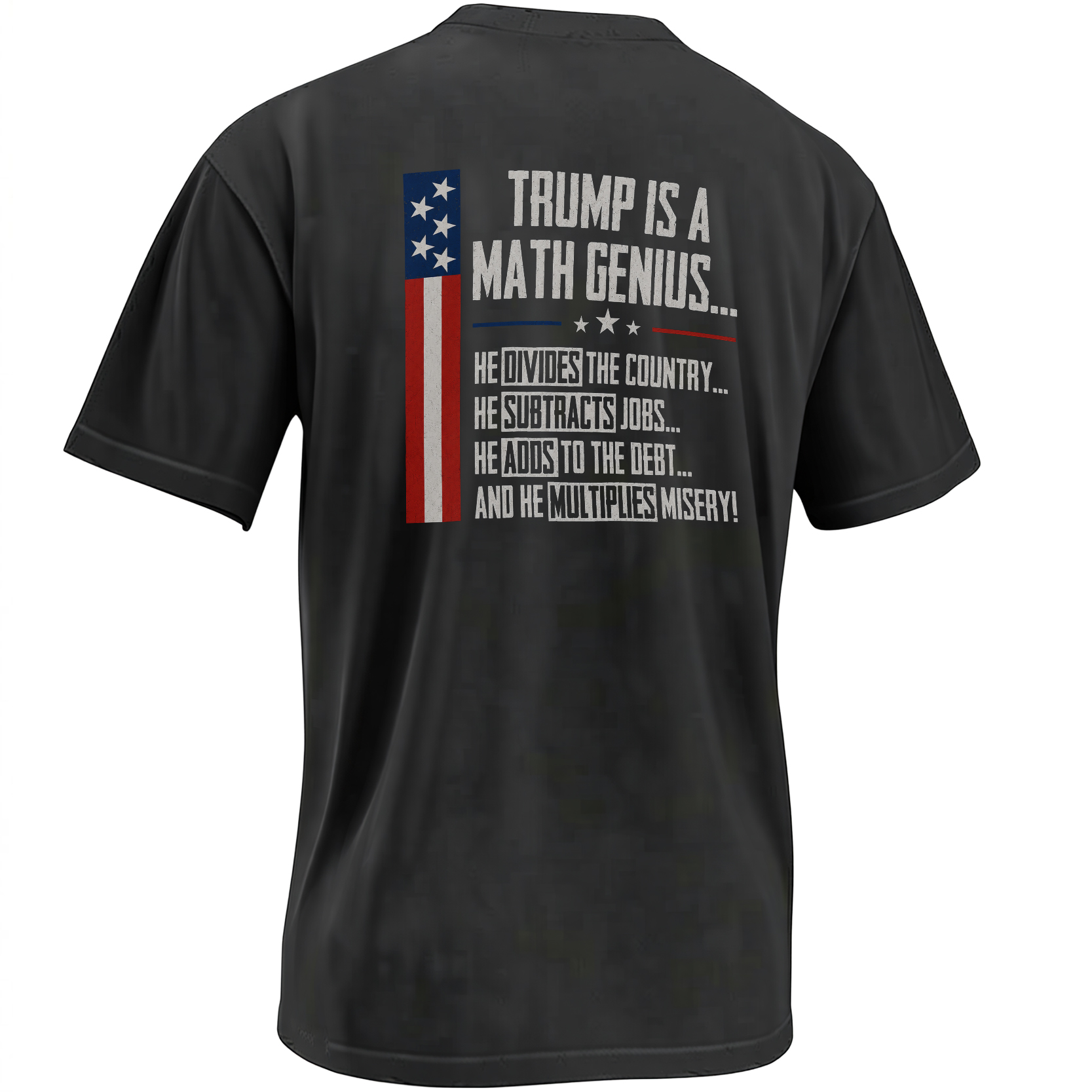
“Trump is a math genius” sounds like praise for a president who has long sold business instinct as evidence of political competence. The next four lines erase that interpretation.
He divides the country. He subtracts jobs. He adds to the debt. And he multiplies misery. Each verb belongs to arithmetic, but every result is political. The word “genius” becomes sarcasm because the supposed achievement is producing more of what critics fear and less of what they value.
The slogan was circulating widely again across political-shirt and short-video feeds in July 2026, but its structure is older than one news cycle. That longevity is part of its power: whenever jobs, debt or division return to the headlines, the same four operations can be reposted as a ready-made verdict.
The opening operation turns partisan polarization into the central accusation and establishes the emotional frame for every line that follows.
Economic anxiety is reduced to a familiar kitchen-table measure: whether employment opportunity appears to be expanding or disappearing.
The plus sign becomes negative—a neat inversion that treats accumulation as failure rather than growth.
The final line leaves measurable policy and delivers the emotional sum: critics believe the consequences spread beyond any single statistic.
The joke does not prove its case with equations. It uses the emotional authority of arithmetic to make a political judgment feel instantly solved.
Why the Setup Needs the Word “Genius”
Donald Trump’s public mythology has always leaned heavily on superlatives: smartest, greatest, strongest, best. His supporters read that language as confidence and his opponents read it as self-inflation. “Math genius” fits cleanly inside the pattern before the reader reaches the ellipsis.
The pause is essential. Printed after “genius,” the three dots imitate the timing of a comedian allowing an audience to settle on the wrong meaning. Then the slogan reveals that Trump is allegedly skilled not because he solves national problems, but because he performs four destructive operations on the country.
This is a classic praise-to-insult reversal. It lets the critic borrow Trump’s own language of exceptional ability and redirect it toward a hostile conclusion.
Division Is the First and Most Important Operation
The graphic begins with national division because every later line depends on the existence of two political audiences. Supporters and opponents do not merely disagree about Trump’s results; they often encounter entirely different explanations for the same result.
Pew Research Center has documented partisan hostility growing beyond disagreement with parties and toward negative judgments about the people in them. Its 2026 research also found broad frustration with both major parties: 58 percent of adults viewed the Republican Party unfavorably and 59 percent viewed the Democratic Party unfavorably, while 26 percent disliked both.
Those findings complicate the slogan’s implied one-man theory of polarization. American division predates Trump and is sustained by institutions, media systems, geographic sorting and behavior across party lines. Yet Trump remains a uniquely effective symbol of that division because reactions to him are unusually intense and identity-based.
“Subtracts Jobs” Is a Political Line, Not a Clean Dataset
Employment is where the slogan most obviously compresses a complicated record. A president does not personally add or subtract every job, and monthly payrolls respond to interest rates, consumer demand, technology, global shocks and private decisions as well as federal policy.
The latest available Bureau of Labor Statistics report before publication showed nonfarm payroll employment increasing by 57,000 in June 2026, with the unemployment rate at 4.2 percent. That means “subtracts jobs” should not be presented as a literal description of that single month.
As satire, however, the line collects a wider set of anxieties: layoffs, federal workforce cuts, businesses facing higher costs, industries disrupted by trade policy and workers who believe opportunity is narrowing even when the national total remains positive.
The arithmetic verb succeeds because subtraction is visually immediate. It does not ask readers to choose a baseline, adjust for population or separate inherited conditions from new policy. Something that should be there has been taken away.
“Adds to the Debt” Has the Strongest Numerical Backdrop
The debt line attaches itself to an unmistakably large national number. Treasury’s daily Debt to the Penny data placed total public debt around $39.64 trillion in July 2026. The Congressional Budget Office projected a $1.9 trillion federal deficit for fiscal year 2026 and debt held by the public rising from 99 percent of GDP at the end of 2025 to 120 percent by 2036 under current law.
Those totals cannot honestly be assigned to one president alone. They accumulate across administrations and reflect tax policy, congressional spending, mandatory programs, emergencies, interest costs and the economic cycle.
But political satire is interested in accountability, not actuarial footnotes. Trump has presented himself as a businessman capable of imposing discipline on government, so rising debt becomes especially useful to critics: it challenges the competence claim on its own chosen terrain.
BLS reported modest payroll growth, illustrating why one slogan cannot substitute for a time series.
Treasury’s current national-debt display gives the “adds” line a vast numerical backdrop.
CBO’s projection shows that large annual deficits remain a structural national problem.
“Multiplies Misery” Is the Emotional Answer
The final line cannot be audited like payrolls or debt because misery is not a federal series. That is why it belongs at the end. The previous statements invoke national conditions; the conclusion tells readers how those conditions are supposed to feel.
“Multiplies” also suggests spread. One decision produces effects across many households; one conflict creates several new conflicts; one source of anxiety reproduces itself through prices, work, immigration, health care or foreign policy.
Supporters will reject that verdict and point to policies they believe improve security, growth or national confidence. The line is not written for them. Like most political merchandise, it helps opponents recognize one another and carry a complex moral objection in a form readable across a room.
The Design Looks Like a Patriotic Accounting Error
The black garment turns the artwork into a night-mode protest poster. Distressed white letters carry the texture of a stencil or repeatedly copied handbill, while red and blue lines keep the message visibly inside American political language.
A narrow vertical flag motif anchors the left edge. It resembles both a patriotic banner and the margin of a ledger, which is exactly where the design wants to live: between national symbolism and an accusation that the national books do not balance.
The typography becomes smaller after the setup, encouraging a close read. “TRUMP IS A MATH GENIUS” works as the distant headline; the four operations supply the reward to anyone who approaches.
Why Arithmetic Makes Political Satire So Portable
Effective slogan writing depends on a structure people can reconstruct after seeing it once. Arithmetic supplies that structure for free. Readers know which operation follows which, and each verb accepts a political object without complicated grammar.
The phrase also travels across formats. It can be spoken in a video, posted as four lines of text, printed on a protest sign or placed on the back of a shirt. No portrait or breaking-news reference is necessary, which protects the joke from expiring with one scandal.
Its durability does not make every line equally factual. It makes the arrangement unusually reusable. New statistics can change the debate around jobs and debt while the emotional equation remains recognizable.
A Protest Slogan That Asks the Viewer to “Show the Work”
The most revealing way to read “Trump is a math genius” is not as a completed proof but as a prompt. Each operation points toward a larger argument that a serious reader can investigate: What kind of division? Which jobs and over what period? How much debt, produced by which laws? Whose misery, measured how?
Satire opens the file; reporting fills it. The slogan is successful because it makes those questions memorable, not because four rhyming verbs settle the record.
As an artifact of anti-Trump culture in 2026, the design captures the opposition’s broadest economic and emotional case in a single schoolroom device. Trump’s critics do not believe his math fails. The darker joke is that it works exactly as intended—and they dislike every answer.
Continue through anti-Trump visual culture
View the Trump Is a Math Genius design or explore more protest graphics and political satire in the Anti-Trump collection.
Frequently Asked Questions
What does the “Trump Is a Math Genius” slogan say?
It says Trump divides the country, subtracts jobs, adds to the debt and multiplies misery, using four arithmetic operations as an anti-Trump political critique.
Is the Trump Is a Math Genius design pro-Trump or anti-Trump?
It is anti-Trump satire. “Math genius” is sarcastic praise, and the four lines that follow describe outcomes his critics consider harmful.
Why does the slogan use divide, subtract, add and multiply?
The familiar arithmetic sequence gives the political message rhythm and makes it easy to remember, repost and recognize across shirts, signs and social video.
Are all four lines literal factual claims?
No. The slogan is political rhetoric. Jobs and debt can be examined with data, while division and misery are broader judgments. Even measurable outcomes require dates, baselines and policy context.
Why did the Trump math slogan resonate again in 2026?
Its themes—polarization, employment, federal debt and public frustration—remained active in national debate, while its simple four-verb structure made it highly reusable in political-shirt and short-video culture.
Trump Is a Math Genius turns division, subtraction, addition and multiplication into a four-line anti-Trump indictment, framing national polarization, jobs, debt and public pain as one dark political equation.