
The MAGA Avoidance List
Four locations, one partisan stereotype and a back print designed to make its point before anybody has time to ask whether the map is literal.
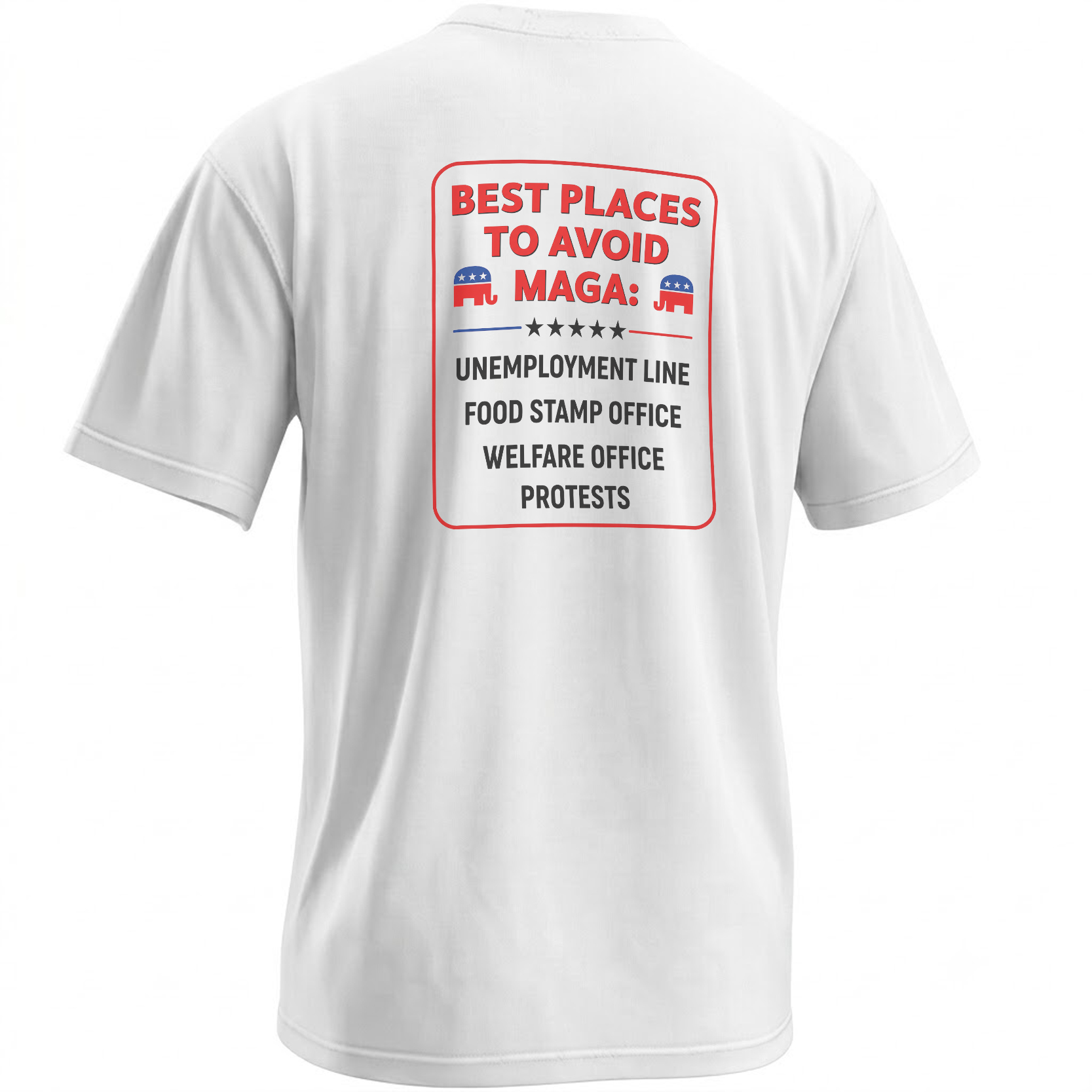
“Best Places to Avoid MAGA” looks like the beginning of a travel guide. Then the list arrives: unemployment line, food-stamp office, welfare office and protests.
The reversal is the whole joke. Instead of naming cities, campuses or liberal neighborhoods where a Trump supporter might feel unwelcome, the graphic claims MAGA voters will be absent anywhere associated with not working, receiving public assistance or demonstrating in the street.
It is conservative identity compressed into a checklist: work rather than wait, earn rather than receive, and remain on the job rather than join a protest. The list does not attempt to win a policy debate. It performs belonging for people who already recognize that moral vocabulary.
The joke equates MAGA identity with steady work and treats joblessness as the opposite of self-reliance.
Public assistance becomes shorthand for dependence—the most familiar target in this strain of conservative humor.
The repeated government-office image turns a policy argument about safety nets into a character judgment.
The final line contrasts visible activism with a conservative self-image built around ordinary work and private responsibility.
The list is not really a map of where MAGA voters go. It is a map of how one political community prefers to describe itself.
Why “Avoid MAGA” Is the Necessary Setup
Online political humor is often built for reversal. A phrase that appears hostile to one side is repurposed by that same side and made flattering. “Places to avoid MAGA” initially sounds like advice for Trump opponents. The reveal changes the speaker and turns avoidance into proof of virtue.
That structure matters because MAGA culture has spent years converting criticism into identity material. Words intended as insults become slogans; hostile headlines become rallying points; attempts to exclude supporters become evidence that the movement stands apart from elite institutions.
Here, “avoid” does not suggest MAGA is hiding. It suggests that certain spaces fail the movement’s test of industriousness. The wearer is invited to read the absence as voluntary and morally meaningful.
The headline borrows the language of a liberal recommendation list. Only after the four locations appear does the graphic reveal itself as conservative humor. That half-second of mistaken expectation supplies the punch.
The Work-Ethic Story MAGA Tells About Itself
“Hardworking Americans” is one of the most durable phrases in U.S. campaign language because it does more than describe employment. It attaches economic participation to citizenship, discipline, family responsibility and deservingness.
MAGA messaging intensifies that contrast. The ideal subject is a worker, small-business owner, tradesperson, veteran, farmer or parent who believes institutions reward rule-breaking while ignoring ordinary contribution. Whether every supporter matches that biography is beside the rhetorical point. The identity is aspirational as much as demographic.
The back print uses offices and lines rather than individual caricatures, keeping the joke visually simple. A place stands in for an entire moral category. The unemployment line becomes “not working”; the benefit office becomes “depending”; the protest becomes “complaining instead of producing.”
Where the Punchline and Reality Separate
The stereotype should not be mistaken for a reliable portrait of who uses public assistance. USDA’s detailed SNAP research shows that many participants are children, older adults or people with disabilities. Its fiscal-year 2022 report also found earned income in many households with children, including 66 percent of married-couple households with children.
Unemployment is similarly not an ideological location. The Bureau of Labor Statistics defines unemployed people through work-search and availability criteria, while job losers and people completing temporary work make up a specifically tracked category. In June 2026, the national unemployment rate was 4.2 percent, representing about 7.1 million people across the country.
Those facts do not make the design unreadable. They reveal how it works. Political jokes depend on compressed types, not representative samples. A reader can understand the intended conservative message while recognizing that a laid-off MAGA voter can stand in an unemployment line and a working family can receive SNAP.
Why the Back Print Is the Right Format
The placement delays the joke. From the front, the shirt can pass as an ordinary white tee. The statement becomes visible as the wearer turns away, giving the person behind them time to read from headline to list.
That reading order resembles a roadside notice or campaign handbill. Red and blue frame the message as unmistakably American political material, while black condensed lettering gives each destination the blunt authority of an official sign.
The two Republican elephants near the headline resolve any remaining ambiguity. The symbols tell viewers which side owns the joke before the list begins, while the five stars and horizontal rules lend it a campaign-era structure without using a candidate portrait.
A Joke Built for Recognition, Not Conversion
Very little contemporary political merchandise is designed to persuade an undecided voter. Its more common function is recognition: identifying allies, testing the room and converting a large political identity into a sentence that can be understood from several feet away.
“Best Places to Avoid MAGA” performs that function efficiently because the viewer does not need to know a bill number, speech or breaking-news controversy. The necessary argument has circulated for decades: conservatives work; liberals depend on programs and protest.
The line therefore belongs to a broader family of conservative memes that treat political disagreement as a clash of habits rather than policies. One side wakes up and goes to work; the other waits for government. The simplification is precisely what makes the idea portable.
The More Complicated America Behind the List
Pew Research Center’s 2026 political typology is a useful counterweight to all four-line political identities. It found that most Americans in both partisan coalitions are not consistently conservative or consistently liberal across every value. Roughly 15 percent of Republican identifiers held an overall set of values left of center, with a similar share of Democrats falling right of center.
That mixture is the country the shirt intentionally edits out. Benefit recipients vote Republican. Protesters hold jobs. Democrats own businesses. Conservatives experience layoffs. Political identity remains powerful, but daily economic life refuses to organize itself into a perfect meme.
The design is most interesting when read with both realities visible: as a confident piece of MAGA in-group humor and as an example of how modern political merchandise transforms messy social categories into a clean moral map.
Continue through the MAGA visual archive
View the Best Places to Avoid MAGA design or explore more pro-Trump and conservative graphics in the Trump Ultra MAGA collection.
Frequently Asked Questions
What does the “Best Places to Avoid MAGA” joke mean?
It claims MAGA supporters are unlikely to be found in unemployment lines, benefit offices or protests because conservative identity is associated with work, self-reliance and opposition to government dependency.
Is the Best Places to Avoid MAGA design pro-MAGA or anti-MAGA?
It is pro-MAGA conservative humor. The headline initially sounds anti-MAGA, but the listed locations turn the phrase into a compliment about the movement’s claimed work ethic.
Which places are listed on the back print?
The artwork lists the unemployment line, food-stamp office, welfare office and protests.
Does the list literally describe all MAGA supporters or benefit recipients?
No. It uses a partisan stereotype as a punchline. Public-assistance recipients include workers, children, older adults and people with disabilities, while people across political groups experience unemployment.
Why does the design use a back print?
The back placement creates a delayed reveal. Viewers first read the apparent anti-MAGA headline, then discover the conservative punchline as they move down the four-item list.
Best Places to Avoid MAGA turns four politically charged locations into a conservative work-ethic joke, using a patriotic back-print layout to transform MAGA identity into a blunt visual checklist.