
Trey’Dez Green Has LSU’s No. 7. Now Comes the Expectation.
LSU’s most recognizable playmaker number is moving onto the 6-foot-7 frame of Trey’Dez Green in 2026 — an honor that says almost as much about what the Tigers expect next as what he already accomplished.
At LSU, No. 7 stopped being an ordinary jersey number a long time ago.
Patrick Peterson gave it modern meaning. Tyrann Mathieu turned it into chaos. Leonard Fournette gave it star power at running back. Later players inherited an expectation that was never written formally into the uniform rules: No. 7 belonged to somebody opponents had to locate before every snap.
On August 26, LSU revealed the newest version of that tradition. Trey’Dez Green will wear No. 7 on offense in 2026, while linebacker Whit Weeks will wear it on defense.
The number has become LSU shorthand for an impact playmaker. Green now carries that symbolism into Lane Kiffin’s first season in Baton Rouge.
The jersey is not a reward for being famous. At LSU, it is an announcement that the offense is supposed to run through your presence.
Why Green Is an Unusual No. 7
Most players who inherit this tradition look like traditional football stars: a corner, safety, receiver or running back. Green changes the silhouette completely.
He is listed at 6-foot-7 and 242 pounds. Officially, he is a tight end. Functionally, LSU can move him into the slot, split him outside or use him as a red-zone mismatch against defenders who rarely have both the size and speed to handle him.
His 2025 season proved that the athletic profile was translating into production. Green caught 33 passes for 433 yards and seven touchdowns, setting LSU’s single-season receiving touchdown record for a tight end. By the end of the season, he also owned the LSU career record at the position with 11 receiving scores.
LSU Made the Announcement With Its Own History in the Room
Former LSU star Leonard Fournette helped present the jerseys, making the symbolism impossible to miss. Fournette wore No. 7 from 2014 through 2016 and remains one of the clearest examples of what LSU means when it describes the number as belonging to a playmaker.
The First Season of the Lane Kiffin Era Raises the Stakes
Green’s new number arrives at exactly the moment his role is expected to expand. Lane Kiffin’s offense historically creates space, isolates matchups and moves skill players around formations to force defenses into uncomfortable decisions.
Few college tight ends offer a more obvious mismatch tool than Green. His catch radius lets quarterbacks throw into windows that would be dangerous for smaller receivers. His background as a two-sport LSU athlete — he briefly joined the basketball team in 2025 — explains why his movement looks unusual for his size.
The Walter Camp Foundation also placed Green on its 2026 Player of the Year watch list. He was the only tight end among the initial 50 players, a useful indication of how far his reputation has moved beyond Baton Rouge.
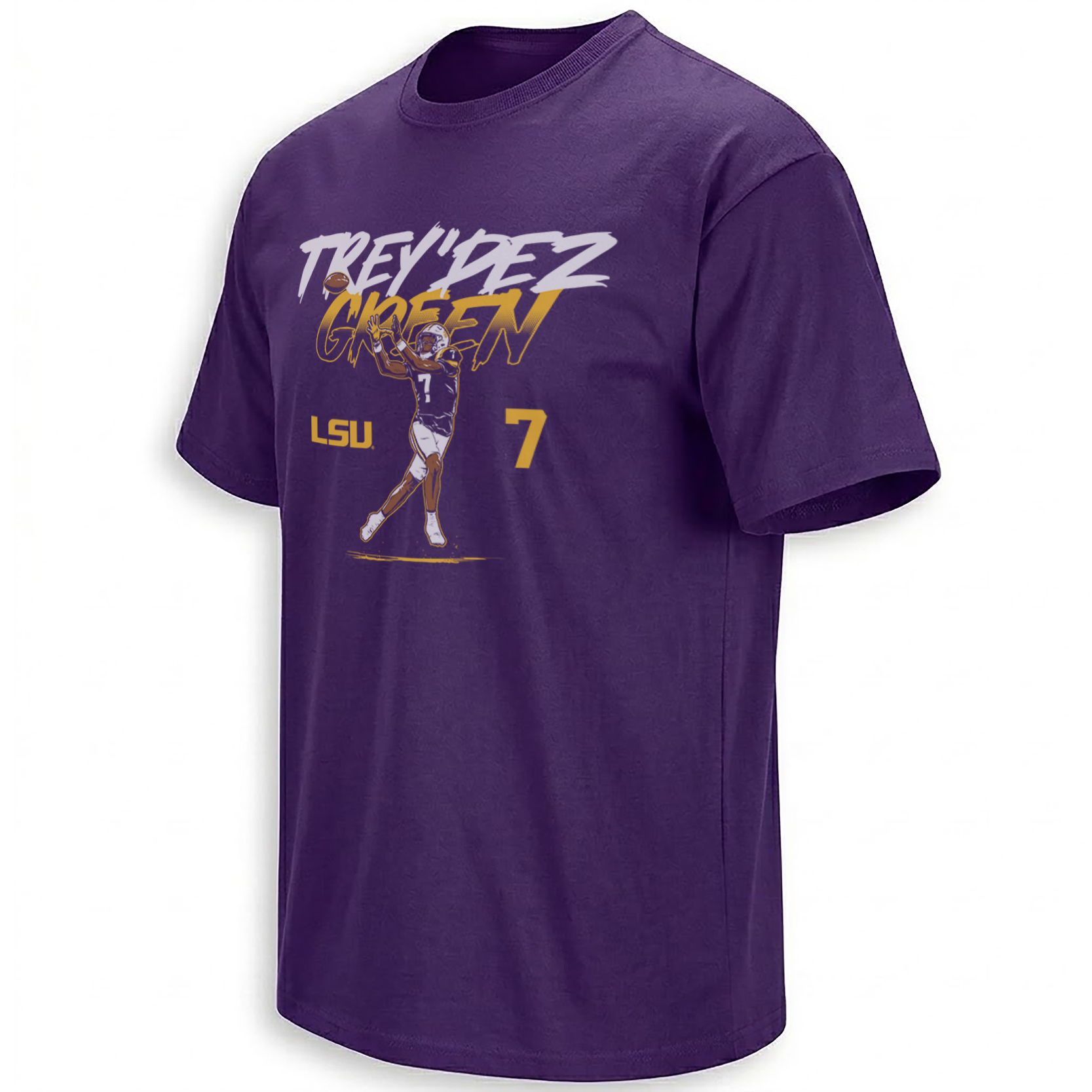
The graphic treats the number as LSU fans do: not simply as uniform identification, but as a badge attached to playmaking expectation.
View the No. 7 piece →Two No. 7s Make 2026 Historically Different
Green is not carrying the number alone. LSU also awarded No. 7 to veteran linebacker Whit Weeks.
The program has previously recognized an offensive and defensive No. 7 in the same era, but 2026 represents the first time two newly selected players are both actually able to wear the number on the field rather than one using a commemorative patch because of positional numbering rules.
That gives LSU a symmetry it clearly likes: Green as the mismatch on offense, Weeks as the disruptive veteran on defense.
The Number Is Now Part of Green’s 2026 Search Identity
This is where jersey traditions become particularly powerful in college football culture. A player name can be temporary. A number can connect generations.
Green’s No. 7 season immediately places him into searches and conversations involving Peterson, Mathieu, Fournette, D.J. Chark, Grant Delpit and the other players who carried the number before him.
The broader NCAA Shirts archive tracks similar college football traditions, while the Trey’Dez Green design search collects graphics tied specifically to his LSU career.
Frequently Asked Questions
Who is wearing LSU No. 7 in 2026?
Tight end Trey’Dez Green will wear No. 7 on offense and linebacker Whit Weeks will wear No. 7 on defense.
Why is LSU No. 7 important?
The number has become a program tradition associated with elite playmakers, with previous wearers including Patrick Peterson, Tyrann Mathieu and Leonard Fournette.
What did Trey’Dez Green do in 2025?
He caught 33 passes for 433 yards and seven touchdowns, setting LSU’s single-season receiving touchdown record for a tight end.
Why could Green have a bigger role in 2026?
His 6-foot-7 frame, receiving ability and positional flexibility give Lane Kiffin’s offense an unusual matchup weapon who can line up as a traditional tight end, in the slot or outside.
Trey’Dez Green Shirt marks the LSU tight end receiving the iconic No. 7 for 2026, connecting his record-setting touchdown production, enormous mismatch potential and new role in the Lane Kiffin era to one of LSU football’s most recognizable traditions.