The Tip-In Poster Turns OG Anunoby’s Game 4 Moment Into Knicks Renaissance Myth
OG Anunoby’s putback did not only finish a Finals comeback. In this poster, it becomes something closer to a painted legend — a New York basketball scene lifted out of the box score and placed into the language of classical art.
The Knicks’ Game 4 comeback already felt too large for ordinary sports language. New York had been down 29 to San Antonio, the Finals looked ready to tilt in another direction, and then the night slowly began to change shape. By the final seconds, the whole game had narrowed into one loose ball, one leap, and OG Anunoby’s tip-in at the rim.
That basket gave the Knicks a 107-106 win, a 3-1 series lead, and one of the cleanest images of their modern postseason life. It was a basketball play, but it behaved like a tableau: bodies gathered under the rim, tension suspended in the air, the ball becoming the center of the scene, and the crowd about to realize what had happened.
That is why The Tip-In Poster works as a Renaissance-style fan artifact. It treats the moment not like a meme and not like a stat graphic, but like a painting of a miracle. The design understands that some plays become highlights, while others become myths.
The play became myth because it already looked like art: the bodies, the reach, the suspended ball, and the city waiting for the ending to reveal itself.
Why the Tip-In Works as Renaissance Basketball
Renaissance-inspired sports art works best when the moment already has weight, gesture, and consequence. Anunoby’s putback had all three. The play was not a casual rebound. It was a final-second act that completed a historic comeback and changed the emotional direction of the Finals.
The drama is built into the scene. A missed shot creates uncertainty. The rebound creates motion. The tip-in creates resolution. In classical composition terms, the eye knows exactly where to go: toward the ball, the hand, the rim, and the figure who turns chaos into order.
That is why this poster treatment feels more natural than it might sound at first. Knicks fans were already treating the play like a sacred image. The artwork simply makes that feeling visible.
The Poster as a Fan-Culture Painting
The Tip-In Poster does not flatten Game 4 into a single slogan. It expands the moment. By using a Renaissance-style visual language, the design gives the play a sense of age before it is even old. It makes the comeback feel like something pulled from a museum wall rather than a phone screen.
That matters because Finals moments move quickly online. Clips loop for a day, captions change, and the next game starts demanding attention. A poster like this slows the moment down. It asks fans to look at the tip-in not only as the winning play, but as the visual center of a larger New York basketball story.
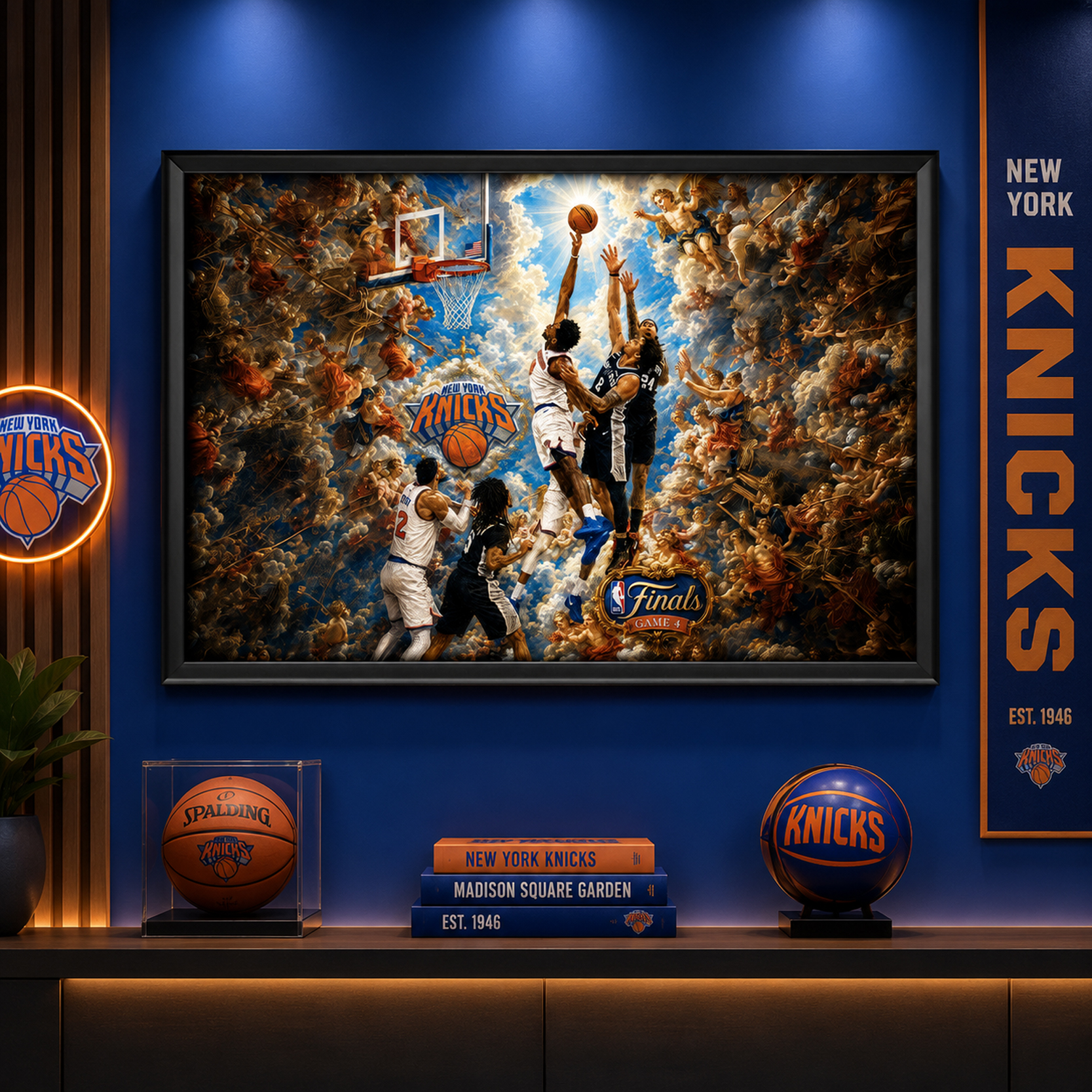
A dramatic art-poster reading of Anunoby’s putback, turning the Game 4 finish into a painted Knicks myth.
View the piece →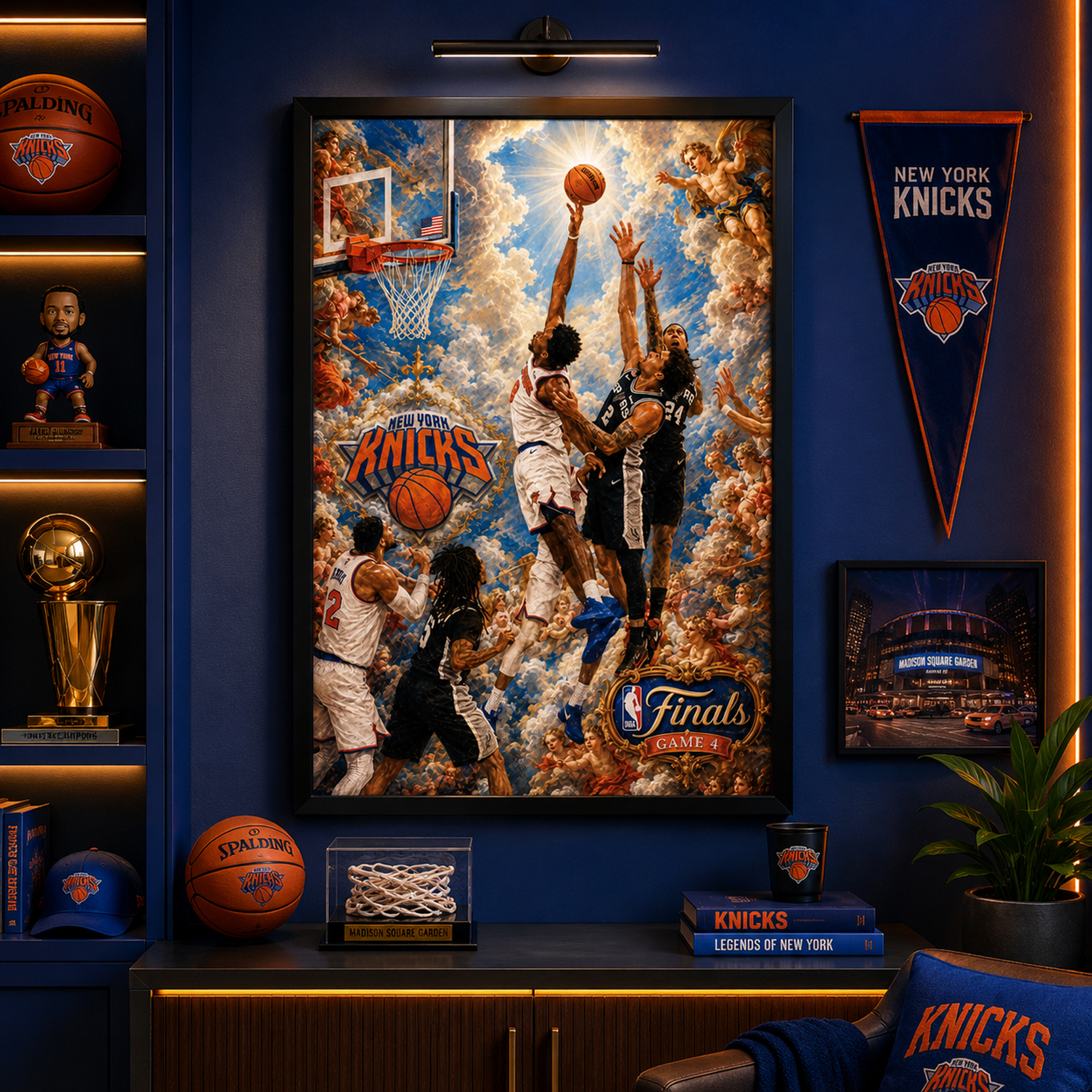
A second visual angle on the same Finals memory, built like a gallery piece for the Knicks’ comeback archive.
Open the design →Design Language: Museum Tone, Garden Noise
The strongest part of the artwork is the contrast. The subject is loud: Knicks Finals basketball, a 29-point comeback, a last-second putback, the Garden living and dying with every bounce. But the visual language is patient. It frames the chaos with the gravity of an old painting.
That contrast gives the poster its power. The Knicks orange and blue still matter because they keep the piece tied to New York identity, but the Renaissance treatment makes the color feel almost ceremonial. The figures become more than players in a scramble. They become part of a composition about rescue, timing, pressure, and release.
The poster also understands the emotional shape of Game 4. It was not clean. It was not calm. It was a night of collapse, resistance, and sudden salvation. Renaissance-style framing works because it lets the play feel dramatic without needing to shout.
How Fans Turn Highlights Into Sacred Images
Sports fans often talk about big plays like they are paintings before anyone actually paints them. They remember the body angle, the defender’s reach, the crowd behind the basket, the scoreboard pressure, and the strange stillness right before the arena erupts.
Anunoby’s tip-in has that quality. It can be frozen into one image and still tell the story. A fan who knows the game does not need the full video to understand the stakes. The leap, the rim, and the ball are enough.
That is why the poster belongs inside the internet conversation around Game 4. It takes a moment that was already being replayed, clipped, captioned, and argued over, then gives it a slower and more permanent form.
Why This Is Different From a Standard Game 4 Graphic
Many Game 4 designs focus on the score, the comeback number, or the phrase fans shouted after the basket. This one takes another route. It treats the play as a visual event first. The product is not trying to be the loudest reaction in the room. It is trying to become the image that survives after the noise settles.
That gives The Tip-In Poster a different kind of fan value. It is less about instant meme speed and more about long-term memory. It belongs to the side of sports culture where a highlight becomes a print, a wall piece, a visual archive, and a way to remember the exact second the season seemed to tilt.
For Knicks fans, that matters because this Finals run has created more than scores. It has created scenes. Anunoby’s tip-in is one of them.
Where It Fits in the Knicks Finals Visual Archive
The 2026 Knicks Finals run has produced many kinds of visual language: comeback shirts, meme captions, Brunson devotion, Game 4 tip-in logos, role-player cinema, and now Renaissance-style poster art. The The Tip-In Poster fits into that archive by giving the night its most museum-like treatment.
It also belongs naturally beside the wider New York Knicks Shirts collection, where each graphic can read like another page from the city’s postseason memory. On the broader basketball side, the NBA Shirts archive tracks the same process: a play becomes a phrase, a phrase becomes a visual, and sometimes a visual becomes something close to myth.
The strongest thing about this poster is that it trusts the moment enough to slow it down. Instead of chasing the loudest caption, it turns Anunoby’s putback into a scene Knicks fans can study like a piece of Finals folklore.
Why the Renaissance Treatment Has Life Beyond Game 4
The best poster art does not expire with the next game. It survives because it captures the emotion underneath the result. Here, that emotion is not just joy. It is disbelief, relief, history, and the sense that a single touch at the rim can carry years of waiting.
That is why the Renaissance approach works beyond the immediate highlight cycle. The poster is not only about the Knicks beating the Spurs by one point. It is about the way fans turn one play into memory, and then memory into art.
FAQ
Why is The Tip-In Poster connected to OG Anunoby?
The poster is connected to Anunoby because it interprets his Game 4 tip-in for the Knicks as a Renaissance-style fan-art scene, turning the final-second putback into a visual memory.
Why does the Renaissance art style fit this Knicks moment?
The style fits because Anunoby’s putback already had the drama of a classical composition: a suspended ball, bodies gathered under the rim, enormous stakes, and a final gesture that changed the game.
How is this different from a normal Knicks Game 4 shirt?
A normal Game 4 shirt might focus on the score or slogan. This poster focuses on the image itself, treating the tip-in as a piece of fan mythology rather than only a sports result.
Why did OG Anunoby’s tip-in become such a memorable visual?
It became memorable because it completed a 29-point Finals comeback in the final seconds, giving Knicks fans one clear image to attach to the entire emotional arc of Game 4.
For readers following the visual language of this Finals run, the poster sits naturally beside the latest New York Knicks Shirts and the broader NBA Shirts archive — a gallery-style record of the night Anunoby’s tip-in became Knicks folklore.
The Tip-In Poster turns OG Anunoby’s Knicks Game 4 Finals putback into Renaissance-style fan art, capturing New York’s 29-point comeback as a dramatic basketball scene built for memory, myth, and orange-and-blue belief.