“That Song Was on Digimon: The Movie” Is an Extremely Specific Millennial Reflex
Twenty-six years after the American movie arrived, one soundtrack still has the power to make grown adults interrupt conversations about Smash Mouth, Barenaked Ladies or ska music just to explain where they heard it first.
There is a particular kind of Digimon fan who cannot hear the opening seconds of a familiar late-1990s song without supplying unsolicited historical context. Somebody plays “One Week.” Somebody else mentions Smash Mouth. A ska track appears in a playlist. Before the conversation can move anywhere useful, the sentence arrives: that song was on Digimon: The Movie.
The joke works because the soundtrack genuinely was ridiculous.
The 2000 American release gathered together an almost concentrated sample of turn-of-the-millennium alternative pop culture: Smash Mouth’s “All Star,” Barenaked Ladies’ “One Week,” Fatboy Slim’s “The Rockafeller Skank,” The Mighty Mighty Bosstones’ “The Impression That I Get,” Less Than Jake’s “All My Best Friends Are Metalheads” and Len’s version of “Kids in America.”
Then it added original Digimon music such as “Digi Rap” and “Hey Digimon.” The result sounds less like a conventional film score and more like somebody emptied an entire 2000 CD wallet into one animated movie.
The movie became a time capsule partly because its soundtrack never tried to be timeless. It sounds aggressively, gloriously like the year 2000.
Yes, “All Star” Really Was in Digimon Before Shrek
This is probably the fact that creates the most nostalgic evangelism. *Shrek* turned “All Star” into one of the most recognizable movie-song pairings of the era, but *Digimon: The Movie* reached American theaters in October 2000, months before *Shrek* arrived in 2001.
For children who saw Digimon first, that created a permanent memory conflict. Later culture may insist that “All Star” belongs to the green ogre. Their brain insists there is a Digimon somewhere nearby.
The same thing happens with “One Week.” The Barenaked Ladies track accompanies Tai and Izzy in the movie, and fans still describe hearing the song decades later and mentally returning to Digimon.
The Soundtrack Was Weirdly Good at Introducing Kids to Genres
Plenty of children watching Digimon in 2000 did not know what ska-punk was. They simply knew the horn-heavy song playing over an animated sequence sounded good.
Years later, fans have described the soundtrack as formative because it accidentally introduced them to artists they might never have encountered otherwise. Less Than Jake, the Bosstones, Fatboy Slim and Barenaked Ladies were not “kids music,” but the movie placed them inside a children’s anime release anyway.
That accidental education is one reason the soundtrack has aged differently from many tie-in albums. Adults revisit it not only because they remember Digimon but because they recognize how many future musical associations started there.
The American Movie Itself Was Already a Strange Cultural Object
Part of the nostalgia comes from how specifically American the release feels. The English-language *Digimon: The Movie* was created by combining material from multiple Japanese Digimon films into one theatrical feature.
That construction produced a film whose pacing, jokes, dubbing and soundtrack all carry unmistakable Y2K fingerprints. It is not remembered as a pristine adaptation. It is remembered as something more chaotic and arguably more culturally interesting: a localization from an era when distributors were willing to reshape anime aggressively for American children.
Fans revisiting the movie in 2025 and 2026 often describe exactly that contradiction. The structure is strange. The music choices are excessive. The nostalgia is overpowering. Somehow all three things support each other.
The joke is not simply “Digimon fans like Digimon.” It is about adults recognizing unrelated late-’90s songs in everyday life and being physically unable to stop themselves from identifying the movie soundtrack connection.
The Shirt Turns That Behavior Into the Whole Punch Line
The That Song Was on Digimon the Movie Shirt does not need characters or an elaborate anime battle. The funniest part is the text itself.
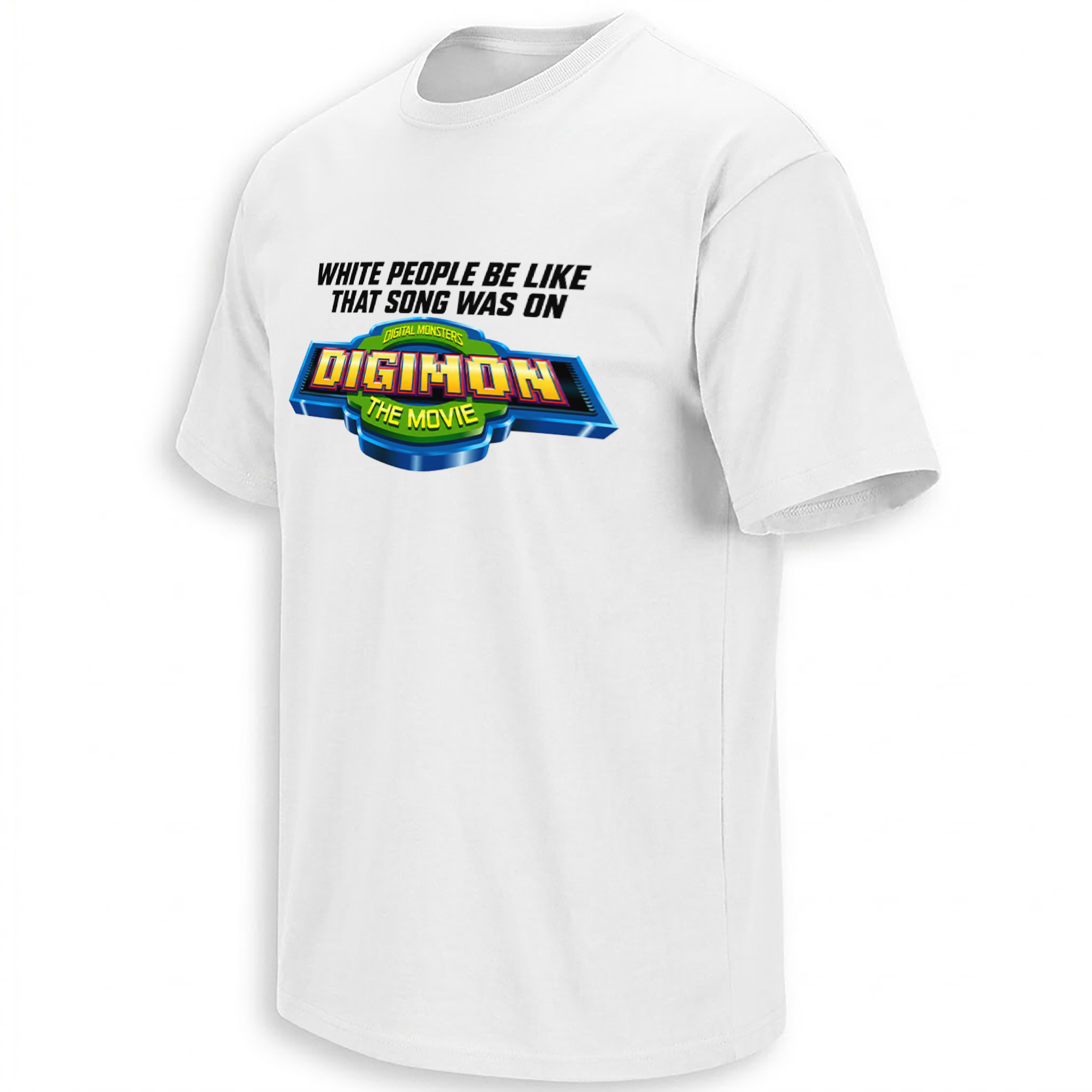
The graphic uses the internet-meme setup “White People Be Like,” then makes the behavior absurdly specific. The humor is exaggeration rather than a serious demographic claim: it sketches the person who has become so attached to this soundtrack that every random playlist becomes a chance to give an unsolicited Digimon history lesson.
Visually, the large bright logo anchors the design in VHS/DVD-era anime marketing. Blue, yellow, green and red feel intentionally loud. The heavy condensed setup text has none of the elegance of modern minimal fashion, which is exactly correct for a joke about people whose childhood media memories come from the year 2000.
Twenty-Six Years Later, the Soundtrack Is the Cultural Artifact
Movies are often remembered through characters or plot. *Digimon: The Movie* has developed a second route into memory: somebody hears a song.
That is powerful because music can trigger nostalgia outside the original fandom. You do not have to sit down and rewatch the film. “The Impression That I Get” can come on in a grocery store and suddenly an animated movie from childhood reappears in your head.
Ellie Shirt currently places the design in its verified Movies collection , with newer cultural-moment graphics also available through Newest .
Frequently Asked Questions
Was “All Star” by Smash Mouth really in Digimon: The Movie?
Yes. “All Star” appears in the 2000 American movie and on its official soundtrack.
Was “One Week” in Digimon: The Movie?
Yes. Barenaked Ladies’ “One Week” is another major soundtrack song that fans continue associating with the film.
What other famous songs were on the soundtrack?
The soundtrack also included “The Impression That I Get,” “All My Best Friends Are Metalheads,” “Kids in America” and “The Rockafeller Skank,” among others.
Why do fans still talk about the soundtrack?
Its dense mixture of ska, alternative rock, pop and Digimon-specific music has made it an unusually vivid snapshot of late-1990s and early-2000s youth culture.
What is the joke behind the shirt?
It exaggerates the real nostalgia habit of fans immediately pointing out that a familiar song they hear elsewhere also appeared in Digimon: The Movie.
The Digimon soundtrack meme graphic captures a very specific kind of millennial brain wiring created by one exceptionally overloaded movie soundtrack.
That Song Was on Digimon the Movie Shirt turns the film’s famously stacked 2000 soundtrack into a millennial nostalgia meme for anyone who still hears “All Star,” “One Week” or ska-punk and immediately thinks Digimon.