
Tampa Bay Devil Rays 1998: Why the Rainbow Era Still Matters in 2026
As Tampa Bay prepares for another World Series, the original Devil Rays identity is back in the conversation. The rainbow uniforms, inaugural-season memories and strange beauty of 1998 still hold a special place in baseball culture.
Before the Tampa Bay Rays became American League champions, before the dramatic October moments and before the franchise established a reputation for winning against baseball’s financial giants, there was a new expansion team wearing one of the most colorful uniforms in Major League Baseball.
On March 31, 1998, the Tampa Bay Devil Rays played their first regular-season game at Tropicana Field. Nearly three decades later, that inaugural identity feels unexpectedly relevant again. With the Rays having secured the 2026 American League pennant and preparing to face the Milwaukee Brewers in the World Series, fans have another reason to revisit where Tampa Bay baseball began.
What makes that connection fascinating is the contrast. The 1998 Devil Rays were not a winning team. The 2026 Rays are playing for a championship. Yet the original rainbow artwork bridges the eras through a visual identity that fans have never completely let go.
March 31, 1998: The Night Tampa Bay Baseball Began
For years, the Tampa Bay region had pursued its own Major League Baseball franchise. When the Devil Rays finally took the field against the Detroit Tigers, the occasion carried a significance that could not be measured by the scoreboard alone.
Wilson Álvarez threw the first pitch in franchise history to Detroit leadoff hitter Brian Hunter. Wade Boggs hit Tampa Bay’s first home run. Dave Martinez recorded the club’s first hit. The inaugural crowd at Tropicana Field numbered 45,369, according to MLB’s official franchise timeline.
The Tigers won 11–6, an outcome that established an early distinction between sporting success and civic importance. Tampa Bay had lost its opening game, but it finally had a Major League club of its own. The following day, the Devil Rays recorded their first victory, defeating Detroit 11–8 behind Rolando Arrojo.
The inaugural season finished at 63–99. That record explains why the 1998 team is remembered differently from Tampa Bay’s later postseason contenders. Its historical importance comes from the beginning itself: the first ticket, the first pitch, the first home run and the gradual creation of a regional baseball identity.

Why the Original Rainbow Identity Refuses to Disappear
The original Devil Rays branding looked unlike almost anything else in baseball. Its purple, blue, green and yellow gradient stretched across the lettering, while a ray graphic gave the uniform a distinctly Florida-inspired personality.
Many baseball uniforms are built around restrained color combinations and traditional lettering. Tampa Bay chose something closer to the visual confidence of late-1990s entertainment culture. The typography looked energetic, the gradient felt experimental, and the overall composition seemed to belong to the era of colorful sports graphics, oversized logos and bold souvenir artwork.
That is part of its appeal in 2026. A design that once reflected contemporary trends now functions as a recognizable historical marker. The colors instantly identify a period in franchise history, even without a particular player or game attached.
The Devil Rays name was retired ahead of the 2008 season, when the franchise adopted its modern Rays identity. But the original artwork continued to return through merchandise, commemorative programs and throwback uniforms. The organization itself celebrated the inaugural team in 2018, twenty years after its first game.
The 1998 Inaugural Season Design as a Baseball Archive
The Devil Rays 1998 Inaugural Season Shirt draws from this exact visual tradition. Rather than copying a modern championship layout, it uses crossed baseball bats, baseballs, a diamond-shaped composition and rainbow lettering to establish the mood of an old ballpark souvenir.
Its date carries the strongest historical meaning. The number 1998 is not attached to a championship claim or an invented milestone. It identifies the year the franchise first appeared in Major League Baseball.
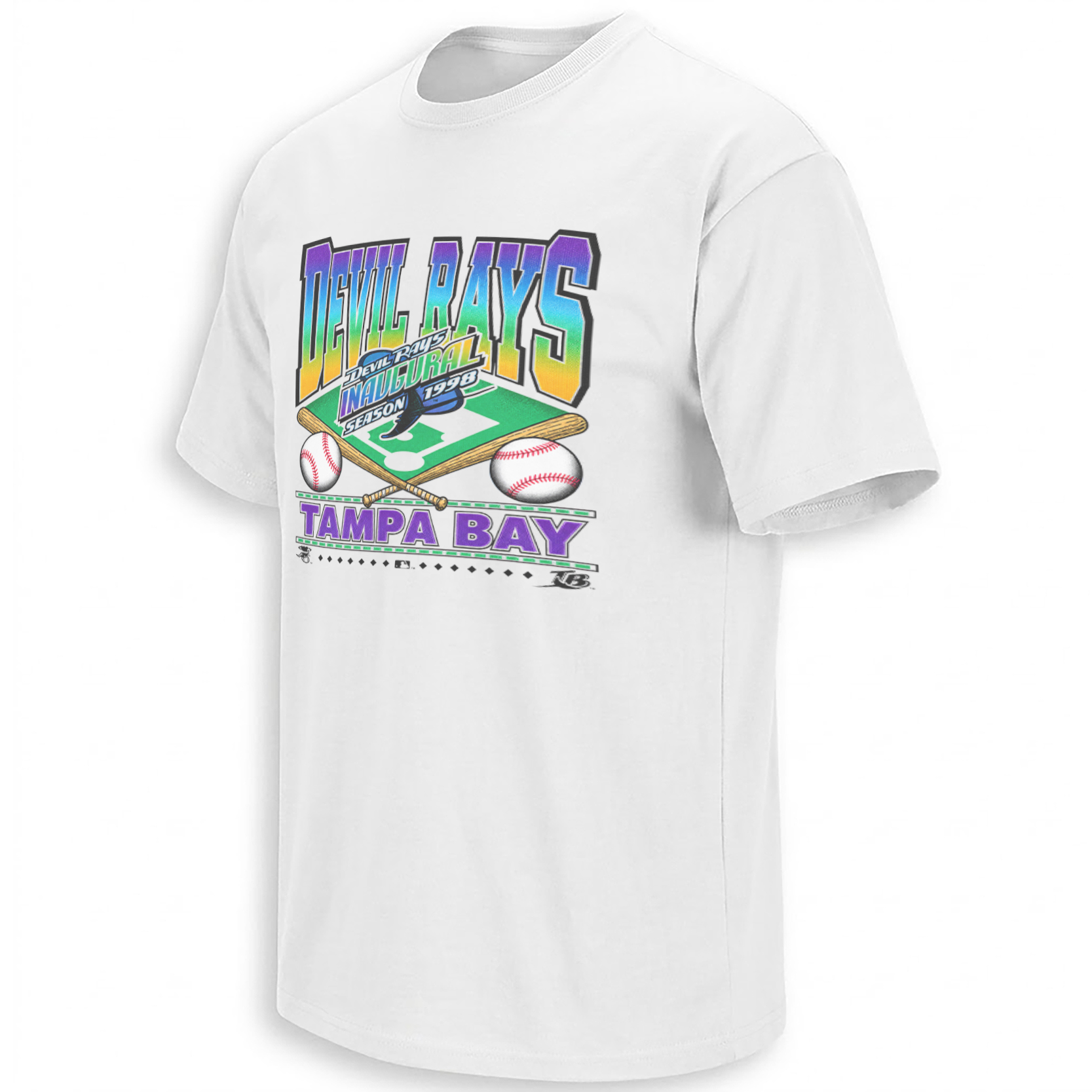
That styling matters because baseball nostalgia often survives through objects rather than statistics alone. An old cap, a game program or a colorful jersey can recall family visits to Tropicana Field and the excitement surrounding a franchise’s arrival. Retro apparel becomes part of that same visual archive.
Why 2026 Has Brought the Old Devil Rays Back Into Focus
On October 19, 2026, Tampa Bay defeated Cleveland 7–3 in ALCS Game 6 and advanced to its third World Series. Junior Caminero and Yandy Díaz supplied crucial two-run home runs, while Freddy Peralta earned ALCS MVP honors.
That achievement creates an unusual historical arc: the franchise that began as an expansion experiment in 1998 is now preparing for another chance to win its first World Series title.
It has also brought uniform history back into fan discussion. In a Tampa Bay Rays Reddit thread posted October 20, supporters debated which uniforms the team should wear in the World Series, with some expressing enthusiasm for a stronger return to the original Devil Rays look. Those comments are individual fan opinions, not evidence of any confirmed rebrand.
The discussion illustrates a broader point: Tampa Bay’s various uniform eras represent different forms of fan memory. The modern Rays branding is connected to sustained competitiveness, while the original Devil Rays gradient brings back the emotion of baseball’s arrival in the region.
From Expansion Baseball to the World Series
The journey from 1998 to 2026 has included playoff breakthroughs, two previous World Series appearances and generations of supporters who discovered Tampa Bay baseball at very different stages of its development.
For someone who attended the inaugural game, 1998 means the excitement of a new beginning. For a fan who first followed the club in 2008, the franchise may be defined by an unexpected pennant and a new visual identity. For younger supporters, Junior Caminero and the 2026 team are creating another entry point.
All three belong to the same baseball history. The wider Tampa Bay Rays collection connects these eras through retro graphics, player moments and modern playoff imagery. Within the broader MLB apparel archive, the Devil Rays rainbow represents one of the sport’s most immediately recognizable late-1990s identities.
The 1998 season and the 2026 World Series appearance should not be presented as equivalent achievements. Their connection is cultural: one marks the foundation of Tampa Bay baseball, while the other shows how far the franchise has traveled.
Frequently Asked Questions
When did the Tampa Bay Devil Rays play their first MLB game?
They made their regular-season debut against the Detroit Tigers at Tropicana Field on March 31, 1998.
What was the result of the Devil Rays’ inaugural game?
Detroit defeated Tampa Bay 11–6 before a crowd of 45,369.
Why were the original Devil Rays uniforms so colorful?
The original branding used multicolored gradient lettering and a stingray graphic, creating an unusually expressive late-1990s baseball identity.
When did the Devil Rays become the Tampa Bay Rays?
The franchise adopted the Tampa Bay Rays name and a revised visual identity ahead of the 2008 season.
Why is the 1998 Devil Rays identity relevant in 2026?
Tampa Bay’s return to the World Series has renewed interest in the franchise’s complete history, including its original rainbow-era uniforms and inaugural season.
One Franchise, Many Eras
Baseball history is not preserved only by championship banners. It is also carried by the colors people remember, the first games they attended and the familiar symbols that continue to appear decades later. The 1998 inaugural-season graphic belongs to that tradition: a visual reminder of where Tampa Bay’s baseball story started, at a moment when another important chapter is about to begin.
The Devil Rays 1998 Inaugural Season Shirt revisits Tampa Bay’s original rainbow baseball identity, connecting the franchise’s first season at Tropicana Field with renewed retro nostalgia during its 2026 World Series run.