
Starbury No. 3 as Renaissance Art
Stephon Marbury’s journey from Coney Island playgrounds to Madison Square Garden and basketball immortality in China has always felt too large for a conventional throwback jersey. This front-and-back artwork treats it like mythology.
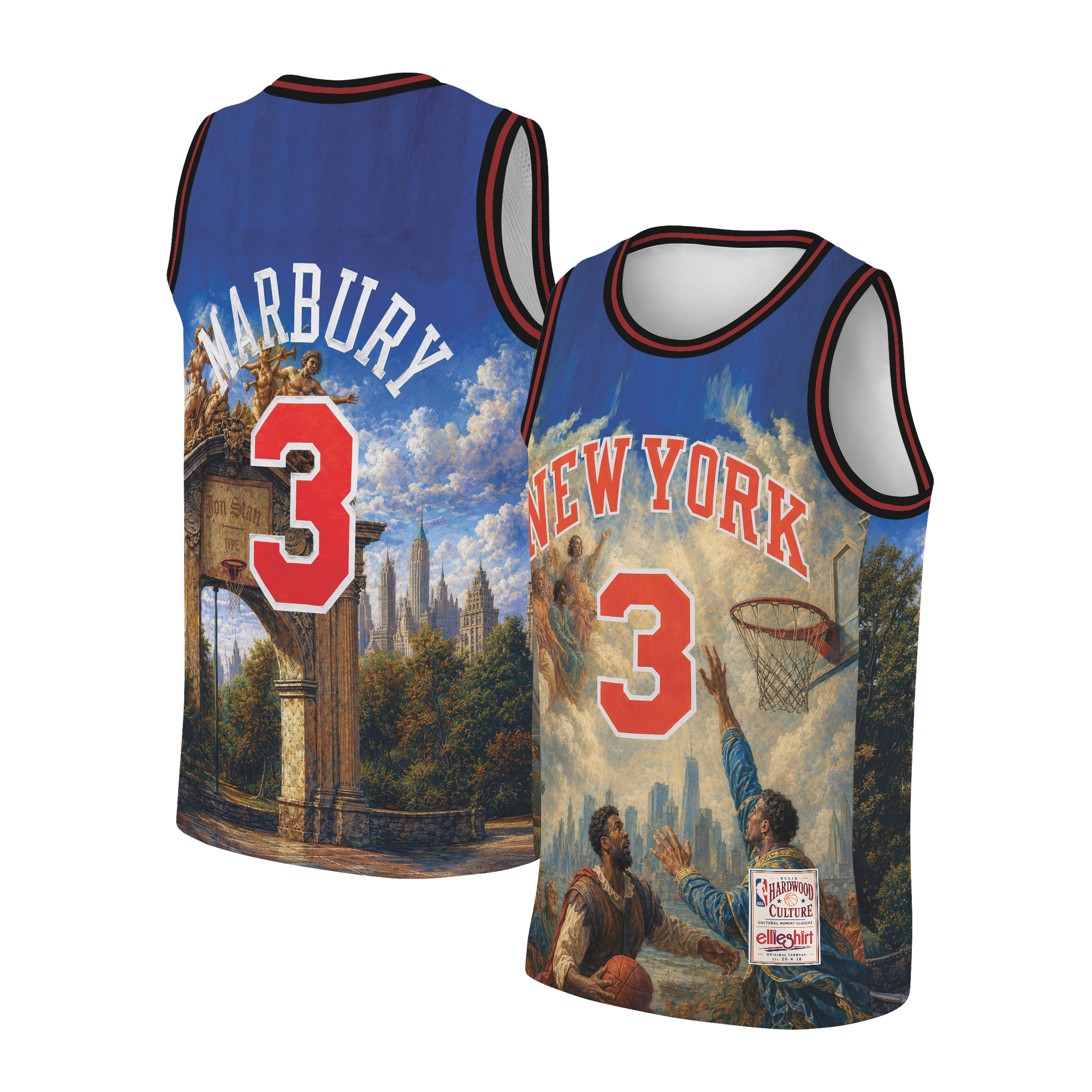
In July 2026, a familiar blue-and-orange No. 3 returned in an unfamiliar form. Mitchell & Ness and New York artist Jon Stan reimagined Stephon Marbury’s Hardwood Classics jersey as wearable art, filling its surface with classical figures, city architecture, playground basketball and the visual language of an old-world masterpiece.
The concept worked because Marbury’s relationship with New York was never confined to one professional season. He was born in Brooklyn, raised inside the basketball mythology of Coney Island and became famous long before an NBA uniform confirmed what the city already believed about him.
The STARBURY 3 JERSEY translates that history into a full canvas. The front reads like a Renaissance court portrait interrupted by street basketball. The back transforms his nickname and No. 3 into a monumental identity panel, making the jersey feel equal parts player uniform, neighborhood mural and museum textile.
The artwork does not place Marbury inside history. It suggests that New York basketball had already painted him into its mythology.
A Jersey Reframed as a Museum Canvas
Traditional throwback jerseys rely on recognition. The familiar colors, surname and number are usually enough to trigger memory. This design asks what happens when those familiar elements become only the underlying structure.
Instead of leaving the jersey surface clean, the artwork fills it with visual narrative. Figures, buildings, basketball courts and architectural forms gather around the number like scenes inside a historical painting.
That density changes how the piece is read. The jersey no longer functions only as evidence that Marbury once played for New York. It becomes an interpretation of what his New York identity meant: talent shaped by the city, ambition born on public courts and a career that repeatedly moved between glory, conflict and reinvention.
The Front Reads Like the Origin Chapter
The front of the jersey functions as the narrative side. Its layered imagery places basketball inside a larger urban and artistic environment rather than isolating Marbury in a standard action pose.
Classical figures introduce the gravity of Renaissance painting, but playground hoops prevent the piece from becoming detached from the street. The two visual traditions collide: museum composition and public-court basketball.
That collision is essential to Marbury’s story. He was a nationally known schoolboy star whose talent emerged from a specific New York basketball ecosystem. The city did not merely serve as his birthplace. It created the language through which his confidence, style and ambition were understood.
Architecture, hoops and classical figures create a layered origin story. The imagery suggests that the player emerged from an environment already full of history, competition and visual drama.
STARBURY and No. 3 become the dominant symbols, transforming a player identifier into something closer to a carved inscription or central panel in an altarpiece.
The Back Turns a Nickname Into a Monument
On the back, the design becomes more direct. The name STARBURY occupies the traditional surname position, while the number 3 becomes the primary architectural form.
This is where the artwork most clearly behaves like a jersey. The hierarchy is familiar: name above, number below. Yet the internal imagery prevents either element from remaining simple typography.
The number is not merely printed. It is inhabited. Figures and city references transform its interior into another visual field, allowing the most recognizable symbol of Marbury’s New York years to carry the story rather than simply label it.
The blue-and-orange palette preserves New York recognition, while parchment, stone and aged-gold tones introduce museum atmosphere. The contrast between classical bodies and playground basketball creates the central idea: street culture is being granted the scale and dignity traditionally reserved for historical painting.
Why Number 3 Belongs to the New York Chapter
Marbury wore different numbers during different stages of his professional career, but No. 3 remains especially connected to the version of him that returned home to play at Madison Square Garden.
The number also reaches backward. It appeared during earlier chapters of his NBA journey and became part of the broader Starbury visual identity before New York fully claimed it.
In the Renaissance edition, No. 3 functions less like a statistic and more like a family crest. It provides continuity across the conflicting versions of Marbury remembered by fans: playground prodigy, All-Star guard, Knicks hometown return and global basketball icon.
Coney Island Was the First Court in the Myth
New York basketball legends are often remembered through geography. A neighborhood becomes attached to a player’s style, reputation and origin story.
For Marbury, Coney Island carries that role. His rise belonged to a family basketball tradition and a public-school environment where talent became local knowledge before it became national scouting information.
Calling him “Coney Island’s Finest” therefore does more than identify where he came from. It places him inside a neighborhood lineage. The phrase implies that his success carried local history with it every time he entered a larger stage.
Starbury Was Always More Than a Basketball Nickname
“Starbury” combines surname and aspiration so cleanly that it sounds less invented than inevitable. It was large enough to describe the player, the public persona and eventually an entire footwear philosophy.
Marbury’s affordable shoe project challenged the assumption that signature basketball footwear needed luxury pricing to carry cultural value. The brand became part of his identity because it connected celebrity back to access.
That history gives the name additional weight on the jersey. STARBURY does not refer only to a point guard who wore No. 3. It refers to an ecosystem of basketball, fashion, neighborhood pride and the belief that personal mythology could be shared rather than protected by price.
A Brooklyn prodigy whose reputation formed on New York courts before professional basketball could define him.
A Knicks No. 3 carrying the emotional complexity of returning home under Madison Square Garden expectations.
A player who rebuilt his career in China and became a championship figure, cultural hero and symbol of reinvention.
The New York Years Were Never a Simple Homecoming
Marbury’s arrival with the Knicks in 2004 appeared to complete a familiar sports narrative: the Brooklyn-born point guard returning home to lead New York.
Reality was more complicated. His Knicks tenure contained individual production, organizational instability, coaching conflict and intense public scrutiny. The hometown connection amplified every success and every failure.
That complexity makes the Renaissance framing more interesting. Historical art often transforms turbulent lives into composed images. The jersey does something similar, gathering conflict, ambition and memory into one balanced visual field.
China Completed the Reinvention
Marbury’s career did not end when his NBA narrative became difficult. It moved to China, where he transformed from former American star into championship leader and one of the most celebrated international figures in Chinese basketball.
His success there changed how the entire career could be read. The story was no longer a decline from New York expectations. It became a second life built through adaptation, trust and cultural connection.
Statues, championships and enduring recognition in Beijing gave Marbury something rare: a legacy with two geographical centers. New York remained the origin. China became the reinvention.
Why Renaissance Imagery Fits Marbury Specifically
The Renaissance is commonly associated with rebirth. That meaning makes the style more than decorative when applied to Marbury.
His career contains several rebirths: neighborhood prodigy to NBA star, hometown savior to controversial figure, former NBA guard to Chinese basketball legend.
The artwork therefore creates a conceptual connection between form and biography. Classical imagery supplies grandeur, but the deeper connection lies in transformation. Marbury repeatedly became visible again in a new form after the previous narrative appeared complete.
Street Basketball Deserves Historical Scale
One of the design’s strongest ideas is the refusal to place playground basketball below museum art. The imagery treats hoops, city surfaces and neighborhood memory as worthy of the same visual seriousness as ancient architecture and classical figures.
That hierarchy reversal reflects how basketball actually functions in New York. Public courts are not merely recreational spaces. They are stages where reputation, style and local history are produced.
By merging those courts with Renaissance composition, the jersey argues that New York basketball culture already possesses its own epics, heroes and sacred locations.
A Full Front-and-Back Story Changes How the Jersey Is Worn
Many graphic jerseys rely on one dominant side. This piece divides its storytelling responsibilities.
The front rewards close viewing through environmental detail. The back supplies immediate recognition through STARBURY and No. 3. One side explains the world; the other names the figure inside it.
That relationship makes the jersey feel complete from multiple viewing angles. It does not treat the back as secondary branding. The back delivers the visual climax.
Why the Design Arrived at the Right New York Moment
The artwork appeared during a period when New York basketball had regained championship confidence and older Knicks identities could be revisited from a new emotional distance.
Marbury’s tenure no longer needs to be judged only through the frustration surrounding the teams of his era. Time allows supporters to separate the player’s larger New York meaning from the organization’s instability.
The result is a more complete form of nostalgia. It does not claim that every chapter was successful. It recognizes that the image of Starbury in No. 3 still belongs to the city’s basketball memory.
The Piece Lives Between Throwback and Contemporary Art
A standard throwback attempts to reproduce the past faithfully. This edition uses the past as raw material.
The silhouette and number structure remain recognizable, but the interior artwork belongs to a contemporary fashion conversation about customization, collage and the transformation of sports uniforms into gallery objects.
That distinction is important. The jersey is not trying to look exactly like something Marbury wore during a game. It is interpreting what his New York jersey means after decades of additional history.
Where the Starbury 3 Jersey Belongs in the New York Archive
The design sits naturally inside the New York Knicks collection, where championship moments, player identities and older city basketball references form a changing visual history.
The broader NBA Shirts collection places it beside the many ways basketball culture converts names, numbers, highlights and personal reinventions into wearable memory.
What separates this piece is its ambition. It does not preserve only a moment from one game. It attempts to hold an entire mythology inside the shape of a jersey.
Frequently Asked Questions
What inspired the Starbury 3 Renaissance Art Jersey?
The concept was inspired by a 2026 Mitchell & Ness and Jon Stan reinterpretation of Stephon Marbury’s No. 3 New York Hardwood Classics jersey as wearable art and a visual tribute to the city.
Why is Stephon Marbury associated with the name Starbury?
“Starbury” combines Marbury’s surname with his star identity and later became the name of his affordable footwear and apparel project.
What does the front of the jersey represent?
The front combines classical figures, city architecture and playground basketball to present Marbury’s New York origins as a Renaissance-style narrative scene.
What appears on the back of the jersey?
The back centers the STARBURY name and No. 3 inside an ornate full-canvas composition, turning the traditional jersey identity panel into a monumental artwork.
Why is No. 3 important to Marbury’s New York legacy?
No. 3 was the number Marbury wore during his hometown Knicks chapter and remains one of the clearest visual symbols connecting Starbury to New York basketball.
Why does Renaissance imagery fit Marbury’s career?
Renaissance imagery evokes rebirth, matching a career that moved from New York prodigy to NBA star, controversial hometown figure and eventually a championship icon in China.
The Starbury 3 Jersey transforms Stephon Marbury’s nickname, No. 3 and Coney Island roots into a full Renaissance-style composition. More city basketball artifacts can be found through the New York Knicks archive and the wider NBA collection.
Starbury 3 Jersey transforms Stephon Marbury’s New York basketball legacy into a full front-and-back Renaissance artwork featuring playground imagery, classical figures, city architecture and his monumental No. 3 identity.