
Spider-Man:
Brand New Day
The Art of a Fresh Start
A brighter suit, raised webs, street-level collisions and a city crowded with dangerous new relationships: Spider-Man’s next chapter rebuilt the familiar visual language of the web-slinger without abandoning the history stitched into it.
The most important word in Spider-Man: Brand New Day is not “new.” It is “day.” The title suggests that Peter Parker has survived a long night and must now step into the light without the relationships, protections and certainty that once defined him. Every web line, red emblem and New York silhouette in this collection records a different part of that difficult beginning.
Released in theaters on July 31, 2026, Spider-Man: Brand New Day begins a new period in Tom Holland’s Spider-Man story after the memory-erasing conclusion of No Way Home. Peter remains New York’s masked hero, but the personal network beneath the mask has been broken.
That isolation gives the new film and its visual culture a distinctive tension. Spider-Man has never looked more recognizably like the classic comic-book hero, yet Peter has rarely been required to define himself with so little emotional support. The costume appears familiar because the life inside it is changing.
The classic silhouette returns
Brighter red and blue, raised webbing and a stronger spider emblem reconnect the screen version of Spider-Man with his comic-book image.
Peter rebuilds without recognition
The world still knows Spider-Man, but the people closest to Peter no longer share the personal history that once existed beneath the mask.
New York becomes physical again
Scorpion, Punisher, Hulk and an expanding group of street threats place the story among rooftops, alleys, vehicles and damaged city blocks.
The suit and July 31 release were introduced through Marvel’s official reveal. Returning-character context was checked against Entertainment Weekly, while the film’s post-release reception and visual emphasis were compared with the Daily Bruin review.
The Suit Says Classic Spider-Man
The first official glimpse of the Brand New Day suit emphasized texture before spectacle. A close view revealed black, raised web lines running across red material, followed by the complete red-and-blue silhouette. The design is modern in its construction but deliberately traditional in its visual vocabulary.
That choice matters after the technologically assisted suits of Peter’s earlier MCU years. This Spider-Man looks less like a young recruit carrying another hero’s equipment and more like an independent New York figure whose identity can be read from three elements: mask, web and spider.
The collection’s first group of designs isolates those elements. Some preserve movement, others imitate comic-book covers, and others reduce the entire character to a single distressed emblem. Together they show how little information is needed before the eye recognizes Spider-Man.
Chapter One · The New Silhouette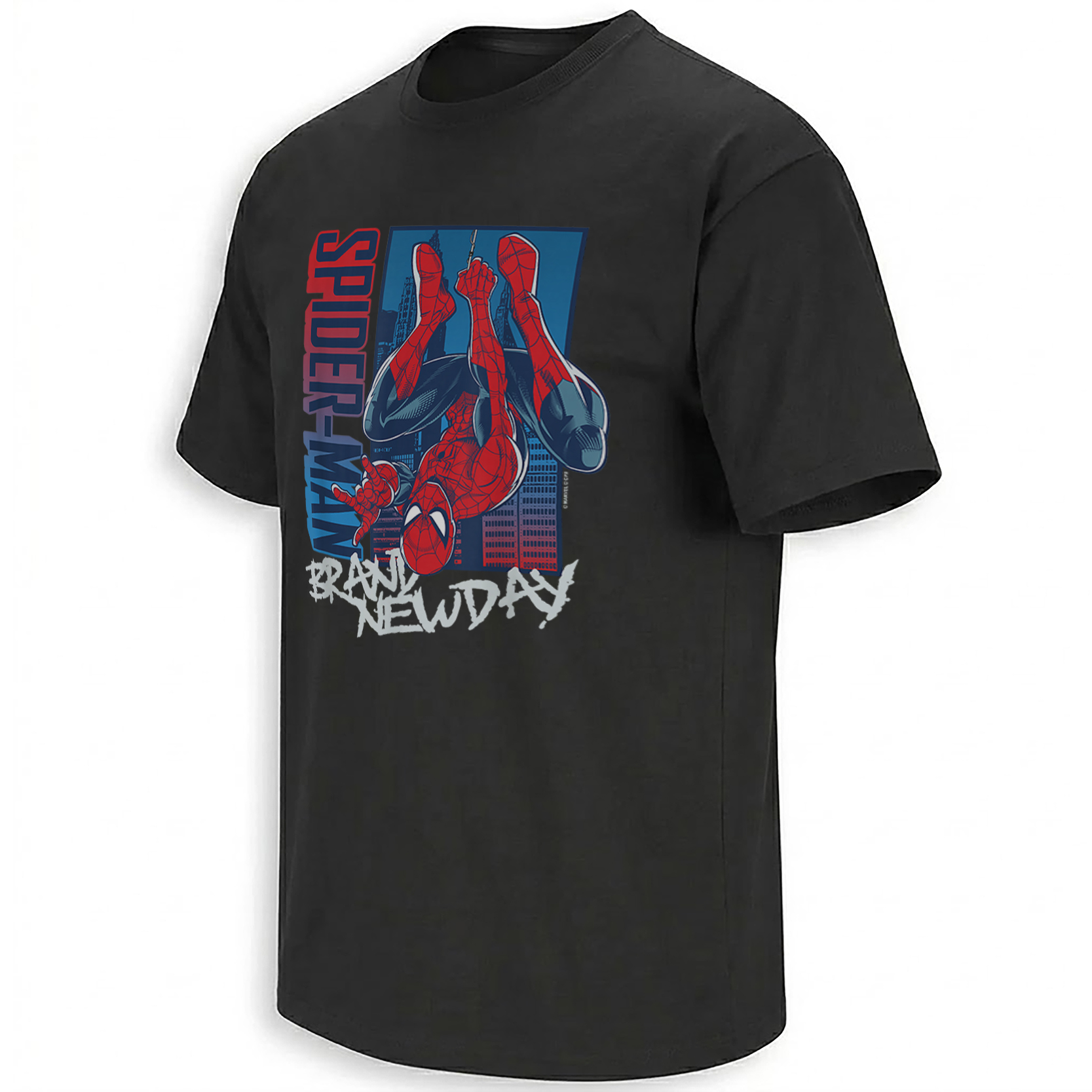
Brand New Day Spidey Shirt
The upside-down swing captures the playful physical grammar that separates Spider-Man from heavier superheroes. The design is less about victory than about the impossible ease with which he occupies New York’s vertical space.
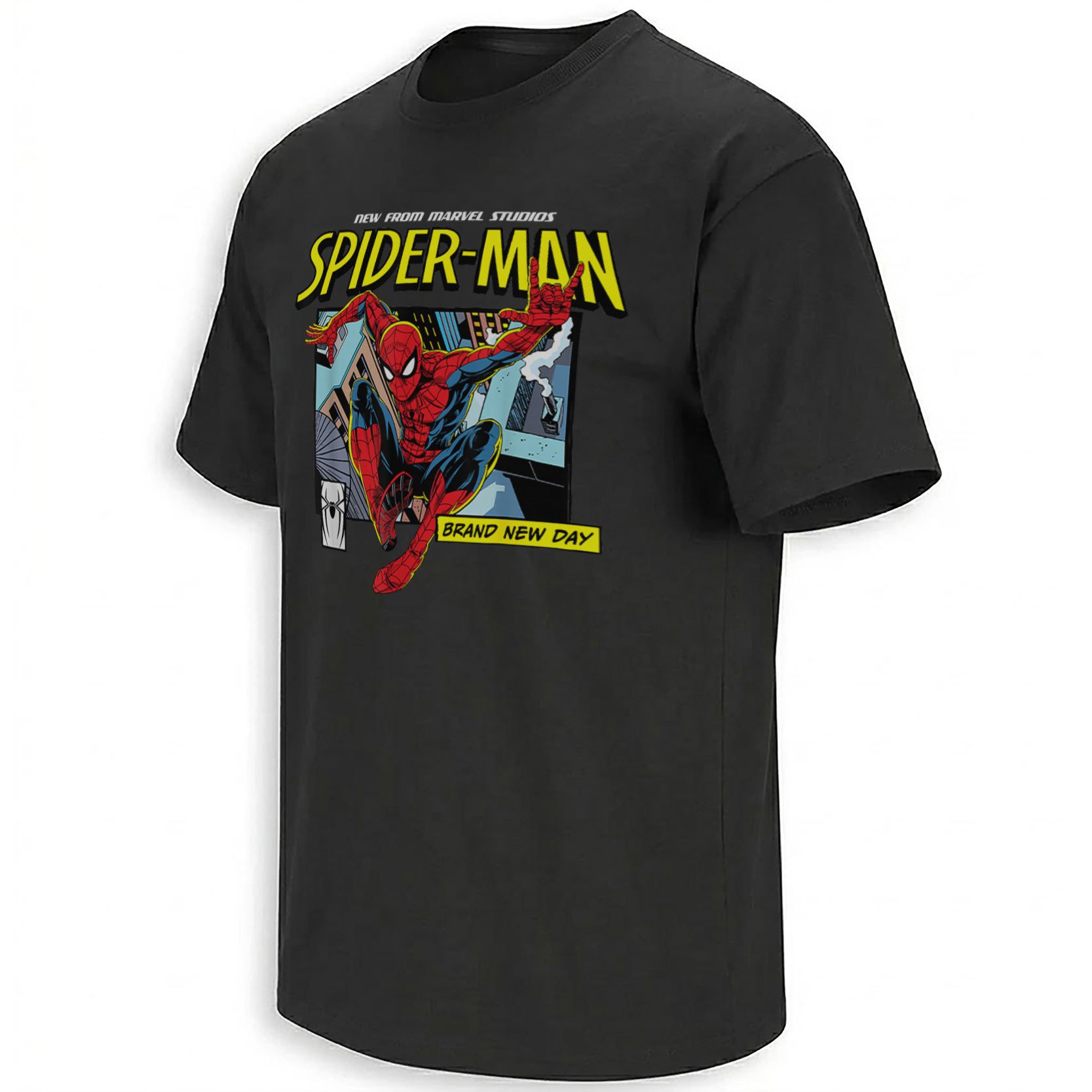
Brand New Day Comic Shirt
Framed like a dramatic issue cover, the artwork places the movie’s fresh chapter back inside the illustrated tradition that first taught audiences how a swinging Spider-Man should look.
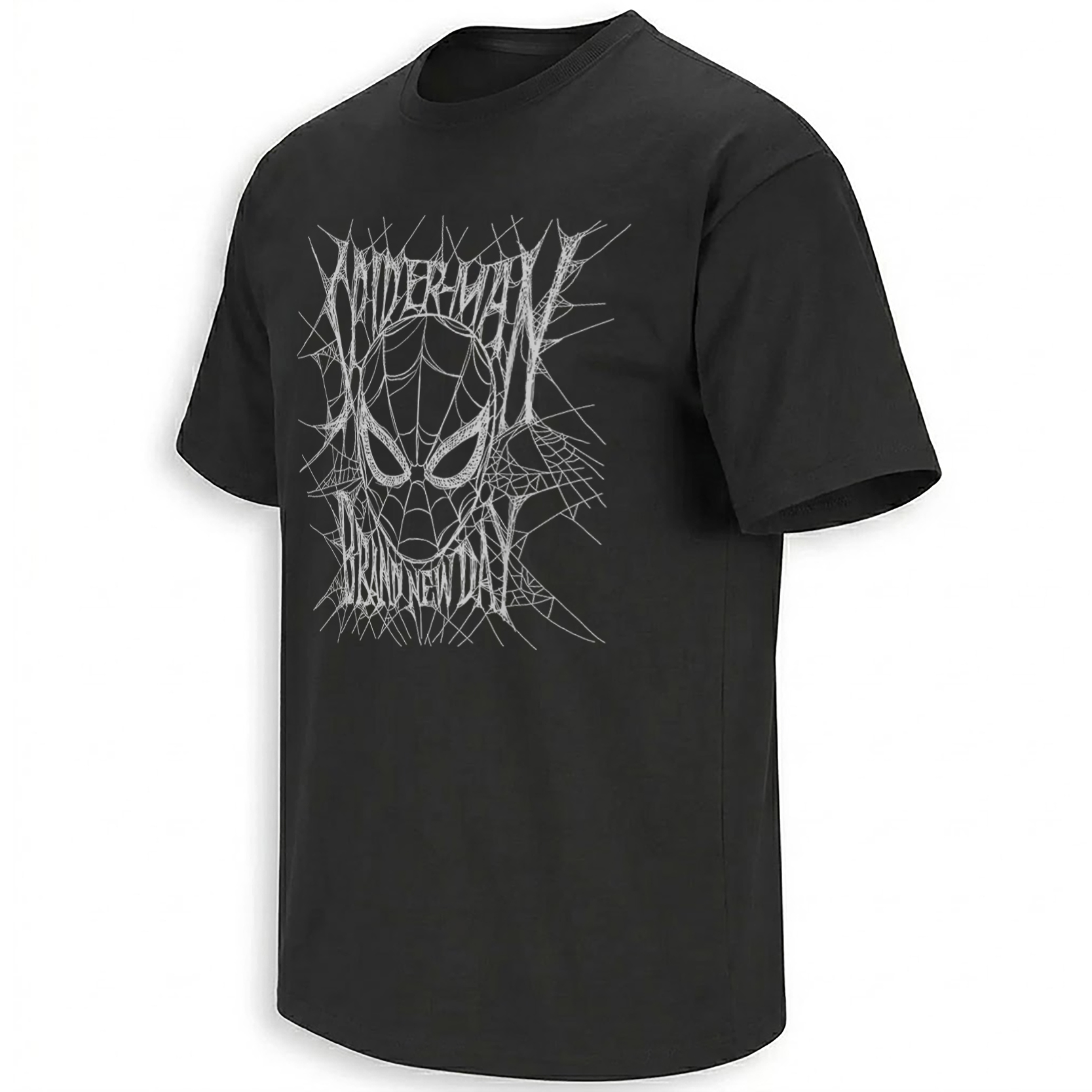
Brand New Day Web Mask Shirt
Silver sketch lines transform the mask into something between a technical drawing and an unfinished memory. Peter may be forgotten, but the geometry of Spider-Man remains immediately recognizable.
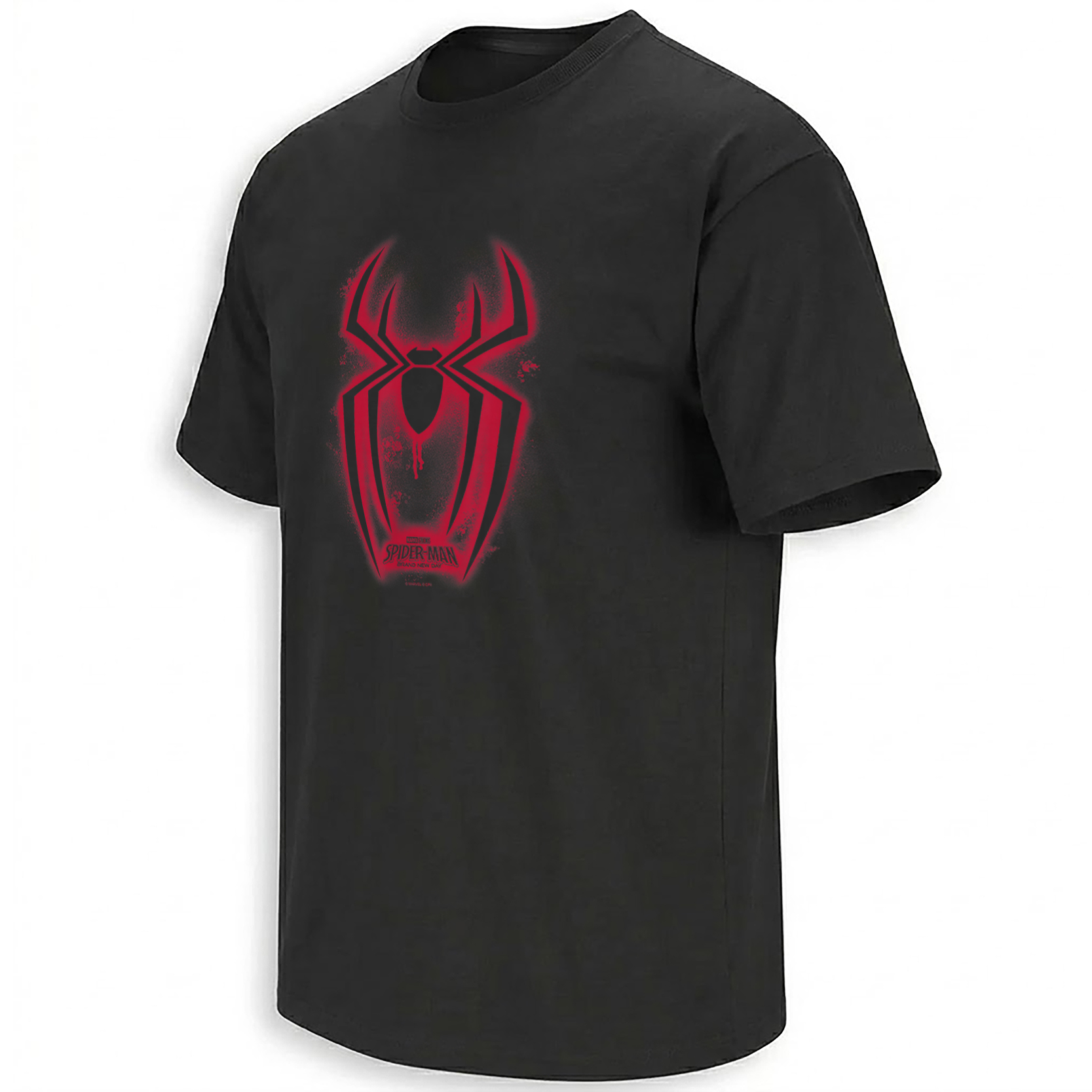
Red Spider Logo Shirt
The distressed crimson spider removes the actor, the pose and even the mask. What remains is a warning mark: compact, worn and strong enough to carry the identity of the entire character.
A successful Spider-Man redesign does not ask audiences to forget the old image. It makes the old image feel newly alive.
New York Is More Than a Background
Spider-Man’s mythology depends on a city that can push back. Towers provide height, but street traffic, brick walls, fire escapes and crowded intersections provide scale. Peter’s abilities become meaningful because the environment is dense enough to test them.
Post-release commentary praised the film’s web-swinging and its dynamic use of New York. That movement reinforces the central contradiction of Spider-Man: he can fly through the city without technically possessing the power of flight, but he must always remain attached to something inside it.
The same relationship appears in the artwork. Web lines do not merely decorate the designs. They connect masks to skylines, bodies to buildings and heroes to enemies. Every thread turns empty background into part of the action.
The Vertical City
Spider-Man is usually read diagonally—falling, swinging or climbing. His body interrupts the straight architectural lines of Manhattan and makes the city appear kinetic.
The Tangled City
Punisher, Scorpion, Hulk and smaller rogues complicate the idea of a simple hero-versus-villain conflict. The web becomes a map of unstable relationships.
Hulk Turns the City Into a Collision Zone
Bruce Banner’s presence changes the physical scale of the story. Peter is agile, reactive and dependent on momentum. Hulk is mass, impact and force. When those two visual languages meet, Manhattan begins to resemble a comic page being torn apart from inside.
Hulk should not be read as an ordinary member of Spider-Man’s rogues gallery. Bruce enters the story as a complicated returning figure rather than a permanent villain. Conflict between the characters expresses instability, misunderstanding and the danger created when immense power becomes difficult to control.
Spider-Man redirects force through webs, angles and speed. Hulk resolves the same physical problem by moving directly through it.
Split-panel artwork makes that contrast readable before either character lands a blow: red against green, narrow movement against overwhelming mass.
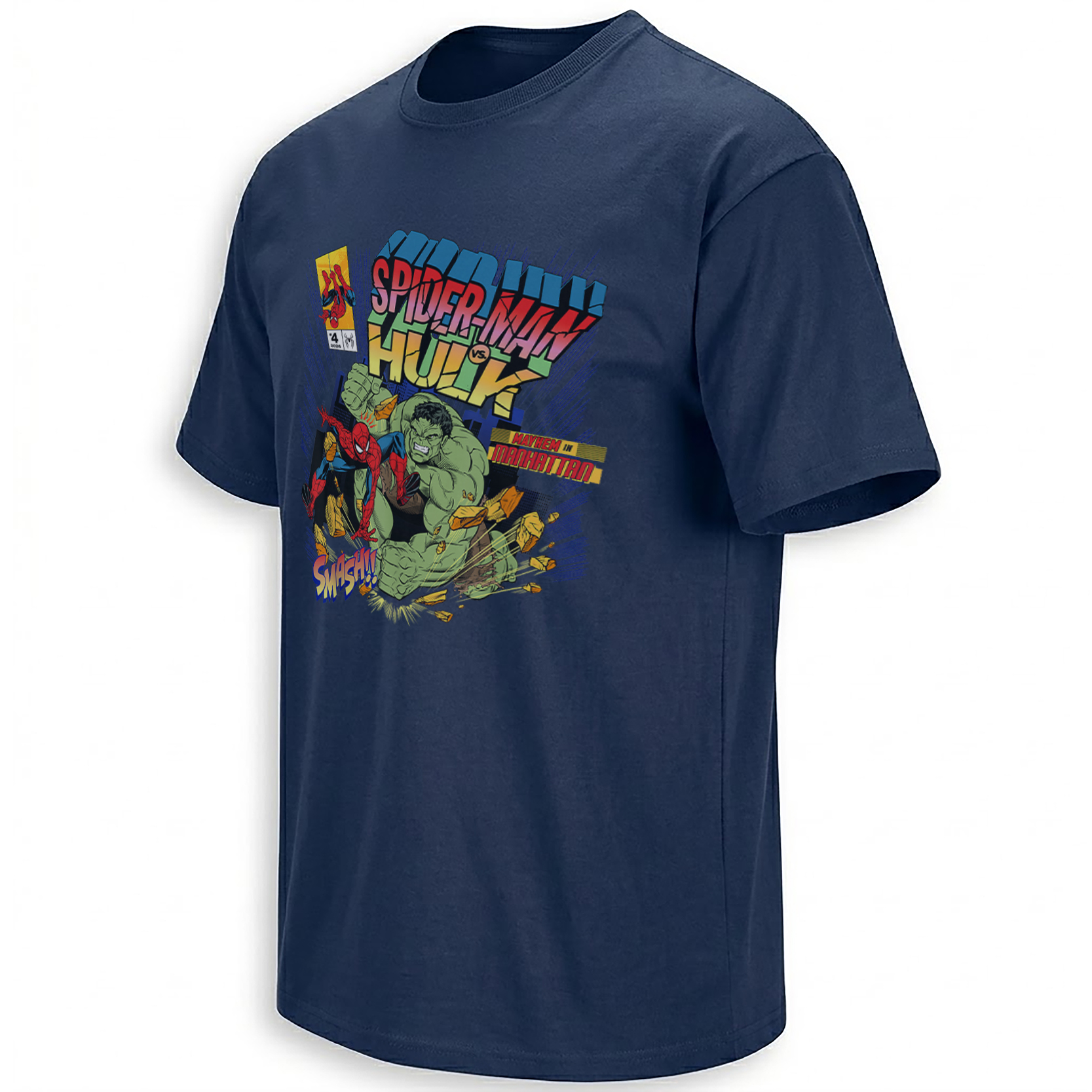
Spider-Man vs. Hulk: Mayhem in Manhattan
The composition treats New York as contested ground between two incompatible kinds of power. Spider-Man’s speed cuts across the scene while Hulk’s weight appears capable of breaking its borders.
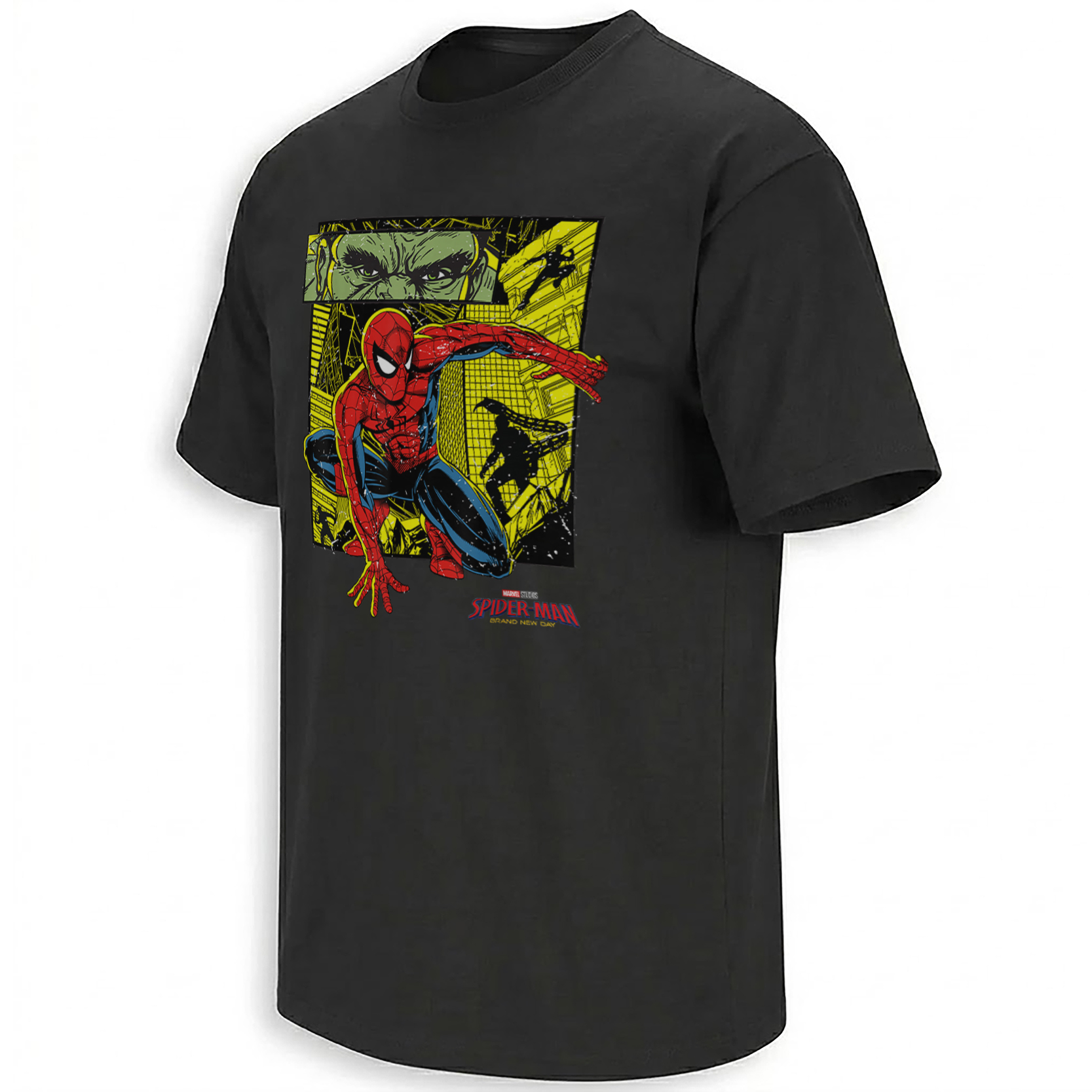
Hulk vs. Spidey Split Panels Shirt
Dividing the characters into comic panels gives the confrontation a printed rhythm. The eye moves between opponents as though advancing through consecutive frames of a fight already in motion.
Punisher Brings a Different Meaning to Justice
Frank Castle is not visually important merely because another established Marvel character has entered Spider-Man’s movie. He matters because his moral vocabulary is almost the inverse of Peter’s.
Spider-Man restrains, rescues and tries to preserve the possibility that people can change. Punisher approaches New York crime through finality. Their encounters therefore place more than two costumes in the same frame; they place two definitions of responsibility against one another.
Jon Bernthal’s Frank Castle becomes an unlikely ally and mentor, but that development does not erase the friction. Mutual respect is meaningful precisely because it grows between men who do not naturally agree on how power should be used.
The two Punisher designs translate that uneasy connection differently. One absorbs Spider-Man’s web pattern into the skull. The other makes the New York skyline part of Castle’s emblem, visually tying his methods to the same city Peter protects.
Chapter Three · The Skull and the Web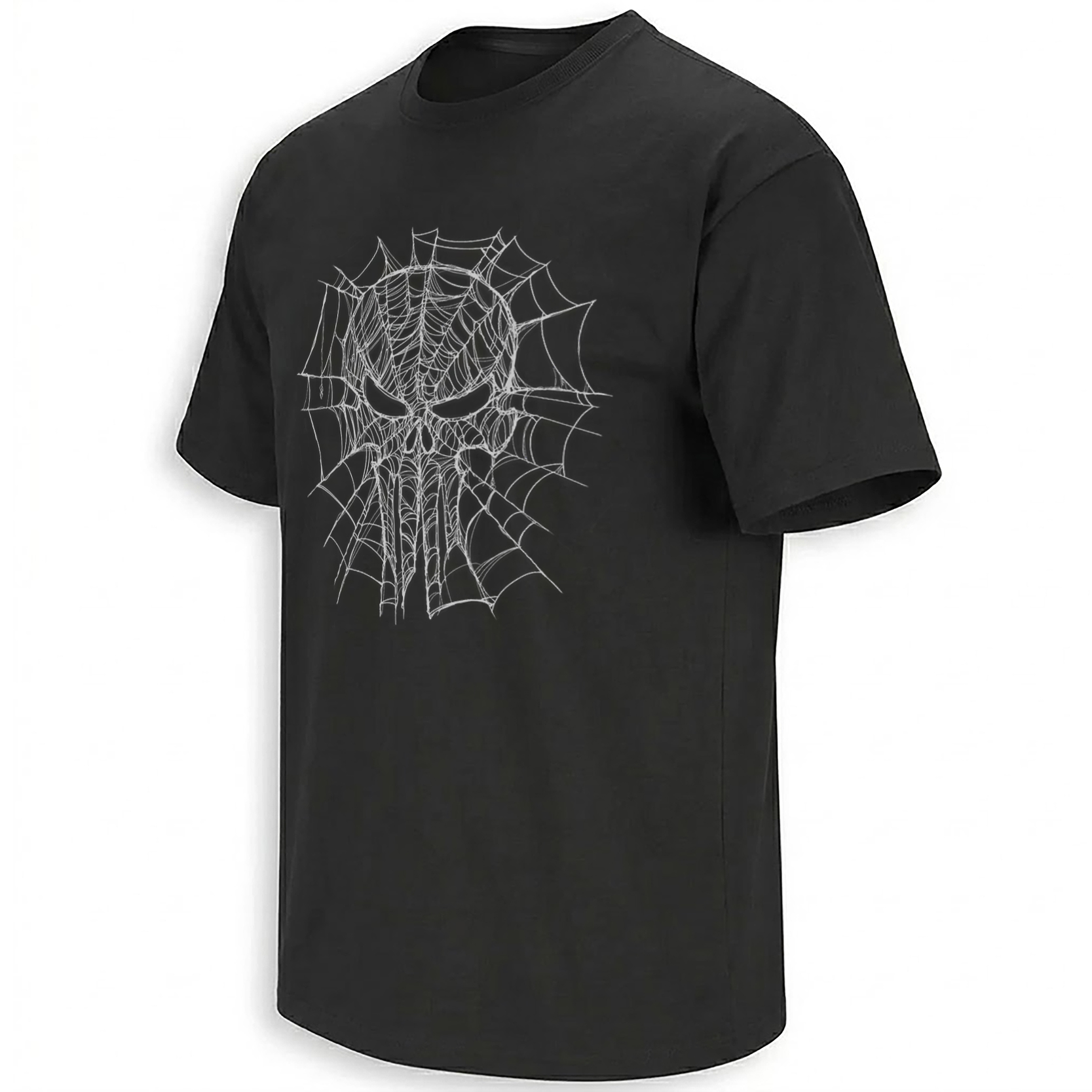
Punisher Skull Web Shirt
Webbing interrupts the severe geometry of Frank Castle’s skull, creating a hybrid emblem for an alliance that never becomes completely comfortable or morally simple.
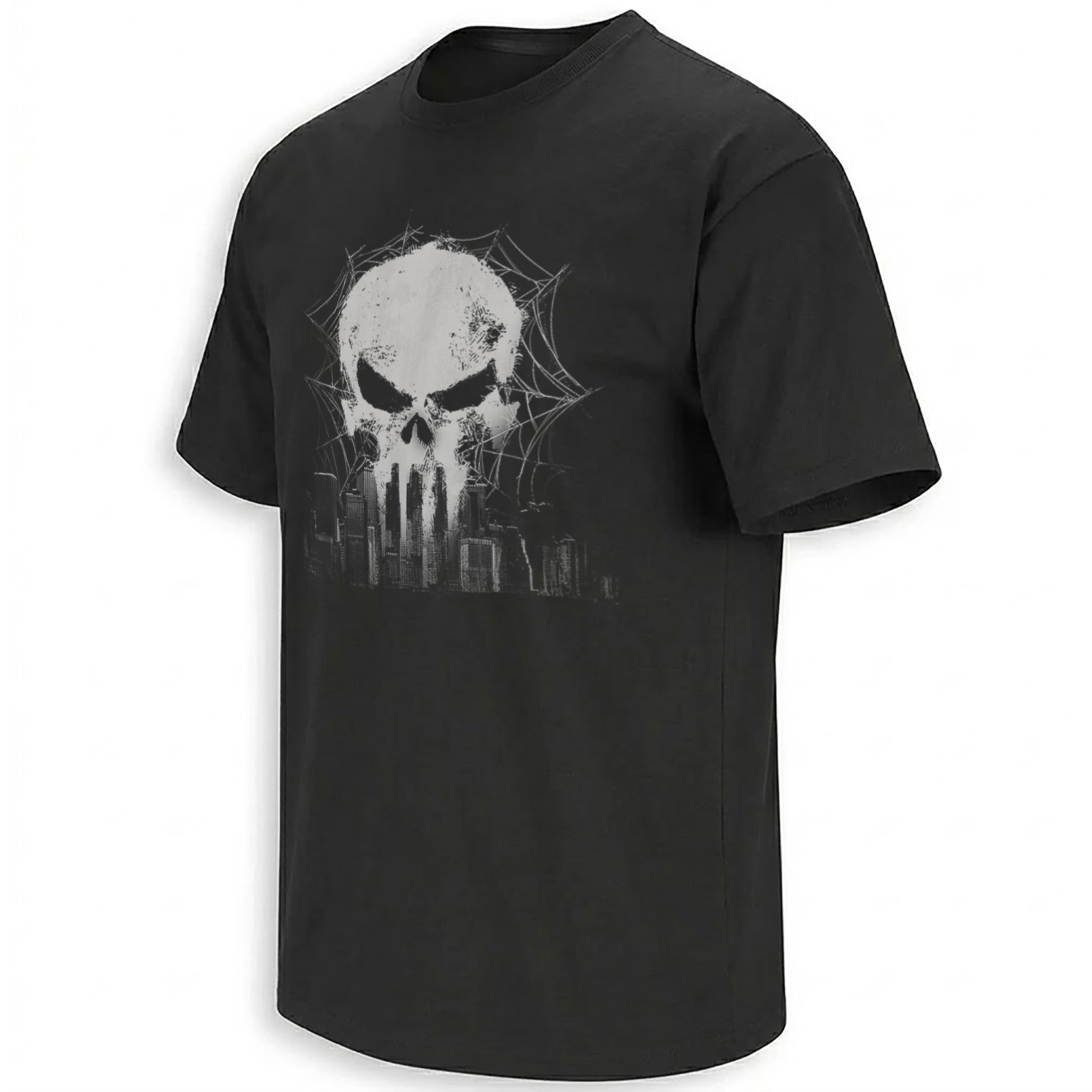
Punisher Skull NYC Shirt
The skyline transforms Castle’s skull from a personal insignia into a portrait of his territory. Spider webs then remind the viewer that New York already has another masked protector moving through it.
A Rogues’ Gallery Built From Unfinished Business
Mac Gargan’s return as Scorpion gives Brand New Day a direct line back to Spider-Man: Homecoming. Gargan was left in prison seeking Spider-Man’s identity; the new movie finally allows that old threat to emerge in a mechanized suit with the tail and stinger associated with his comic-book form.
Alongside Scorpion, characters such as Tarantula and Boomerang expand the visual field beyond a single central adversary. They bring exaggerated silhouettes, specialist weapons and the slightly unruly energy of a comic issue crowded with opponents.
This does not mean every character shown together occupies the same moral category. Hulk is not simply another villain, Punisher does not become a conventional team member, and temporary conflict does not equal permanent hostility. The most accurate way to read the ensemble is as a collision map: enemies, allies and unpredictable forces pulled into Spider-Man’s orbit.
Chapter Four · Everyone in the Web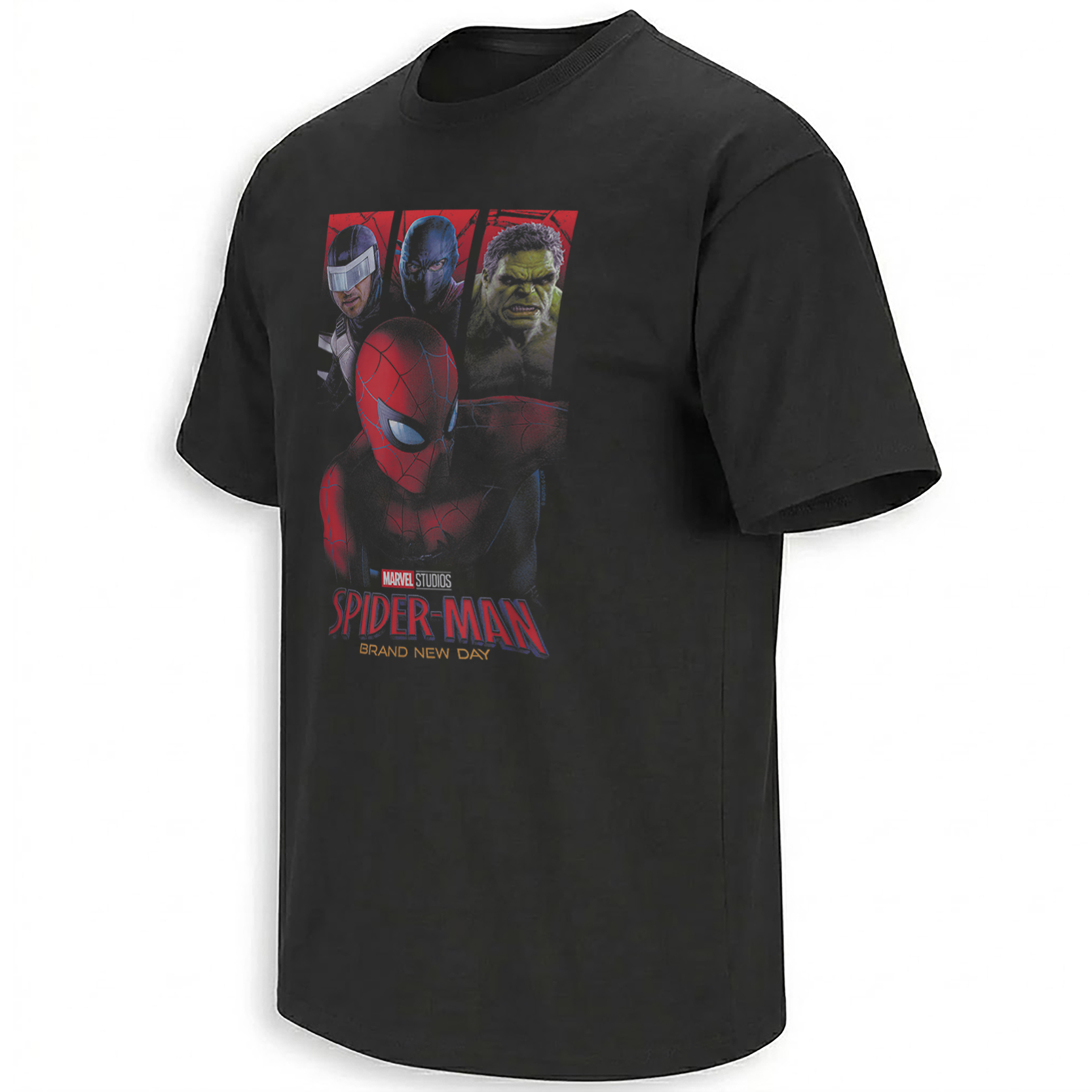
Brand New Day Team-Up Shirt
Despite the “team-up” shorthand, this is best read as a movie collision lineup rather than four characters calmly sharing one side. Hero, vigilante, returning enemy and unstable powerhouse occupy the same crowded frame.
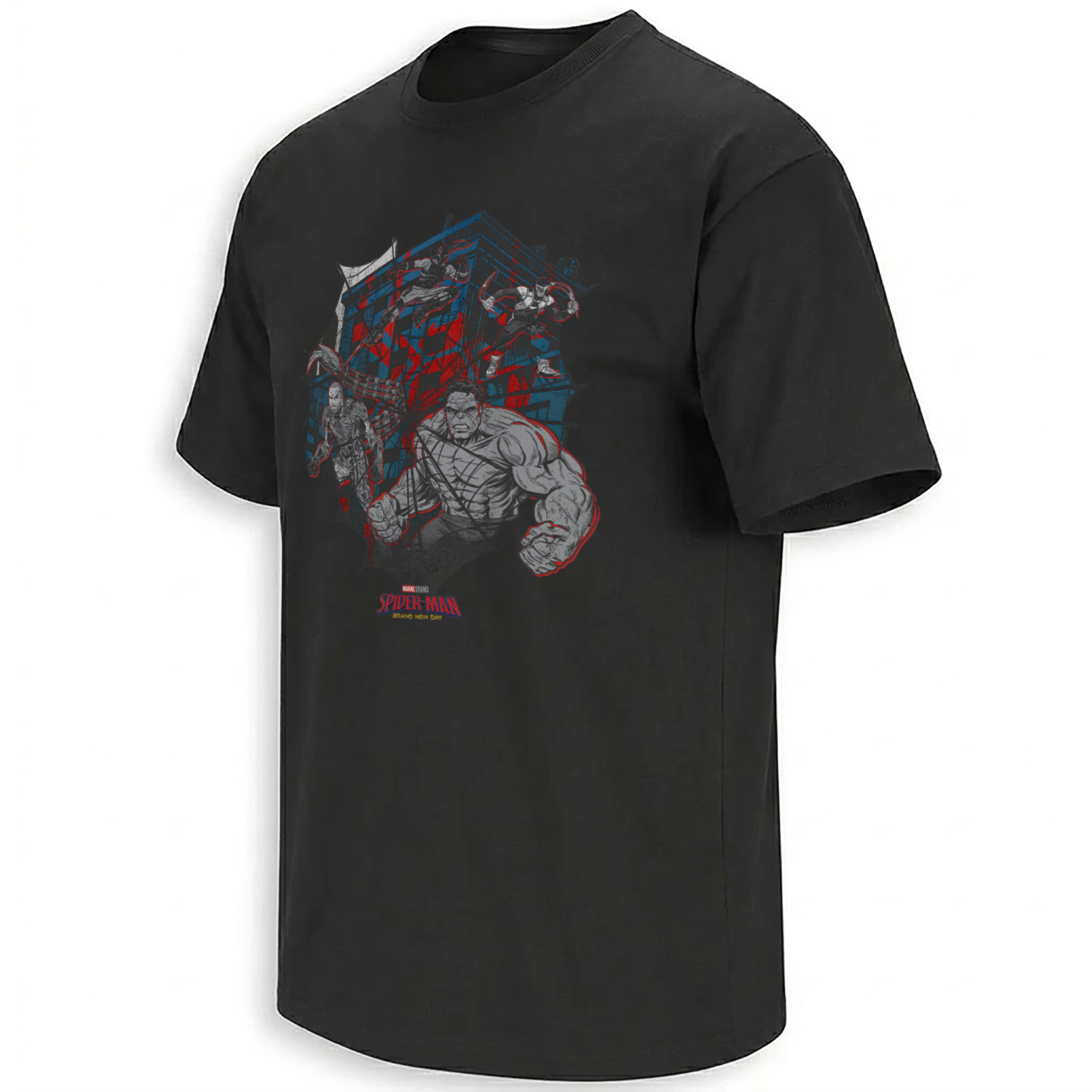
Spidey’s Foes Caught in Web Shirt
The web organizes a chaotic field of threats, rivals and temporary opponents. Scorpion, Tarantula and Boomerang evoke the rogues’ gallery, while Hulk adds the uncertainty of power that cannot be classified so neatly.
Why These Designs Work as a Cultural Set
Each design can stand alone, but the complete collection records a broader transition. The upside-down swing represents freedom. The web-mask sketch represents an identity being reconstructed. The red spider represents the permanence of the symbol even when Peter’s personal history has disappeared.
Hulk and the split battle panels expand the physical scale. Punisher’s skull introduces moral conflict. Scorpion and the wider villain lineup reconnect the new chapter to unfinished history.
Together, the shirts behave like alternate covers released around one major comic event. Each chooses a different promise: movement, costume, confrontation, crossover or rogues’ gallery. None needs to summarize the complete film because each preserves one recognizable part of the atmosphere surrounding its release.
A Fresh Start That Still Carries Old Threads
“Brand new” does not mean historically empty. Peter begins again with the consequences of everything that happened before him. Scorpion returns because an earlier conflict was never completed. Punisher brings years of violence and loss into his relationship with Peter. Hulk carries the history of Bruce Banner’s struggle with control.
Even the suit communicates continuity. Its brighter colors and raised webs appear new on screen, but they point backward toward decades of Spider-Man illustration. The costume works because it looks capable of belonging to this particular Peter Parker while also resembling the hero readers have recognized across generations.
That is the visual achievement preserved by this collection. Spider-Man steps into a different life, but the mask still reads instantly. New York remains underneath him. The villains remain caught somewhere inside the web. And when Peter swings forward, every old thread moves with him.
Frequently Asked Questions
When was Spider-Man: Brand New Day released?
Spider-Man: Brand New Day opened in theaters on July 31, 2026. Destin Daniel Cretton directed the film, with Tom Holland returning as Peter Parker and Spider-Man.
What is different about the Brand New Day Spider-Man suit?
The suit emphasizes brighter classic red-and-blue colors, prominent raised black webbing and a strong spider emblem. Its visual design connects the MCU version more closely with traditional Spider-Man comic artwork.
Are Hulk and Spider-Man enemies in Brand New Day?
Hulk should not be classified as a permanent Spider-Man villain. The characters come into conflict, but Bruce Banner occupies a more complicated role connected to Peter’s changing powers and the danger of losing control.
What role does Punisher have in Spider-Man: Brand New Day?
Frank Castle begins as a severe moral and tactical counterpoint to Spider-Man. Their relationship develops toward an uneasy alliance and mutual respect without eliminating their very different beliefs about justice.
Does Scorpion return in Spider-Man: Brand New Day?
Yes. Michael Mando returns as Mac Gargan, whose revenge against Spider-Man was first teased in Spider-Man: Homecoming. In the new film, Gargan appears in mechanized Scorpion armor with a tail and stinger.
Who appears on the Spidey’s Foes Caught in Web design?
The artwork features Spider-Man imagery alongside Hulk, Scorpion, Tarantula and Boomerang. The lineup represents a web of villains, rivals and unstable opponents rather than four identical kinds of antagonist.
What does “Brand New Day” mean for Peter Parker?
It describes Peter beginning a new chapter after the world’s memories of his civilian identity were erased. He remains Spider-Man, but must rebuild his personal life and relationships from an unusually isolated starting point.