Sound the Siren: Carolina’s Loudest Ritual Became a Championship Cry
When the Carolina Hurricanes completed their 2026 Stanley Cup run, one familiar phrase carried the emotion from the arena to the wider hockey world. “Sound the Siren” was no longer only a pregame command. It became the sound of Raleigh reaching the summit again.
The horn sounded in Las Vegas, but the emotional echo belonged to Raleigh. Carolina’s 3–0 victory over the Golden Knights in Game 6 on June 14 completed a 4–2 Stanley Cup Final win and ended the franchise’s twenty-year wait for another championship.
Almost immediately, the reaction moved beyond score lines and tactical analysis. Fans returned to the language that had long defined Hurricanes home games: the storm, the surge, the warning signal and the siren. What began as an arena ritual had become the most natural way to announce that Carolina was back on top of hockey.
That is why “Sound the Siren” works so well in the championship moment. It does not feel like a slogan added after the fact. It feels inherited from the building, from the crowd and from years of playoff nights in which the siren marked the point when ordinary arena noise became something distinctly Carolina.
The siren was once a warning that a Hurricanes game was about to begin. In June 2026, it became the signal that twenty years of waiting had ended.
A Phrase That Already Belonged to Raleigh
Sports slogans often arrive through marketing campaigns. “Sound the Siren” feels different because its meaning begins with a physical ritual. Before Hurricanes home games, a guest steps toward the arena siren, turns the handle and sends a mechanical howl through the building.
The noise does more than introduce the team. It changes the temperature of the room. Conversations stop, the crowd rises and the building becomes aware of itself as one collective body. The siren announces that the ceremony of a Hurricanes game has begun.
Over time, the people invited to operate it have reinforced its connection to the region. Athletes, celebrities, former players and local figures have all participated, but the important element remains the same: the ritual belongs to the crowd. The guest starts the sound; the arena completes it.
That history gave the phrase unusual power after the Cup-clinching victory. Carolina did not need to invent a new championship language. The franchise already had one waiting inside the building.
Why the Siren Became Bigger After the Final Horn
A championship changes the meaning of familiar symbols. Before the Final, the siren represented anticipation. It was the sound before the opening faceoff, before the forecheck arrived and before the crowd knew what kind of night it was about to experience.
After Carolina won the Cup, that same signal acquired an ending. It could now represent the entire path from Raleigh to Las Vegas: the dominant playoff record, the recovery after difficult moments in the Final, three consecutive victories to close the series and the shutout that secured the trophy.
The phrase also matched the emotional speed of the online reaction. “Sound the Siren” is brief, visual and instantly recognizable to Hurricanes followers. It works as a headline, a caption, a chant and a celebration without requiring a long explanation.
Across hockey coverage and fan spaces, the words quickly became shorthand for the result. They captured both the local identity of the winning team and the larger announcement that Carolina had completed one of the most commanding postseason runs of the year.
“Sound the Siren” operates on two levels. Locally, it recalls the ritual that opens Hurricanes home games. Nationally, it reads like an alarm announcing that Carolina has returned to the top of the NHL.
The Design Uses the Language of an Arena Warning
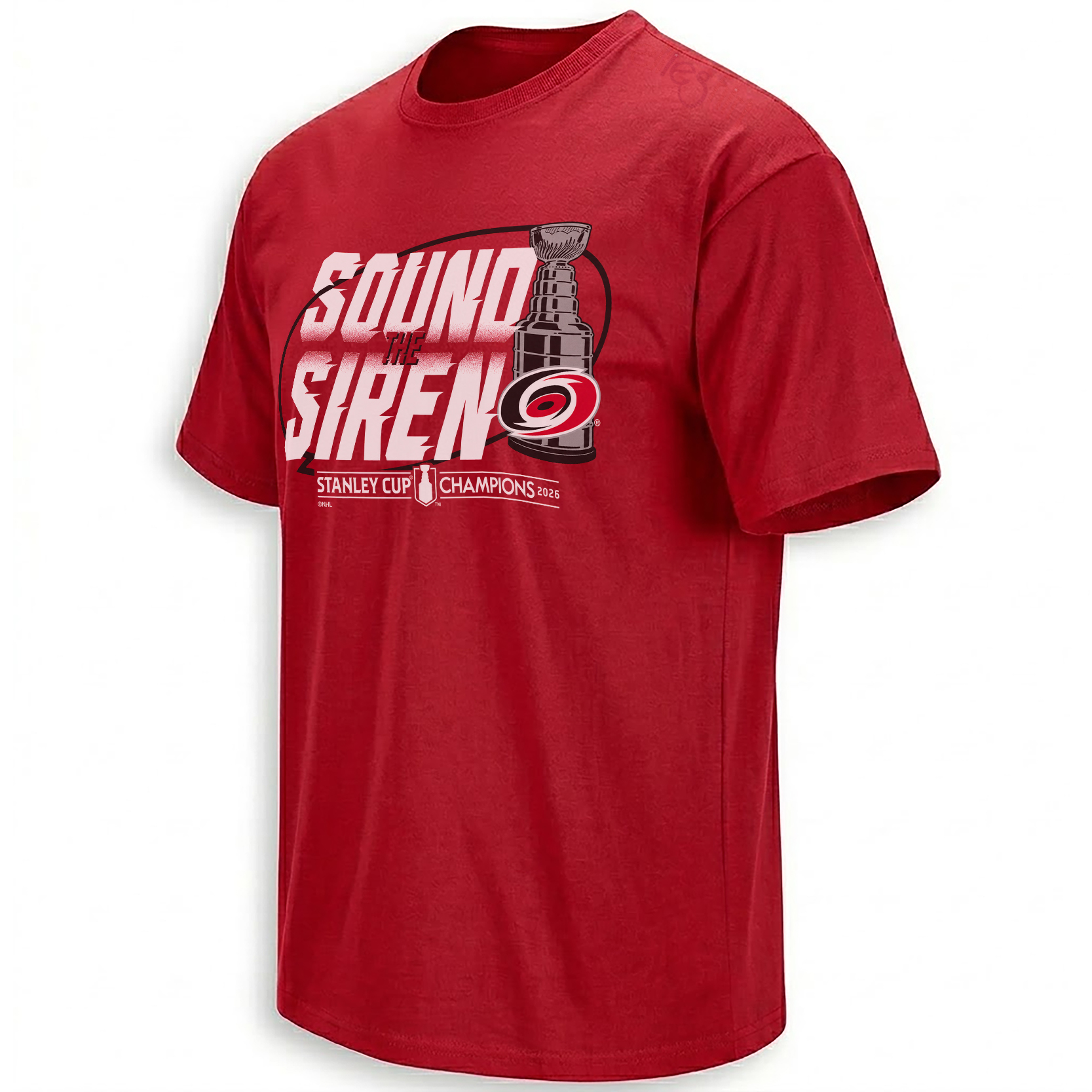
The graphic succeeds because it does not treat the phrase delicately. The typography is bold, compressed and designed to be read with the force of a command. “Sound the Siren” sits at the center like an arena announcement rather than a decorative caption.
Red, black and white keep the artwork firmly inside Carolina’s visual world. The red supplies urgency. Black adds the weight of playoff hockey, while white separates the lettering and imagery so that the message remains readable from a distance.
The championship reference gives the familiar slogan a precise timestamp. Without the 2026 title context, the phrase could belong to any Hurricanes season. With it, the image becomes attached to the night Carolina defeated Vegas and lifted the Stanley Cup for the second time.
That distinction matters. Strong fan graphics do not merely repeat team branding. They preserve how a specific event felt. Here, the design records the moment when an established local ritual became a victory cry heard across the entire hockey conversation.
Raleigh’s Hockey Identity No Longer Needs an Explanation
Hurricanes culture has often been discussed through the lens of geography. Outsiders once treated a successful hockey community in North Carolina as unusual, as though every loud playoff crowd in Raleigh required an explanation.
The 2026 championship makes that framing feel increasingly obsolete. The Hurricanes now have two Stanley Cups, a recognizable game-night identity and a fan culture built through years of postseason pressure. The siren, the Storm Surge, the red playoff crowds and the team’s relentless style have created a visual and emotional language that does not resemble any other NHL market.
The franchise also provides a shared sports identity across a region famous for college rivalries. North Carolina, NC State and Duke loyalties may divide the Triangle, but the Hurricanes create a different type of map. When the Cup run becomes the central story, Raleigh, Cary, Durham and communities across the Carolinas can respond to the same sound.
The wider Carolina Hurricanes collection reflects that evolving visual language through playoff moments, player references, local phrases and championship imagery. The broader NHL Shirts collection places those designs inside the larger culture of Stanley Cup traditions, team rituals and fan-created memory.
From Pregame Ritual to Championship Artifact
The most lasting championship graphics often focus on one symbol rather than attempting to summarize an entire season. A complete playoff run contains too many goals, saves, injuries, arguments and turning points to fit into one composition.
“Sound the Siren” avoids that problem by choosing the image fans already understand. It does not try to explain every round. It preserves the signal that belongs to the team and attaches it to the year Carolina won.
In that sense, the shirt functions like an arena poster or championship newspaper front page. It captures the public language of the moment—the phrase people could use immediately after the final horn—and turns it into a visual record.
Years from now, the design will not need to recreate every detail of Game 6. The score, the Cup and the exact sequence of the celebration will live elsewhere. Its role is simpler: to bring back the sound fans associated with the storm finally reaching the summit.
Why the 2026 Run Made the Phrase Feel Earned
Carolina did not reach the Cup through one chaotic upset. The Hurricanes finished the postseason 16–3, never faced elimination and went unbeaten in clinching games. Their route to the championship reflected the identity Rod Brind’Amour had spent years building: pressure, discipline, depth and a refusal to release control once the team established it.
The Final still demanded resilience. Vegas won Games 1 and 3, forcing Carolina to answer after both setbacks. The Hurricanes responded by winning Games 4, 5 and 6, ending the series with a shutout on the road.
That final stretch gave the siren metaphor additional force. It was no longer simply noise surrounding a celebration. It matched the sense that Carolina had become impossible to ignore. Once the Hurricanes took control of the series, the warning had already arrived.
Frequently Asked Questions
What does “Sound the Siren” mean in Carolina Hurricanes culture?
It refers to the arena siren used as part of the Hurricanes’ pregame ritual in Raleigh. The phrase has become shorthand for the beginning of a major Hurricanes moment and, after the 2026 title, a championship celebration.
When did the Carolina Hurricanes win the 2026 Stanley Cup?
Carolina clinched the championship on June 14, 2026, by defeating the Vegas Golden Knights 3–0 in Game 6 and winning the series 4–2.
Why did “Sound the Siren” fit the championship reaction?
The phrase was already closely connected to Hurricanes home-game culture, so it provided fans and media with an authentic local expression for announcing Carolina’s return to the top of the NHL.
Why is the siren important to Raleigh hockey identity?
The siren helps distinguish Hurricanes games from other NHL environments. It marks the transition into game-night intensity and connects the crowd, the arena and the team through a shared ritual.
What does the Sound the Siren championship design represent?
The design connects Carolina’s familiar arena ritual with the 2026 Stanley Cup victory, turning a local warning signal into a visual timestamp of the franchise’s second championship.
The Sound the Siren Shirt preserves the phrase that followed Carolina from the arena into the championship conversation, while the wider Hurricanes visual archive follows the player moments, playoff language and celebrations that defined the 2026 run.
Sound the Siren Shirt captures the Carolina Hurricanes’ 2026 Stanley Cup victory through Raleigh’s signature arena ritual, bold red-and-black warning typography and the championship cry that followed the final horn.