Sophie Cunningham and the XX-XY Athletics Debate That Followed the Fever
What began as one player’s public position on transgender participation in girls’ and women’s sports quickly became a traveling WNBA controversy, complete with rallies, arena signs, boos, supportive apparel and a wider argument about who gets to define fairness and belonging.
By the time the Indiana Fever reached Minneapolis on August 2, Sophie Cunningham’s comments were no longer confined to an interview or a social-media argument. Supporters and critics had gathered around three consecutive Fever games, turning the team’s road schedule into a moving public forum about transgender participation in women’s sports.
The scene at Target Center captured the scale of the divide. Some people arrived carrying messages that thanked Cunningham for speaking about sex-based athletic categories. Others wore shirts declaring that transgender children belong in sports. Inside the arena, Cunningham was met with boos, while outside, competing signs and chants transformed the entrance into an extension of the national culture debate.
This was no longer only a disagreement about league policy. It had become a story about athlete speech, fan identity, youth sports, biological categories, inclusion and the way apparel now functions as one of the fastest forms of public response.
The argument traveled with the team because fans were no longer responding only to basketball. They were responding to what they believed women’s sports should protect.
Why Sophie Cunningham Became the Center of the Conversation
Cunningham’s importance to the story came from her willingness to speak in direct language. She supported excluding transgender girls and women from girls’ and women’s athletic categories, framing her position around fairness and protection for female competitors.
Her critics read the position differently. They argued that transgender athletes and transgender youth were being turned into political targets, and that language presented as protection could create exclusion and hostility toward a small, already vulnerable community.
Cunningham said the demonstrations did not distract her or her teammates and described herself as someone motivated by love, basketball and inspiring younger athletes. Her refusal to step away from the subject strengthened her position among supporters while making her an increasingly visible target for opposition inside WNBA arenas.

How XX-XY Athletics Became a Visual Identifier
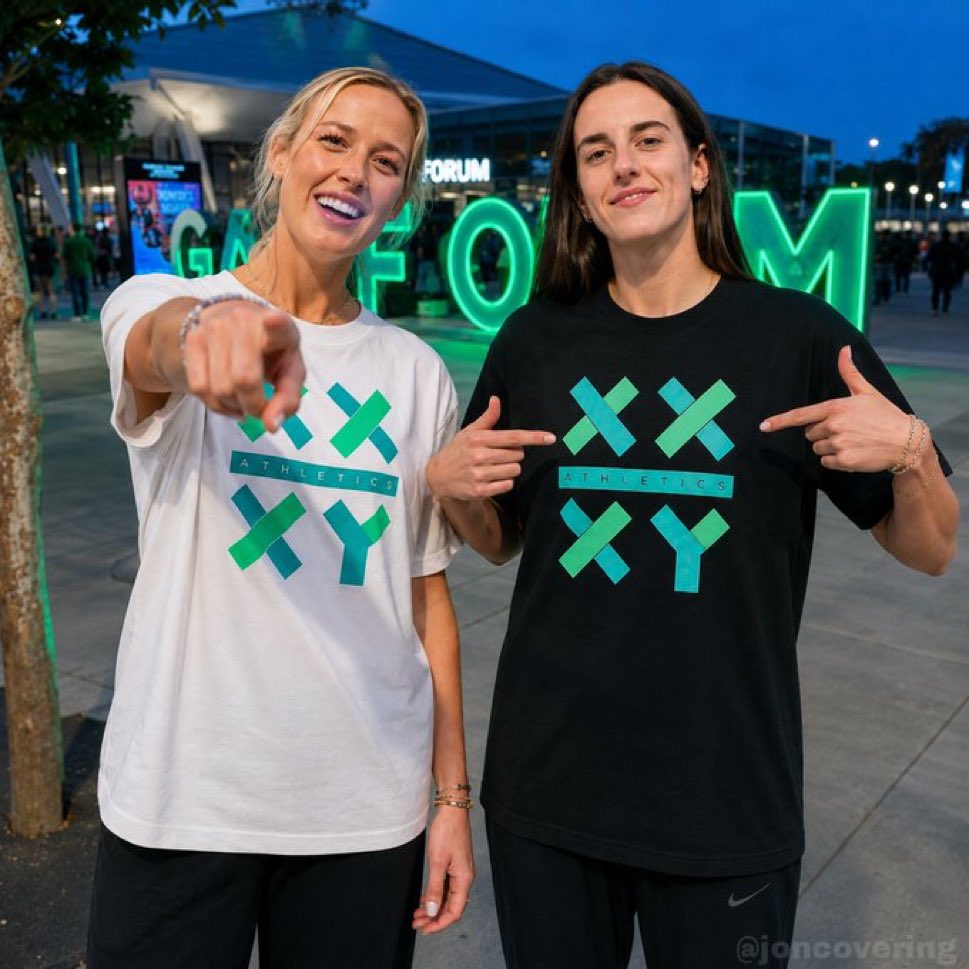
The XX-XY lettering works because it compresses a complicated policy dispute into two instantly recognizable symbols. Supporters use the chromosome language as shorthand for the belief that women’s athletic categories should remain separated according to biological sex.
That simplicity also explains why the symbol is contested. Human biology, sex development and sports eligibility regulations are more complex than a two-character contrast, while critics argue that the graphic reduces individual people to a political binary.
In visual culture, however, short symbols spread faster than policy papers. Large block lettering, black-and-white contrast and the small red-and-blue accents give the design the authority of an athletic-training mark. It feels closer to a team-issued slogan or campaign patch than a conventional political paragraph.
The restrained black, white, red and blue palette keeps attention on the XX–XY construction. Its power comes from compression: two chromosome references become an immediate declaration about sex-based categories in women’s athletics.
Why the Debate Expanded Beyond One Player
The reaction followed Cunningham because the WNBA has long existed at the intersection of sport, identity and social advocacy. Its players and coaches frequently speak on civil rights, gender, pay equity, race and LGBTQ issues. That history means a disagreement over transgender participation is not treated as a detached technical question.
Supporters saw Cunningham as someone willing to express a position they believed many athletes privately shared. Opponents saw the attention around her as evidence that national political conflict was being imported into a league whose community includes many LGBTQ players and fans.
The wider Indiana Fever collection now sits inside that complicated cultural environment, documenting player moments that extend beyond the scoreboard. Cunningham-specific graphics also appear in the Sophie Cunningham collection, while the broader WNBA collection maps how basketball, fandom and public debate increasingly overlap.
Frequently Asked Questions
Why did Sophie Cunningham’s comments become a national WNBA story?
Her position on transgender participation drew rallies, arena reactions and political attention around several consecutive Indiana Fever games.
What does the XX-XY Athletics graphic represent?
Supporters use the chromosome lettering as shorthand for maintaining sex-based categories in girls’ and women’s athletic competition.
Why is the design controversial?
Supporters view it as a fairness message, while critics argue it simplifies biology and can exclude or stigmatize transgender athletes and youth.
How did fans respond at Fever road games?
Some supporters organized rallies and carried pro-Cunningham signs, while other spectators booed her and displayed messages supporting transgender inclusion.
The XX Athletics XY design preserves the visual language used by Cunningham supporters, while the Indiana Fever and WNBA collections document the wider season in which basketball and public identity became inseparable.
XX Athletics XY Shirt reflects the chromosome-based imagery associated with Sophie Cunningham supporters during the 2026 WNBA debate over transgender participation, women’s sports and athlete speech.