
Sophie Cunningham Pointed for 22 Seconds. The Internet Has Been Writing the Dialogue Ever Since.
“You Are Fine, Go Back to Class” was not something Cunningham shouted across the floor. That is what makes the graphic interesting: a silent WNBA moment became an endlessly reusable reaction image because the internet could supply whatever sentence it wanted.
On June 22, 2026, Sophie Cunningham discovered that silence can be better meme material than trash talk. During the fourth quarter of Indiana’s 86–77 win over Phoenix, Caitlin Clark and DeWanna Bonner became tangled in an argument. Cunningham stepped into the scene and, instead of delivering the line social media would later repeat, simply pointed.
And kept pointing.
Roughly 22 seconds of unwavering finger, eye contact and almost no verbal performance gave the internet an unusually clean reaction template. Cunningham later explained that Bonner told her not to point, which only made her want to continue. Both players received technical fouls. By the end of the week, the basketball incident had escaped basketball entirely.
Cunningham supplied the gesture. The internet supplied the script.
The Original Image Was Almost Too Perfect for a Meme
The visual contains almost nothing unnecessary. Cunningham’s arm enters the confrontation as one long directional line. Her finger identifies a target. Her expression looks serious enough for authority and amused enough for comedy.
:max_bytes(150000):strip_icc():focal(749x0:751x2):format(webp)/Sophie-Cunningham-062926-1-ac60b2efcf8340fb845612290741435c.jpg)
PEOPLE reported that the point lasted approximately 22 seconds and noted that Cunningham later described the move herself as extremely silly. That self-awareness probably helped its meme life. The moment was not heroic in the conventional sports sense. Nobody hit a game winner. Nobody broke a record. One person discovered that pointing could annoy another person and committed fully to the bit.
Important: “You Are Fine, Go Back to Class” Is Meme Dialogue
The shirt should not be read as a transcript of Cunningham’s on-court words. The viral source moment was largely visual. “You Are Fine, Go Back to Class” is a caption placed onto that pointing persona — the same way thousands of other users have turned her gesture into imagined instructions, warnings and reactions.
This distinction actually makes the design better. If Cunningham had literally shouted the sentence, the shirt would preserve one quote. Because she did not, the phrase demonstrates how reaction memes evolve: an image develops a personality, then users write dialogue that feels compatible with that personality.
“You Are Fine, Go Back to Class” works because the pointing already looks like authority. Add school language and Cunningham suddenly becomes the teacher, nurse, principal or coach who has decided your complaint does not justify leaving.
Why Teacher Humor Fits the Pointing Pose So Cleanly
It does not merely react. It gives direction, which allows captions to read like commands instead of observations.
Cunningham looks composed enough to play the authority figure while still carrying the absurdity of the original confrontation.
Because there is no famous spoken line competing with the image, almost any caption can be inserted without breaking the template.
Teachers and students are particularly fertile meme territory because the scene is universally legible. A student wants to leave class. An adult makes a rapid diagnosis from across the room. Finger toward the door. Conversation over.
The phrase exaggerates that dynamic into darkly familiar school humor: “You are fine. Go back to class.”
The Product Freezes One Caption From an Infinite Template
The You Are Fine Go Back to Class Shirt takes one branch of the meme and turns it into a permanent composition.
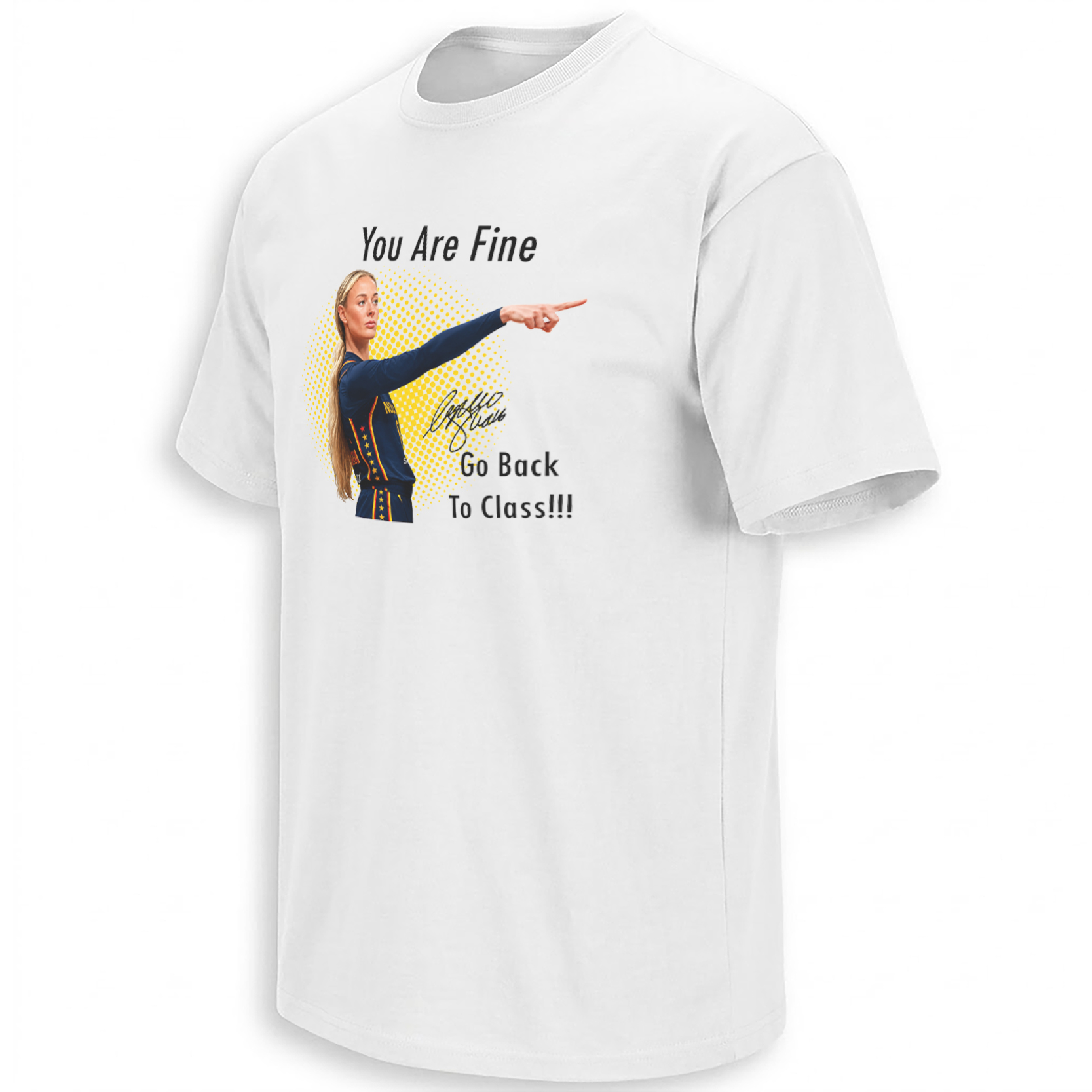
Why the Pointing Meme Became Bigger Than the Game
Sports reaction images often fail outside their original fandom because too much context is required. A coach’s face may only be funny if the viewer knows the score. A player’s celebration may only make sense after a particular win.
Cunningham’s point has almost no such barrier. A person is pointing at another person with unreasonable dedication. That is enough.
By late June, media outlets were already cataloguing versions of the meme, and the image moved into subjects far beyond the WNBA. Cunningham herself acknowledged seeing the memes, while her explanation of the incident reinforced the comedy: she realized the pointing annoyed Bonner, so she continued doing exactly that.
The template therefore contains the three properties internet reaction images need most: immediate readability, easy caption substitution and a facial expression strong enough to survive cropping.
A Quiet Meme Inside a Very Loud Sophie Cunningham Year
The pointing image has also lasted because Cunningham has remained highly visible throughout 2026. Her on-court physicality, media appearances and public controversies have kept her name moving through sports conversation long after the June game.
That broader context can become politically polarizing, but the original pointing meme is much simpler. It began as a basketball confrontation, then escaped into comedy because the gesture itself was strange enough to become universally reusable.
The wider Indiana Fever collection contains Cunningham, Caitlin Clark and other pieces tied to the team’s current visual language, while the WNBA collection places the meme inside the broader league culture that produced it.
Readers following Cunningham specifically can also browse Sophie Cunningham products on Ellie Shirt .
Why This Caption Has a Different Energy From the Original Confrontation
In the Fever–Mercury game, Cunningham’s point was confrontational. In the classroom version, the exact same body language becomes administrative.
That is the pleasure of a good reaction meme. Context is detachable. The source image supplies attitude, but the caption chooses the situation.
“You Are Fine, Go Back to Class” converts WNBA tension into the voice of someone who has heard enough excuses before first period. The basketball history remains visible underneath, but viewers do not have to know DeWanna Bonner’s name, the technical-foul sequence or the final score for the new joke to work.
That portability is why the pointing image has a chance to last beyond the 2026 season. It no longer belongs only to one game. It belongs to anyone who needs a visual way to say: discussion over, that direction.
Frequently Asked Questions
When did Sophie Cunningham’s pointing meme happen?
The source moment occurred on June 22, 2026, during Indiana’s 86–77 win over the Phoenix Mercury at Gainbridge Fieldhouse.
Who was Sophie Cunningham pointing at?
Cunningham was pointing toward Phoenix Mercury player DeWanna Bonner after Bonner and Caitlin Clark became involved in a fourth-quarter verbal exchange.
How long did Sophie Cunningham keep pointing?
Coverage of the viral moment measured the gesture at approximately 22 seconds.
Did Sophie Cunningham actually say “You Are Fine, Go Back to Class”?
The phrase is meme caption language rather than a documented quote from the original on-court confrontation. The source moment became famous largely because Cunningham silently continued pointing.
Why did the Sophie Cunningham pointing image become such a big meme?
The pose is visually simple, directional and easy to recaption, allowing the original WNBA confrontation to work as a reaction image for school jokes, workplace humor and everyday internet arguments.
The You Are Fine Go Back to Class graphic preserves one of the funniest mutations of the pointing template, while the Indiana Fever archive holds the basketball context that created the image in the first place.
You Are Fine Go Back to Class Shirt turns Sophie Cunningham’s viral 22-second Indiana Fever pointing moment into classroom reaction humor, using a fan-created caption rather than presenting the phrase as an actual Cunningham quote.