
Seiya Suzuki’s Cubs Future Looms After the 2026 Wild Card Exit
Chicago’s October run lasted only two games, leaving an uncomfortable question behind: after five seasons linking Wrigley Field with Japanese baseball culture, was the Padres series Seiya Suzuki’s final appearance in a Cubs uniform?
One week before Chicago’s season ended at Petco Park, Seiya Suzuki gave Wrigley Field exactly the kind of swing the Cubs had spent all year waiting for in important moments. Miami led 1-0. Chicago still needed to officially secure its postseason berth. Suzuki drove a splitter 407 feet to center field for his 26th home run and tied the game.
The Cubs eventually won 2-1 and punched their ticket to October for a second consecutive season. Less than a week later, San Diego ended that celebration with a two-game Wild Card sweep. Chicago scored only one run across the series, and an offense that had produced more runs than any other MLB team during the regular season disappeared at exactly the wrong time.
Suzuki leaves the series with two postseason hits in seven at-bats. More importantly, he leaves it with his future suddenly central to Chicago’s offseason. His five-year Cubs chapter has reached its contractual edge, and MLB identified Suzuki among the club’s prominent potential free agents.
Suzuki’s Chicago story has always been larger than one postseason result because No. 27 never represented only the Cubs — he also carried an entire Japanese baseball history into Wrigley Field.
The homer that helped Chicago get back to October
Suzuki’s 26th home run was not the winning run against Miami, but it changed the emotional shape of the afternoon. The Cubs had struggled through a season full of injuries, winning streaks, losing streaks and an increasingly tense Wild Card race. When Suzuki tied the final regular-season home game at Wrigley, the crowd could finally feel the postseason becoming real.
Nico Hoerner later supplied the go-ahead RBI, while Pete Crow-Armstrong completed his historic 40-40 season on the same afternoon. Suzuki’s contribution was therefore part of a larger celebration rather than an isolated headline — exactly the kind of role he has occupied during much of his Chicago tenure.

Why Japanese lettering belongs at the center of the design
The cultural logic of the SEIYA SUZUKI SHIRT begins long before Chicago. Suzuki spent nine seasons with the Hiroshima Carp in Nippon Professional Baseball before signing his five-year Cubs contract in March 2022.
His Japanese résumé was already substantial: a .315 career average with Hiroshima, 182 home runs, multiple Gold Gloves and multiple Best Nine selections. He arrived in Chicago as an established star rather than a prospect being introduced to professional baseball.
That is why the Japanese characters 鈴木誠也 on the artwork matter. They are not decoration added to make the piece look vaguely Japanese. They are the player’s actual name, connecting the identity Chicago knows as “Seiya Suzuki” with the identity that had already become famous in Hiroshima.
Suzuki’s Cubs career has always been understood through movement between NPB and MLB. The Japanese typography therefore works like biography inside the graphic rather than an ornamental theme.
The artwork makes the crossover deliberately cheerful
The most noticeable choice is that Suzuki is not treated like a solemn international icon. The graphic is playful. His cartoon figure finishes a powerful swing while No. 27 remains visible on the cap. A giant smiling baseball runs below him. A small glove-wearing cub turns the team name itself into a character.
“Seiya” arrives in loose blue script, while “SUZUKI” appears in stronger red lettering. Beneath the characters sits the Japanese name, creating a visual hierarchy that allows English and Japanese typography to share the same space instead of one being treated as a translation footnote.
The design therefore feels closer to Japanese baseball illustration, collectible character art and old stadium souvenir graphics than to the standard American player-photo tee. That distinction is important because Suzuki’s fan base has never existed only in Chicago.
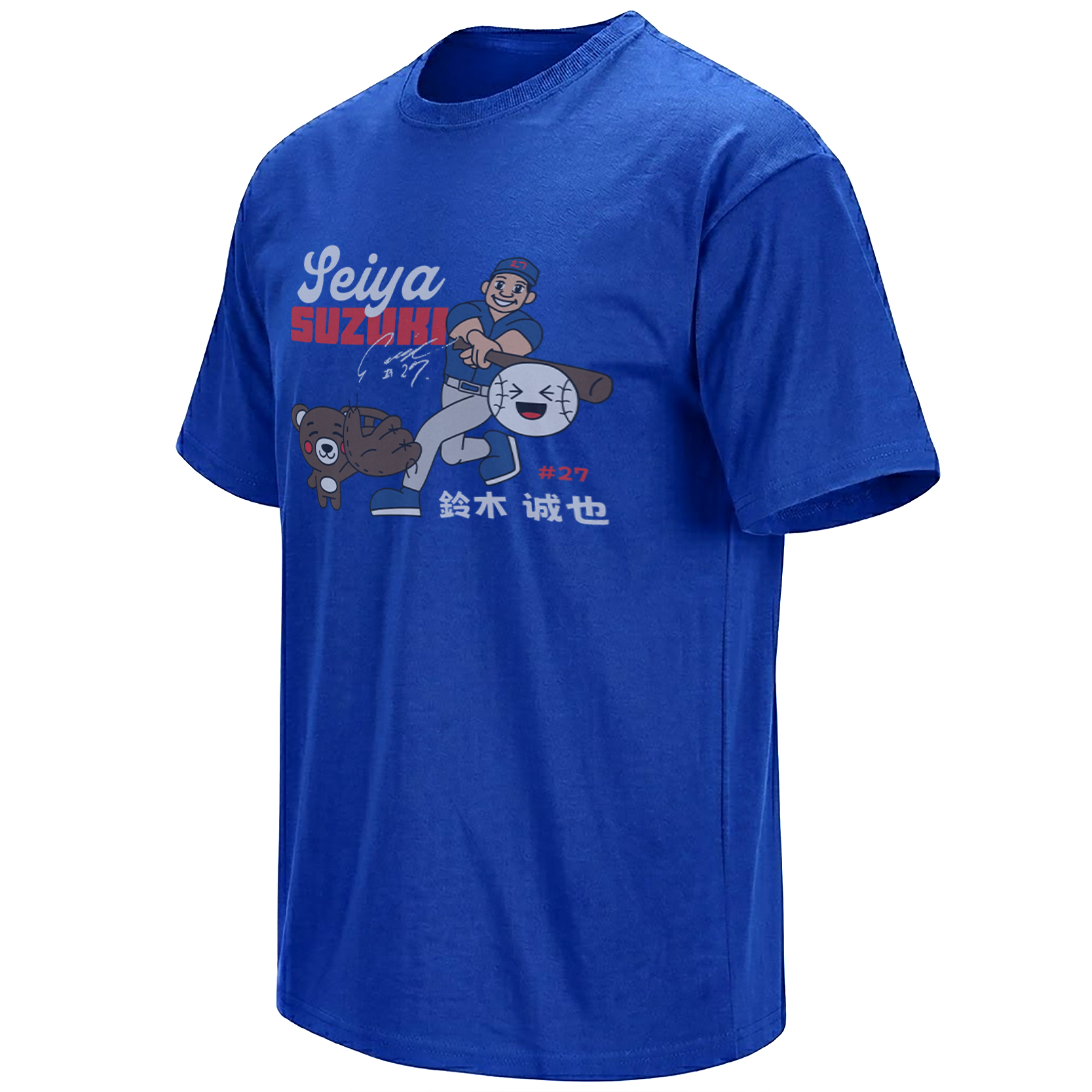
A bright Chicago-Japan baseball crossover built around Suzuki’s No. 27 identity, Japanese 鈴木誠也 lettering and playful illustrated baseball characters.
Explore the illustrated piece →Chicago’s celebration lasted only six days
The emotional contrast is what gives the design unusual timing now. On September 24, the Cubs were spraying champagne after clinching a postseason spot. Their official social channels framed the night as the beginning of more baseball.
Six days later, the season was finished. San Diego held Chicago to one run in Game 2 after shutting the Cubs out in the opener. The final series made the regular season feel abruptly distant, especially for veteran players whose contracts may not carry them into 2027.
Five seasons turned Suzuki from import into part of Cubs identity
When Suzuki signed in 2022, much of the language around him was understandably about transition: Japan to the United States, Hiroshima to Chicago, NPB pitching to Major League velocity. Five seasons later, that framework feels incomplete.
Suzuki has now accumulated more than 100 Major League home runs, played postseason baseball in consecutive years and become a familiar presence alongside Japanese teammate Shota Imanaga. His identity is no longer defined by “adjusting to MLB.” He has become one of the recognizable veteran hitters in Chicago’s lineup.
The 2026 line reinforces that point. He hit .270 with 147 hits, 96 runs, 26 home runs and 86 RBI while posting an .841 OPS. Those are not novelty numbers attached to an international story. They are the production of a middle-of-the-order Major League hitter.
The Wild Card loss did not settle Suzuki’s value to Chicago. It simply moved the conversation from October performance to roster construction: whether the Cubs want to extend a relationship that began in 2022, and whether Suzuki wants the next stage of his career to remain at Wrigley Field.
A design that may become a Chicago-era artifact
That uncertainty gives the shirt a different emotional reading than it would have had in July. If Suzuki returns, the Japanese characters and No. 27 continue as part of the living Cubs roster. If he leaves, the same graphic begins to look like a compact visual archive of his Chicago period.
Either way, the design remains broader than the two-game Wild Card defeat. It remembers the bridge from Hiroshima to Wrigley, the player’s Japanese name, the Cubs identity and the lighter cartoon language that makes the piece feel celebratory rather than retrospective.
The wider Chicago Cubs collection captures more of that evolving player culture, while the MLB collection places Suzuki alongside other player identities, postseason moments and baseball phrases from across the league.
For No. 27 specifically, the Seiya Suzuki product search keeps related designs together.
FAQ: Seiya Suzuki, the Cubs and the Japanese design
What does 鈴木誠也 mean on the shirt?
鈴木誠也 is Seiya Suzuki’s name written in Japanese.
How did Seiya Suzuki perform in 2026?
Suzuki finished the regular season batting .270 with 26 home runs, 86 RBI, 147 hits and an .841 OPS.
Did Suzuki help the Cubs clinch a 2026 playoff spot?
Yes. His 26th home run tied the September 24 game against Miami that Chicago eventually won 2-1 to secure a postseason berth.
What happened to the Cubs in the 2026 postseason?
San Diego swept Chicago in two games in the National League Wild Card Series, ending the Cubs’ season on September 30.
Where did Seiya Suzuki play before the Cubs?
Suzuki spent nine seasons with the Hiroshima Carp in Nippon Professional Baseball before signing with Chicago in 2022.
Why does the design include a cartoon cub and smiling baseball?
Those characters translate Suzuki’s Chicago identity into playful illustrated baseball language rather than relying on a standard team-logo or photo treatment.
The Seiya Suzuki graphic captures what that chapter has looked like visually: Cubs blue and red, No. 27, Japanese identity and a player who became part of two baseball cultures at once.
SEIYA SUZUKI SHIRT celebrates Cubs No. 27 through Japanese 鈴木誠也 lettering, colorful cartoon baseball art and the Chicago-Japan identity Suzuki built across five Major League seasons.