
Payton Tolle’s 171-K Breakout Made No. 70 a Red Sox Cult Hero
Boston’s postseason ended almost as quickly as it began, but the Red Sox came out of 2026 knowing something they did not know with certainty in April: Payton Tolle can miss Major League bats, handle Fenway pressure and make a pitching start feel like its own piece of entertainment.
By the time Payton Tolle walked off the Yankee Stadium mound in his first full postseason start, Boston’s night had not collapsed yet. The 23-year-old left-hander had allowed one run through 4⅔ innings, struck out four and kept the Red Sox within reach of New York.
The bullpen unraveled after he left. Boston lost Game 1, then lost Game 2 and watched its season end in a two-game Wild Card sweep. For Tolle, however, the brief October appearance looked less like an ending than a strange final chapter to a rookie year that had already changed how Red Sox fans saw No. 70.
His full-season line tells part of it: 26 appearances, a 9-6 record, 3.03 ERA, 1.10 WHIP and 171 strikeouts across 148⅔ innings. The more interesting story is how those strikeouts acquired a visual identity of their own — rows of K’s, Fenway green, a giant mustache and a pitcher whose personality often looked as animated as his fastball.
Tolle’s rookie season turned the strikeout from a pitching statistic into something Red Sox fans could practically keep tallying on a wall.
The night the K-board became the obvious visual
August 7 is the cleanest explanation for why the design revolves around strikeout notation. Boston entered the night against the Athletics having already used eight relievers in a 13-inning game. What the Red Sox needed was innings. What Tolle supplied was something much louder.
He struck out 14 hitters in six innings, allowing two hits, one run and no walks. It took only 84 pitches. Three different innings ended with Tolle striking out the side, and his fastball reached 99.5 mph while the curveball generated the kind of ugly swings that made the night feel less like routine starter work and more like a live demonstration.
MLB noted that the performance put Tolle into rare Boston company at his age. OptaSTATS also reported that he was the first pitcher in the pitch-tracking era to reach at least 14 strikeouts while throwing fewer than 85 pitches.

Fenway green turns baseball notation into character design
The PAYTON TOLLE SHIRT starts from something every baseball fan already understands. A “K” is a strikeout. Put enough K’s next to a pitcher, and the symbol becomes a résumé.
The artwork turns that notation into a large green board that immediately recalls Fenway Park. It is not trying to reproduce the Green Monster scoreboard exactly. Instead, it borrows the emotional shorthand: deep green panel, old-ballpark texture and rows of information that feel as if someone has been manually keeping track of the damage.
Tolle stands beside the board in No. 70, but he is not rendered as a serious pitching portrait. His mustache is exaggerated, his proportions are compressed and the character has the visual grammar of an old console-game pitcher.
Boston supplies the green scoreboard language. Tolle supplies the strikeouts and No. 70. Retro video-game cartooning supplies the humor. The design works because each layer is already recognizable before anyone reads a product description.
That cartoon direction fits the player better than it might fit most pitchers. Tolle spent the season developing a small collection of moments that had little to do with conventional mound stoicism. He tagged Seattle’s Dominic Canzone by wrapping him up almost like a hug near first base. After slipping during a pitch in Baltimore, he responded by doing a push-up on the mound.
Those clips helped turn a physically imposing 6-foot-6 left-hander into something less distant than the usual young power pitcher. Fans were not only watching to count strikeouts. They were waiting to see what kind of Tolle moment would happen next.
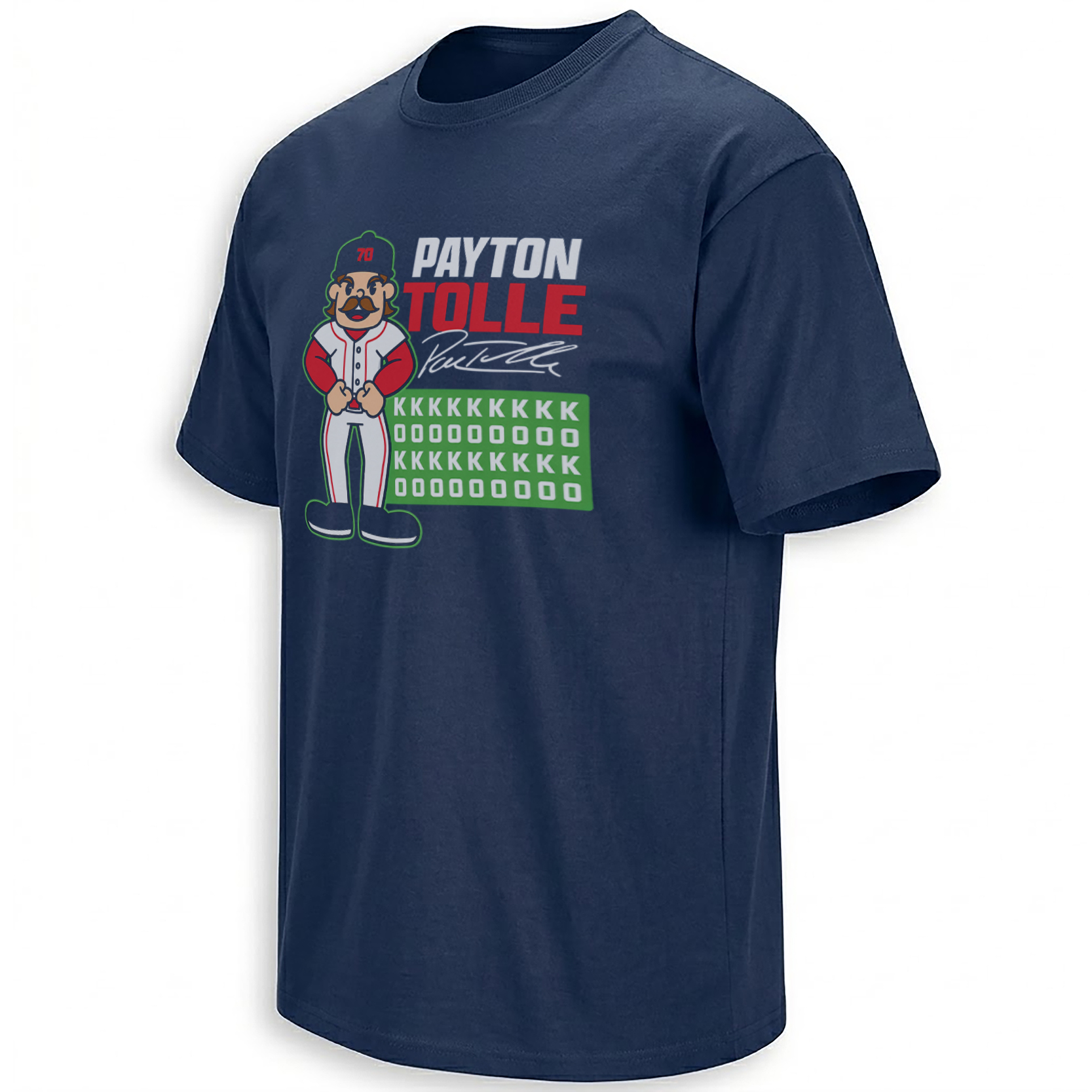
A Fenway-green player graphic built around Tolle’s 171-strikeout season, his career-high 14-K night and the cartoon personality surrounding Boston’s rookie left-hander.
View the strikeout piece →The internet saw all 14 strikeouts at once
Tolle’s 14-K game was particularly suited to social media because the highlight did not require one dramatic home run or a complicated late-inning situation. The repetition was the point. Swing, miss. Curveball. Fastball. Another K. Another one.
The fan reaction around that start also focused on something encouraging for Boston: Tolle was no longer winning only with a big fastball. His curveball was generating strikeouts, and his secondary pitches were giving right-handed hitters another problem to solve. Days later in Toronto, he demonstrated the other version of himself by throwing eight scoreless innings with only four strikeouts.
October ended badly for Boston, but not for Tolle’s identity
Starting a rookie at Yankee Stadium in Game 1 told its own story. Boston could have treated Tolle as a promising arm to protect. Instead, the Red Sox gave him the ball against their oldest rival with the postseason beginning.
His line was not spectacular in the way the 14-K Athletics start had been, but one run over 4⅔ innings kept Boston alive. The decision to remove him became part of the postgame discussion only because what followed went so poorly: New York broke the game open against the bullpen and eventually swept the series.
That should keep the design anchored to the full season rather than one October loss. The wider Boston Red Sox collection captures a year that contained both the playoff disappointment and the emergence of young players worth carrying forward. The broader MLB collection does the same across the league, where one performance can create an entire visual vocabulary around a player.
For No. 70 specifically, the Payton Tolle product search keeps those player-driven pieces together.
FAQ: Payton Tolle and the strikeout-board design
How many strikeouts did Payton Tolle have in 2026?
Tolle recorded 171 strikeouts in 148⅔ regular-season innings for Boston.
What was Payton Tolle’s biggest strikeout game?
He struck out a career-high 14 Athletics hitters over six innings at Fenway Park on August 7, 2026.
Why are there rows of K’s on the shirt?
In baseball scorekeeping, K represents a strikeout. The board turns Tolle’s swing-and-miss identity into the main visual element.
Why is the strikeout board green?
The green palette references Fenway Park and Boston’s classic Green Monster scoreboard atmosphere without reproducing the scoreboard literally.
Did Payton Tolle pitch in the 2026 postseason?
Yes. He started Game 1 of Boston’s Wild Card Series against the Yankees and allowed one run over 4⅔ innings with four strikeouts.
Why is Tolle drawn like a retro video-game character?
The exaggerated mustache and compact cartoon proportions reflect the playful internet personality that developed around Tolle during his breakout season.
The Payton Tolle graphic works as a timestamp of the year Boston learned exactly what kind of pitcher — and personality — No. 70 could become.
PAYTON TOLLE SHIRT turns Boston’s No. 70 into a retro cartoon pitcher beside a Fenway-inspired K-board, capturing his 171-strikeout rookie season and unforgettable 14-K breakout at Fenway Park.