
When Political Satire Accuses Both Parties at Once
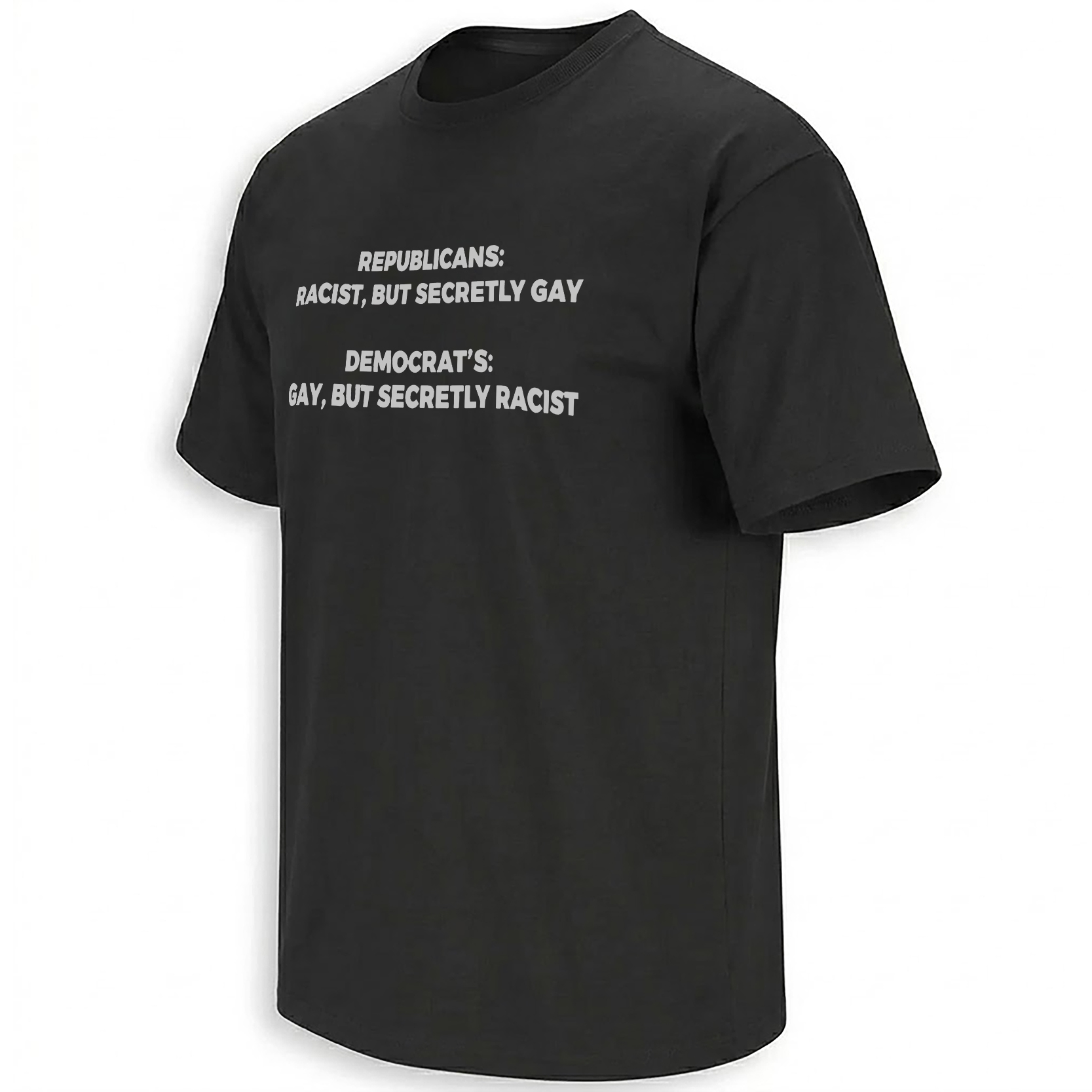
“Republicans: Racist, But Secretly Gay / Democrats: Gay, But Secretly Racist” uses an intentionally abrasive symmetry to mock the accusations, contradictions and identity performances surrounding America’s two-party divide.
By July 2026, the American midterm conversation had already returned to familiar territory: immigration, election legitimacy, culture-war identity and increasingly compressed accusations designed to move faster than policy explanations.
Republicans were placing immigration enforcement and election security near the center of their campaign messaging. Democrats were building their attacks around Trump, government power and the consequences of the administration’s agenda. Online, however, arguments rarely stayed inside those formal categories. They became labels, screenshots, punchlines and allegations of hypocrisy.
The “Republicans / Democrats” slogan belongs to that harsher internet register. It does not offer a serious demographic description of either party. It takes common partisan accusations—racism on the right, performative progressivism on the left and moral contradiction across both—and arranges them as a deliberately offensive two-line mirror.
The joke does not ask which party is innocent. Its entire mechanism depends on denying innocence to both.
The Slogan Is Built Like a Two-Panel Meme
The wording uses parallel construction. Each party receives a public accusation, followed by “but secretly” and a second identity-based charge. Because the sentence structure repeats, the reader understands the reversal before finishing the second block.
That symmetry performs most of the satirical work. Republicans and Democrats are placed inside the same grammatical machine, suggesting that partisan identity changes the content of political hypocrisy without removing hypocrisy itself.
The design also reflects the way contemporary political humor circulates. It is short enough to photograph, provocative enough to trigger an argument and incomplete enough that different viewers can project different meanings onto it.
Why the Minimal Design Makes the Language Harsher
The artwork contains no elephant, donkey, flag or candidate portrait. Without familiar campaign symbols, the viewer cannot dismiss the message as a normal piece of party branding. The words become the entire visual event.
Condensed italic lettering gives the text the speed of a caption or shouted aside. Generous space between the Republican and Democrat blocks creates the equivalent of a comedic pause: first accusation, short silence, reversal.
Black and white prevent color from assigning obvious partisan loyalty. Red would make the graphic appear Republican-coded; blue would push it toward Democratic messaging. The neutral black field allows the slogan to attack both directions without visually choosing one.
The slogan relies on exaggeration and stereotype. It should not be read as evidence that Republicans as a group are racist or secretly gay, nor that Democrats as a group are gay or secretly racist. Sexual orientation is also not proof of hypocrisy; the satire is aimed at perceived public-versus-private contradiction.
The “Secretly” Structure Targets Political Performance
The most important word in both lines is not “Republicans,” “Democrats,” “racist” or “gay.” It is “secretly.” That word transforms the graphic from a pair of insults into an accusation about performance.
Modern partisan politics depends heavily on public identity. Candidates and voters communicate who they are through language, media choices, cultural affiliations and the causes they display. The slogan assumes that these visible identities conceal something contradictory underneath.
On the Republican side, the joke draws from recurring stories about anti-LGBTQ rhetoric existing alongside private behavior or hidden identity. On the Democratic side, it targets the argument that progressive language can coexist with institutional, electoral or personal racial bias.
The claims are broad and intentionally unfair. That unfairness is part of the format. Political memes rarely survive by carefully distinguishing leadership, voters, factions and policy records. They survive by compressing an entire critique into a form that can be understood before someone scrolls away.
Why the Phrase Fits the 2026 Midterm Mood
Midterm elections rarely generate the unified national spectacle of a presidential race, but they intensify local versions of the same cultural conflicts. Immigration, voting rules, LGBTQ rights, education, race and executive power become both policy disputes and tests of group identity.
In that environment, charges of hypocrisy are especially efficient. They allow political speakers to argue that an opponent’s stated values are not merely wrong but fraudulent. The debate shifts from “your policy will fail” to “you do not actually believe the identity you perform.”
The shirt captures that shift in its rawest internet form. It is not a platform or voting guide. It is a timestamp of a discourse in which both parties are increasingly described through contradictions, suspected motives and the gap between branding and behavior.
The Joke Also Reveals the Limits of Shock Satire
Shock language produces immediate attention, but it can also reproduce the assumptions it intends to criticize. Using “secretly gay” as the twist risks treating gay identity itself as embarrassing, even when the intended target is conservative hypocrisy around sexuality.
Likewise, describing Democrats as “secretly racist” compresses a serious debate about policy, institutions and representation into one universal accusation. Some readers will recognize a critique of performative progressivism; others will see false equivalence between distinct political records.
That disagreement is not separate from the design’s cultural meaning. It is the meaning. The graphic functions as a provocation because viewers must decide whether the symmetry exposes both parties, oversimplifies both parties or merely turns identity into ammunition.
From Internet Caption to Wearable Argument
Political graphics often operate differently from ordinary fan designs. A baseball image can create recognition between strangers who share the same memory. A political slogan can create instant sorting: agreement, anger, laughter, discomfort or a demand for explanation.
This particular piece acts like a portable comment section. Its two blocks invite viewers to begin debating before the wearer says anything. That makes the typography part of the social interaction rather than simple decoration.
Because EllieShirt does not currently have a confirmed dedicated political collection for this topic, the design sits within the wider newest cultural graphics archive, where current sports moments, memes and political language appear as visual records of what people were arguing about at a particular time.
Frequently Asked Questions
What does the Republicans and Democrats slogan mean?
It uses mirrored accusations to satirize perceived hypocrisy in both major parties, especially the gap between public political identity and alleged private prejudice or contradiction.
Is the slogan making a factual claim about every Republican and Democrat?
No. The wording is broad political satire built from exaggeration and stereotype; it should not be treated as a factual description of every member or voter in either party.
Why does the design use only black and white?
The neutral palette avoids visually endorsing either red Republican branding or blue Democratic branding, keeping attention on the symmetrical wording.
Why is “secretly” important to the joke?
“Secretly” turns both lines into accusations about political performance, suggesting that each party’s public identity conceals a contradictory private reality.
Why can the phrase be controversial even as satire?
It uses sexuality and racism as shock-language punchlines, which can expose perceived hypocrisy but can also reinforce stereotypes or create a false equivalence between different political histories.
The Republicans and Democrats satire graphic preserves the abrasive language of the 2026 political internet, while the newest visual archive follows other moments moving through current culture.
Republicans Racist But Secretly Gay Shirt uses mirrored black-and-white typography to satirize partisan hypocrisy, identity performance and America’s polarized 2026 political discourse.