
Ray Kerr Said “Kerr Mode” Was Activated. Then He Did It Again.
Three days separated a winner-take-all start against Philadelphia from an NLDS start at Dodger Stadium. Ray Kerr threw six combined scoreless innings across both. Suddenly, “Kerr Mode Activated” stopped sounding like one good postgame quote and started sounding like Atlanta’s October pitching setting.
Ray Kerr entered October as exactly the kind of pitcher postseason baseball is supposed to expose. He had made only nine major-league appearances during the regular season. He was returning from Tommy John surgery. He was 32 years old, working primarily as a reliever and suddenly being asked to start the most important game of Atlanta’s season.
Instead, Kerr became the answer to a postseason problem the Braves did not know they had. In Wild Card Game 3 against Philadelphia on October 1, the left-hander gave Atlanta 3⅓ scoreless innings, allowing only one hit and one walk as the Braves built the foundation for a 6–2 elimination-game victory.
When reporters asked him afterward how he handled the pressure, Kerr supplied the phrase that turned the outing into fan language: “That’s my Kerr mode being activated. That’s when I just lock in.”
One October start created “Kerr Mode.” The second one proved Atlanta could actually turn it back on.
Wild Card Game 3 Was Already an Unlikely Assignment
The Phillies lineup was built to punish mistakes. Kyle Schwarber and Bryce Harper gave Atlanta a left-handed problem immediately, and Braves manager Walt Weiss wanted a lefty to confront that part of Philadelphia’s order before moving into the rest of his pitching plan.
Kerr fit tactically. His larger story made the assignment feel improbable.
He had torn the UCL in his pitching elbow in 2024 and missed the 2025 season. His rehab suffered another setback in March 2026. He did not return to the majors until August 17, then quietly finished the regular season with a 1.47 ERA across 18⅓ innings.
Atlanta trusted that small sample in the biggest possible setting. Kerr struck out Harper in the first, kept Philadelphia off the scoreboard and eventually walked off the mound to a standing ovation at Truist Park.

AJC’s Wild Card coverage shows Kerr leaving the mound after the outing that generated the phrase, the standing ovation and Atlanta’s newest postseason folk hero.
View AJC source →“Kerr Mode Activated” Came From Kerr Himself
That point is important because the Kerr Mode Activated Shirt is not retroactive marketing copy invented around a stat line.
Kerr gave fans the phrase himself. He described a mental state in which he stops processing everything around him and simply pitches. The wording happened to sound less like baseball psychology and more like somebody switching a machine into a higher performance setting.
The artwork follows that interpretation literally. “Kerr Mode” appears like a system label. “Activated” arrives in bright warning red. A capsule-shaped device with a baseball inside resembles a power button, upgrade icon or video-game item. Kerr’s extended pitching motion runs horizontally through the composition like the machine the typography claims has just been switched on.
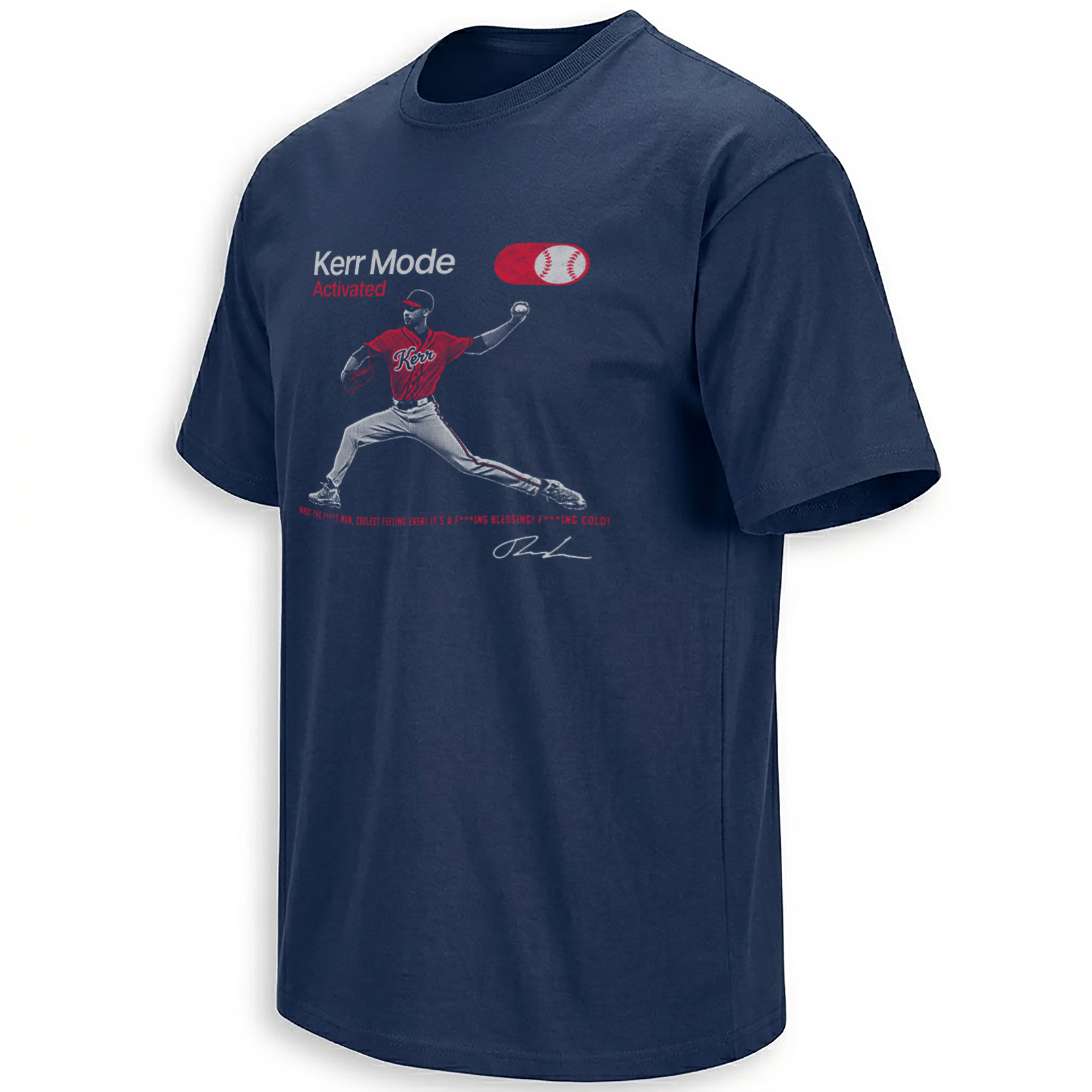
A postseason pitching performance becomes a retro-futuristic activation screen, built around Kerr’s own words rather than a generic playoff slogan.
View the Kerr Mode piece →Then Atlanta Asked Him to Face the Dodgers
Three days later, Weiss made another unconventional choice. Rather than push Chris Sale back onto the mound on short rest, Atlanta saved its ace for Game 3 and opened NLDS Game 2 against Los Angeles with Kerr.
That meant Kerr’s reward for surviving Schwarber and Harper was facing Mookie Betts, Shohei Ohtani and the two-time defending champions at Dodger Stadium.
He looked even better.
Kerr struck out four, allowed two hits and completed 2⅔ scoreless innings on 42 pitches. Most importantly, he faced Ohtani twice and retired him twice. He left with Atlanta ahead 1–0, and the Braves eventually held on for a 3–2 victory that tied the NLDS at one game apiece.
3⅓ scoreless innings, one hit and one walk allowed. Atlanta wins the winner-take-all game 6–2 and advances.
2⅔ scoreless innings, two hits and four strikeouts. Atlanta wins 3–2 and brings the series back home tied 1–1.
The Phrase Is Better After the Second Start
Sports slogans often peak immediately because the moment around them cannot be repeated. Kerr’s is unusual because the sequel strengthened it.
Had the Phillies outing remained his only major October contribution, “Kerr Mode Activated” still would have represented one brilliant night. Facing Los Angeles on three days of rest changed the meaning. It showed that Atlanta’s pitching staff had turned the phrase into something close to an actual postseason role.
The Braves now know they can hand Kerr the first trip through a dangerous lineup, exploit left-handed matchups and then change the game with a succession of different arms. What began as an emergency-looking Wild Card strategy has become part of the structure of Atlanta’s October run.
Kerr’s route included foster care, junior-college baseball, jobs outside the sport, an unconventional path to professional baseball, Tommy John surgery and nearly two full seasons away. October did not introduce a blue-chip prospect arriving on schedule. It introduced a pitcher whose career repeatedly required another route.
Why the Design Feels Like a Power-Up Screen
Visually, dark navy creates a Braves-friendly base without simply reproducing standard team branding. Gray gives the figure an industrial, almost mechanical quality. Red is reserved for the parts meant to feel active: jersey details, headline typography and the baseball capsule.
That distribution of color creates a clear visual hierarchy. The viewer reads “Kerr Mode Activated” first, the pitching figure second and the smaller postgame language last.
The design therefore works as both baseball merchandise and internet-era storytelling. Fans who know the quote see an exact cultural reference. Someone encountering it later can still understand the basic metaphor: pitcher, switch, activation, performance state.
Atlanta Now Brings Kerr Mode Home
The Braves return to Truist Park tied 1–1 with the Dodgers, with Sale scheduled for Game 3 and Tyler Mahle lined up behind him. Kerr’s work helped make that rotation possible because Atlanta did not need to force its ace into another short-rest assignment.
That makes Kerr’s value larger than six scoreless innings. He changed the way the Braves were able to arrange the rest of the series.
The wider Atlanta Braves collection now contains another unusually specific October phrase, while the MLB collection connects Kerr’s breakout to the broader 2026 postseason. Because this design belongs to one player, Ray Kerr products can also be followed directly through Ellie Shirt search.
Frequently Asked Questions
What does “Kerr Mode Activated” mean?
Ray Kerr used the phrase himself after Atlanta’s Wild Card Game 3 win, describing the locked-in mental state he reaches when he stops thinking about the pressure and simply pitches.
What did Ray Kerr do against the Phillies?
He threw 3⅓ scoreless innings in the deciding 2026 Wild Card Game 3 as Atlanta beat Philadelphia 6–2.
Did Kerr pitch again against the Dodgers?
Yes. Three days later he started NLDS Game 2 and threw another 2⅔ scoreless innings with four strikeouts in Atlanta’s 3–2 victory.
How many scoreless postseason innings has Kerr thrown?
Through his first two 2026 postseason starts, Kerr has thrown six scoreless innings.
Why does the shirt use an activation or video-game visual?
The system-style typography and baseball capsule convert Kerr’s phrase into a visual power-up metaphor, as though his playoff pitching has been switched into a different mode.
The Kerr Mode Activated graphic records the quote that emerged from Atlanta’s Wild Card clincher, while the Ray Kerr archive can follow whatever this unexpected October role becomes next.
Kerr Mode Activated Shirt captures Ray Kerr’s breakout 2026 Braves postseason through his own “Kerr mode” phrase, retro-futuristic activation graphics and the scoreless pitching run that carried from Philadelphia into Atlanta’s NLDS win over Los Angeles.