Milwaukee Is Winning Its Way — While 1983 Keeps Whispering “Here We Go Again”
Two Brewers graphics tell opposite sides of the same fan emotion. “Win Our Way” belongs to a 103-win 2026 powerhouse two victories into October. “Here We Go Again ’83” looks backward to the year Milwaukee tried to follow its first World Series run with another one.
Milwaukee entered October with a slogan that sounded almost modest for baseball’s best regular-season team: Win Our Way. No promise of domination. No player’s name. No declaration that 103 wins made the Brewers inevitable. Just an insistence that this team had spent six months discovering its own route to victory and had no reason to abandon that identity now.
Two games into the National League Division Series, the phrase has become increasingly difficult to separate from what is happening on the field. Milwaukee beat San Diego 3–2 in Game 1 after falling behind early. In Game 2, the Brewers entered the ninth trailing 3–2 against Mason Miller, loaded the bases through walks and then watched Jackson Chourio drive a 101-mph fastball into center field for a two-run walk-off.
Now Milwaukee travels to San Diego leading the best-of-five series 2–0. The postseason slogan is no longer marketing placed around the stadium. It is being tested in real time.
One shirt says Milwaukee can win differently. The other remembers the last generation that thought another magical October was about to begin.
“Win Our Way” Became More Than a Postseason Tagline
The Win Our Way Shirt is visually simple because the 2026 Brewers identity does not need a single face.
Milwaukee finished with 103 victories, the highest total in franchise history and its first 100-win season. The Brewers secured the best overall record in Major League Baseball, won the NL Central for a fourth consecutive season and entered October with home-field advantage throughout the postseason.
Yet this was not a conventional home-run superteam. The Brewers built their record through contact, speed, pitching, defense, situational execution and a roster in which different players became the most important person on different nights.

The phrase appears at stadium scale above the field, confirming that the shirt is reproducing Milwaukee’s actual 2026 postseason language rather than generic fan copy.
View source →Game 2 Looked Like the Slogan Becoming a Baseball Game
Milwaukee did not win Sunday the way a 103-win team is “supposed” to win. San Diego had the lead. Miller had already dominated the eighth. The Brewers were down to their final outs against one of the hardest throwers in baseball.
Christian Yelich walked. Sal Frelick walked. After an out, Gary Sánchez walked as a pinch-hitter. Then Chourio stepped in with two outs and the bases loaded, stayed alive against triple-digit velocity and lined the winning hit through center.
It was messy, patient, opportunistic and completely consistent with the slogan.
Two Shirts, Two Versions of Brewers Confidence
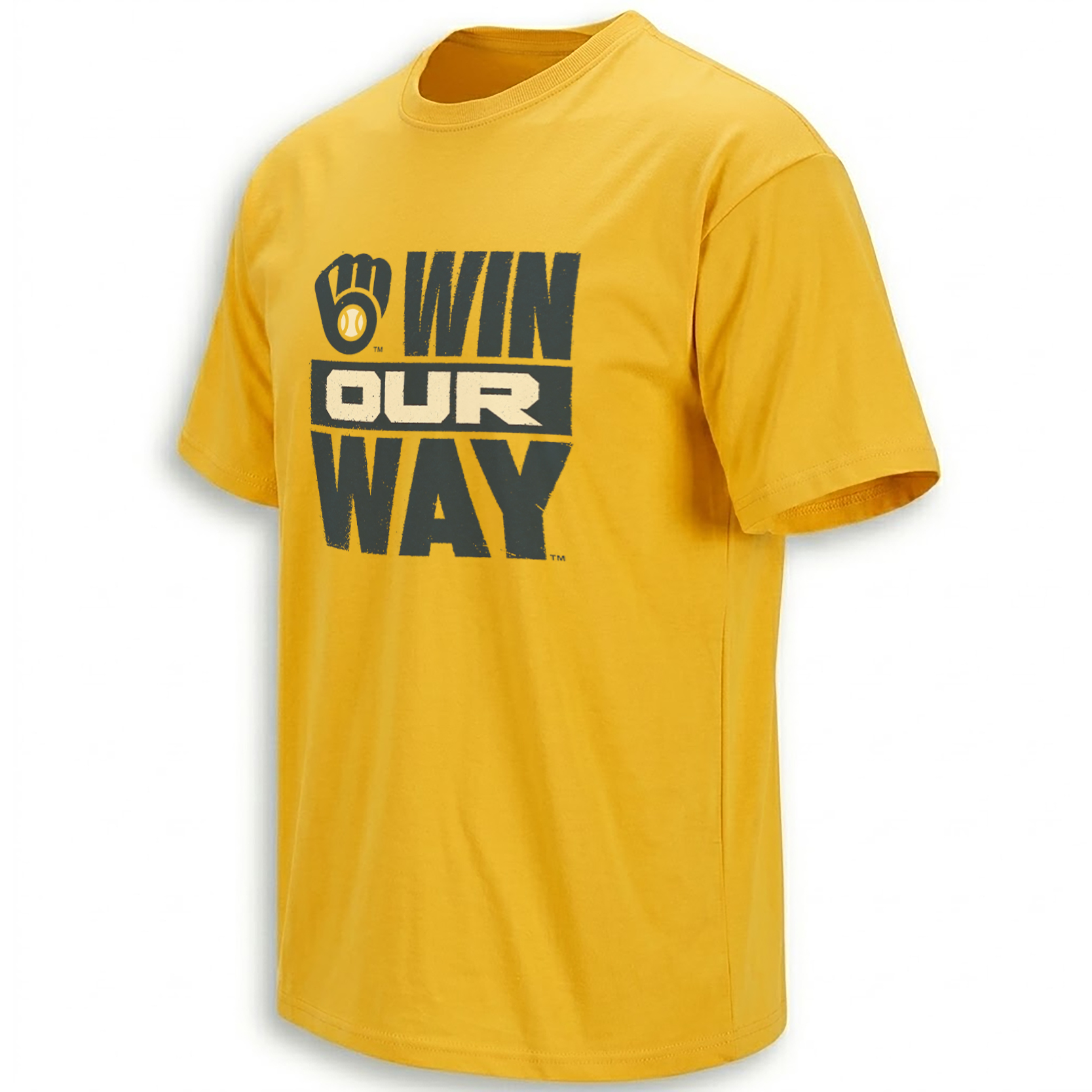
Bright Brewers gold, the ball-in-glove mark and oversized distressed typography turn the current postseason philosophy into a stadium-readable identity.
View the 2026 piece →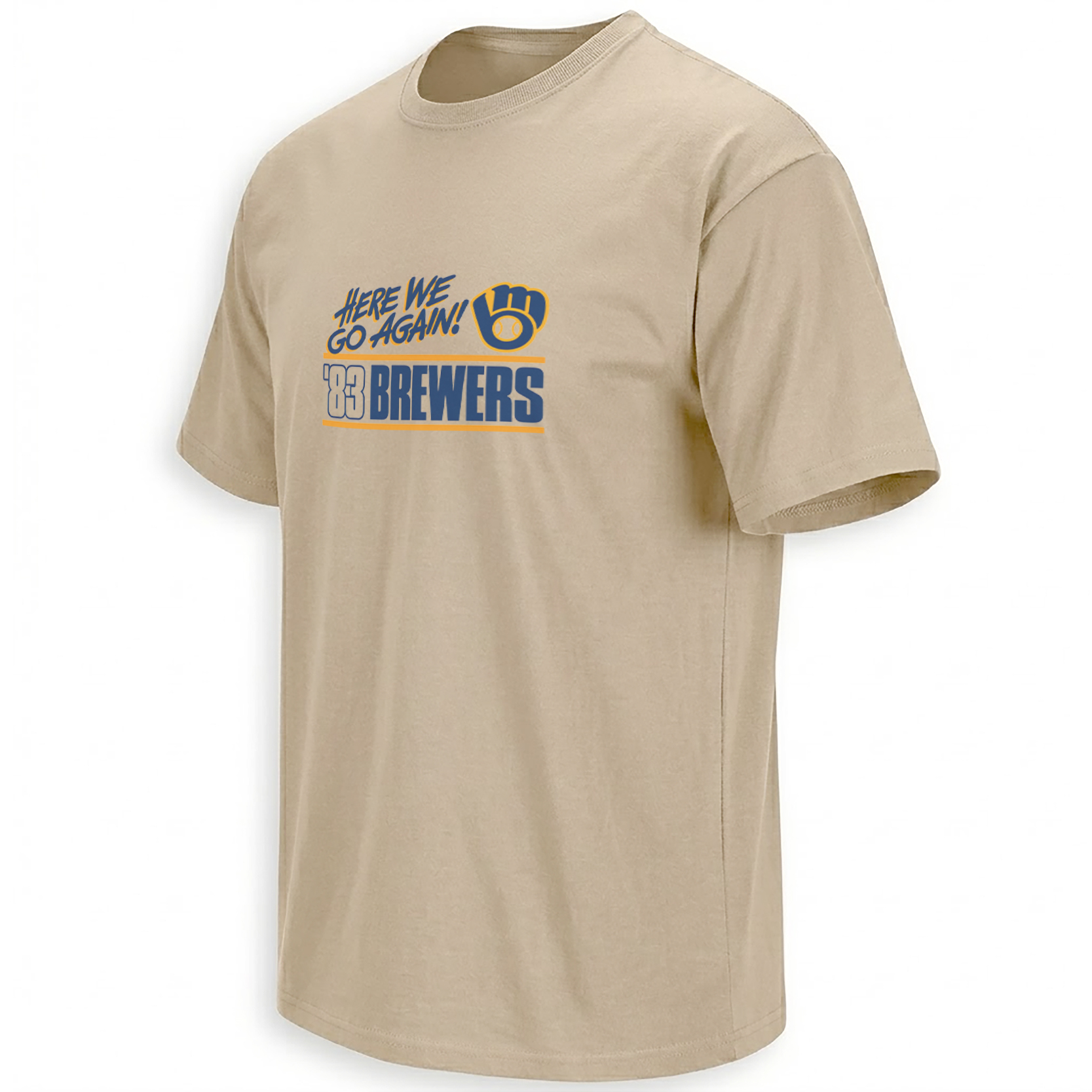
Cream fabric, brush lettering and the original-era ball-in-glove logo recreate the optimism immediately after Milwaukee’s 1982 World Series breakthrough.
Open the 1983 piece →Why “Here We Go Again” Belongs to 1983, Not 1982
The Here We Go Again Shirt is deliberately stamped ’83 because the emotional point is not the Brewers reaching the World Series. It is what fans felt afterward.
The 1982 team — Harvey’s Wallbangers — became the first Brewers club to win an American League pennant. Robin Yount won MVP, Milwaukee survived an ALCS deficit against California and then pushed the St. Louis Cardinals to Game 7 of the World Series.
One victory separated Milwaukee from a championship.
When 1983 arrived, much of the same core was still present: Yount, Cecil Cooper, Paul Molitor, Ben Oglivie, Don Sutton and others who had turned County Stadium into the center of Wisconsin baseball. Fans had every reason to enter the new season thinking: here we go again.
The season followed Milwaukee’s first World Series appearance. The Brewers finished 87–75 and did not return to October, but attendance remained enormous and the city was still living inside the afterglow of 1982.
The current club did not enter the postseason hoping to reproduce one miraculous year. It arrived with 103 wins, baseball’s best regular-season record and four consecutive division championships.
The Ball-in-Glove Logo Connects Both Eras
This is where the two designs stop feeling separate.
The famous Brewers ball-in-glove mark debuted in 1978 after a public logo contest. Tom Meindel’s design hides a lowercase “m” and “b” inside the shape of a baseball glove, turning Milwaukee Brewers into one compact symbol.
Milwaukee wore that original logo through 1993, making it the visual identity of Yount, Molitor and the 1982–83 era. Decades later, fan attachment remained so strong that the Brewers modernized and restored the concept as their primary logo beginning in 2020.
That means the mark on the 2026 slogan tee and the mark on the ’83 throwback are not merely similar. They are two generations of the same design language.
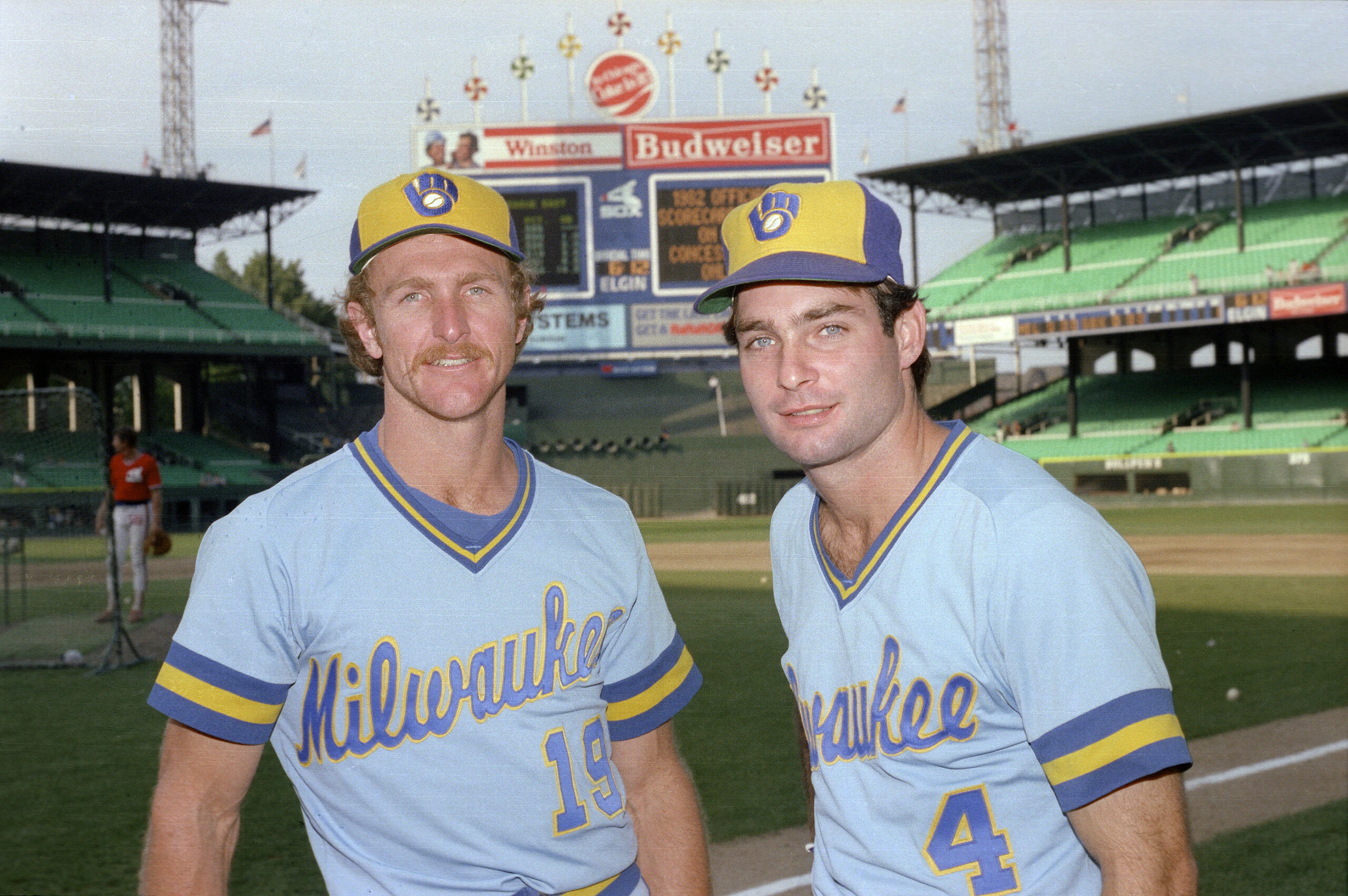
Robin Yount and Paul Molitor in powder blue, blue-and-gold caps and the ball-in-glove era show why the retro graphic can communicate a specific period with almost no explanation.
View historical source →“Here We Go Again” should be read as the design’s fan-facing expression of 1983 optimism, not as a documented official Brewers slogan from that season. The ’83 date, roster continuity and ball-in-glove identity are the verified historical anchors.
2026 Feels Different Because Milwaukee Has Been Here Repeatedly
The older design remembers a city wondering whether one magical pennant run could happen again. The current design comes from a franchise that now expects October.
Milwaukee has reached the postseason eight times in nine seasons. The 2026 NL Central crown was the club’s fourth straight. That consistency changes the meaning of “Here We Go Again.” Today the phrase can describe postseason participation almost literally.
But “Win Our Way” expresses the part Milwaukee still wants to change. Recent Brewers teams have repeatedly reached October without reaching the World Series. This 103-win roster is trying to prove that sustained regular-season success can finally become a deeper championship run.
That is why Chourio’s Game 2 walk-off felt bigger than one dramatic hit. It placed Milwaukee one victory from the NLCS and turned the team’s postseason campaign phrase into something fans had just watched happen.
Two Different Graphic Languages for the Same Franchise
The current shirt uses stadium language: massive block lettering, high contrast, gold and navy, distressed texture and a vertical stack readable from across a parking lot.
The 1983 piece behaves like something pulled from an old County Stadium drawer. Cream replaces bright gold. Brush script replaces campaign typography. The date becomes central. Instead of trying to look like postseason branding, it looks like memory.
Together, they form a useful visual timeline: one design asks whether Milwaukee can finish the journey now; the other remembers the generation that came closest first.
Both belong naturally inside the verified Milwaukee Brewers collection, while the MLB collection connects the current NLDS run and the franchise’s historical identity to the wider culture of October baseball.
Historical player searches for Robin Yount and Paul Molitor, along with current searches for Jackson Chourio, connect the two eras through the players fans remember most clearly.
Frequently Asked Questions
What does “Win Our Way” mean for the 2026 Milwaukee Brewers?
It describes Milwaukee’s team-first approach built around pitching, defense, contact, baserunning and situational baseball rather than relying on one superstar or one offensive formula.
Is “Win Our Way” an official Brewers postseason slogan?
Yes. The phrase became part of Milwaukee’s official 2026 postseason messaging and appears around American Family Field and in team postseason communication.
Why does the other Brewers shirt say “Here We Go Again ’83”?
The design references the optimism surrounding the 1983 season immediately after Milwaukee won the 1982 American League pennant and reached the first World Series in franchise history.
How did the 1983 Brewers finish?
Milwaukee finished 87–75 and fifth in the American League East, so the club did not repeat its 1982 postseason run.
How are the Brewers doing in the 2026 NLDS?
Milwaukee leads San Diego 2–0 after winning both opening games at American Family Field, including Jackson Chourio’s dramatic walk-off single in Game 2.
What is hidden inside the Brewers ball-in-glove logo?
The glove is formed from a lowercase “m” and “b,” representing Milwaukee Brewers. The original version debuted in 1978 and became one of baseball’s best-known hidden-symbol logos.
Explore the Win Our Way and Here We Go Again ’83 graphics as two ends of the same Milwaukee baseball timeline, with the wider Brewers archive connecting the eras between them.
Milwaukee Brewers 2026 meets early-1980s nostalgia through two fan-culture graphics: Win Our Way captures the identity of a franchise-record 103-win postseason team, while Here We Go Again ’83 returns to the hopeful season after Harvey’s Wallbangers reached the 1982 World Series.