
Ravens Barbell: Baltimore Football Built to Carry Weight
The Ravens’ 2026 summer has given a football-strength graphic an unusually literal backdrop: pads, oppressive August heat, one of the longest practices of camp and a coaching staff openly demanding physical football. Then Baltimore opened the preseason with a 24–7 win over Philadelphia.
There are easier ways to prepare an NFL team than asking players to spend roughly two and a half hours in pads during temperatures in the high 90s. Baltimore chose the harder version.
During the Ravens’ August 6 practice, the pads came back on after a non-padded day and the session became the longest of camp to that point. Head coach Jesse Minter’s explanation was straightforward: Baltimore wanted the practice long, physical and demanding enough that players had to fight through discomfort.
That language is almost a blueprint for the Barbell concept. Weight training works because resistance is intentional. The load is supposed to make repetition harder. Football camp follows the same logic. The heat, pads, contact and fatigue expose whether technique holds up when the body no longer feels fresh.
Baltimore’s version of strength culture is not built around looking powerful. It is built around staying technically sound when the practice is hot, long and physical.
The Ravens made physicality part of the 2026 story
Training camp clichés are easy to produce because every team talks about toughness. Baltimore’s August practices have provided something more useful: specific conditions in which that toughness is being tested.
Minter did not merely tolerate the long padded session. He described it as intentional. The objective was to make players work through fatigue while remaining focused enough to avoid turning competition into wasted aggression.
That distinction fits the Barbell graphic particularly well. A loaded bar only matters if it can be controlled. Reckless movement is not strength. In the same way, physical football becomes useful only when force remains connected to assignment, leverage and discipline.
The preseason opener gave the work a visible result
Baltimore’s 24–7 preseason victory over Philadelphia should be read carefully. August results do not predict a season, and many established starters are being protected while roster competitions unfold.
Still, the game gave Minter’s first Ravens camp an important public checkpoint. Baltimore’s defense kept Philadelphia scoreless until late, and the final margin matched the physical, disciplined identity the coaching staff had spent camp trying to establish.
For a design centered on strength, that matters more than attaching the graphic to one spectacular play. The barbell represents preparation before the result. The preseason opener simply allowed fans to see some of that preparation transferred into another uniform.

Derrick Henry makes the symbolism easy to understand
The design itself does not need to belong to Derrick Henry, but his presence helps explain why strength language feels so natural around Baltimore football. Few NFL running backs make mass, acceleration and contact balance as visible as Henry.
The Ravens’ own training-camp preview used Henry as one of the defining images of the summer. That is fitting. Baltimore already has a quarterback capable of changing geometry with speed in Lamar Jackson, while Henry gives the offense an entirely different physical reference point.
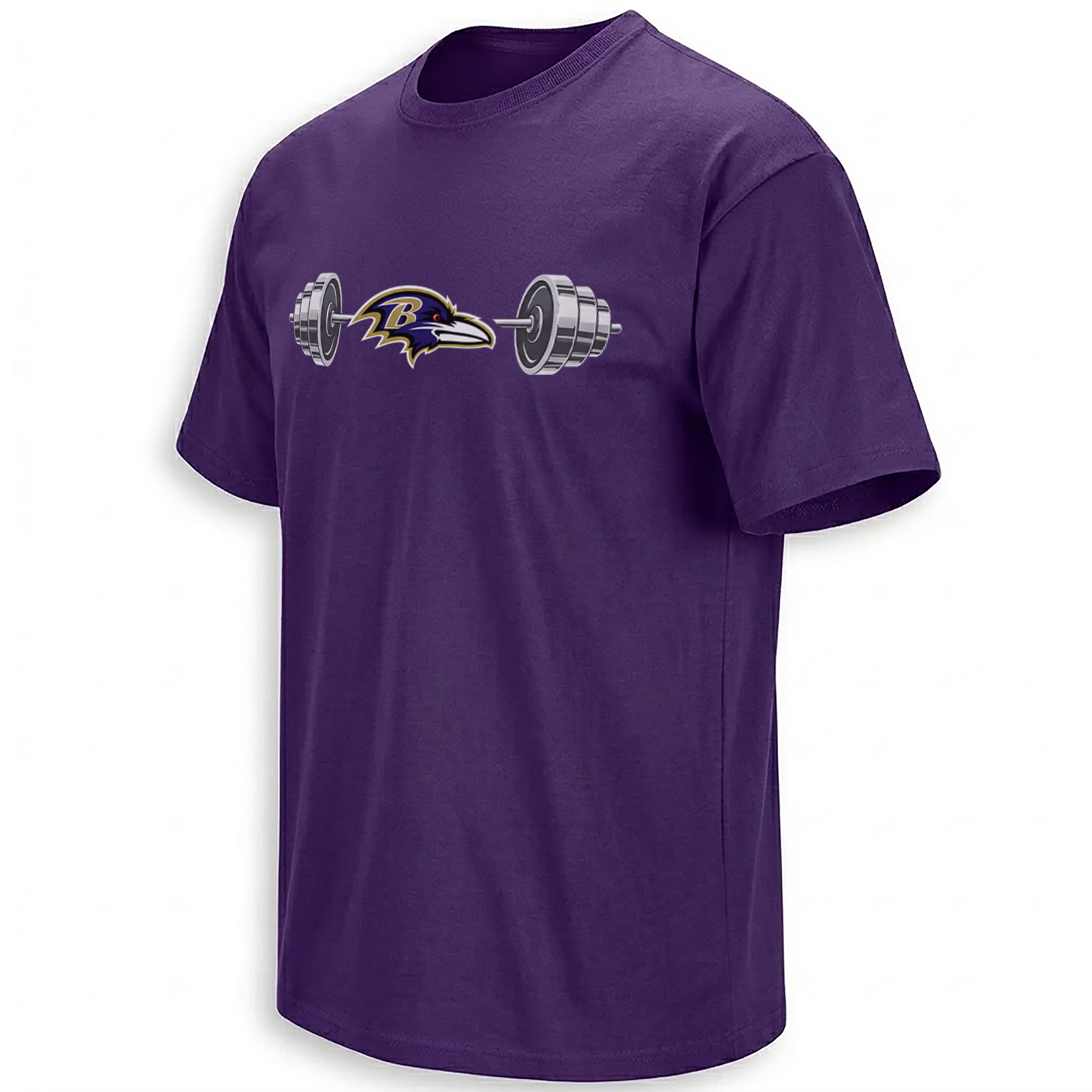
The interesting part of Ravens Barbell is that neither name needs to appear. Instead of functioning as player merchandise, the bar becomes a team-level symbol that can contain multiple forms of football power: Henry’s downhill force, an offensive lineman anchoring, a pass rusher converting speed into power or a defender ripping at the football after contact.
Purple establishes Ravens identity, black supplies visual weight and muted gold keeps the composition connected to Baltimore without turning it into a conventional team-logo layout. The barbell’s symmetry gives the piece the feeling of an old strength-program badge.
Why the purple-and-black version should feel heavier
A successful NFL Barbell series cannot simply recolor the same emotional story thirty-two times. Baltimore has its own natural direction.
Buffalo can read cold and blue-collar. Detroit can feel industrial. Philadelphia belongs to iron and trench culture. Baltimore’s strongest version is darker: purple, black, pressure, defense and the feeling of a program comfortable making practice uncomfortable.
The Ravens also carry a long cultural association with defense, which gives the weight motif another layer. A barbell can represent offensive force, but in Baltimore it can just as easily represent the strength required to stop force.
Strength is useful only when discipline survives it
The chippy moments from Baltimore’s long August 6 practice make this point especially useful. Players became irritated. Tempers rose. There was a brief pile after one confrontation.
Minter stopped practice and brought the group together. His message was essentially that competitive spirit and physicality were valuable only if they remained connected to football.
That makes the training-camp story more interesting than generic toughness rhetoric. Baltimore is not trying to build maximum aggression. It is trying to build aggression that can be controlled.
Inside the wider Baltimore Ravens collection, Ravens Barbell therefore occupies a different space from player-specific or game-specific graphics. The broader NFL collection shows how the same weight-room framework can become a different cultural artifact when the city and franchise change.
Frequently Asked Questions
Why does a barbell fit Baltimore Ravens football culture?
The barbell represents strength under resistance, preparation and controlled physical force, themes that fit naturally with Baltimore’s physical 2026 camp and long-standing football identity.
Why is Ravens Barbell especially relevant in August 2026?
Baltimore has held demanding padded practices under Jesse Minter, including a roughly two-and-a-half-hour session in high-90s heat, before opening the preseason with a 24–7 win over Philadelphia.
Is Ravens Barbell a Derrick Henry design?
No. Henry helps illustrate Baltimore’s current physical identity, but Ravens Barbell is a broader team-strength graphic rather than a player-specific piece.
Why are discipline and strength connected in the article?
Baltimore’s coaching staff has emphasized physical practices while also stressing that aggression must remain focused on football, making controlled force an important part of the team’s current camp narrative.
How does the Ravens version differ from other NFL Barbell designs?
Baltimore’s purple, black and gold palette combines with the franchise’s defensive and physical identity to create a darker, pressure-oriented interpretation of the shared Barbell concept.
The Ravens Barbell graphic turns that idea into one compact visual, while the Baltimore Ravens archive follows the players, slogans and football moments surrounding the 2026 season.
Ravens Barbell Shirt turns Baltimore football strength into a purple-and-black weightlifting graphic, connecting Ravens Flock culture with Jesse Minter’s physical 2026 training camp, padded work and pressure-tested football identity.