
49ers Barbell: Why Strength Still Starts in the Trenches
San Francisco’s 2026 preseason opened with a 19–13 loss to Tennessee, but the stronger Barbell story was already developing in Santa Clara: pads on, offensive-line competition, renewed defensive pressure and one of football’s clearest living examples of strength translated into technique — Trent Williams.
The most misleading thing about football strength is that the strongest-looking player does not automatically win the rep. NFL bodies are too powerful for strength alone to solve the problem. Hands have to arrive correctly. Feet must remain underneath the frame. Leverage matters. Timing matters.
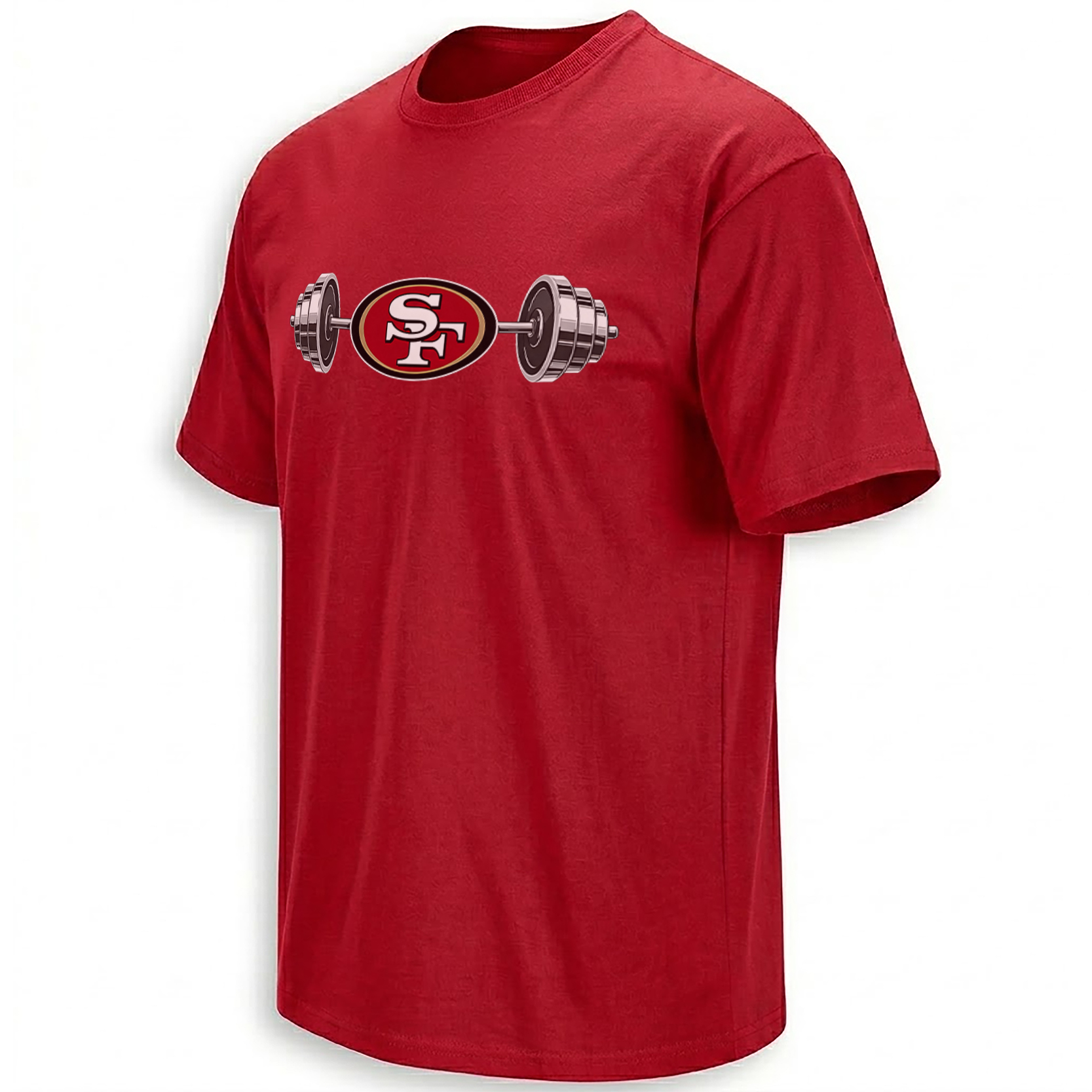
That is why San Francisco’s version of a Barbell graphic needs a slightly different interpretation from the rest of the NFL series. The loaded bar represents power, but the 49ers’ football language adds another idea: power has to move efficiently.
The team’s 2026 camp has repeatedly returned to that relationship. Pads arrived on Day 4 and immediately increased the physicality of practice. The run game remained a point of emphasis, while offensive-line competition continued deep into camp and the defensive front generated pressure during team periods.
For San Francisco, the barbell works best as the beginning of the story. The real test is whether that strength can become leverage, balance and movement once another NFL body pushes back.
The pads changed the meaning of camp
There is a reason NFL coverage treats the first padded practice differently from everything before it. Shorts-and-shells football can reveal timing, recognition and conditioning, but it cannot fully recreate the problems linemen are paid to solve.
San Francisco’s Day 4 session marked that transition in 2026. The team’s own camp hub described increased physicality as the pads came on, while later practices continued testing the offensive line and defensive front.
That is exactly the point at which a weight-room graphic becomes culturally relevant. Strength training creates capacity. Padded football reveals whether the player can use it.
Trent Williams is what happens after the weight room
No current 49ers player explains the concept better than Trent Williams. Offensive tackle is an ideal position for understanding the difference between raw strength and usable football strength.
An elite tackle needs enough mass and power to survive a bull rush, but also enough balance to redirect against speed. He must move backward without losing control, then generate forward movement when the play changes from protection to run blocking.
Williams has made that blend recognizable to an entire generation of football fans. His presence at San Francisco’s first padded practice in 2026 therefore provides the strongest possible external image for the Barbell piece. The photograph does not show a weight room. It shows what the weight room is supposed to produce.

The red-and-gold version needs an old training-program feel
San Francisco’s football palette changes the visual direction immediately. Red is already energetic, while gold brings age, prestige and an almost archival quality. Used carefully, those colors make a Barbell graphic feel less like modern gym merchandise and more like an old team strength-program mark.
That is why this article avoids a metallic industrial approach. Detroit owns that language more naturally. The 49ers version leans into cream, faded gold and deeper reds, creating a vintage athletic-program atmosphere that fits a franchise with decades of visual history.
The effect also helps the design avoid becoming too literal. The graphic is not saying San Francisco football is about weightlifting. It is borrowing the visual grammar of old strength rooms to talk about the preparation beneath football.
Deep red provides the competitive signal, muted gold creates a vintage athletic-program feeling, and the balanced barbell structure gives the artwork the authority of an old training-room emblem rather than a conventional game-day graphic.
San Francisco’s run game makes the symbolism deeper
For years, the 49ers’ offensive identity has made blocking angles and coordinated movement visible to casual viewers. Outside-zone concepts, motion and the use of fullbacks or tight ends all depend on bodies arriving in specific places at specific times.
That creates an interesting relationship with strength culture. A blocker does not simply overpower the nearest defender. Often he must reach a landmark, establish leverage and move the defender just enough to change the runner’s path.
The barbell therefore represents the physical base of the system, not the entire system. Strength helps create the possibility. Technique determines whether it becomes useful football.
Defense adds the other half of the equation
The 2026 camp has also produced a strong defensive story. San Francisco’s secondary has generated interceptions and pass breakups, while its defensive line has created hurried throws and forced quarterbacks to move during team work.
Those moments make the Barbell concept two-sided. Offensive strength attempts to preserve structure. Defensive strength attempts to collapse it.
Nick Bosa, Fred Warner and the returning Dre Greenlaw give the defense several familiar physical reference points, while newer players are being evaluated inside the same system of leverage, contact and repeatability.
The preseason loss does not weaken the concept
San Francisco’s first preseason game ended in a 19–13 loss to Tennessee. That result should remain part of the real-time context rather than being edited out because it complicates an optimistic narrative.
In fact, the Barbell idea works better when it is separated from one scoreboard. Strength training is cumulative. It exists before wins and after losses. Training camp is precisely the stage where a team is still finding out which pieces can carry the load once the regular season starts.
That makes the graphic closer to a preseason artifact than a victory souvenir. It belongs to the process.
The wider San Francisco 49ers collection tracks other player references, slogans and cultural moments around the franchise, while the NFL collection shows how a shared Barbell framework can change character as it moves from team to team.
Frequently Asked Questions
Why does a barbell fit San Francisco 49ers football culture?
The barbell represents the physical base behind blocking, tackling and contact, while San Francisco’s football identity adds an emphasis on leverage, coordinated movement and technique.
Why is 49ers Barbell relevant during the 2026 training camp?
San Francisco began padded practices on Day 4 and has continued evaluating offensive-line competition, run-game execution and defensive pressure throughout camp.
Is the 49ers Barbell design a Trent Williams shirt?
No. Williams is a useful real-world example of strength translated into elite offensive-line technique, but the design represents the broader San Francisco football strength culture.
Why does the design use vintage strength-program language?
San Francisco’s red-and-gold palette naturally supports an old athletic-program aesthetic, allowing the Barbell concept to reference the franchise’s long football history without becoming a game-result graphic.
Does the preseason loss to Tennessee change the meaning of the design?
No. Barbell imagery is tied to preparation and accumulated work rather than one result, making the design especially appropriate to training-camp and preseason culture.
The 49ers Barbell graphic captures San Francisco’s strength-program side, while the 49ers archive follows the wider players, moments and visual language surrounding the 2026 season.
49ers Barbell Shirt connects San Francisco football with red-and-gold strength culture, padded training, offensive-line leverage and the physical preparation defining the 49ers’ 2026 training camp.