Pete Alonso Is Learning the Language of Birdland — Bird Hands Included
Baltimore brought Pete Alonso to Camden Yards for power and veteran presence. Eight months later, the Orioles’ biggest offseason addition is also becoming part of the club’s gestures, jokes and visual language.
The easiest way to measure whether a free-agent signing belongs somewhere is through statistics. Pete Alonso had 26 home runs by August 11. He had just produced his first multi-homer game as an Oriole two days earlier. Baltimore had given him a five-year contract because middle-of-the-order power was supposed to change the shape of the lineup.
But baseball has another measurement that never appears in a contract: how quickly a player begins to look natural inside the rituals of a new clubhouse.
That is where the Orioles’ “bird hands” celebration becomes interesting. The gesture is deliberately goofy — hands arranged to resemble a bird, a visual joke built for dugout cameras and screenshot culture. It belongs naturally to a team whose entire fan vocabulary revolves around birds, Birdland and the cartoon Oriole identity.
Bird hands are funny precisely because they do not need explanation. One gesture says Orioles, Birdland and clubhouse celebration at the same time.
Alonso’s Baltimore Story Was Never Going to Be Only About Home Runs
When Baltimore announced Alonso’s five-year deal in December 2025, the significance went beyond adding another hitter. He arrived after seven seasons in New York with an established nickname, a recognizable personality and the pressure attached to being one of baseball’s most visible power hitters.
During his first months with the organization, Alonso spoke repeatedly about the positive atmosphere he felt in Baltimore and described himself as excited to join Birdland. By August, that language had become less theoretical. He was no longer the new player holding an Orioles jersey at an introductory event. His reactions, home-run celebrations and dugout interactions were now part of the season’s weekly visual rhythm.
The timing is particularly useful in mid-August. Baltimore’s offense had gone through an ugly stretch before Alonso broke through with two home runs in the August 9 win over Texas. On August 11, he went deep again at Minnesota for No. 26 as the Orioles scored early and won 5–2.
Bird Hands Turn a Clubhouse Gesture Into a Logo Without Words
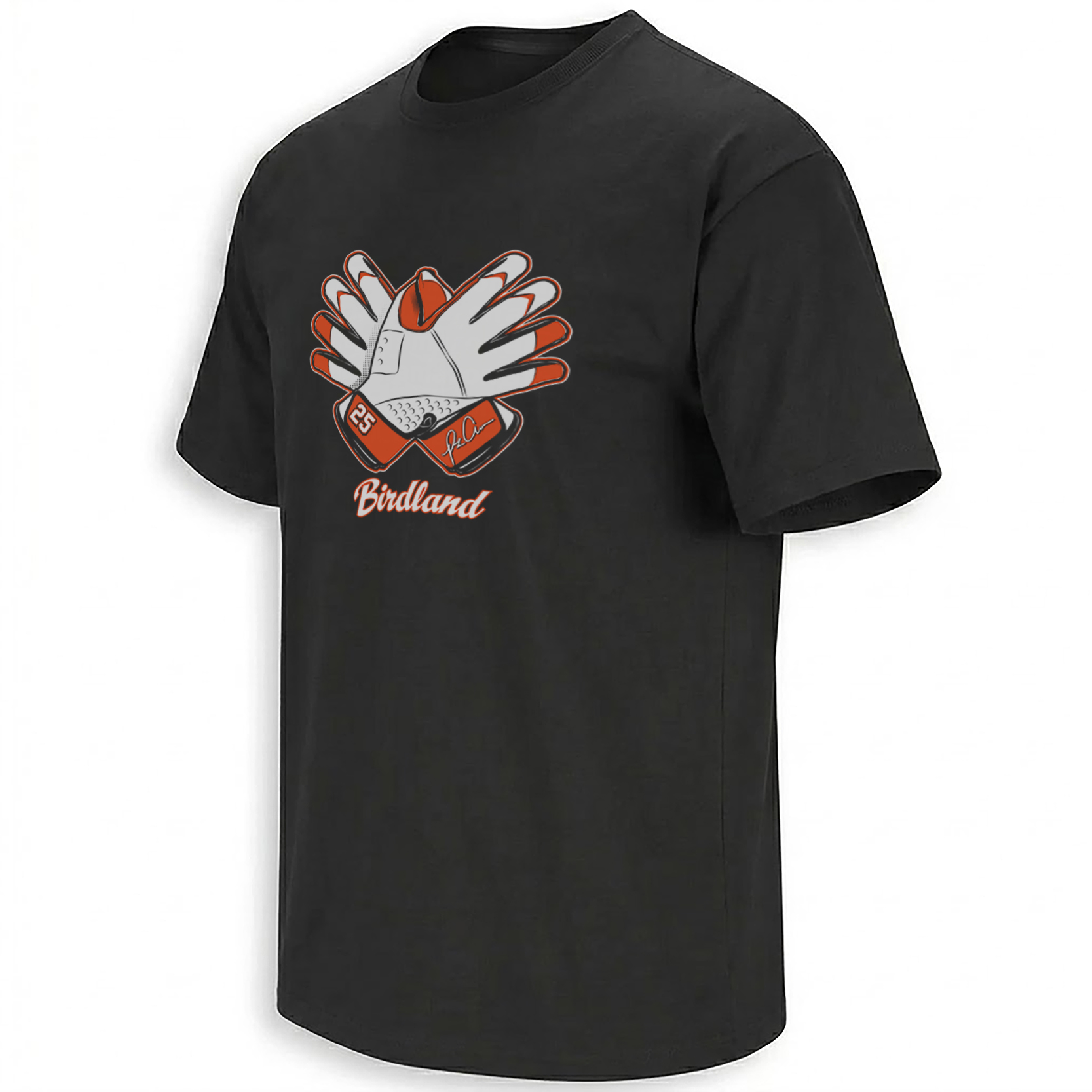
The design is strongest where it refuses to become a portrait shirt. There is no need for a large photo of Alonso’s face. The hands carry the idea. Orange outlines establish Baltimore immediately, the No. 25 connects the visual directly to Alonso, and the handwritten Birdland lettering gives the whole composition the feeling of clubhouse shorthand.
That approach mirrors how celebrations function in modern baseball. A home run may last only a few seconds, but one repeated gesture can survive across highlights, GIFs, fan photos and graphics for months. The celebration becomes a symbol that exists beside the box score.
The glove shapes function almost like a secondary Orioles mascot. They do not imitate an official logo; instead, they translate the idea of a bird into body language, which is exactly why the visual works as fan culture rather than formal branding.
The Real Pete Alonso Is Now Visually Part of Baltimore

Alonso’s transition is now visually complete: orange-and-black uniform, No. 25 and a season in which the longtime “Polar Bear” identity has acquired a distinctly Baltimore layer. View Pete Alonso on MLB.com →
That transformation matters because star players rarely arrive as blank slates. Alonso came to Baltimore with “Polar Bear,” Home Run Derby memories and years of Mets imagery already attached to him. The Orioles did not need to erase those associations. They needed to add something new.
Birdland provides exactly that kind of framework. It is not simply the name of a fan base. Baltimore uses the word across promotions, ballpark identity and team communication. When Alonso said before the season that he was honored to become part of Birdland, the phrase carried organizational meaning. A bird-themed celebration turns that same language into a visible action.
Fans Had Already Turned “Bird Hands” Into Shared Vocabulary
Orioles fan discussion shows how quickly the gesture became recognizable. On Reddit, supporters assembling GIFs of the season specifically asked for “the first Adley bird hands,” while another discussion about the team’s home-run celebration referred to “bird hands” as though the phrase required no definition.
That is the point where a celebration becomes culturally useful. People stop describing what the players are physically doing and simply name the gesture. “Bird hands” becomes enough.
It is important not to overstate the ownership of the gesture. This is not presented as a celebration invented by Pete Alonso. The interesting part is that a player who arrived with such a strong preexisting identity can now be represented through a celebration associated with his new baseball home.
Why the Timing Works Right Now
Alonso’s August run gives the image current energy. On August 9, he homered twice and reached base in all five plate appearances during Baltimore’s 10–5 win over Texas. Two nights later in Minnesota, he launched a 418-foot home run at 107.1 mph for his 26th of the season.
Those are the moments when celebration imagery matters most. A gesture without performance can feel manufactured. A gesture attached to a player driving the offense begins to feel like part of the season.
That is why the Pete Alonso Birdland design works best as an artifact of assimilation rather than a generic Orioles graphic. It records the point when one of Baltimore’s largest recent signings started looking culturally at home in orange and black.
The broader MLB Shirts collection follows the same phenomenon across the league: gestures, dugout jokes, nicknames and celebratory language that turn long regular seasons into a sequence of recognizable fan memories.
Frequently Asked Questions
What are the Orioles’ “bird hands”?
“Bird hands” is fan language for a bird-shaped hand gesture associated with Orioles celebration culture, especially around home-run and dugout moments.
Did Pete Alonso invent the bird-hands celebration?
The gesture is better understood as part of wider Orioles celebration culture rather than a Pete Alonso invention. The design connects Alonso to a visual language already recognized by Birdland.
How many home runs did Pete Alonso have by August 11, 2026?
Alonso hit his 26th home run of the season on August 11 at Minnesota, two days after recording his first multi-homer game as an Oriole.
Why does “Birdland” matter to Pete Alonso’s Orioles story?
Birdland is a long-standing name for Baltimore’s Orioles community and team culture. Alonso publicly embraced the term after signing with Baltimore, making the bird-themed celebration a natural visual symbol of his new chapter.
The Birdland Pete Alonso graphic preserves that 2026 transition through one unmistakably Baltimore gesture, while the wider MLB archive tracks the celebrations and inside language that fans carry from game to game.
Birdland Shirt captures Pete Alonso’s 2026 Orioles chapter through Baltimore’s recognizable bird-hands celebration, No. 25 and the visual language surrounding his growing place in Birdland.