
People
Absolute nightmare, would not recommend. One familiar review interface delivers an impossibly broad verdict with perfect deadpan efficiency.
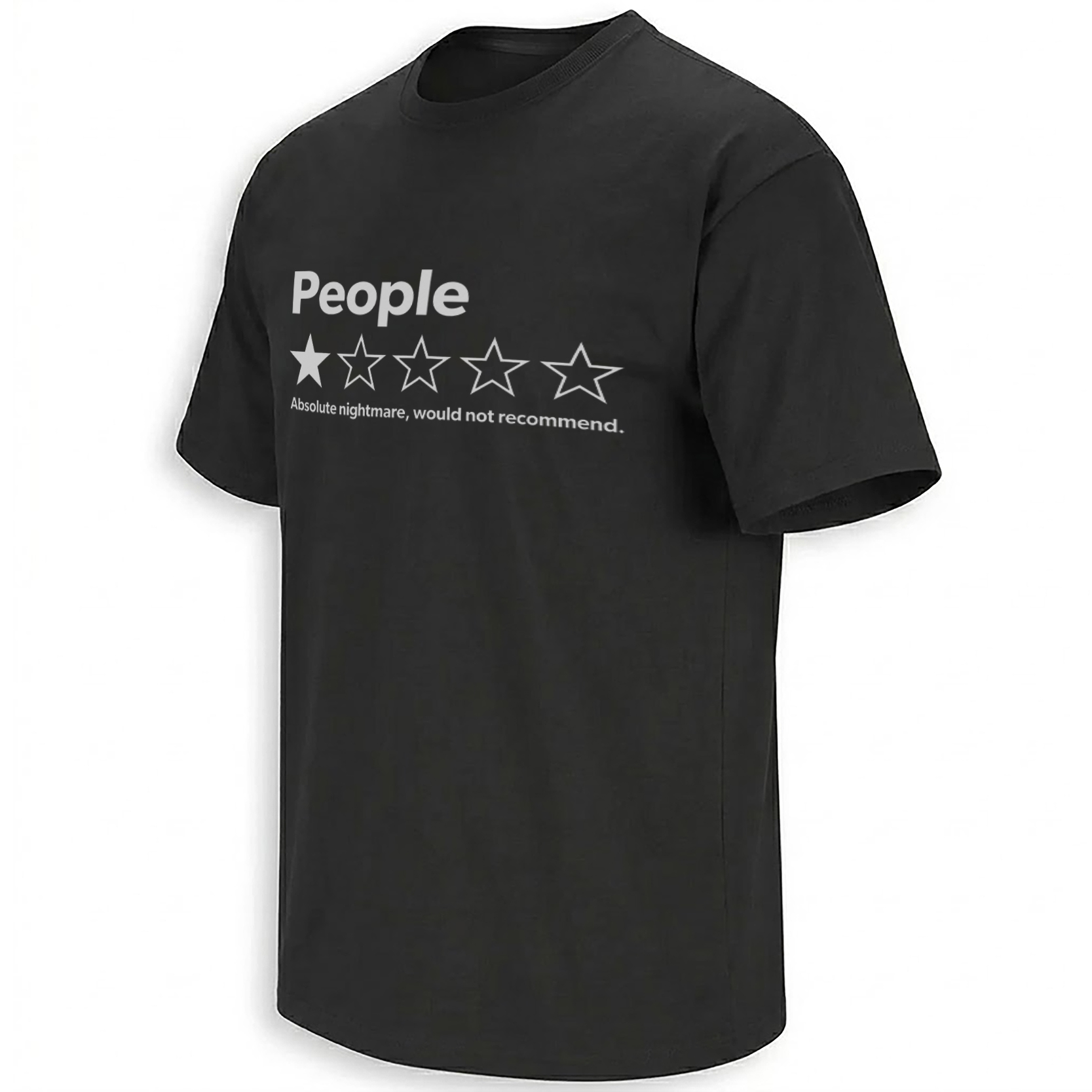
The People shirt treats human interaction as though it were a disappointing online purchase. Five outlined stars appear beneath a single category heading; only the first is filled. The written review is brutally concise: “absolute nightmare, would not recommend.”
The joke works because the format is instantly legible. Online shoppers have been trained to scan stars before reading prose. One filled star signals failure before the viewer reaches the sentence underneath it.
Why a star rating says so much so quickly
Star systems compress complicated experiences into a visual summary. Research from Northwestern University’s Spiegel Research Center describes online reviews as a measurable influence on purchase decisions, while consumer research also shows that the presentation of a rating can alter perception.
The shirt borrows that authority and applies it where it clearly does not belong. “People” are not a product, humanity has no returns desk, and a lifetime of social experience cannot honestly be reduced to one score. The mismatch creates the humor.
Everyone has experience with people, so the setup requires no fandom knowledge.
The stars resemble the rating language used across shopping, dining and travel.
The review jumps from minor social fatigue to rejecting humanity as a category.
The design turns “I need a quiet night” into a customer-service verdict on the entire human species.Ellie Shirt internet culture desk
Introvert humor without a personality test
The slogan is often read as introvert humor, but it does not require the wearer to make a clinical or permanent claim about personality. It can describe a bad meeting, an overcrowded room, a week of customer-facing work or the simple desire not to make small talk.
Its exaggeration creates social cover. Most wearers do not literally reject every person. The one-star verdict dramatizes temporary depletion in a form other people can recognize—and perhaps wisely avoid interrupting.
Deadpan typography is part of the joke
The design avoids cartoon characters and decorative punchlines. White type on black fabric resembles a stripped-down review screen. That restraint makes the statement feel less like a performance and more like a calm assessment entered after careful consideration.
The lowercase sentence underneath the stars is especially effective. It does not shout. Its rhythm resembles the short verdict left after a terrible hotel stay: problem identified, recommendation denied, case closed.
People Shirt
Minimal stars and dry review language transform everyday social exhaustion into a concise, instantly readable verdict.
A cultural artifact of rating everything
Restaurants, drivers, films, sellers, holidays and even individual transactions are now routinely scored. The People design takes that habit to its absurd endpoint by rating the reviewers themselves.
That reversal is what gives the shirt staying power. It is not merely “antisocial.” It captures a world in which the five-star scale has become such a natural language that it can communicate a mood faster than a paragraph.
Reporting and research
Frequently asked questions
What does the People one-star shirt mean?
It jokingly reviews the experience of dealing with humanity as if “people” were a disappointing product or service.
Why does the design use one out of five stars?
One star is the familiar visual shorthand for a strongly negative online review, allowing the punchline to register before the sentence is read.
Is the shirt only for introverts?
No. Introverts may identify with it, but the joke also fits anyone experiencing social fatigue, an exhausting workplace or a temporary need for space.