
Pascal’s Rager Explained: When Pascal’s Wager Learned How to Party
One changed letter turns a seventeenth-century argument about God, probability and infinite consequences into the title of the least historically plausible party imaginable.
“Pascal’s Rager” sounds like a joke invented five minutes ago, but the wordplay has been circulating inside philosophy humor for years. Public-philosophy projects have used the name deliberately, and older parody apparel has used the same Wager-to-Rager substitution. It works because “Pascal’s Wager” is already compact enough to behave like a meme template.
The original idea comes from Blaise Pascal, the French mathematician, physicist and religious thinker whose unfinished writings were published after his death as Pensées. What later became known as Pascal’s Wager does not function as a conventional proof that God exists. Instead, it asks how a person should act when certainty is unavailable but the possible consequences are enormous.
Stanford’s philosophical account describes the Wager as an important early meeting point between religious reasoning, probability and decision theory. That intellectual seriousness is exactly what makes replacing one letter with party slang so efficient.
Pascal asked what you should wager when eternity might be at stake. The meme asks what happens if Pascal simply throws a rager instead.
First, What Was Pascal Actually Wagering On?
Pascal begins from uncertainty. Reason, in his presentation, does not simply settle whether God exists. Yet a person still has to live and choose. The Wager therefore shifts the problem from “Can I prove this?” toward “What decision makes sense when the possible payoff is infinite?”
In its most familiar simplified form, belief carries the possibility of infinite reward if God exists, while the costs of belief remain finite if God does not. Philosophers have spent centuries arguing about whether that reasoning succeeds, whether the possible outcomes have been framed fairly, whether belief can be chosen voluntarily and what happens when many possible religions enter the decision table.
None of those objections make the meme less funny. They make it better. “Pascal’s Rager” compresses an enormous academic literature into a nightclub-quality spelling mistake.
The Real Pascal Is What Makes the Fake Party Work
.jpg)
Blaise Pascal’s actual portrait supplies the straight-faced half of the joke: seventeenth-century collar, restrained expression and absolutely no visual evidence that the man was preparing to host anything describable as a “rager.”
Portrait of Blaise Pascal, circa seventeenth century, Musée d’Art Roger-Quilliot / Wikimedia Commons.Pascal was born in 1623 and worked across mathematics, physics, mechanical calculation, probability and religious philosophy. Long before the Wager became an undergraduate philosophy-class staple, his mathematical work helped shape the language that made probability-based arguments possible in the first place.
That creates the perfect setup for internet humor. The source material is famous, serious and linguistically rigid. Changing “Wager” to “Rager” instantly collapses the distance between seventeenth-century intellectual history and modern party slang.
Then the Cyborg Face Makes the Joke Stranger
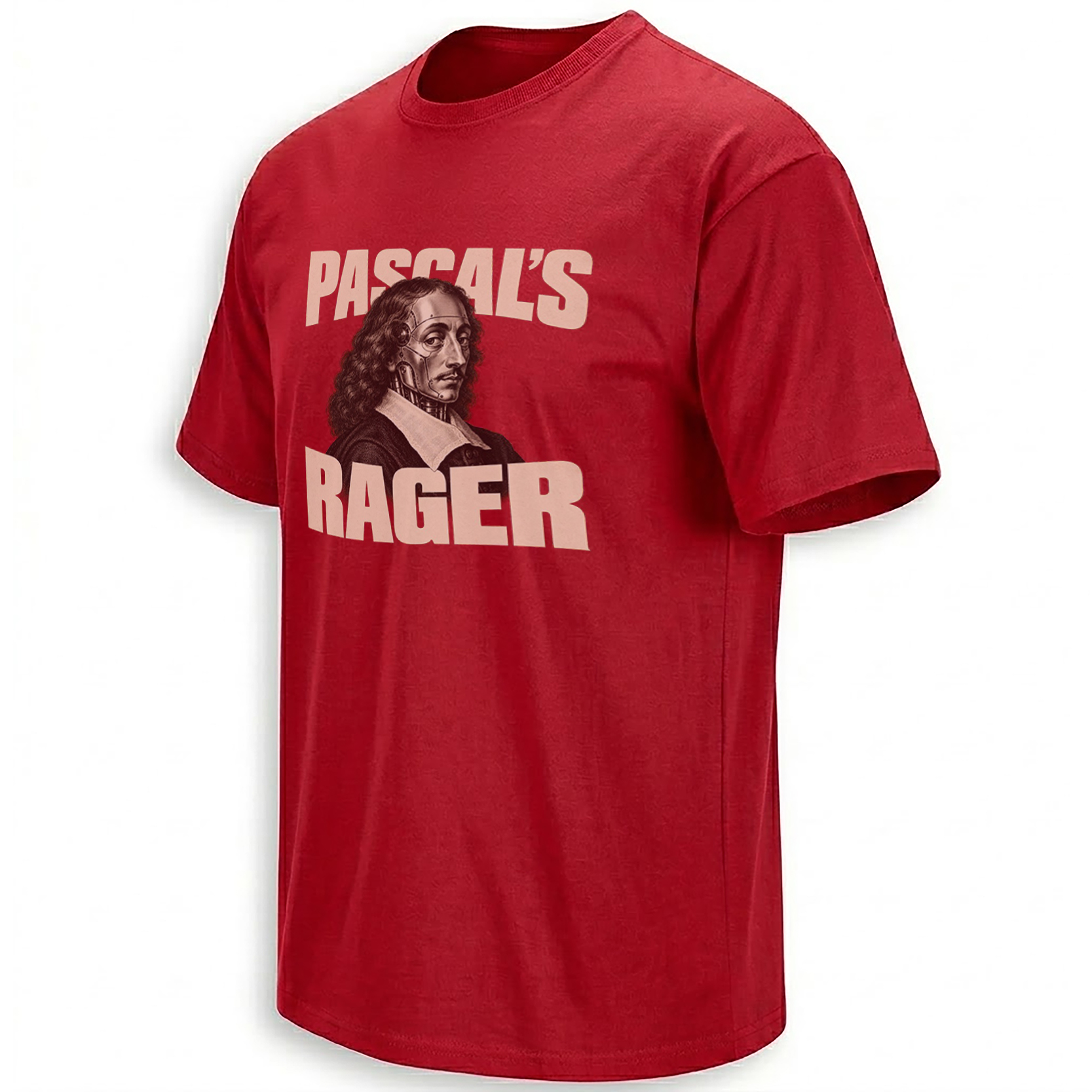
The Pascal’s Rager Shirt does not simply reproduce an antique portrait and add one funny word. Its Pascal has been rebuilt.
The long period hair and broad white collar remain recognizable, but the face and neck contain metallic seams, plates, rivet-like details and machine anatomy. The historical philosopher becomes a half-Enlightenment, half-science-fiction figure.
Why the Machine Imagery Feels Especially Current
The artwork never explicitly says “artificial intelligence,” and it should not be mislabeled as an AI-safety graphic. Still, the mechanical Pascal creates an unavoidable modern association with decision theory, machine reasoning and internet thought experiments.
One example is Roko’s Basilisk, a speculative internet thought experiment involving a hypothetical future superintelligence. Commentators have repeatedly compared its structure with Pascal’s Wager because both involve uncertain premises paired with potentially extreme consequences. They are not the same argument, but the comparison shows how Pascal’s old decision problem keeps reappearing in technological culture.
Nothing visible in the design explicitly names Roko’s Basilisk or claims Blaise Pascal had anything to do with artificial intelligence. The cyborg treatment simply lets the Wager’s modern afterlife — probability, decision theory and machine-era thought experiments — hover behind the joke.
A Meme That Rewards Knowing One Extra Thing
Many internet jokes explain themselves immediately. Philosophy memes often operate differently. They offer a second payoff to the person who recognizes the reference.
Read without context, “Pascal’s Rager” is absurd event branding. Recognize Pascal’s Wager, and the single-letter substitution becomes the punchline. Notice the mechanical face, and another interpretive layer opens around rational machines and contemporary thought experiments.
That layered structure is why the design feels at home among Ellie Shirt’s Newest cultural releases rather than inside a generic education category. It behaves like internet culture first and classroom merchandise second. Readers looking for related references can also browse Blaise Pascal search results.
Frequently Asked Questions
What does “Pascal’s Rager” mean?
It is a wordplay joke that changes “Pascal’s Wager,” the famous philosophy argument associated with Blaise Pascal, into “Pascal’s Rager,” modern slang for a large or wild party.
What is Pascal’s Wager?
Pascal’s Wager is an argument about how a person should decide whether to wager on belief in God when certainty is unavailable and the possible consequences are treated as extremely large or infinite.
Was Blaise Pascal mainly a philosopher?
He was also an important mathematician and physicist whose work contributed to probability theory, fluid mechanics and mechanical calculation.
Is “Pascal’s Rager” a new 2026 meme?
No. The phrase has existed in philosophy humor for years, although its compact wordplay continues to work naturally in current internet and academic meme culture.
Why is Pascal portrayed as a cyborg?
The mechanical treatment modernizes the historical portrait and adds a science-fiction layer that fits contemporary conversations about rational machines, decision theory and technological thought experiments.
The Pascal’s Rager design works because the viewer gets the joke in stages: first the party phrase, then Pascal’s Wager, then the deeply unnecessary mechanical philosopher staring back from the center.
Pascal’s Rager Shirt turns Blaise Pascal’s famous Wager into academic meme culture with oversized vintage typography, a cyborg philosopher portrait and a one-letter joke connecting probability, philosophy and internet absurdity.