
How the Oregon Trail’s Most Infamous Death Screen Became the Perfect Lettuce Recall Meme
When iceberg lettuce was linked to a major Cyclospora outbreak, the internet reached backward to one of gaming’s oldest shared memories: a covered wagon, glowing green pixels and a brutally concise report that the journey had ended.
“You have died of diarrhea lettuce” reads like a corrupted line from an old computer game. That is exactly its advantage. The sentence borrows the visual language associated with The Oregon Trail and rewrites its most remembered disease joke for a real food-safety alert in July 2026.
The public-health context is serious. CDC and FDA investigators linked a multistate Cyclospora outbreak to shredded iceberg lettuce. Taylor Farms recalled iceberg lettuce sourced from central Mexico, including products supplied to retailers and restaurants.
The cultural response was characteristically digital: reduce an unsettling, complicated warning to a reference that several generations recognize instantly.
The joke works because an old educational game already taught millions of players that a routine journey could suddenly become a disease-management disaster.
The real outbreak behind the pixelated punch line
As of the CDC’s July 18 update, more than 1,644 illnesses and 94 hospitalizations had been reported across five states, with no deaths. The investigation remained open.
Cyclospora is a microscopic parasite that causes an intestinal illness called cyclosporiasis. Its most prominent symptom is frequent watery diarrhea, often accompanied by fatigue, appetite loss, cramping, bloating, nausea and weight loss.
Symptoms commonly begin about a week after exposure, although the window can range from two days to two weeks or longer. Without treatment, the illness can persist for weeks and may appear to improve before returning.
The meme is not medical guidance. CDC advises consumers not to eat recalled lettuce, to discard or return it, and to clean surfaces that may have contacted the product. Anyone experiencing symptoms should contact a healthcare provider.
Why The Oregon Trail remains shorthand for accidental disaster
Three student teachers—Don Rawitsch, Bill Heinemann and Paul Dillenberger—created the original Oregon Trail computer game in 1971. It asked students to manage supplies, travel speed, illness and risk while attempting to reach Oregon.
MECC later distributed the program through schools, and the graphical editions became a fixture of American computer classrooms. Players remembered the wagon, river crossings, hunting sequences and the way a seemingly successful trip could collapse because of disease or depleted supplies.
Popular internet memory has compressed those experiences into the familiar construction “You have died of dysentery.” Exact wording varied across versions and memories of the game, but the formula became more culturally durable than any individual screen.
From dysentery to “diarrhea lettuce”
The substitution is intentionally inelegant. “Diarrhea lettuce” sounds less like a carefully named product and more like an item generated by a malfunctioning game. That awkwardness gives the phrase its comic force.
It also connects two different types of risk language. Public-health agencies must explain parasites, distribution chains, dates and symptoms accurately. Meme culture searches for the shortest recognizable translation. Here, the translation is a fatal status message attached to a vegetable.
The humor does not come from denying the outbreak. It comes from recognizing how closely the official symptom list resembles the kind of random catastrophe that would stop a virtual wagon party.
The artwork behaves like a rescued school-computer screen
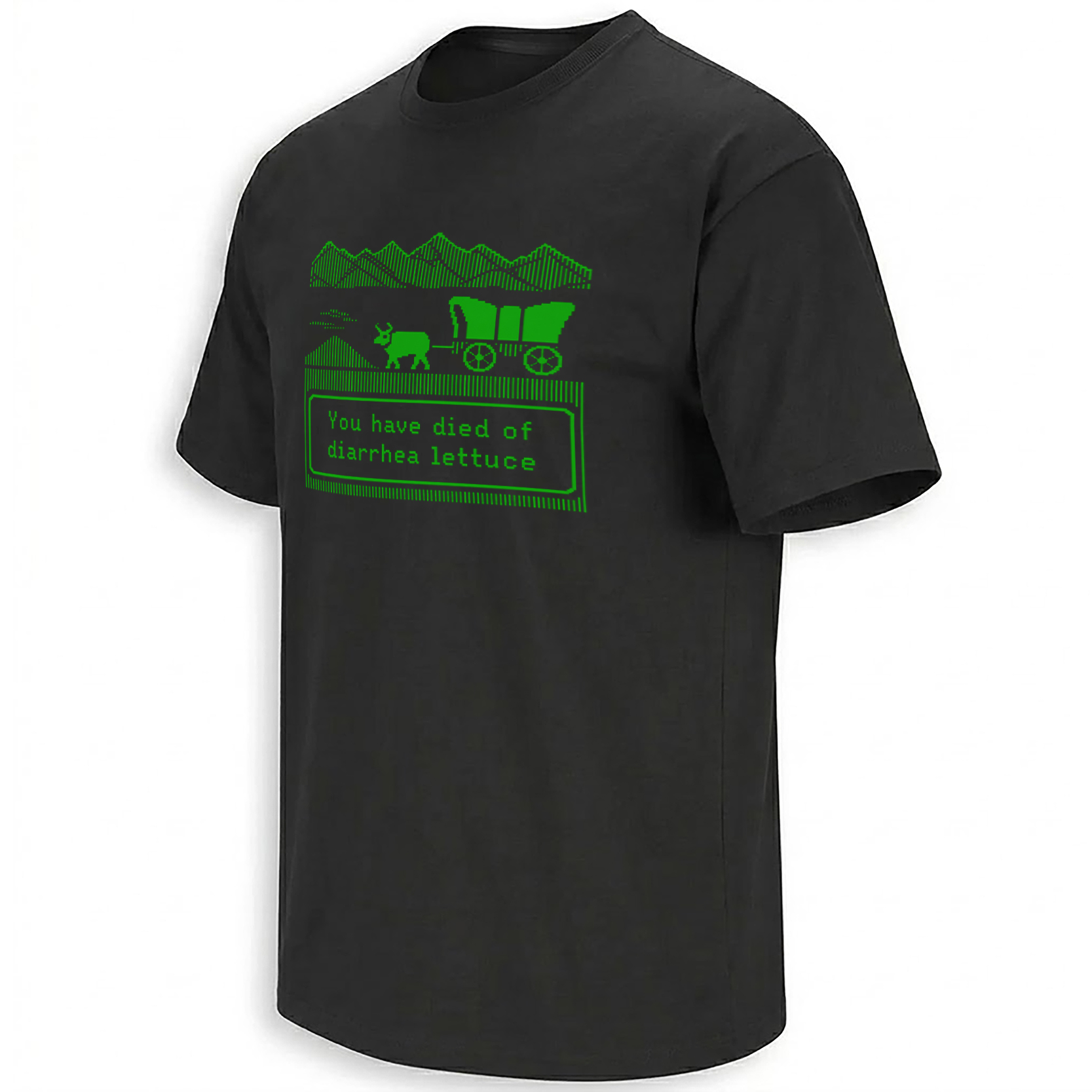
The You Have Died of Diarrhea Lettuce Shirt uses bright green pixel graphics against black fabric. Mountains, a wagon and small traveling figures establish the Oregon Trail reference before the viewer reads the sentence.
A rectangular status window contains the punch line, reproducing the visual hierarchy of an early computer interface. The limited palette is important: green-on-black suggests monochrome monitors, school computer labs and a period when software graphics were assembled from hard-edged blocks.
A cultural timestamp from the week the recall entered everyday conversation
The design belongs specifically to July 2026, when iceberg lettuce, Cyclospora and gastrointestinal symptoms suddenly became national news. Yet it reaches back to a game created more than half a century earlier.
That distance is what gives the artifact its texture. An educational program designed to simulate nineteenth-century survival becomes the interface through which modern consumers process a twenty-first-century supply-chain warning.
Among Ellie Shirt’s newest cultural graphics, the piece records the moment a public-health alert collided with one of the internet’s most persistent gaming memories.
Frequently Asked Questions
What is the “You Have Died of Diarrhea Lettuce” joke referencing?
It references the disease and death notifications culturally associated with the educational computer game The Oregon Trail.
What caused the 2026 lettuce recall?
A multistate Cyclospora outbreak was linked to shredded iceberg lettuce sourced from central Mexico, prompting a recall by Taylor Farms.
What are common symptoms of Cyclospora infection?
Common symptoms include frequent watery diarrhea, appetite loss, cramping, bloating, nausea, fatigue and weight loss.
Did The Oregon Trail teach players about disease?
Yes. Disease, depleted supplies, difficult travel decisions and death were central hazards within the game’s simulation of westward migration.
Why does the artwork use green pixel graphics?
The monochrome green palette recalls early computer monitors and makes the graphic resemble a status screen from a school computer lab.
The complete Oregon Trail lettuce recall graphic preserves the week’s strange collision of food-safety news, classroom gaming and pixel-era fatalism.
Oregon Trail nostalgia meets the July 2026 iceberg lettuce recall in a green pixel-art status screen. The graphic turns a real Cyclospora alert into a sharply time-stamped piece of gaming meme culture.