“Booooo, This Is Philadelphia” Was the Real Soundtrack of the Derby
Kyle Schwarber finished one home run short of the trophy, but his explanation of the crowd turned an exhibition night into a compact lesson in Philadelphia sports culture.
The 2026 Home Run Derby was staged as an All-Star exhibition, but Citizens Bank Park treated it like a home game. Kyle Schwarber and Bryce Harper received the noise reserved for Philadelphia’s own; nearly everyone else received boos, cheers for misses and a crowd actively attempting to shape the contest.
Schwarber understood the behavior immediately. Other players had noticed the “hometown cooking.” His answer became the line that explained the entire night: “This is Philadelphia. They want their guys to go out there and do it, and they’re going to try to will the other guys not to.”
The tactic almost worked. Schwarber hit 11 homers in the final round, but Jordan Walker closed with six consecutive home runs and won 12–11. The defeat created one of the strange emotional combinations Philadelphia understands well: disappointment, respect for the opponent and pride that the city had turned a skills contest into hostile baseball theater.
“This is Philadelphia. They want their guys to go out there and do it, and they’re going to try to will the other guys not to.”Kyle Schwarber after the 2026 Home Run Derby
The crowd refused the idea of neutrality
All-Star events usually ask the host city to welcome the league. Philadelphia welcomed the league by making the local preference unmistakable. The boos were not evidence that the crowd misunderstood the assignment. They were the crowd rewriting the assignment.
Every unsuccessful swing by a non-Phillie became a small home-team success. Every Schwarber home run raised the sound toward postseason volume. MLB’s recap compared the atmosphere to an early arrival of Red October, while Schwarber said he initially had to calm himself because he was trying too hard to deliver for the people behind him.
Introductions, batting practice and each final-round homer brought the loudest approval of the night.
Taken pitches, misses and opposing home runs became opportunities for the park to perform its allegiance.
Why “Booooo” reads differently in Philadelphia
Outside the city, booing is often interpreted only as rejection. In Philadelphia, it can also function as pressure, participation and proof that the audience refuses emotional distance. The sound is not automatically affectionate, but during the Derby its purpose was obvious: help Schwarber, unsettle everyone between him and the trophy.
Walker understood the distinction even after absorbing it. He called the environment brutal, then explained that the intensity came from the way Philadelphia loves its players. His later line—“You don’t boo nobodies”—turned the hostility into recognition and gave the winner his own memorable answer.
The crowd was not saying that the visitors did not belong at the Derby. It was saying that only two hitters belonged to Philadelphia, and the building would use every available decibel to make that difference matter.
The design freezes sound instead of a final score
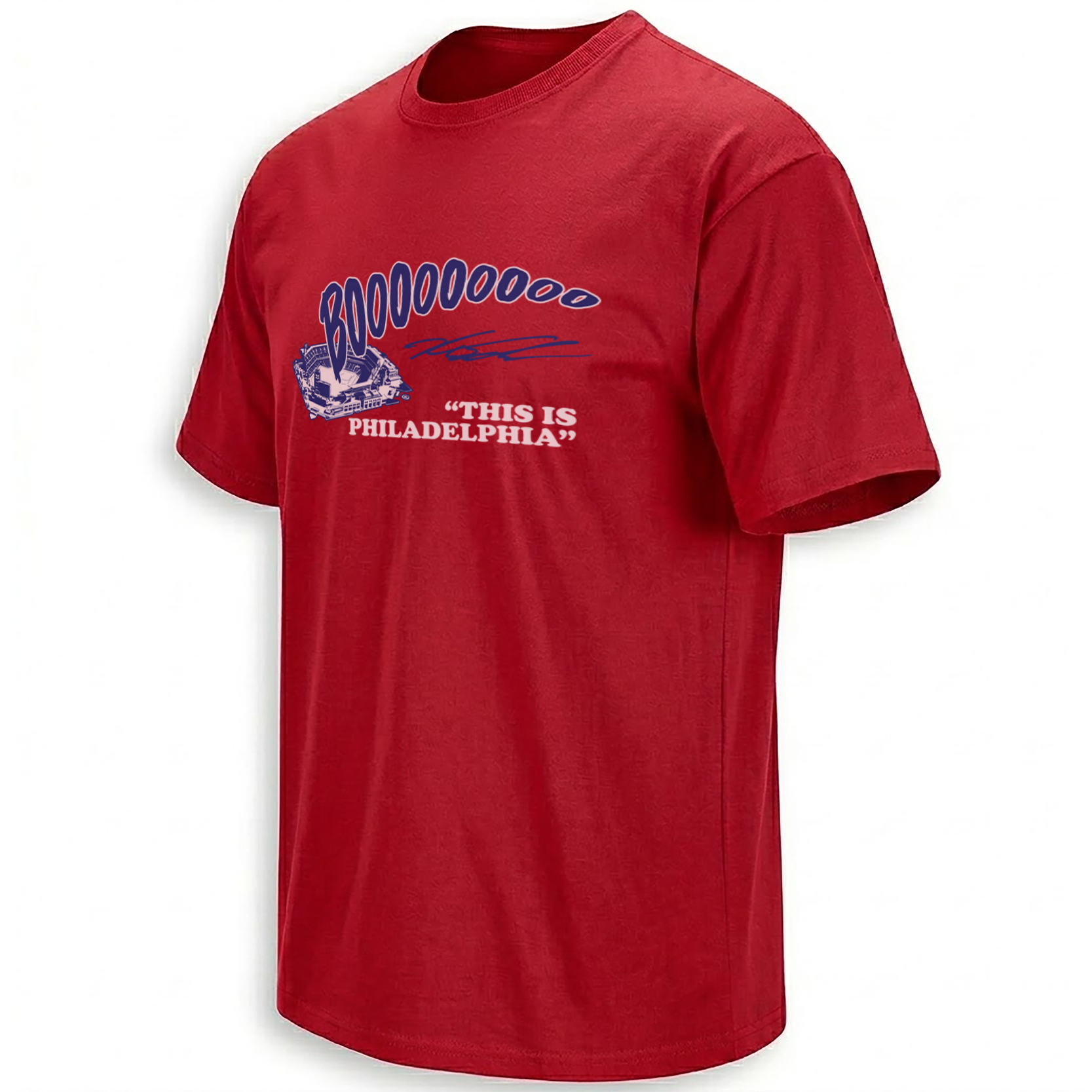
The Booooo This Is Philadelphia Shirt makes the extended vowel the visual headline. “BOOOOO” is not normal written language; it is crowd audio translated into typography. The extra letters force the reader to hear duration rather than simply read a word.
“THIS IS PHILADELPHIA” then supplies the explanation. Placed beside Schwarber, the phrase becomes less defensive than declarative. It identifies the park, the fan code and the player who understood why a nominally neutral event had become a home-field contest.
Schwarber lost the trophy and strengthened the bond
The runner-up finish did not diminish Schwarber’s position in the city. He hit 30 home runs across the event and came within one of winning, months after returning to Philadelphia on a five-year contract. He described the crowd’s support as exceeding his expectations and emphasized that Philadelphia was where he wanted to be.
That matters because sports belonging is rarely created by a single victory. It is built when a player recognizes the city’s emotional language and the city recognizes itself in his response. Schwarber did not apologize for the crowd or pretend the boos were polite. He explained their competitive purpose and tipped his cap to Walker for surviving them.
The moment joins Ellie Shirt’s Philadelphia Phillies collection as a record of atmosphere rather than championship outcome. Inside the broader MLB collection, it captures what made the 2026 Derby different from a portable television event: the host city became a participant.
Frequently Asked Questions
What did Kyle Schwarber mean by “This is Philadelphia”?
He was explaining that Philadelphia fans wanted their own players to succeed and were using boos and noise to make the competition harder for opposing hitters.
Who won the 2026 Home Run Derby?
Jordan Walker defeated Kyle Schwarber 12–11 in the final round after finishing with six consecutive home runs.
How many home runs did Schwarber hit during the Derby?
Schwarber hit 30 total home runs across the event, including 11 in the final round.
Why were Philadelphia fans booing other Derby hitters?
The crowd treated the exhibition like a home game, cheering Phillies hitters Schwarber and Harper while trying to create pressure for their opponents.
Why did the phrase become a Philadelphia fan-culture artifact?
It condensed the night’s sound, local loyalty and Schwarber’s understanding of the crowd into a sentence that fans could instantly recognize and repeat.
The Booooo This Is Philadelphia graphic preserves the Derby’s defining local truth: the trophy went home with Jordan Walker, but the atmosphere belonged entirely to Philadelphia.
Booooo This Is Philadelphia Shirt captures Kyle Schwarber’s explanation of the 2026 Home Run Derby crowd, where Philadelphia turned boos, loyalty and home-field pressure into the night’s unmistakable soundtrack.