OG Liberty Shirt: How Anunoby Became New York’s Finals Statue
After OG Anunoby’s Game 4 tip-in completed the Knicks’ historic Finals comeback, the internet did what New York does best: it turned a basketball play into a civic monument.
New York did not need much time to understand what OG Anunoby had done. The ball was still being replayed above the rim, the Garden was still trying to process the noise, and Knicks fans were already speaking in statue language. Build him one. Put him somewhere permanent. Make the moment taller than the scoreboard.
The facts are already heavy enough: Knicks 107, Spurs 106; a 29-point comeback, the largest in NBA Finals history; a 3-1 series lead; and Anunoby’s game-winning tip-in with 1.2 seconds left. But the cultural reaction moved even faster than the box score. OG did not just win a game. He gave New York an image.
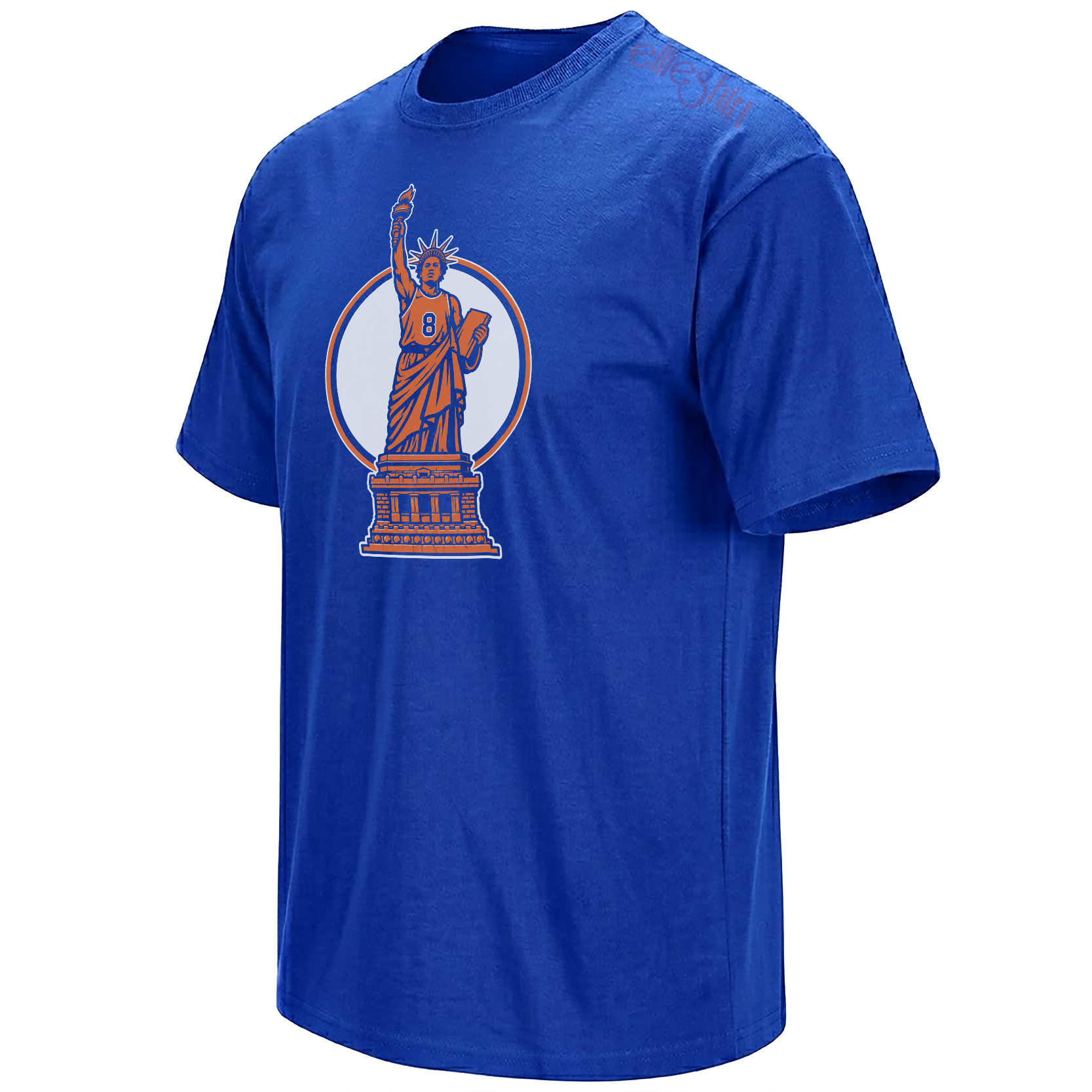
That is why the OG Liberty idea works. It connects Anunoby’s sudden Finals immortality to one of the city’s most recognizable symbols. Not because a shirt can make a statue official, but because fan culture often builds monuments before any city ever does. In this case, the monument is blue, orange, torch-lit, and still vibrating from Game 4.
Why Game 4 turned OG into a New York symbol
Anunoby has always been the kind of player whose game feels stronger than his volume. He defends without theatrical waste. He shoots without needing the spotlight. He moves like someone who knows exactly where the possession is going before the broadcast catches up. Game 4 took that quiet force and gave it a citywide ending.
His final play was not a designed coronation. It was a crash, a read, a hand above the rim, and a finish that arrived in the narrow space between Jalen Brunson’s missed three and San Antonio’s last breath. That is what made it feel so New York. It was not clean. It was not polite. It was survival made beautiful.
The Statue of Liberty symbolism gives that feeling a visual form. Liberty is height, torch, skyline, arrival, belief. OG’s tip-in became a different kind of arrival: the moment Knicks fans could look at a Finals series and feel the championship dream become physically close.
The “build him a statue” energy behind the design
Sports fans reach for statue language when a play feels bigger than a game. It is rarely literal at first. It is emotional exaggeration, internet shorthand, and civic gratitude all at once. After Game 4, that language fit Anunoby because the moment had the right scale: Finals pressure, historic comeback, one-point finish, and a fanbase living inside a 53-year championship wait.
The joke works because it points to something true. OG’s game-winner instantly entered Knicks lore. NBA’s own Finals MVP Ladder moved him to the top after the performance, emphasizing not only the putback but the broader two-way work that made his Game 4 feel complete. That is the key: the statue energy did not come from one lucky bounce. It came from a whole night of impact suddenly condensed into one unforgettable frame.
The OG Liberty Shirt turns that frame into a symbolic object. It does not need to claim that a real statue exists. It captures the fan impulse to make one, to place OG inside the city’s visual language, to say that for one Finals night, he felt like a landmark.
As Knicks Finals graphics keep turning into a living archive, the wider New York Knicks Shirts collection starts to read like a city map of belief: Brunson pressure, OG heroics, Garden noise, skyline symbolism, and the emotional architecture of a fanbase one win from history.
Design language: Liberty icon, Knicks color, Finals mythology
The strongest part of this concept is how naturally it blends city symbolism with basketball memory. Liberty imagery carries weight before any sports reference appears. It already belongs to New York’s emotional vocabulary. When that icon is filtered through Knicks blue and orange, it becomes a Finals-specific statement instead of a generic city graphic.
The torch matters because it suggests a moment being carried forward. The statue reference matters because fans are already talking about permanence. The OG naming matters because it keeps the design rooted in the player rather than letting the symbol become too broad. It is a New York graphic, but it is not only New York. It is New York after OG’s hand met the ball.
In streetwear terms, the design sits somewhere between playoff poster, bootleg monument, and fan-made civic tribute. It has the dramatic clarity of a landmark graphic, but the humor and timing of internet basketball culture. That balance is what keeps it from becoming stiff. It feels like a statue drawn by the crowd, not a plaque written by a committee.
Why OG’s quiet image makes the Liberty concept stronger
If the same concept were built around a louder player, it might feel obvious. With Anunoby, it feels more interesting. He does not usually play like a performer asking the arena to crown him. He plays like a problem the opponent slowly realizes it cannot solve. That contrast makes the Liberty treatment feel earned rather than forced.
New York tends to love athletes who do the work before they demand the mythology. OG fits that emotional lane perfectly. He is not a catchphrase machine. He is not a constant headline. He is the wing who guards the hardest assignment, hits timely threes, crashes the glass, and then, when the Finals need a defining image, appears exactly where the city needed him to be.
That is why the design can carry both reverence and meme energy. The Liberty reference gives OG a heroic silhouette. The fan context gives it humor. The Finals moment gives it legitimacy. Together, those layers make the shirt feel like a timestamp of how quickly a quiet player can become the loudest symbol in New York.
The broader NBA Shirts archive works the same way across basketball culture: it preserves the plays that outgrow highlights, the phrases that outlive game threads, and the visual symbols fans use when ordinary recap language is not enough.
The internet reaction: from highlight to civic mythology
Across basketball spaces, the reaction to Anunoby’s winner quickly moved beyond the mechanics of the tip-in. Fans talked about the absurdity of a 29-point Finals comeback, the shock of Madison Square Garden, the timing of Brunson’s miss turning into OG’s immortal rebound, and the kind of “build him a statue” language that appears when a city wants to make a player permanent.
That reaction makes sense because the play had everything internet culture loves: a clean replay, a perfect timestamp, a stunned arena, a heroic secondary star, a historic stat, and a city identity strong enough to turn a single frame into a civic joke. The Statue of Liberty angle is not random. It is how New York converts sports emotion into imagery.
The design belongs inside that reaction. It does not simply say OG played well. It says OG became a symbol. It gives the fanbase a way to talk about the moment without reducing it to a score.
Why this piece belongs to the Finals memory archive
Some Finals shirts are built for final results. Others are built for the moments that make a result feel possible. The OG Liberty Shirt belongs to the second category. It captures the play that made New York’s championship imagination feel physically closer than it had in decades.
That distinction matters because the series is still a live story. The Knicks lead 3-1, but the emotional power of Game 4 exists even before the ending is settled. Anunoby’s tip-in has already become part of the run’s mythology. Whether fans describe it as a miracle, a rebound, a rescue, or a statue moment, the image is already fixed.
That is what the Liberty concept preserves: the exact moment when OG Anunoby stopped being only a two-way force and became a New York symbol large enough for skyline language.
FAQ: OG Liberty Shirt, Anunoby’s Game 4 tip-in, and Knicks Finals culture
Why does the OG Liberty Shirt use Statue of Liberty symbolism?
The Liberty symbolism connects OG Anunoby’s Game 4 heroics to New York’s civic visual language. After his tip-in completed the Knicks’ historic Finals comeback, fans naturally framed the moment with monument and statue energy.
What made OG Anunoby’s Game 4 moment so important?
Anunoby’s tip-in with 1.2 seconds left gave the Knicks a 107-106 win over the Spurs, completed a 29-point comeback, and moved New York ahead 3-1 in the 2026 NBA Finals.
Why are fans connecting OG Anunoby to “build him a statue” language?
Fans use statue language when a player creates a moment that feels permanent. OG’s game-winner came in the Finals, finished a historic comeback, and gave New York a visual memory big enough to feel like a civic tribute.
How does this design fit the current Knicks Finals run?
The design fits because the Knicks’ Finals run has become about more than scores. It is about belief, Garden noise, New York identity, and players like Anunoby turning pressure into images fans want to remember.
The OG Liberty Shirt fits the exact emotional window after Game 4: the replay still moving, the Garden still echoing, and Knicks fans already turning OG Anunoby into a Finals monument.
OG Liberty Shirt captures OG Anunoby’s Knicks Finals Game 4 moment through Statue of Liberty symbolism, New York fan mythology, and the historic tip-in that turned a 29-point comeback into civic basketball memory.