Obama, Are You Coming Home Soon?
“The babysitter is weird” compresses a decade of political division into the language of a nervous child waiting for a familiar adult to return.
The joke begins like an ordinary message sent from a child to a parent: “Obama, are you coming home soon?” Then its final sentence reveals the political metaphor: “The babysitter is weird.”
No politician is named as the babysitter. The design does not need to name one. Its humor depends on the audience supplying the current occupant of the White House and recognizing the contrast being constructed between Barack Obama and Donald Trump.
In that imagined household, Obama becomes the familiar parent who once established the rules. Trump becomes the temporary authority whose conduct makes the children uneasy. The United States becomes the house everyone is trapped inside until someone trustworthy comes home.
It is not a literal request for Obama to return to the presidency. The Twenty-Second Amendment prevents a person from being elected president more than twice. The line instead expresses political nostalgia: a desire to recover the emotional atmosphere supporters associate with the Obama years.
The joke does not ask whether Obama can come back. It asks why the present feels strange enough to make some Americans wish he could. The political feeling beneath the punchline
Why the babysitter metaphor works
Political satire succeeds when it turns an enormous subject into a relationship that can be understood immediately. Constitutional authority, institutional norms and presidential temperament are abstract ideas. A strange babysitter inside the family home is not.
A babysitter has real power, but that power is supposed to be temporary and bounded. The sitter did not build the household, does not own it and is expected to follow rules established before arriving.
Calling a president a babysitter therefore reduces the grandeur of the office. The leader is no longer imagined as a king, savior or patriarch. He is temporary help who has been left responsible for something that belongs to everyone else.
The satire relies on Obama nostalgia
Barack Obama served as the 44th president from January 2009 until January 2017. He left office after completing two terms, but his political image never disappeared from American public life.
For supporters, Obama came to symbolize qualities they believed were missing from the political culture that followed: rhetorical discipline, institutional familiarity, personal composure and an ability to present the presidency as larger than the personality occupying it.
That memory is selective, as political memory almost always is. Obama’s presidency contained war, surveillance controversies, deportations, partisan conflict, economic frustration and deeply contested policy decisions. Nostalgia smooths those edges because it compares a remembered past with the emotional intensity of the present.
The shirt does not provide a policy argument for the Obama administration. It captures the simpler emotional version of that nostalgia: the feeling that the grown-up left and the atmosphere changed.
 The political artifact
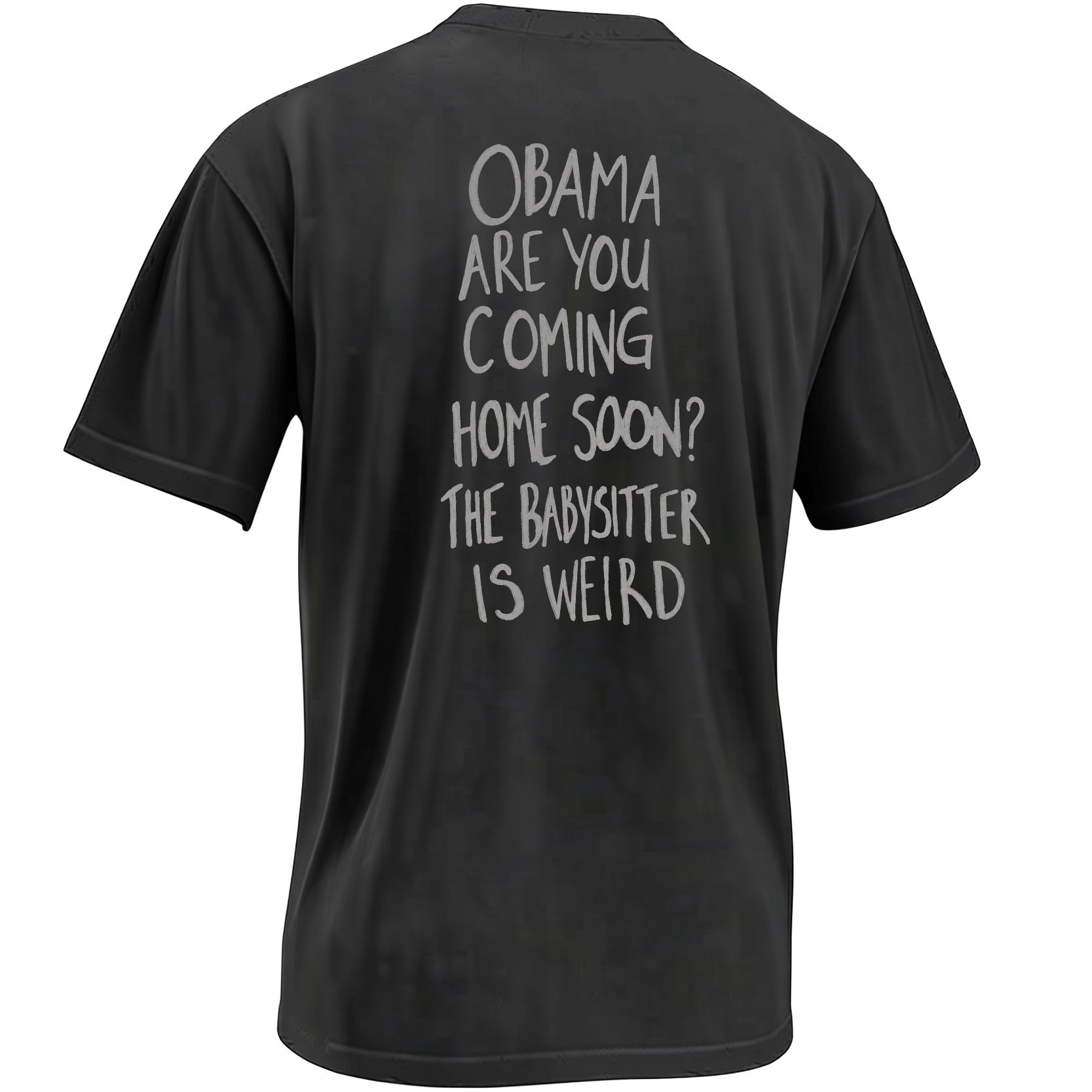
The handwritten gray message on a black back print resembles a private plea, bathroom-wall confession or note left by someone who no longer feels comfortable in the house.
The political artifact
The handwritten gray message on a black back print resembles a private plea, bathroom-wall confession or note left by someone who no longer feels comfortable in the house.
What each sentence contributes to the joke
The word “weird” is especially efficient because it does not sound like formal political criticism. It sounds instinctive. A child may not be able to explain executive power, democratic norms or presidential decorum, but the child can recognize that something in the room feels wrong.
That vagueness also invites participation. Each viewer can mentally insert a different incident, statement or controversy into the blank space created by the adjective.
Donald Trump does not need to appear
The design’s most important visual absence is Donald Trump himself. There is no portrait, name, campaign slogan or party symbol on the back print.
Yet the joke is readily interpreted as anti-Trump satire because Obama and Trump have occupied opposing positions in American political memory. Trump succeeded Obama in 2017, continued attacking his record and returned to the presidency in 2025.
Their political identities have also remained entangled through years of public comparison. Trump’s rhetoric repeatedly revisits Obama, while Obama’s appearances are often interpreted through contrast with Trump’s temperament and governing style.
Leaving Trump unnamed gives the statement greater flexibility. The wearer does not have to carry a politician’s face or turn the shirt into conventional campaign merchandise. The criticism remains legible through implication.
Why handwriting is more effective than a campaign font
Traditional political merchandise aims to project organization and confidence. It uses flags, stars, official colors, block capitals and polished slogans designed to resemble campaign branding.
This artwork takes the opposite approach. Its narrow handwritten letters look unplanned and personal. The message appears to have been written quickly by someone who needed help more than attention.
The back-print placement strengthens that effect. Instead of confronting the viewer like a campaign placard, the sentence is discovered as the wearer walks away. It behaves like an overheard confession.
Gray lettering against black fabric removes the celebratory red-white-and-blue language ordinarily associated with presidential imagery. The palette belongs more naturally to unease, deadpan comedy and late-night political commentary.
Political regression is part of the humor
Democracy theoretically gives citizens collective power, but modern political life can make individual people feel helpless. Elections are distant, institutions are complicated and major decisions are made far outside everyday control.
The child’s voice captures that powerlessness by regressing from citizenship to dependency. Instead of organizing, voting or protesting, the speaker calls the previous adult and asks to be rescued.
That is also where the satire turns inward. The joke mocks the current leader, but it gently mocks liberal nostalgia as well. Waiting for Obama to “come home” is emotionally understandable and constitutionally impossible.
A former president cannot simply return to repair the house. Citizens remain responsible for deciding what political home they want after the familiar figure has gone.
The artwork does not explicitly name Donald Trump as “the babysitter.” Reading it as anti-Trump commentary is an inference created by the Obama reference and the contemporary presidential context, not a literal statement printed on the shirt.
A meme-sized expression of political discomfort
The phrase works in the same way as an effective political meme: it does not attempt to document every grievance. It provides a compact emotional frame through which those grievances can be recognized.
Supporters may read it as a longing for dignity, predictability or institutional restraint. Others may see it as evidence that political nostalgia turns presidents into parental figures. Both interpretations are present in the joke.
That tension makes the design more durable than a reference to one news cycle. Its subject is not merely a specific controversy. It is the recurring American habit of comparing an unsettling present with an idealized former presidency.
The Obama Are You Coming Home Soon? The Babysitter Is Weird Shirt preserves that feeling as a stark handwritten message worn across the back.
More satire and political statement designs can be explored through Ellie Shirt’s verified Politics collection.
Obama babysitter satire FAQ
What does “Obama, are you coming home soon? The babysitter is weird” mean?
It uses a family metaphor to express nostalgia for Barack Obama and discomfort with the current political leadership. Obama becomes the familiar adult, while the unnamed president is framed as an unsettling temporary babysitter.
Is “the babysitter” supposed to mean Donald Trump?
The shirt does not print Trump’s name, but its contemporary political context strongly encourages an anti-Trump interpretation. That identification remains an inference rather than an explicit statement.
Can Barack Obama become president again?
Obama has already been elected president twice. The Twenty-Second Amendment prevents any person from being elected to the presidency more than two times.
Is this an official Barack Obama slogan?
No. It is an independent satirical statement and should not be interpreted as an official Obama campaign slogan, quotation or endorsement.
Why does the design use handwritten lettering?
The informal lettering makes the message resemble a worried personal note rather than polished campaign merchandise, reinforcing the joke’s childlike voice.
Why is the statement printed on the back?
The back placement allows the message to be discovered gradually, like an overheard confession or private plea carried into public space.
Where can shoppers find more political designs?
Additional political satire and statement designs are available at https://ellieshirt.com/collections/politics/.
See the Obama babysitter political satire design that turns presidential nostalgia into one uneasy message from inside America’s house.
A dark political joke that recasts America as a nervous child, Obama as the familiar adult and the present leadership as a deeply strange babysitter.