
Notre Dame Is 5-0 — and “Fighting Irish” Still Says Almost Everything
Notre Dame’s 2026 season has reached October unbeaten and ranked No. 3, giving one of college football’s oldest identity phrases fresh energy without needing a new slogan, viral meme or player-specific catchphrase.
The Irish left Chapel Hill on October 3 with a 37-26 win over North Carolina, surviving a rain-soaked afternoon that briefly tightened after halftime before Notre Dame reclaimed control. The victory moved Marcus Freeman’s team to 5-0 and kept the program at No. 3 nationally as October begins to separate contenders from teams simply carrying September hype.
What makes Notre Dame unusual is that its visual identity rarely needs to chase the current moment. A gold helmet, dark green, an interlocking ND and two words — “Fighting Irish” — already carry nearly a century of accumulated football meaning.
That is why a deliberately simple Fighting Irish graphic can suddenly feel especially current during an undefeated run. It does not commemorate one score. It activates the larger mythology that every score is being added to.
At Notre Dame, “Fighting Irish” works less like a nickname printed on merchandise and more like inherited football vocabulary.
What happened against North Carolina?
Notre Dame’s latest win offered a useful snapshot of why the current team remains unbeaten. North Carolina cut the margin to 21-20 when the second half opened with a kickoff-return touchdown, turning what had looked comfortable into a one-point game.
Notre Dame responded by controlling the third quarter. The Irish used two long drives that consumed roughly 13 minutes, while quarterback CJ Carr finished 21-of-29 for 234 yards and four passing touchdowns. Freshman Jonaz Walton added a career-high 120 rushing yards as Notre Dame leaned on both efficiency and possession to pull away.

Where did the “Fighting Irish” nickname come from?
Notre Dame itself is careful about the origin story. There is no single perfectly documented moment when the nickname was invented. Stories point to early games against Northwestern and Michigan, while another explanation credits sportswriters who used the phrase to describe Notre Dame teams for their persistence, grit and refusal to quit.
The phrase also emerged from a complicated cultural setting. Notre Dame teams had previously been called the Catholics, the Ramblers and other labels, some of them shaped by anti-Catholic and anti-Irish prejudice of the era. During the 1920s, alumnus and sportswriter Francis Wallace helped popularize “Fighting Irish” nationally.
In 1927, university president Rev. Matthew Walsh officially accepted Fighting Irish as Notre Dame’s athletic nickname. That history explains why the words carry more weight than an ordinary mascot name. A label that once could be used dismissively was gradually absorbed and turned into institutional pride.
Why does green matter when Notre Dame’s official colors are blue and gold?
Green occupies a different category in Notre Dame football. It is not simply a brand color. It behaves like an event color.
The defining memory remains October 22, 1977. Notre Dame warmed up against USC in its normal blue jerseys before head coach Dan Devine revealed green uniforms in the locker room shortly before kickoff. The No. 11 Irish emerged in green and overwhelmed No. 5 USC 49-19.
That team continued toward a national championship, permanently attaching green to surprise, emotional escalation and the idea that a Notre Dame game had suddenly become something larger than its normal Saturday rhythm.
Gold represents Notre Dame’s permanent football identity. Green often represents the moment when that identity becomes theatrical — rivalry energy, surprise uniforms, Irish heritage and a crowd realizing it is watching a special version of Notre Dame.
Why this Fighting Irish design works without a player
The artwork strips Notre Dame down to three pieces of recognition. “Fighting” appears in a heritage-style script. “IRISH” expands into large gold block lettering. The interlocking ND closes the composition underneath.
There is no portrait, jersey number, score or championship year. That absence is exactly what makes the graphic flexible. It belongs to the 2026 team while Notre Dame is 5-0, but it also reads naturally beside older photographs of South Bend Saturdays.
The deep green base gives the design emotional weight, while gold typography references the helmets that have long made Notre Dame instantly recognizable on television. The slightly old-fashioned lettering keeps the piece closer to vintage collegiate apparel than modern template-driven sports graphics.
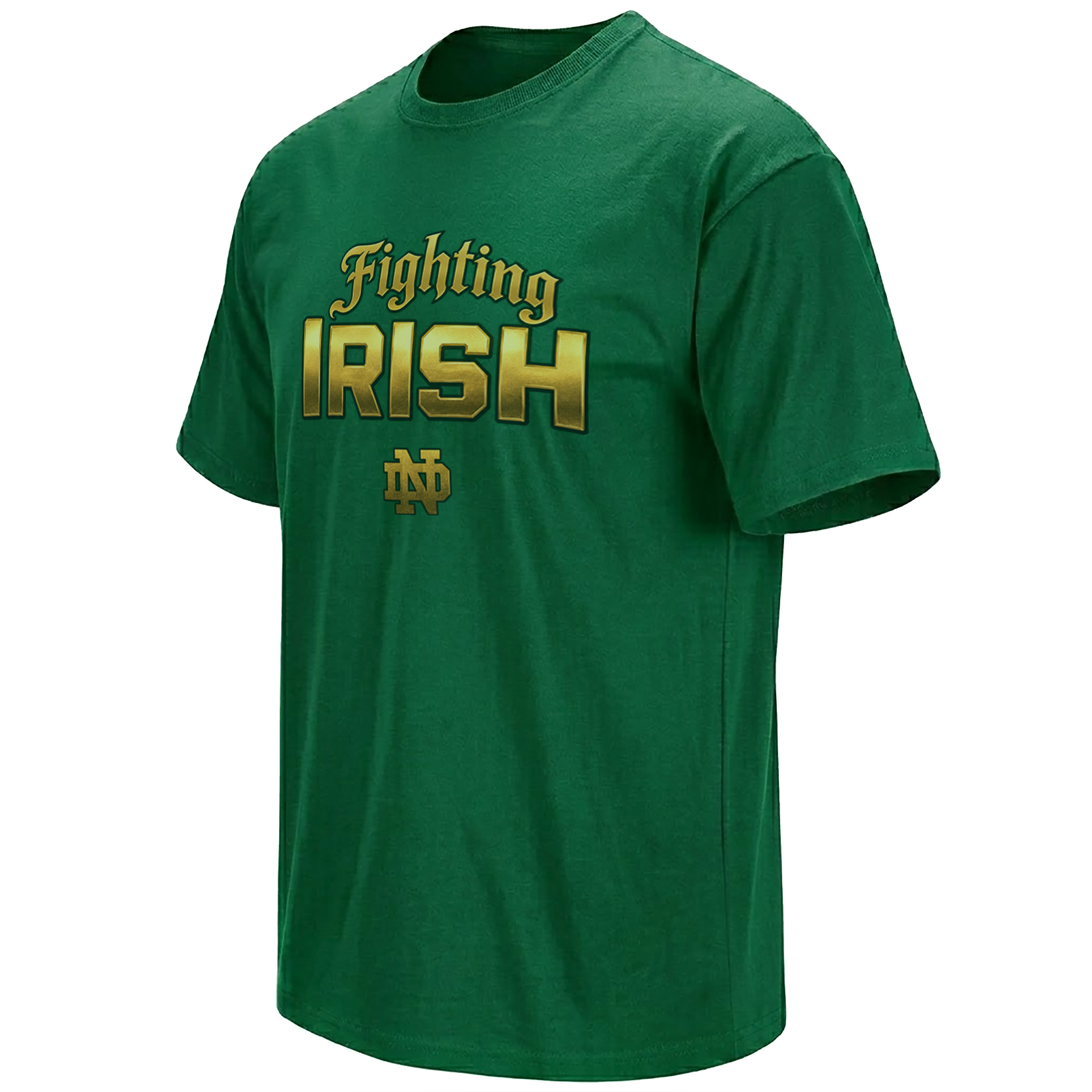
A team-first design that uses Notre Dame’s nickname, gold collegiate typography and the interlocking ND rather than anchoring itself to one game or player.
View the design →Why the design feels especially relevant in 2026
Undefeated starts change the emotional temperature around evergreen team graphics. At 5-0, Notre Dame is no longer simply entering another season with national attention. The Irish are actively occupying the championship conversation.
That turns “Fighting Irish” from background branding into current-season language again. Every week adds another result underneath it. The UNC victory extended the story through rain, road pressure and a second-half response; the next home stretch will determine how long that undefeated identity remains attached to the 2026 team.
Fans following the broader program can move through the Notre Dame Fighting Irish collection, while the wider NCAA collection places the graphic alongside the rivalry language and traditions shaping college football culture. Current quarterback-related designs can also be found through the CJ Carr search archive.
Frequently Asked Questions
What is Notre Dame’s record in October 2026?
Notre Dame is 5-0 after defeating North Carolina 37-26 on October 3, 2026.
What is Notre Dame ranked right now?
The Fighting Irish are ranked No. 3 nationally after their undefeated 5-0 start.
When did Notre Dame officially adopt the Fighting Irish nickname?
University president Rev. Matthew Walsh officially accepted “Fighting Irish” as Notre Dame’s athletic nickname in 1927.
Why are green jerseys important to Notre Dame football?
Green has become an unofficial event color tied to major Notre Dame moments, most famously the surprise green-jersey victory over USC in 1977.
What does the Fighting Irish Shirt design represent?
The graphic distills Notre Dame football identity into the Fighting Irish nickname, oversized gold IRISH lettering, a deep green base and the interlocking ND monogram.
The Fighting Irish design works as an identity piece rather than a one-game souvenir, while the Notre Dame archive follows the specific players, slogans and moments being added to that history now.
Fighting Irish Shirt captures Notre Dame football identity through deep green, oversized gold IRISH lettering and the interlocking ND monogram, arriving as the No. 3 Irish open October 2026 at 5-0.