New York Forever: How Five Boroughs Became One Knicks Championship City
Manhattan holds Madison Square Garden, but the Knicks have never belonged to one address. The 2026 title traveled through Brooklyn, Queens, The Bronx and Staten Island, turning five distinct boroughs into one blue-and-orange city.
The New York Knicks won the championship in San Antonio, but the meaning of the victory was distributed across an entire city. Their 94–90 Game 5 win completed a 4–1 NBA Finals victory and ended a 53-year wait stretching back to 1973.
Jalen Brunson scored 45 points and received the Bill Russell Finals MVP trophy, yet the response after the final buzzer could not be contained inside one player’s achievement or one arena’s walls. Supporters gathered in bars, streets and public screenings across New York. Brooklyn celebrated. The Bronx celebrated. Queens, Staten Island and Manhattan joined the same conversation.
That geography gives “New York Forever” its full meaning. The phrase is not limited to the blocks surrounding Madison Square Garden. It includes five boroughs with different histories, accents, neighborhoods and relationships to the city, all temporarily organized around the same championship result.
Five Boroughs, Five Identities, One Basketball Language
New York City is unified administratively, but rarely experienced as one undifferentiated place. Each borough carries its own cultural shorthand, neighborhood loyalties and ideas about what represents the “real” New York. Sports can sharpen those distinctions, but it can also create the rare moment when they become secondary.
The Knicks’ championship supplied that moment. The team’s home arena may sit in Manhattan, yet its audience extends far beyond Midtown. Fans traveled from outer-borough neighborhoods to the Garden, attended local watch parties and turned restaurants, bodegas, sidewalks and living rooms into extensions of the Finals.
The result created a shared sentence with five different local accents: New York is champion.
Champions
Manhattan Hosted the Stage, but It Did Not Own the Story
Madison Square Garden remains the emotional headquarters of Knicks basketball. The building hosted its first NBA Finals games since 1999 and carried the pressure of every previous era into each possession.
Manhattan also became a central gathering point after the title, with crowds converging around the Garden and preparations beginning for a historic ticker-tape parade through the Canyon of Heroes. The official civic ceremony naturally gives Manhattan an important role in how the championship will be remembered.
Yet the city’s relationship with the Knicks does not stop at the arena doors. Manhattan provides the stage. The other boroughs supply millions of the people, arguments, family traditions and daily journeys that keep the culture alive between games.
Brooklyn Turned the Finals Into a Neighborhood Event
Brooklyn’s sports identity contains its own teams and rivalries, but the Knicks’ championship run demonstrated that borough geography does not produce simple fan boundaries. Bars, public spaces and neighborhood watch parties filled with supporters who treated the Finals as a city event.
From Carroll Gardens to communities farther east, the celebration operated through local gathering points rather than one centralized viewing room. That pattern matters. It reveals how a major sports moment becomes culturally durable: not only through television ratings or arena footage, but through repeated neighborhood experiences.
Brooklyn did not need to imitate Madison Square Garden. It created its own versions of the Garden atmosphere.
Queens Gave the Championship Its Everyday Multilingual Energy
Queens contains one of the most diverse collections of neighborhoods in the world. Knicks fandom moves there through multiple languages, generations and cultural traditions, often meeting inside restaurants, family businesses and local sports spaces.
During the playoff run, Queens businesses incorporated Brunson and Knicks references into food, signs and promotions. That local creativity showed how the title conversation could be translated without losing its New York identity.
Queens makes the “New York Forever” message larger because it rejects the idea that there is only one way to sound, look or celebrate like a Knicks fan.
The Bronx Brought Street-Level Basketball History
The Bronx has its own deep basketball tradition, built through school gyms, outdoor courts, community programs and players whose influence extends beyond professional arenas. Knicks fandom there exists inside a wider relationship with the game itself.
Watch parties across the borough allowed Game 5 to function as a communal basketball event. The championship belonged to people who had argued about point guards, defense and New York toughness long before Brunson completed his 45-point performance.
The Bronx adds historical texture to the five-borough message. It represents a place where basketball is not simply consumed. It is studied, played and debated as part of neighborhood life.
Staten Island Refused to Be Left Outside the Circle
Staten Island is geographically separated from the city’s subway network and is often treated as an afterthought in simplified images of New York. The five-borough design corrects that tendency by giving it the same circular placement as Manhattan, Brooklyn, Queens and The Bronx.
During the Finals, Staten Island publicly embraced defining Knicks moments. The borough even declared an OG Anunoby Day after his Game 4 tip-in completed the historic comeback and moved New York within one win of the title.
That response demonstrates why inclusion in the graphic matters. Staten Island may reach Manhattan by ferry rather than subway, but it reached the same championship destination.
The Design Places Every Borough on the Same Championship Orbit
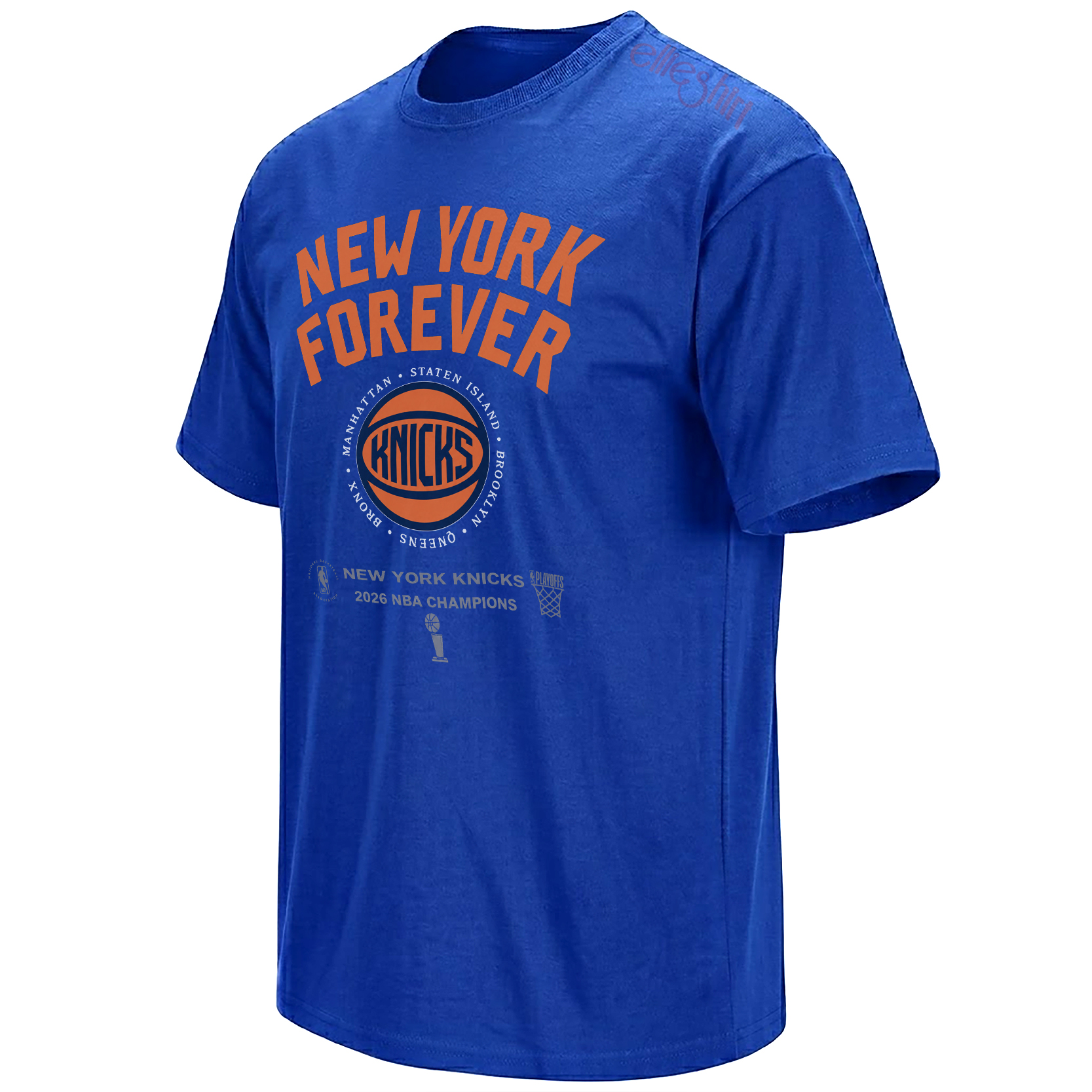
The New York Forever Shirt organizes its message through a circular structure. Manhattan, Staten Island, Brooklyn, Queens and The Bronx form a ring around the central Knicks basketball symbol.
That arrangement is more meaningful than a simple list. No borough is placed permanently above the others. Each name occupies part of the same orbit, suggesting that the team sits at the center of a city made from distinct but connected territories.
Above the circle, “New York Forever” expands the message beyond one season. Below it, “2026 NBA Champions” attaches the permanent identity to the exact year when the five-borough city received its long-awaited title.
Why the Circular Layout Matters
Circles communicate continuity. They have no obvious beginning or ending, which makes the form especially suitable for the word “Forever.” The borough names appear to rotate around the central basketball without breaking the connection.
The shape also resembles a city seal, transit marker and championship emblem at the same time. It gives the artwork civic authority without becoming too formal. The design feels like something that could appear on a neighborhood banner, arena concourse or street celebration sign.
Most importantly, the circular structure prevents the piece from reducing New York to a skyline. The city is represented through named communities rather than only famous buildings.
Royal Blue Makes the Shirt Feel Like a City Banner
The royal garment provides a complete field of Knicks color before the viewer reads the first word. Orange lettering then creates immediate contrast, producing the familiar visual rhythm associated with New York basketball.
The palette also gives the piece a parade-banner quality. Royal blue feels expansive and civic, while orange carries the heat of the celebration. White lettering around the circular emblem keeps the five borough names readable without competing with the central mark.
The result is direct but not overcrowded. The design contains a citywide argument, a championship date and five geographic names while still reading as one unified symbol.
Five names form one complete circle, giving every borough equal visual membership in the championship city.
The Knicks emblem acts as the shared point around which separate local identities temporarily align.
The championship line turns a permanent New York statement into a record of the exact season that ended the 53-year wait.
“New York Forever” Reaches Beyond Current Residents
Not every Knicks supporter still lives inside the five boroughs. Families move. Careers take people elsewhere. New York identity often survives those changes through food, language, sports and inherited routines.
The borough names therefore operate as origins as much as present locations. A supporter in another state or country can still identify with the block, train line or neighborhood where the relationship with the Knicks began.
“New York Forever” is powerful because it allows physical distance without emotional departure. The city can remain part of someone’s identity even after the address changes.
The graphic names the official boroughs, but its emotional map extends farther—to Long Island, New Jersey, Westchester and every place where New Yorkers carried the Knicks after leaving the city.
The Championship Gave Every Borough a New Shared Date
Before 2026, Knicks title memory remained tied to 1970 and 1973. Those dates belonged deeply to franchise history, but they existed outside the direct experience of most current supporters.
June 13, 2026 created a common timestamp for the modern city. Fans in different boroughs watched from different spaces and brought different histories to the game, yet the final buzzer entered everyone’s memory at the same moment.
That shared date can now be passed forward. Future supporters will hear where their parents watched Game 5, which borough they were in and how the city sounded when New York finally became champion again.
The Five-Borough Message Resists a Manhattan-Only New York
Popular imagery often reduces New York to Midtown, Times Square, the Empire State Building or the Manhattan skyline. Those landmarks are recognizable, but they offer an incomplete cultural map.
By naming all five boroughs, the design shifts attention from monuments to communities. It acknowledges that Knicks loyalty is produced in apartment buildings, schoolyards, neighborhood bars, ferries, buses and local courts far beyond the immediate surroundings of Madison Square Garden.
The championship becomes more democratic when its visual language recognizes the entire city that sustained the team.
Game 4 Had Already United the City Before the Trophy Arrived
The emotional unification did not begin with Game 5. New York’s 29-point comeback in Game 4 created a citywide eruption before the championship had officially been secured.
Fans filled streets, bars, bodegas and watch parties after OG Anunoby’s last-second tip-in produced the 107–106 victory. Manhattan and Staten Island issued separate official recognitions of Anunoby, while calls for statues, street names and permanent tributes spread across fan conversations.
Game 4 made the five boroughs believe together. Game 5 allowed them to celebrate without qualification.
The Parade Will Be in Manhattan, but the Victory Is Citywide
New York’s official ticker-tape parade and City Hall ceremony will follow the traditional Canyon of Heroes route. That setting gives the Knicks a place within the city’s long history of public triumph.
Yet a parade route cannot contain everyone who participated in the season. The formal celebration will be concentrated in Lower Manhattan, while the memories that feed it come from all five boroughs.
The five-borough graphic functions like a wider parade map. It places every part of the city inside the frame even when the official floats travel through only one.
A Citywide Artifact Inside the Knicks’ New Championship Archive
The broader New York Knicks collection records the 2026 title through individual performances, Finals moments, roster tributes, subway culture and citywide declarations.
The NBA collection shows how championship history becomes fan language across different cities. New York’s contribution is inseparable from geography: the Garden, the subway, the bodega and the five boroughs all become part of how the title is remembered.
The Five Boroughs as a Championship Seal
The New York Forever five-borough design preserves the title without relying on one player portrait or one arena image. Its central argument is civic: Manhattan, Brooklyn, Queens, The Bronx and Staten Island all belong to the same championship circle.
The Knicks emblem supplies the basketball identity. The borough names supply the people and places that made the result larger than a team record. The 2026 line supplies the year when those pieces finally formed one championship city.
New York Five Boroughs Championship FAQ
Which five boroughs are named on the New York Forever design?
The design names Manhattan, Brooklyn, Queens, The Bronx and Staten Island, placing all five around the central Knicks basketball emblem.
Why are the borough names arranged in a circle?
The circle gives every borough equal visual membership and supports the word “Forever” through a continuous form without an obvious beginning or ending.
How does the design connect to the Knicks’ 2026 championship?
The artwork includes a 2026 NBA Champions line beneath the central symbol, linking the five-borough identity to New York’s first NBA title since 1973.
Why does the championship belong to more than Manhattan?
Madison Square Garden is located in Manhattan, but Knicks supporters live, gather and celebrate throughout all five boroughs. Watch parties and street celebrations during the Finals reflected that citywide following.
What does “New York Forever” mean in the graphic?
It expresses a lasting connection to New York and Knicks culture that can continue across generations, neighborhoods and even after supporters move beyond the city.
Some supporters reached the Knicks through the Garden. Others found them in a Bronx gym, a Queens restaurant, a Brooklyn watch party or a Staten Island family tradition. The 2026 championship gave all of those routes the same final destination.
New York Forever Shirt celebrates the Knicks’ 2026 NBA championship with Manhattan, Brooklyn, Queens, The Bronx and Staten Island arranged around a central basketball emblem, turning five boroughs into one blue-and-orange championship city.