
Myles Garrett’s Kobe Dodgers First Pitch Became an LA Welcome Ritual
A ceremonial first pitch usually lasts a few seconds. This one carried a city’s sports language: Dodgers blue, Kobe memory, Rams arrival energy, and the internet’s instinct for turning a simple image into a cultural signal.
The internet understood the image almost immediately. Myles Garrett standing at Dodger Stadium, wearing Kobe Bryant across his chest, did not read like a normal celebrity first pitch. It read like a new Los Angeles athlete learning the city’s password in public.
The moment had layers before the ball even reached the plate. Garrett had recently become part of the Rams conversation, the Dodgers stage gave the image civic weight, and Kobe’s presence turned the scene into something softer than a transaction between teams. It became a question of belonging: how does a superstar introduce himself to LA without saying too much?
The answer, at least online, was visual. Fans did not need a press release to decode it. They saw the Dodgers setting, the Kobe tribute, the football crossover, and the timing. Across fan spaces, the reaction quickly turned into a mix of welcome, rivalry jokes, Cleveland-to-LA irony, and the simplest possible read: he understood the assignment.
Why This Moment Felt Bigger Than a First Pitch
Ceremonial first pitches often function as quick programming between innings and headlines. This one carried a different charge because it arrived during a rare crossover point: an NFL star entering the Los Angeles imagination, a baseball stadium acting as the public stage, and Kobe Bryant remaining one of the city’s most recognizable emotional symbols.
That combination explains why the reaction moved so quickly. Dodgers fans understood the setting. Lakers fans understood the tribute. Rams fans understood the arrival narrative. Even rival fans understood the performance of it — the way Los Angeles sports identity often travels through images, colors, memorial language, and shared references rather than long explanations.
In plain terms, the Myles Garrett Kobe Dodgers first pitch became a Los Angeles sports-culture moment because it connected three fan worlds at once: Rams future, Dodgers stagecraft, and Mamba memory.
Kobe as the City’s Shared Sports Reference
Kobe Bryant remains one of the rare Los Angeles figures whose meaning travels across teams. His memory belongs most directly to basketball, but the emotional vocabulary around him is much wider: work, arrival, pressure, loyalty, grief, competitiveness, and the complicated intimacy LA fans still feel when his image appears in a new sports setting.
That is why Garrett wearing Kobe at Dodger Stadium mattered. It was not only a tribute to a basketball legend. It was a public alignment with a city that still uses Kobe as shorthand for seriousness. When an athlete new to the LA ecosystem chooses that reference, fans read it as intentional, even if the gesture itself stays simple.
The strongest part of the moment is that it did not need to be explained. It looked like LA before anyone wrote a caption for it.
The Internet Reaction Turned It Into a Welcome Test
The online conversation did not move in only one direction. Some fans treated the image as a smart introduction to Los Angeles. Others joked about the full crossover stack — Kobe, Dodgers, Rams — as if Garrett had checked every box in the city’s sports starter pack. Lakers-centered spaces also pulled the image into a longer tradition of athletes wearing Kobe references during major LA moments.
There was friction too, which is part of why the image had staying power. Former-team emotion, Rams rivalry noise, and old Garrett controversies gave the thread edges. But that tension made the conversation feel more real. LA did not simply applaud the image; fans negotiated it, joked through it, challenged it, and still kept circulating it.
The Design Language: Bootleg Memory, Stadium Light, Mamba Black
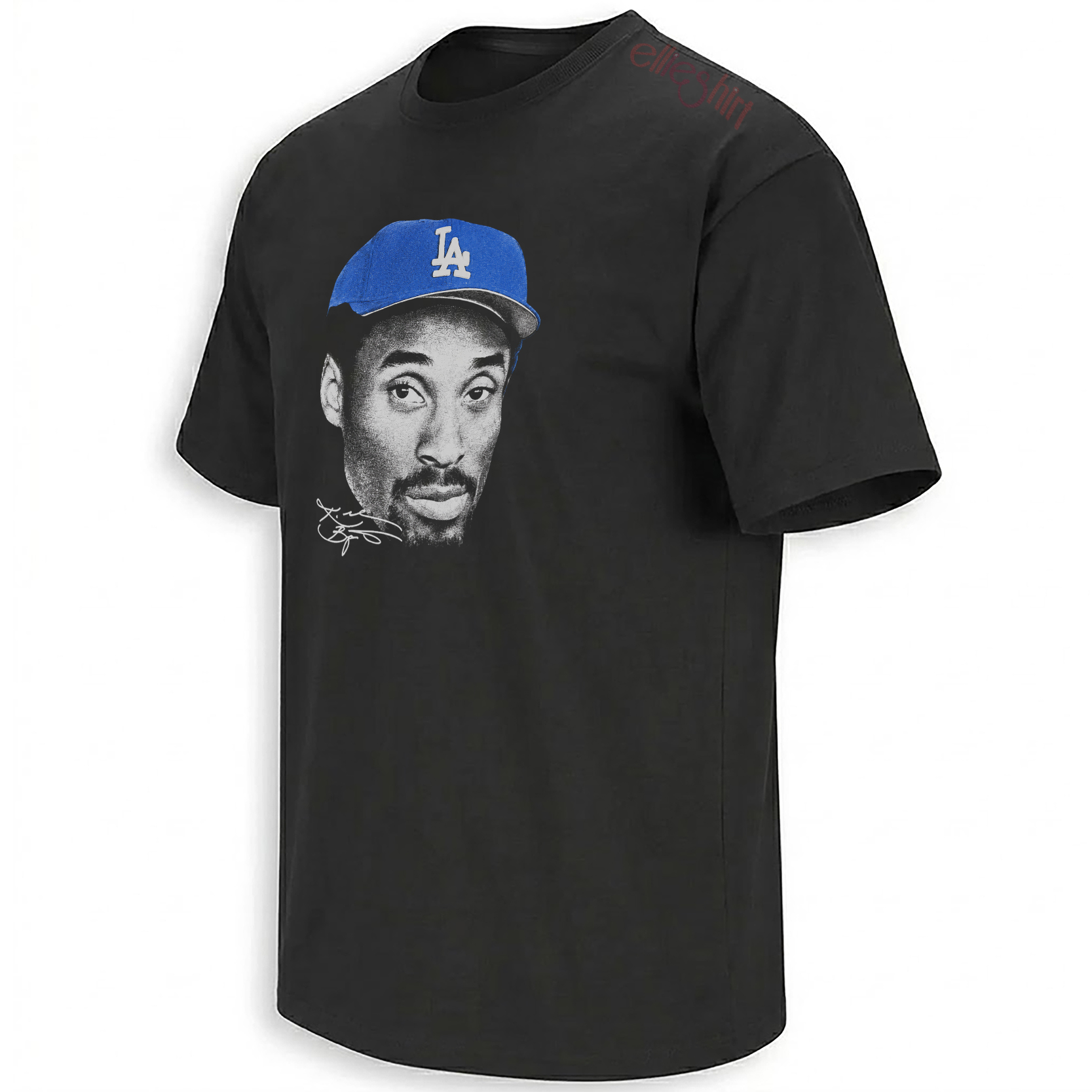
The artwork fits the moment because it does not behave like a clean corporate tribute. It has the feel of a fan-made street graphic: direct, emotional, and built from overlapping city symbols. The black shirt base matters because it pushes the design toward Mamba memory rather than ordinary Dodgers merchandise. The blue keeps the stadium setting alive. The gold and purple echoes pull the image toward Lakers history without needing to overstate it.
That visual tension is the reason the piece works as an artifact. It does not ask the viewer to pick one team lane. It lets Los Angeles feel crowded in the way Los Angeles sports culture often is — baseball, basketball, football, celebrity, grief, arrival, and performance all folding into one image.
Inside the wider Los Angeles Dodgers collection, this kind of graphic reads less like a standard baseball tee and more like a cross-sport memory object. It also fits the broader MLB shirts and apparel archive because Dodger Stadium often becomes a stage for moments that reach beyond baseball.
The Myles Garrett Kobe shirt sits naturally inside this story as a visual archive of the day the first pitch became a larger LA sports signal.
Why LA Sports Moments Become Visual Memory So Quickly
Los Angeles is unusually good at turning sports into imagery. A tunnel fit, a parade jersey, a courtside tribute, a first pitch, a mural, a cap choice — all of it can become part of the city’s archive if the symbols line up. Garrett’s first pitch image lined up because it was instantly legible. You did not need to know the entire Rams roster to understand what the Kobe shirt was doing.
That is the deeper reason the moment traveled. It gave fans a compact image of transition. Garrett was no longer just a headline attached to a roster move. He was standing in one of LA’s most recognizable sports rooms, carrying one of the city’s most emotionally loaded references, and letting the image do the talking.
FAQ
Why did Myles Garrett’s Dodgers first pitch become a cultural moment?
It combined several Los Angeles sports symbols at once: Garrett’s Rams arrival energy, Dodger Stadium as a public stage, and Kobe Bryant’s lasting emotional meaning in the city.
Why did the Kobe shirt matter in this setting?
Kobe’s image carries meaning far beyond basketball in Los Angeles. Wearing a Kobe tee at Dodger Stadium made the first pitch feel like a city-aware gesture rather than a routine appearance.
How did fans react online?
Fan reaction mixed welcome energy, crossover jokes, Rams-Dodgers-Lakers symbolism, and some rivalry tension. That mix helped the image feel like a real internet moment instead of a polished promotion.
Why does the graphic style fit the moment?
The black base, Dodgers blue, Lakers-adjacent purple and gold, and tribute-style composition make the design feel like a fan-made visual timestamp of LA sports culture.
A Soft Place in the Archive
Some sports images last because of the play. Others last because of the symbols around the play. Garrett’s first pitch belonged to the second category. The throw mattered, but the picture around it mattered more: a new LA football star, a Dodgers stage, a Kobe tribute, and a fan base deciding in real time what the gesture meant.
For readers following the crossover, the graphic can be viewed alongside the broader Los Angeles sports pieces on Ellie Shirt as part of the same living archive — not a replacement for the moment, but a small visual record of how quickly fans turned it into shared language.