
Munetaka Murakami’s Swing Is Changing the Sound of the South Side
Japan already knew what happened when number 5 connected. Chicago is now learning the same lesson—one towering swing at a time.
By the end of May, Munetaka Murakami had already changed the emotional temperature around Chicago White Sox baseball. He had launched 20 home runs in his first 57 Major League games, shared the American League lead and turned nearly every plate appearance into an event that demanded attention.
That charge has not disappeared while Murakami recovers from a Grade 2 strain of his right hamstring. As June closes, the White Sox are moving closer to the stage when a rehabilitation assignment could become part of his return plan. The pause has interrupted the numbers, but it has not diminished the story.
Chicago is still waiting for the next swing.
It is waiting because Murakami’s first two months in the United States felt less like a cautious introduction and more like an announcement. His power arrived immediately, his number 5 became recognizable across the South Side, and a season once framed around development suddenly carried the possibility of something much louder.
A Famous Swing Arrives in Chicago
Murakami did not come to Major League Baseball as an unknown prospect waiting to establish an identity. He arrived with an identity powerful enough to cross an ocean.
With the Tokyo Yakult Swallows, he became one of the defining hitters of his generation. His 2022 season included 56 home runs, a Triple Crown and an MVP award. He had already won a Japan Series championship, starred for Samurai Japan and inspired the reverent nickname “Murakami-sama.”
The question was never whether Murakami possessed extraordinary power. The question was how quickly that power would translate against Major League pitching.
His answer came almost immediately.
Murakami homered in each of the first three games of his Major League career, becoming the first White Sox player to begin a career that way. In April, he produced a 431-foot grand slam with an exit velocity of 114.1 mph. Days later, another drive traveled a projected 451 feet. By May 27, he had reached 20 home runs.
Murakami did not simply bring Japanese power to Chicago. He gave the South Side a new reason to anticipate every pitch.
Why the Follow-Through Matters
Home-run hitters are remembered through numbers, but they become culturally recognizable through silhouettes.
Murakami’s silhouette appears at the end of the swing: the bat high above his shoulder, his lower body rotated through the baseball and his eyes tracking the result. It is a pose filled with both force and control. The action has already happened, yet the image still feels alive because everyone looking at it understands what may be traveling beyond the frame.
That is the moment captured by the Munetaka Murakami Slugger Swing Shirt.
Rather than turning Murakami into a generic player portrait, the artwork preserves the physical language that has made him so compelling. The design is about the motion that happens before the roar—the compact load, the violent rotation and the high finish that tells the crowd the ball has been struck with authority.
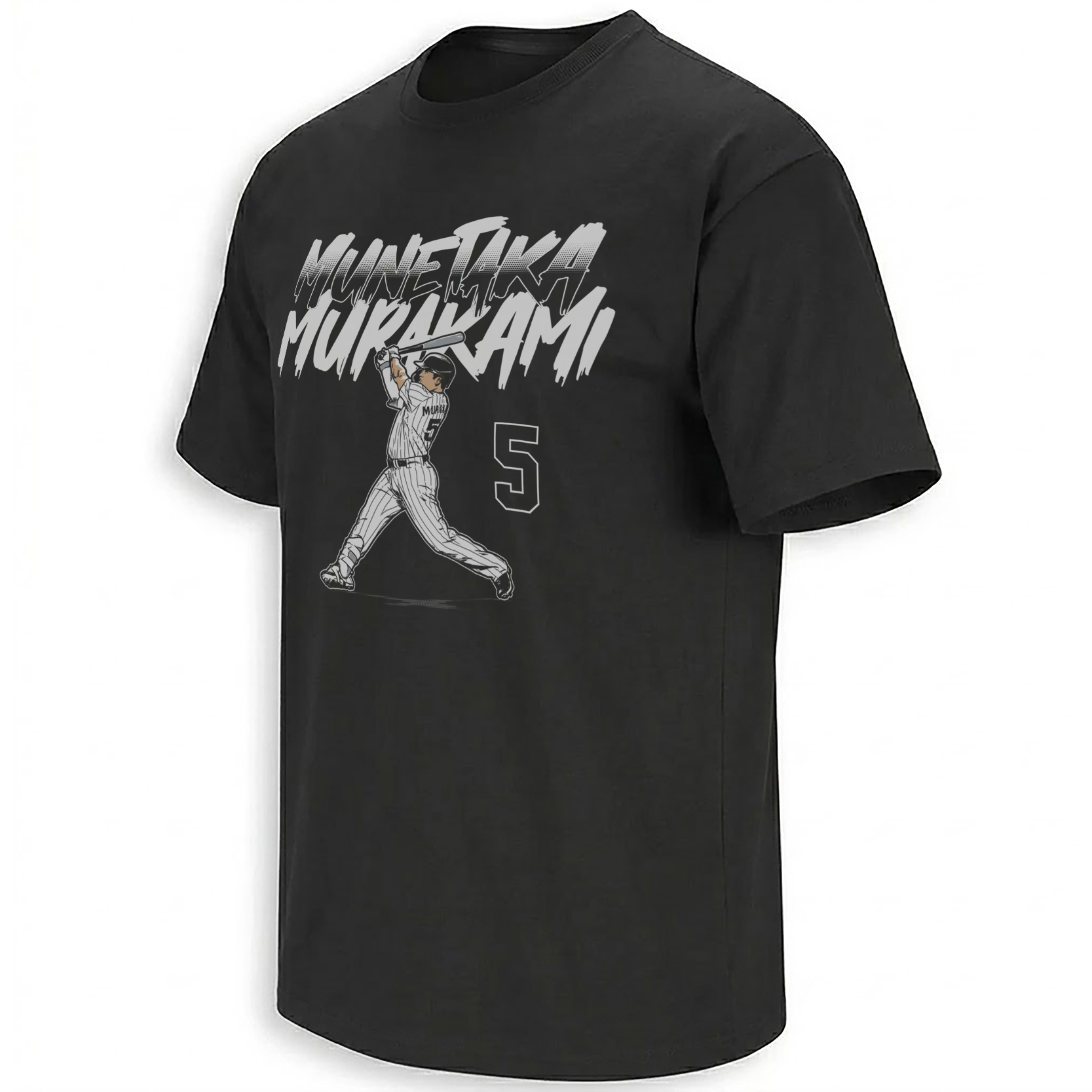
Munetaka Murakami Slugger Swing Shirt
A monochrome player graphic built around Murakami’s left-handed follow-through, layered brush lettering and the oversized number 5 now associated with his White Sox chapter.
The composition treats the swing as the centerpiece. It is not merely a name-and-number shirt; it is a visual record of the movement that introduced Chicago to one of Japan’s most feared power hitters.
View the shirtNumber 5 Becomes a South Side Signal
Player numbers often require years to develop meaning. Murakami’s number 5 began accumulating it within weeks.
The number now carries multiple layers of recognition. It identifies the White Sox hitter standing at the intersection of Japanese and American baseball. It connects Chicago’s present to Murakami’s established reputation overseas. Most importantly, it gives fans a clean visual symbol for the feeling his at-bats have created.
When number 5 enters the box, the game can change with one pitch.
The shirt makes that number deliberately large but leaves it outlined rather than completely filled. That choice keeps Murakami’s body and swing at the center while allowing the numeral to function like a backdrop, scoreboard marker and emerging icon at the same time.
From Murakami-Sama to Mune Mania
The transition from Nippon Professional Baseball to MLB is often described through adjustments: velocity, travel, unfamiliar pitchers, media obligations and the grind of a longer schedule. Murakami’s first season includes all of those realities, but the cultural transition has moved in both directions.
Chicago fans are learning the history behind the hitter. Japanese fans are following a new chapter in a city with its own intense baseball identity. The White Sox are not merely introducing an international star to a new league; they are becoming part of a career already loaded with memory and expectation.
“Murakami-sama” belonged to his rise in Japan. “Mune Mania” describes what happened when that established mythology met the immediacy of American baseball culture.
A 425-foot home run can be clipped, shared and replayed across languages within minutes. A five-game home-run streak can turn a new player into appointment viewing. A black shirt carrying his follow-through can become a wearable sign that the fan understood the moment while it was still unfolding.
The Rookie Run That Changed Expectations
A Shirt About Arrival, Not Nostalgia
Sports apparel often looks backward. It celebrates championships already won, legends whose stories are complete and moments that have settled into history.
This Murakami graphic operates differently. Its energy comes from being attached to a story still developing.
The final totals are unknown. The next landmark has not happened yet. Even his recovery creates a new layer of anticipation because the season is now divided into the explosive beginning and the return Chicago hopes will follow.
That uncertainty is not a weakness. It is what gives the design cultural immediacy.
Wearing the shirt is a way of marking the point when Murakami’s swing first became part of South Side baseball life—before anyone knew how high the home-run count might climb or where the White Sox season might ultimately lead.
What Murakami Represents for the White Sox
For years, Chicago’s South Side conversation has often centered on rebuilding, lost seasons and the search for a convincing direction. Murakami cannot resolve every organizational question with one bat, but he has changed the vocabulary around the club.
His arrival introduced words such as global, electric and must-see. His home runs created moments that traveled far beyond Chicago. His presence gave a young roster a genuine centerpiece and gave fans a player whose plate appearances could interrupt ordinary life.
That is why his return matters beyond the box score. The White Sox are waiting not simply for another first baseman, but for the player who altered what a normal night at the ballpark could feel like.
The injury paused the home-run race. It did not pause the belief that Murakami can define a new White Sox era.
Follow the South Side Story
Murakami’s first MLB season now contains several distinct chapters: the international arrival, the historic opening burst, the race to 20, the sudden injury and the approaching return.
For fans following that story, the Slugger Swing design sits naturally beside a broader collection of Chicago baseball graphics and player-driven MLB apparel.
There will be more numbers, more adjustments and more arguments about what Murakami’s first Major League season ultimately means. Those evaluations belong to the months ahead.
The first impression is already secure.
Munetaka Murakami arrived in Chicago, lifted the bat through his finish and made the South Side look toward the sky.
Munetaka Murakami FAQ
Who is Munetaka Murakami?
Munetaka Murakami is a Japanese left-handed power hitter who became a star with the Tokyo Yakult Swallows before joining the Chicago White Sox for the 2026 MLB season.
What number does Munetaka Murakami wear for the White Sox?
Murakami wears number 5 for the Chicago White Sox. The number is a central visual element in the Munetaka Murakami Slugger Swing Shirt.
How many home runs did Murakami hit before his 2026 injury?
Murakami hit 20 home runs in his first 57 games before a Grade 2 right hamstring strain placed him on the injured list at the end of May 2026.
What does the Munetaka Murakami Slugger Swing Shirt depict?
The design shows Murakami completing his left-handed swing beneath layered name lettering, with a large outlined number 5 positioned behind him.
Why is Murakami called “Murakami-sama”?
“Murakami-sama” is an admiring Japanese nickname that reflects the elevated status he earned through his historic home-run production and achievements in Nippon Professional Baseball.
Is the shirt only for Chicago White Sox fans?
No. The design can also appeal to Japanese baseball followers, Tokyo Yakult Swallows supporters, Samurai Japan fans and collectors documenting Murakami’s transition to MLB.