Phee, KMac, Court, Tash and Liv: How Five Stars Built Minnesota’s Most Complete Lineup
Minnesota’s defining 2026 lineup combines Napheesa Collier’s two-way authority, Kayla McBride’s spacing, Courtney Williams’ rhythm, Natasha Howard’s interior force and Olivia Miles’ fearless control of pace.
The Minnesota Lynx did not become the WNBA’s most complete team by asking one player to carry every possession. Their identity emerged from a five-name rhythm fans could repeat almost like a lineup announcement: Phee, KMac, Court, Tash and Liv.
By early August, Minnesota had won a franchise-record 10 consecutive games and separated itself at the top of the league. The most important number underneath that run was not an individual scoring average. It was the plus-44 point differential produced by Napheesa Collier, Kayla McBride, Courtney Williams, Natasha Howard and Olivia Miles in only 36.3 shared minutes.
That limited sample made the lineup feel less ordinary, not less important. Collier’s return had finally placed Minnesota’s established centerpiece beside the veteran structure and rookie invention that had sustained the team during her absence. The result was a group with almost no obvious stylistic gap.
Minnesota’s strength is not that five stars take turns playing alone. It is that every skill makes the next player’s skill easier to access.
Why These Five Names Became a Fan-Culture Phrase
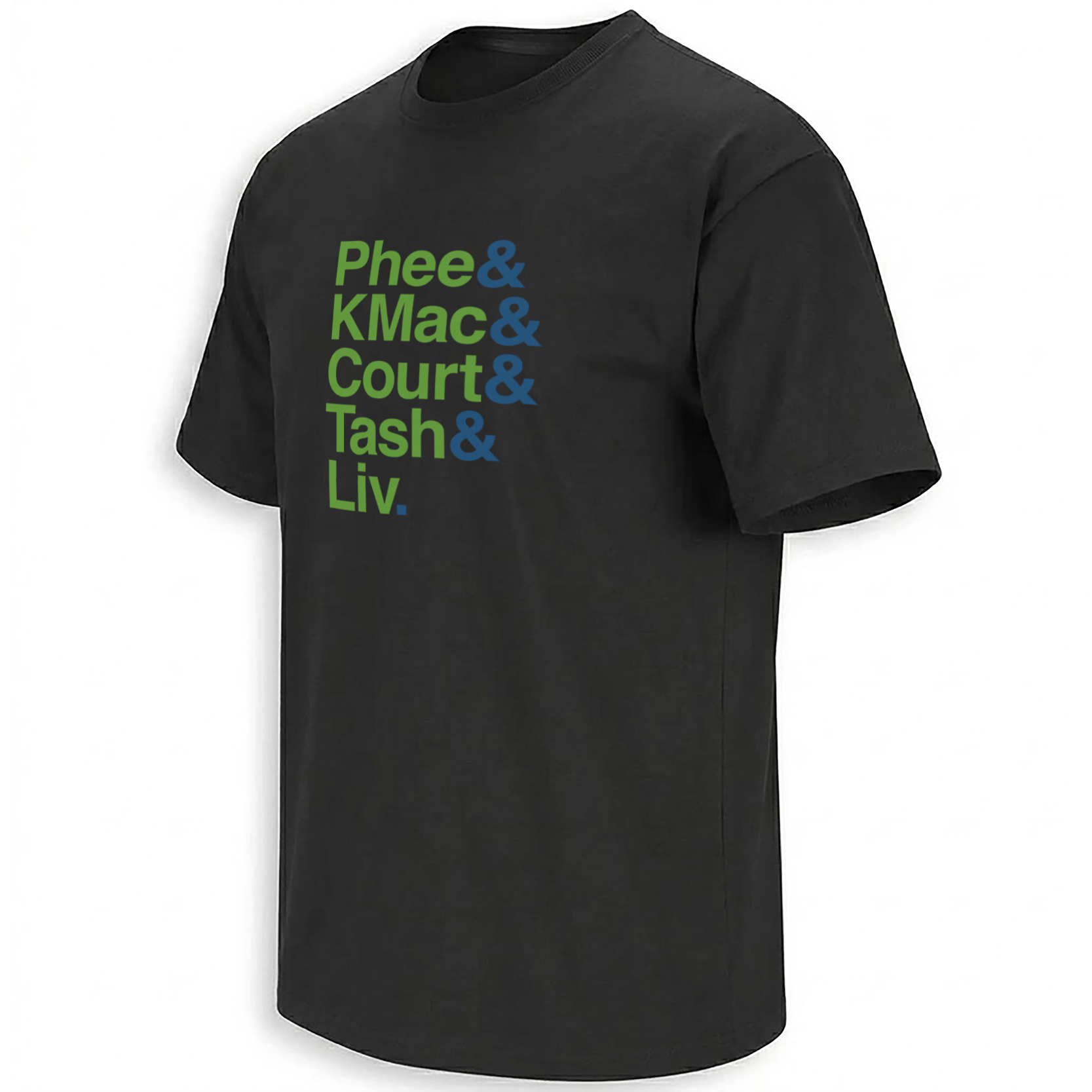
First-name and nickname graphics work when a fan base already recognizes the rhythm. “Phee, KMac, Court, Tash, Liv” does not require surnames, positions or statistics because each shortened name represents a distinct basketball personality.
Phee signals the franchise standard. KMac signals the three-point shot arriving directly in the shooting pocket. Court represents movement, midrange confidence and emotional electricity. Tash brings rebounding, physicality and championship experience. Liv represents the rookie guard who made an advanced offense feel faster almost immediately.
Together, the names read like a roll call for the current Minnesota era. The phrase is conversational rather than ceremonial, which makes the design feel as though it came from the stands, a group chat or the rhythm of a broadcast.
Olivia Miles Changed the Shape of the Team
Miles entered the league with the creativity of a lead guard but quickly demonstrated that her influence extended beyond traditional rookie production. She controlled Minnesota’s tempo, placed passes into McBride’s preferred shooting windows and created scoring opportunities before defenses completed their rotations.
By August, Miles was averaging 19.7 points and 5.8 assists while shooting better than 50 percent from the field. Minnesota was 24–5 with her in the lineup, and her command of the offense had created a legitimate rookie-season MVP discussion.

What Each Veteran Adds Around the Rookie Guard
McBride remains one of the league’s most dependable floor spacers. Her presence discourages help defenders from collapsing too aggressively toward Miles or Collier. A pass delivered only a fraction earlier can become a clean three because McBride prepares her feet before the defense recognizes the danger.
Williams brings a different timing. She is comfortable in the middle of the floor, capable of creating a pull-up jumper or delivering the extra pass after the defense has already shifted. Her personality also gives Minnesota a visible pulse. When the Lynx need a possession to feel less rigid, Court often supplies it.
Howard gives the lineup its physical foundation. She can score around the rim, rebound through contact, defend multiple frontcourt positions and provide the veteran awareness necessary when a possession becomes chaotic.
Miles controls pace, McBride stretches the floor, Williams manipulates the middle, Howard supplies interior force and Collier connects every layer through elite two-way judgment.
Phee’s Return Completed the Picture
Minnesota had already built the league’s best record before Collier fully returned to the rotation. Her comeback did not require the team to abandon what had worked. Instead, it allowed every other player to occupy a more natural role.
Collier’s gravity opens perimeter space. Her defensive versatility gives Williams and Miles greater freedom to pressure the ball. Her ability to score without dominating every dribble lets Minnesota maintain the movement that developed during the first half of the season.
That is why the five-player unit produced such an extraordinary early differential. It was not simply placing the five most recognizable names on the floor. It was combining five players whose strengths solve different basketball problems.
Why the Graphic Feels Like a 2026 Team Poster
The design borrows from the tradition of concert lineups and championship-era roster shirts. Instead of centering one oversized portrait, it gives each nickname equal visual weight. That choice reflects how Minnesota’s season has been discussed: as a collective structure rather than an isolated star vehicle.
The blue and ice-toned palette reinforces the Lynx identity, while the stacked typography creates the feeling of a repeated arena chant. Because the language is informal, the artwork feels closer to fan culture than official roster documentation.
The wider Minnesota Lynx collection records the personalities, player moments and championship ambitions surrounding this team. The broader WNBA collection places Minnesota’s lineup inside the league-wide culture of nicknames, rivalries and season-defining groups.
Frequently Asked Questions
Who are Phee, KMac, Court, Tash and Liv?
The names refer to Napheesa Collier, Kayla McBride, Courtney Williams, Natasha Howard and Olivia Miles of the Minnesota Lynx.
Why is this five-player Lynx lineup significant?
The group combines elite shooting, playmaking, rebounding, defense and interior scoring, giving Minnesota one of the league’s most balanced units.
How effective was the lineup after Collier returned?
In its first 36.3 shared minutes, the five-player group produced a plus-44 point differential.
What role does Olivia Miles play in the lineup?
Miles controls pace and creates efficient scoring opportunities for Minnesota’s veteran shooters and frontcourt players.
What does the stacked-name design represent?
It turns the five players’ familiar nicknames into a fan-facing roll call for Minnesota’s defining 2026 lineup.
The Phee KMac Court Tash Liv graphic preserves that lineup rhythm, while the Minnesota Lynx archive follows the players and moments shaping the season.
Phee KMac Court Tash Liv Shirt captures the Minnesota Lynx’s defining 2026 lineup through the familiar names of Napheesa Collier, Kayla McBride, Courtney Williams, Natasha Howard and Olivia Miles.