
Micah Parsons No. 1
One year after a blockbuster trade brought one of football’s most disruptive defenders to Green Bay, Micah Parsons’ story has shifted from instant domination to patient recovery—and the most unusual jersey number in Packers history now carries even more meaning.
Micah Parsons arrived in Green Bay only days before the 2025 season and immediately changed the emotional temperature around the Packers. The trade itself was enormous. Green Bay sent two first-round draft picks and veteran defensive tackle Kenny Clark to Dallas for a pass rusher already established as one of the league’s defining defensive players.
Then came the number.
Parsons had worn No. 11 at Penn State and in Dallas, but that jersey already belonged to Jayden Reed in Green Bay. He turned to Packers supporters, listened to the response and selected No. 1—a number no Green Bay player had worn in a regular-season game since franchise founder Curly Lambeau in 1926.
What could have felt like a marketing decision quickly became a football identity. Parsons produced 12.5 sacks, 26 quarterback hits and 83 pressures in his first 14 starts with Green Bay. The single digit stopped looking unusual. It began looking inevitable whenever the pocket collapsed.
Parsons reached at least 12 sacks for the fifth consecutive season.
His first Packers season immediately reshaped the defense’s pass-rush profile.
The production extended far beyond plays officially recorded as sacks.
Parsons reached that total through his first five NFL seasons.
Why No. 1 Became More Than a Jersey Choice
Single-digit numbers have become common across modern football, but No. 1 carried unusual historical weight in Green Bay. For nearly a century, the number had remained absent from Packers game uniforms.
That absence was partly a product of old NFL number rules. Before the league expanded single-digit eligibility, those numbers were largely reserved for quarterbacks, kickers and punters. Green Bay therefore had few practical reasons to issue No. 1.
Parsons changed the visual meaning of the number. Instead of appearing on a passer or specialist, it appeared on a 250-pound defender crossing the line of scrimmage with the speed of a smaller player and the power of an interior lineman.
The contrast made the jersey instantly recognizable. A single white numeral sat against green and gold while Parsons moved around the formation, rushed from multiple alignments and forced offenses to account for him before every snap.
The Shirt Freezes the Violence of the Sack
The featured artwork is built around the result every pass rusher chases: the quarterback down, the defender rising and the play permanently moving backward.
Parsons appears in the lower center of the composition completing a sack, his body layered over a fallen offensive player. The image is deliberately rough and grainy, closer to a distressed newspaper photograph than a polished studio portrait.
Behind the action, the name “MICAH PARSONS” rises in oversized yellow and black lettering. Parts of the player image cut through the typography, making the figure feel as though he is breaking out of the poster rather than sitting quietly in front of it.
The enormous “#1” on the right balances the player scene. Its bright white treatment immediately identifies the Green Bay chapter of Parsons’ career, while smaller “DEFENSIVE END” text gives the layout the feel of an old roster card or stadium program.
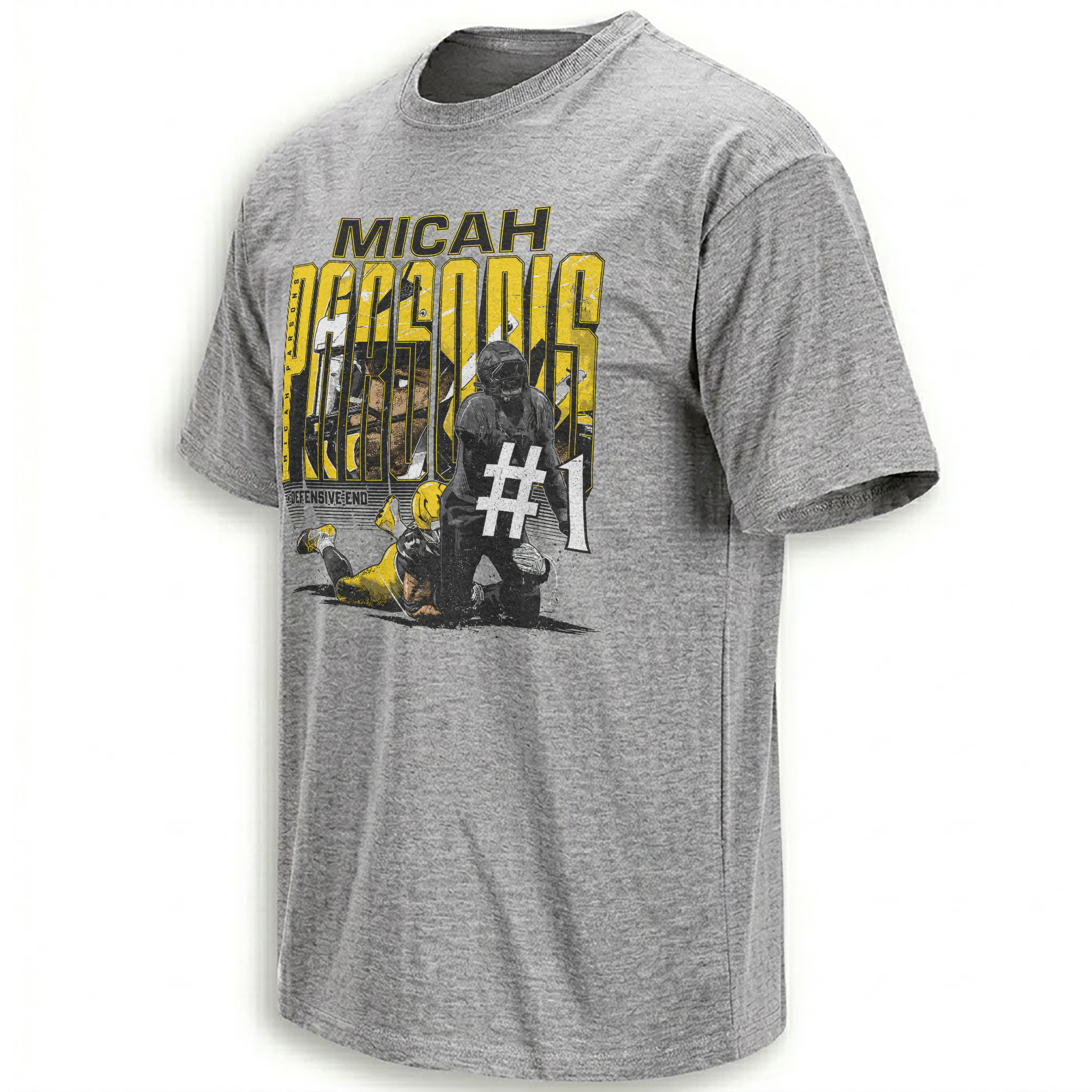
Micah Parsons Shirt
A distressed sport-grey pass-rush graphic combining Parsons’ name in oversized yellow lettering, a central sack scene, small defensive-end typography and the massive No. 1 that defines his Green Bay identity.
The Sport Grey Base Gives the Graphic Its Archival Feel
The shirt’s sport-grey background is not merely neutral. It acts like the paper beneath an old football clipping.
Bright yellow lettering supplies the Green Bay energy, but the washed black shadows and scratched texture prevent the design from looking overly clean. The artwork feels as though it has already survived seasons of stadium weather, tailgates and Sunday routines.
Grey also keeps the individual elements readable. The white No. 1 remains crisp, the darker sack image maintains depth and the gold typography stands forward without needing a heavy border around the entire composition.
The result sits between modern player merchandise and vintage football ephemera. It celebrates a current star through the visual language of an older Packers era.
Three Meanings Behind the Number
Parsons became the first Packers player to wear No. 1 in a regular-season game since Curly Lambeau in 1926.
The single digit separated his Green Bay chapter from the No. 11 associated with Penn State and Dallas.
For fans, No. 1 naturally reinforces the idea that Parsons belongs among football’s most influential defenders.
The best jersey numbers eventually stop feeling assigned. They become inseparable from a player’s movement and reputation.
In Parsons’ case, No. 1 quickly became visible at the edge of every important defensive snap. It appeared outside the tackle, inside over a guard, moving before the snap and closing from behind when quarterbacks attempted to escape.
The number also simplified his silhouette. Even when a television angle could not immediately reveal the nameplate, the lone numeral made the defender easy to locate.
The Trade Changed Green Bay’s Defensive Expectations Overnight
Green Bay did not acquire Parsons as a long-term development project. The price of the trade made the expectation immediate.
By sending two first-round selections and Kenny Clark to Dallas, the Packers made one of the clearest win-now statements in franchise history. Parsons was expected to alter protection schemes, produce pressure without constant blitzing and create better opportunities for every defender around him.
That influence appeared almost immediately. Offensive lines slid protection toward him. Tight ends and running backs became part of blocking plans. Quarterbacks shortened their internal clocks because waiting for a deeper route carried greater risk.
A pass rusher’s value is often measured through sacks, but his presence affects plays on which he never reaches the quarterback. Protection moving toward Parsons can create isolated opportunities for Rashan Gary, interior rushers and blitzing linebackers.
His First Packers Season Produced Several Defining Games
Parsons recorded a career-high three sacks and earned NFC Defensive Player of the Week recognition.
Two sacks pushed him to double digits and reinforced his rare year-to-year consistency.
His 2.5-sack Thanksgiving performance made him the first player to record at least 12 sacks in each of his first five seasons.
The Thanksgiving game against Detroit captured the full effect of Parsons in Green Bay. In a division matchup with playoff weight, he repeatedly disrupted Jared Goff and helped the Packers finish a 31–24 victory.
That performance also created a historical distinction. Parsons became the first player in league history to record at least 12 sacks in each of his first five NFL seasons.
The achievement placed his consistency beside the immediate violence of the highlights. Many pass rushers produce one enormous season. Parsons had built a career in which double-digit sacks were not a peak but an annual baseline.
The Injury Changed the Timeline, Not the Importance
The direction of the season shifted in Week 15 against Denver. Parsons suffered a non-contact knee injury that ended his first Packers campaign after 14 appearances.
He later underwent ACL reconstruction and disclosed that the procedure also included work on his meniscus. The additional repair made patience more important and removed the possibility of treating the recovery as a simple race toward opening day.
Green Bay did not win another game after the injury. The Packers eventually exited the postseason with a Wild Card loss to Chicago, leaving Parsons separated from the part of the season for which his acquisition had been designed.
That absence changed the emotional meaning of 2026. The central question is no longer whether Parsons can transform Green Bay’s defense. He already demonstrated that. The question is how carefully the team can bring him back without sacrificing the years beyond this season.
Parsons has publicly emphasized a strict rehabilitation timeline and said the goal is not to force an early return. His focus is completing the season, avoiding a setback and being available for a potential playoff push.
Why Mid-October Makes More Sense Than Week 1
Parsons said in June that he would not be ready for the beginning of the 2026 regular season. He described a nine-month recovery rule beginning with his late-December surgery and identified mid-October as a realistic target.
That timetable could place divisional and emotionally significant games into view without requiring him to return during the opening weeks. Green Bay begins the season with Minnesota, the New York Jets, Atlanta and Tampa Bay before moving deeper into October.
The temptation to accelerate would be understandable. Parsons is one of the defense’s most important players, and the difference between his presence and absence can alter an entire game plan.
Yet the logic of restraint is stronger. The Packers acquired him for multiple seasons, not only the first month of 2026. A complete recovery gives Green Bay a better chance of having the same explosive defender through the second half, the postseason and the years that follow.
Rehabilitation Has Created a Different Kind of Parsons Story
Parsons’ public identity has long been built around speed, confidence and physical dominance. Recovery from major knee surgery requires the opposite rhythm.
Progress is measured through controlled movement, repeated exercises, weight-bearing milestones and gradual increases in running load. The dramatic Sunday moments are replaced by hours of daily work that most supporters never see.
Parsons has spoken openly about the vulnerability of the process. The injury removed ordinary independence during the earliest stage and forced him to rely on family, medical staff and teammates.
That honesty adds another layer to the No. 1 image. The number still communicates confidence, but the current story is not about presenting oneself as untouchable. It is about rebuilding after football provided a reminder that no player is.
The Artwork Now Functions as a Before-and-After Image
When viewed only through 2025, the sack illustration represents arrival. Parsons is already in Green Bay colors, already wearing No. 1 and already finishing the kind of play the Packers traded for.
Viewed in July 2026, the same image carries anticipation. The body position, force and explosion depicted in the graphic are the qualities supporters are waiting to see again.
Sports artwork often changes meaning without changing a single line. A design created to celebrate immediate dominance can become a symbol of recovery once injury interrupts the player’s momentum.
The shirt therefore occupies two timelines at once: the first Green Bay season that proved Parsons’ value, and the next Green Bay season that will test his return.
Why the Sack Is the Perfect Parsons Image
Parsons can influence a defense in many ways. He can chase the run, cover short zones, pressure from the interior and force protection adjustments before the snap.
Yet the sack remains the most complete visual summary of his role. It captures speed, leverage, pursuit and finality in one frame.
A quarterback pressure may change a throw without appearing clearly in a still image. A double-team may create a teammate’s opportunity without Parsons receiving the statistical credit. A sack requires no explanation. The play ends with the ball behind the line and the defender in control.
That clarity explains why the artwork places the tackle at its center. The typography establishes the name, the number establishes the era and the sack establishes the identity.
Green Bay’s Defense Must Survive the Opening Stretch Without Him
Parsons’ expected absence creates a practical challenge for the rest of the edge-rusher group. Green Bay cannot simply leave his role empty and wait for October.
Rashan Gary remains one of the defense’s central pressure players, while Lukas Van Ness, Barryn Sorrell, Brenton Cox Jr. and younger developmental options may be asked to absorb more snaps.
The defense may also need to manufacture pressure differently. More simulated pressure, more interior movement and more carefully selected blitzes can help compensate for the absence of a defender who normally creates disruption without additional rushers.
The goal is not to reproduce Parsons through committee. Few players combine his acceleration, flexibility and positional range. The goal is to keep the defense structurally competitive until No. 1 returns.
The Return Could Change the Shape of the Season
Midseason returns create an unusual type of momentum. A roster begins the year with one identity, then adds an elite player after the first month has already revealed its strengths and weaknesses.
Parsons’ return could allow Green Bay to simplify certain pressure calls, reduce the burden on younger edge defenders and become more aggressive in obvious passing situations.
It could also help the Packers manage the final part of the schedule with a fresher star than they would have had if he forced his way back in September.
The outcome cannot be guaranteed. Recovery from ACL and meniscus surgery remains individual, and returning to practice is not the same as immediately returning to peak pass-rush form.
That uncertainty is part of what makes the story compelling. Every milestone—from running progression to football drills to the first game activation—will move the number 1 closer to the field.
A Modern Star Inside an Old Football Aesthetic
The design’s distressed texture connects Parsons to the deep historical feeling of Green Bay football without pretending that he belongs to an earlier era.
He is a thoroughly modern defensive weapon: positionless, explosive and capable of moving across the front. The shirt frames that modern player through faded typography, cracked ink effects and a sport-grey base associated with classic practice gear.
That contrast suits the Packers. Few franchises combine present-day expectations with such a visible relationship to their own history. Parsons wearing No. 1 is one of the clearest examples of that tension.
The number points back toward Lambeau. The player points forward toward a defense designed around speed and pressure.
How to Style the Micah Parsons Graphic
Sport grey makes the shirt easy to combine with dark denim, black athletic shorts, olive workwear or a green jacket. The yellow lettering provides enough color that additional bright layers are unnecessary.
For game day, a green or gold cap reinforces the football palette while allowing the central artwork to remain the strongest graphic element.
The distressed composition also works outside a stadium setting because it reads like a vintage sports poster rather than a clean corporate logo.
The large No. 1 stays visible from a distance, while the sack scene and smaller defensive-end text reward a closer look.
Explore more football artwork: Browse additional player, defensive and game-day graphics in the NFL shirts and apparel collection.
What No. 1 Means Entering 2026
In August 2025, No. 1 represented a new beginning. Parsons had left Dallas, entered Green Bay and selected a number with nearly a century of franchise silence behind it.
By December, the number represented production: 12.5 sacks, relentless pressure and proof that the enormous trade had immediately altered the defense.
In July 2026, it represents something else.
It represents the player Green Bay knows it has, the force the defense currently misses and the comeback the season may eventually turn around.
The number remains one. The story now has two chapters.
Frequently Asked Questions
Why does Micah Parsons wear number 1 for Green Bay?
Parsons previously wore No. 11, but that number was already assigned in Green Bay. After hearing from Packers fans, he chose No. 1 for his new chapter.
Was Micah Parsons the first Packers player to wear number 1?
He was the first Green Bay player to wear No. 1 in a regular-season game since franchise founder Curly Lambeau in 1926.
How did Micah Parsons join the Packers?
Green Bay acquired Parsons from Dallas on August 28, 2025, in exchange for two first-round draft selections and defensive tackle Kenny Clark.
How many sacks did Parsons record in his first Packers season?
Parsons recorded 12.5 sacks in 14 appearances during the 2025 regular season.
What injury is Micah Parsons recovering from?
Parsons is recovering from an ACL injury and an additional meniscus procedure performed during his late-December 2025 knee surgery.
Will Micah Parsons play in Week 1 of the 2026 season?
Parsons has said he does not expect to be ready for the season opener. He has identified mid-October as a more realistic target while prioritizing a complete recovery.
What does the Micah Parsons Shirt artwork show?
The design shows Parsons completing a sack beneath oversized distressed name lettering, a large white No. 1 and smaller defensive-end typography on a sport-grey shirt.
Why is the number 1 important to the shirt design?
The number identifies Parsons’ Green Bay era, connects the artwork to an unusual piece of Packers history and creates the strongest visual symbol in the composition.