
Matthew and Brady Are Finally NHL Teammates. Welcome to the Cat-chuk Brothers Era.
Florida’s blockbuster acquisition of Brady Tkachuk did not simply add another elite power forward. It placed two of hockey’s most disruptive brothers inside the same Panthers sweater and turned a long-running family storyline into the defining image of the NHL offseason.
On June 21, 2026, the Florida Panthers completed the move hockey fans had imagined for years. Brady Tkachuk left Ottawa in a blockbuster trade and joined his older brother Matthew in South Florida, ending the period when the NHL’s most recognizable hockey siblings had to save their partnership for international tournaments.
The trade immediately changed the emotional geography of the league. Ottawa lost its captain and one of the central figures of its modern identity. Florida gained a second Tkachuk whose game is built around the same combustible mix of scoring, physical pressure, confrontation and emotional control over an arena.
For Panthers fans, the reaction moved quickly beyond roster construction. Numbers 8 and 19 now belonged to the same team. The family resemblance was no longer a split-screen story between Florida and Ottawa. It was a shared line-change possibility, a shared playoff threat and an almost irresistible source of memes.
The Panthers did not only acquire Brady Tkachuk. They completed the NHL’s most obvious unfinished brother story.
The Trade That Turned a Family Fantasy Into Florida’s Reality
The possibility of Matthew and Brady eventually playing together had followed both brothers for years. Every international tournament revived it. Every warmup conversation between opposing teams created another photograph. Every interview about family eventually reached the same question.
Until June 2026, the idea remained safely hypothetical. Matthew had become central to Florida’s championship identity, while Brady carried the captaincy and emotional burden of Ottawa’s rebuild. Their careers reflected the same family instincts but existed inside very different organizational stories.
Florida changed that arrangement by paying an enormous price in draft capital. Ottawa received the ninth and 25th selections in the 2026 NHL Draft, an additional conditional first-round selection and a second-round pick. The scale of the return showed that this was not a sentimental transaction performed to create a family photograph.
The Panthers acquired a player expected to shape games through net-front pressure, shot volume, physical engagement and leadership. The fact that his brother was already waiting in the same dressing room made the move culturally explosive, but the hockey argument came first.
Brady’s No. 8 and Matthew’s No. 19 now form the visual shorthand for Florida’s new era: two brothers developed inside the same hockey family, shaped by separate NHL franchises and finally reunited on one club.
Why “Cat-chuk Bros” Became the Natural Joke
Florida hockey already speaks through cats. The Panthers name, the long-running rat tradition and the franchise’s aggressive modern personality have created a visual culture filled with claws, predators and arena folklore.
The Tkachuk surname enters that environment with an almost suspicious level of convenience. Replace the opening sound with “cat,” preserve the recognizable ending and the brothers become the “Cat-chuks” before they have even played their first regular-season shift together.
The joke works because it does not require a complicated explanation. Matthew and Brady are Tkachuks. They now play for the Panthers. They are brothers. Reimagining them as two mischievous cats converts the entire blockbuster transaction into one clean visual gag.
It also matches their public reputations. Neither brother is perceived as a quiet, decorative house cat. Both play like animals willing to occupy an opponent’s space, knock objects over and stare without apology after the damage has been done.
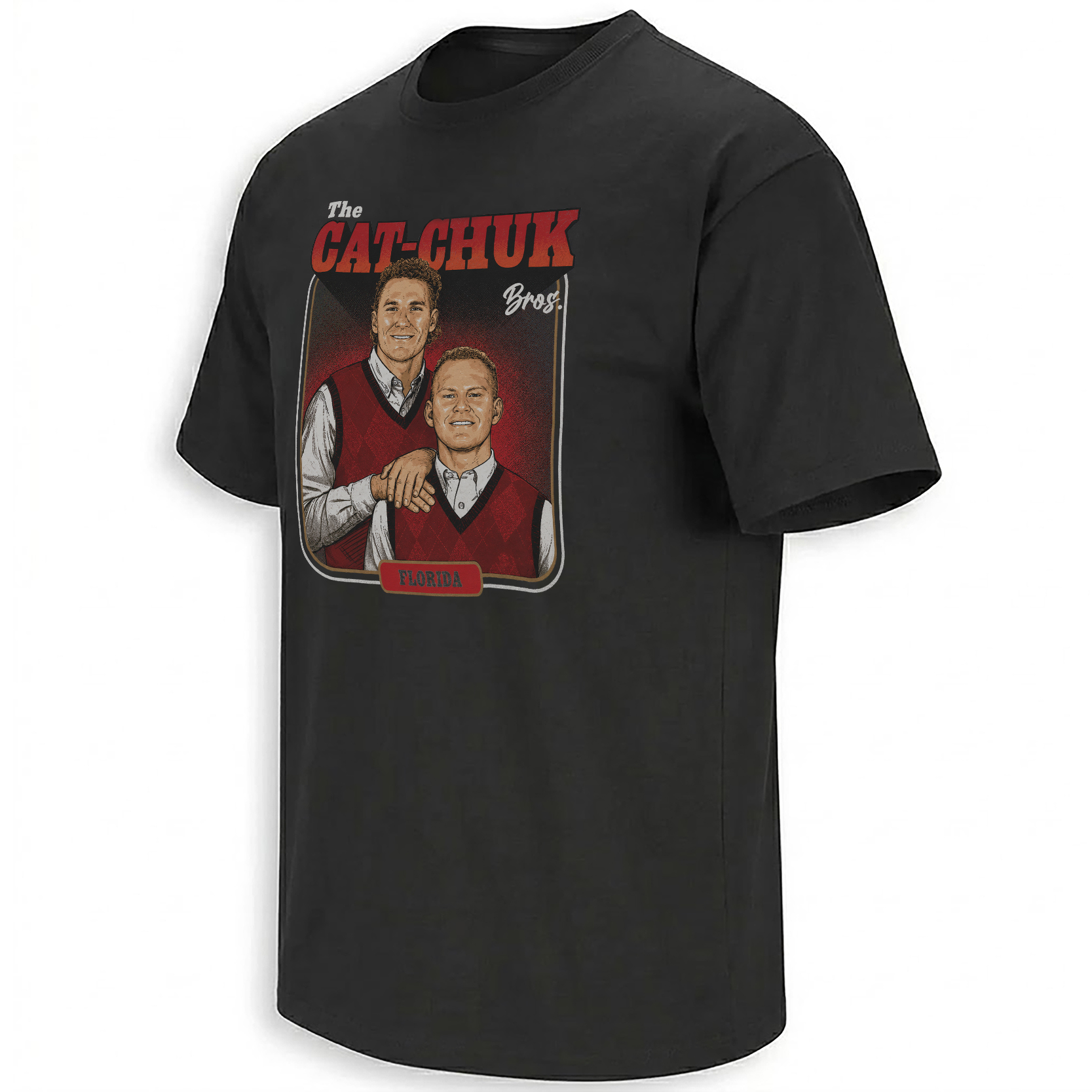
The Artwork Understands the Brothers Through Personality
The Cat-chuk Bros Shirt avoids the conventional structure of a trade-announcement graphic. It does not depend on a formal press-conference photograph, transaction date or list of assets exchanged.
Instead, it translates the brothers into character design. The cats preserve recognizable Tkachuk details while exaggerating the mischievous quality already associated with both players. The visual reads like a cartoon from inside Panthers fan culture rather than an official explanation of the roster move.
That approach is especially appropriate for Matthew, whose Florida identity has always included a theatrical understanding of attention. Mouthguard habits, post-whistle conversations and perfectly timed reactions are not incidental to the way fans remember him. They are part of the performance.
Brady brings a heavier form of emotional force. His net-front battles, fights, shot volume and willingness to drag teammates into competition give the younger brother a more blunt visual energy. Placed together as cats, those differences remain visible without separating them from the family resemblance.
Cartoon cats replace formal player portraits, allowing the design to express the brothers through behavior rather than statistics. Panthers colors, jersey-number references and the “Cat-chuk” wordplay make the image inseparable from the exact moment Brady joined Matthew in Florida.
Black and Sport Grey Tell the Joke Differently
The black version gives the artwork a sharper South Florida hockey atmosphere. Dark fabric allows the red, gold and lighter illustrated details to feel illuminated, producing the contrast of a playoff-night poster or arena concourse graphic.
Sport grey creates a softer, more openly cartoon-driven presentation. The lighter ground exposes the line work and gives the two cat characters the feeling of a vintage newspaper illustration, novelty sports card or hand-drawn family emblem.
A darker Panthers treatment that makes the brother-cat characters and Florida accents feel like an arena-night graphic.
See the black version →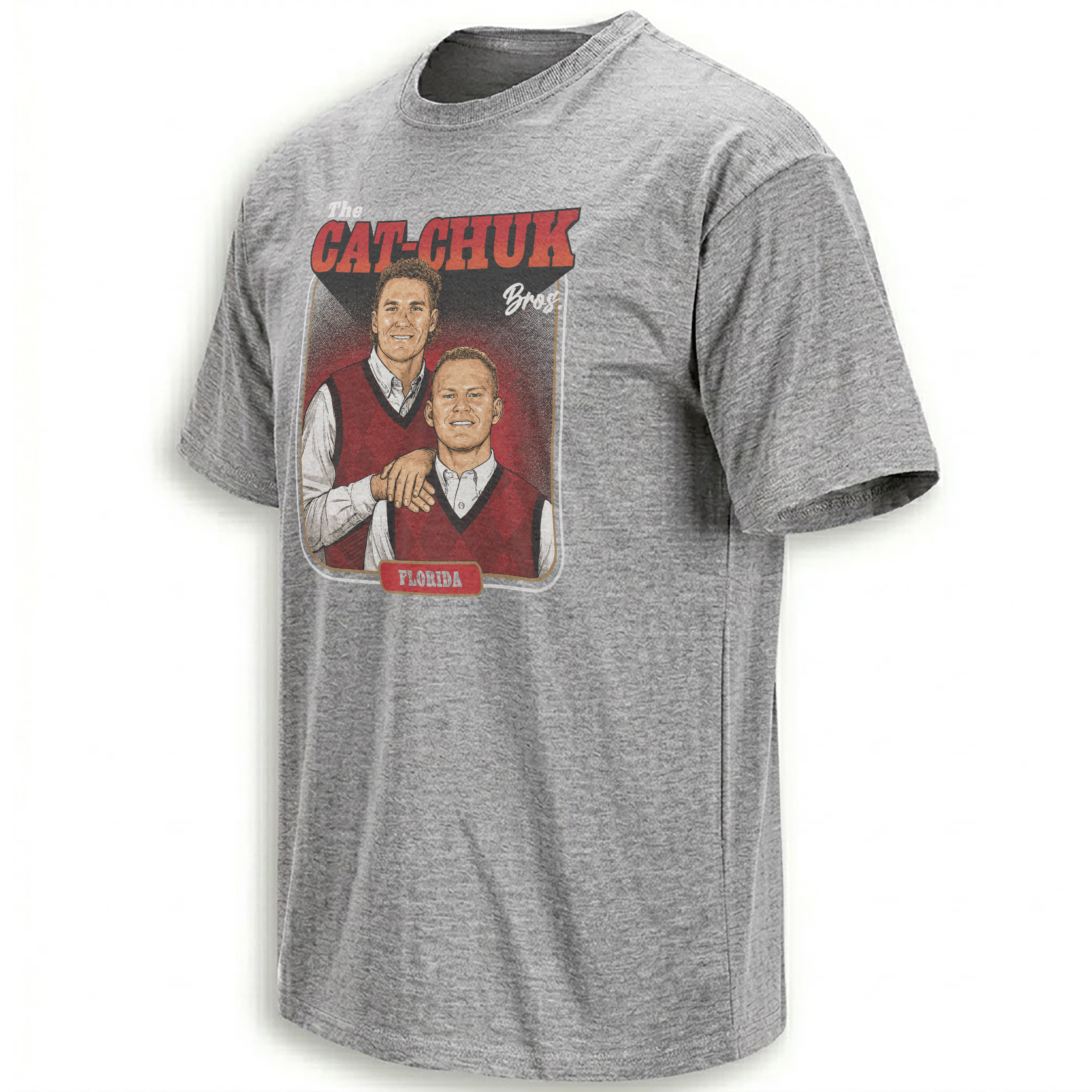
A lighter archive-style presentation that emphasizes the cartoon line work and sibling-comedy quality of the visual.
See the grey version →The Same Family Instinct, Two Different Forms
Matthew often creates emotional chaos with calculation. He understands when to enter a confrontation, when to draw attention and when a single reaction can alter the temperature of a playoff game.
Brady’s game is more visibly built around volume, contact and net-front occupation. His intensity tends to arrive without disguise and forces opponents to respond physically.
Both brothers are comfortable in the areas where goals require contact, screens and repeated punishment rather than clean open-ice skill alone.
The Tkachuks understand that modern hockey identity extends beyond shifts. Interviews, rivalries, family history and fan reactions all become part of the competitive environment.
They Had Already Tested the Chemistry for Team USA
The Panthers will not be the first team to place the brothers on the same side. Matthew and Brady previously shared the ice for the United States, giving fans a preview of what happens when their separate forms of disruption are directed toward the same opponent.
International play changed the emotional framing. Instead of family comparisons or sibling rivalry, the conversation became collective: two brothers representing the same country, reinforcing one another’s physical style and enjoying the rare chance to share a meaningful hockey stage.
Their Olympic experience in 2026 made the Florida trade feel less abstract. Viewers had recently watched the brothers operate within one lineup, speak about the importance of playing together and appear entirely comfortable sharing the spotlight.
The Panthers now receive that chemistry for a full NHL season rather than a short tournament. Systems, line combinations and roles will still need to be determined, but the emotional familiarity is already established.
Why Florida Was the Perfect Team for the Reunion
Not every franchise could absorb two Tkachuks without feeling overwhelmed by the size of their personalities. Florida has spent recent seasons building precisely the kind of environment where emotional confrontation is treated as a competitive resource.
Matthew became one of the clearest symbols of that identity after arriving from Calgary. His ability to score, agitate and shape a playoff narrative fit naturally beside the Panthers’ larger commitment to pressure, depth and collective irritation.
Brady does not require Florida to invent a new personality. He intensifies the existing one. The Panthers are not asking him to become quieter or less physical. They are adding another player whose reputation already matches the emotional language of the room.
That makes the reunion feel less like celebrity roster construction and more like organizational logic. Florida has placed two brothers together because both belong inside the hockey culture the Panthers have already created.
The Trade Also Carries a Complicated Ottawa Memory
Florida’s celebration exists beside a more difficult Ottawa reaction. Brady had served as Senators captain and represented the emotional center of a franchise trying to emerge from a long rebuild.
His departure therefore cannot be reduced to a cheerful family reunion. Ottawa received significant draft capital and gained the opportunity to reshape its future, but the organization also lost the player most closely associated with its recent identity.
That tension is part of what makes the trade historically meaningful. One fan base sees completion. Another sees rupture. The same transaction creates a brother story in Florida and the end of an era in Ottawa.
The Cat-chuk design belongs firmly to the Florida side of that emotional divide. It does not attempt to document every consequence of the trade. It preserves the immediate Panthers reaction: disbelief, humor and the sudden realization that both brothers now belong to the same cat-themed franchise.
From Big Walt to a New Panthers Family Chapter
The brothers’ reunion arrived almost simultaneously with another major Tkachuk family milestone. Their father, Keith “Big Walt” Tkachuk, was selected for the Hockey Hall of Fame Class of 2026, placing the family’s original NHL power-forward figure inside the sport’s permanent institutional history.
That timing made the week feel unusually complete. Keith received formal recognition for the career that established the family identity. Brady joined Matthew in Florida. Three separate hockey stories became one shared family moment.
Matthew and Brady are not replicas of their father, and they are not replicas of one another. Yet all three careers are connected by a recognizable willingness to combine scoring with confrontation and treat the space near the crease as something that must be physically claimed.
In that sense, the Panthers have acquired more than two famous brothers. They now hold the newest chapter of one of American hockey’s most recognizable family traditions.
Why Brother Graphics Become Instant Fan Memory
Sibling teammates create unusually efficient sports imagery. A single frame can contain childhood history, family competition, shared genetics and the professional achievement of reaching the same level.
The Tkachuk reunion adds another layer because the brothers were already stars before becoming NHL teammates. Fans do not need to be introduced to them as a pair. They need only to update the uniform.
That process is visible throughout the Florida Panthers collection, where the trade has already begun generating new slogans, number combinations and brother-driven graphics. The broader NHL collection places those Florida pieces inside the larger culture of blockbuster trades, family legacies and offseason moments that alter the league’s visual map.
The Cat-chuk Bros design may have arrived immediately after the trade, but that speed is part of its documentary value. It records the first wave of fan language before the brothers have even begun creating regular-season memories together.
Frequently Asked Questions
Are Matthew and Brady Tkachuk now teammates on the Florida Panthers?
Yes. Florida acquired Brady Tkachuk from the Ottawa Senators on June 21, 2026, uniting him with Matthew for the first time as teammates in the NHL.
What did Ottawa receive in the Brady Tkachuk trade?
Ottawa received the ninth and 25th selections in the 2026 NHL Draft, a conditional first-round selection in 2029 and a second-round selection in 2027.
Why does the design call them the Cat-chuk Bros?
“Cat-chuk” combines the Tkachuk surname with the Florida Panthers’ cat identity, turning Matthew and Brady into two cartoon cats after their NHL reunion.
Had Matthew and Brady played together before joining the Panthers?
Yes. They had previously played together internationally for the United States, but the 2026 trade marks their first time as teammates on an NHL club.
What does the Cat-chuk Bros design represent?
The graphic preserves the immediate fan reaction to Brady joining Matthew in Florida through cat parody, Panthers colors, sibling imagery and references to their numbers 8 and 19.
The Cat-chuk Bros graphic turns the brothers’ NHL reunion into Panthers folklore, while the wider Florida Panthers archive follows the slogans, number combinations and family energy defining the franchise’s new chapter.
Cat-chuk Bros Shirt transforms Matthew and Brady Tkachuk’s 2026 Florida Panthers reunion into a playful cat parody featuring brother imagery, Panthers colors and the new No. 8 and No. 19 era.